
Hunger
Book Introduction
Hunger (Norwegian: Sult) is a novel by Norwegian author Knut Hamsun, first published in 1890. It is widely regarded as the first modern psychological novel and a landmark of twentieth-century literature. The story is semi-autobiographical, drawing heavily on Hamsun’s own years of poverty and struggle as a young writer. Set in the city of Christiania (now Oslo), the novel follows an unnamed young writer who is desperately poor and often on the verge of starvation. The plot is minimal: the protagonist wanders the streets, pawns his belongings, tries to sell articles to newspapers, and endures the physical and mental ravages of hunger. The real action takes place inside his mind, rendered through an intense stream of consciousness and interior monologue.
Plot Summary
The narrator, a proud and ambitious literary aspirant, has exhausted all his resources. He spends his days wandering the streets of Christiania, avoiding acquaintances and concocting elaborate lies to hide his destitution. He occasionally manages to sell a sketch or a story to a newspaper editor, but the money is never enough to lift him out of poverty. He sleeps in parks, on park benches, or in the most miserable lodgings imaginable. The hunger gnaws at him constantly, producing hallucinations and bizarre obsessions: he imagines tiny animals gnawing inside his chest, hears phantom sounds, and becomes fixated on trivial details. His behavior oscillates between grandiose self-regard and abject humiliation. He gives away his last coins to a beggar, refuses a free meal out of misplaced pride, and invents fantastic stories about his own life. The novel follows a cyclical pattern of brief respite and renewed crisis, culminating in a decision to leave Christiania by ship, but the ending remains open and ambiguous.
Themes and Style
Hunger is a profound exploration of the interplay between physical deprivation and psychological disintegration. Hamsun focuses not on the objective facts of poverty but on how hunger warps perception, memory, and reason. The protagonist’s mental state is characterized by a feverish alternation between elation and despair. A central theme is the conflict between pride and shame: the narrator clings fiercely to his dignity even as he grovels for survival. This tension speaks to the modern experience of alienation and the struggle to maintain a coherent self in the face of social and economic marginalization. The novel also examines the relationship between art and survival, as the protagonist insists on his identity as a writer despite the overwhelming pressure to abandon his craft.
Stylistically, Hamsun broke decisively with the conventions of nineteenth-century realism. He employed an innovative stream-of-consciousness technique that immerses the reader in the protagonist’s chaotic, fragmented thoughts. The narrative is full of digressions, repetitions, and sudden shifts in tone, from lyrical beauty to stark brutality. Hamsun’s prose is both poetic and raw, reflecting the tension between the narrator’s literary aspirations and his brutal reality. This approach paved the way for later modernists such as James Joyce, Franz Kafka, Henry Miller, and Ernest Hemingway, all of whom acknowledged Hamsun’s influence.
Background and Legacy
Hamsun wrote Hunger after returning from a failed sojourn in America, where he had worked as a farm laborer and tram conductor. Those experiences of hunger and degradation gave the novel its authentic edge. When it was published in 1890, it was hailed as a revolutionary work, liberating Norwegian literature from the grip of rural realism and inaugurating a new era of psychological introspection. The novel faced partial censorship for its raw depiction of mental suffering, but it quickly established Hamsun’s reputation as a major European writer.
Hunger remains a cornerstone of modern literature. Its influence can be seen in the works of countless writers who sought to explore the inner landscape of the human mind. Despite the controversy surrounding Hamsun’s later pro-Nazi sympathies, the novel itself has never lost its critical standing. It is frequently cited as one of the finest novels ever written on the subject of poverty, madness, and the creative impulse. The book’s enduring power lies in its ability to make the reader feel the physical and psychological weight of starvation, while also offering a darkly humorous and deeply human portrait of a man at the edge of existence.
About the Author
Biography
Knut Hamsun (born Knud Pedersen, 4 August 1859 – 19 February 1952) was a Norwegian author who won the Nobel Prize in Literature in 1920. He is widely regarded as one of the most influential and innovative stylists of the late nineteenth and early twentieth centuries, known for his pioneering use of interior monologue and stream of consciousness.
Hamsun was born in Lom, Gudbrandsdalen, Norway, into a poor family of seven children. At the age of nine, he was sent to live with an uncle, where he endured harsh labor and abuse. He soon ran away and began a life of drifting. He worked as a shoemaker’s apprentice, a shop assistant, a peddler, a road worker, a stonemason, and even a junior teacher. He was largely self-educated, reading widely despite his poverty. In his early twenties, he traveled to the United States twice, working as a farm hand in North Dakota and as a tram conductor in Chicago. These experiences gave him a harsh view of modern American society, which he satirized in his 1889 book The Intellectual Life of Modern America.
Hamsun’s literary breakthrough came in 1890 with the novel Hunger (Sult). The book, which draws on his own years of destitution, is a psychological tour de force that follows a starving young writer through the streets of Christiania. Its radical use of stream of consciousness and its focus on the irrational mind made it a landmark of modern literature. He followed this success with Mysteries (1892), Pan (1894), and Victoria (1898), all of which explore themes of love, nature, and the inner life of isolated individuals. In 1917, he published Growth of the Soil (Markens Grøde), a epic novel celebrating rural life and the virtues of the soil. This work won him the Nobel Prize in Literature in 1920, with the committee praising it as a “monumental work” that captured the essence of Norwegian peasant life.
Hamsun’s later years were marred by his controversial political stance. A fervent admirer of Nietzsche and a critic of industrial civilization, he developed a deep sympathy for Nazi Germany. During the 1930s, he publicly praised Hitler and wrote articles supporting the Nazi regime. After the German invasion of Norway in 1940, he continued his pro-German activities, even offering his Nobel medal to Joseph Goebbels. Following the war, he was arrested and tried for treason. In 1946, the Norwegian Supreme Court convicted him, imposing a large fine and ordering him to be placed under house arrest. He spent his final years in a nursing home in Oslo, under psychiatric supervision. He died in 1952 at the age of 92.
Despite his political fall, Hamsun’s literary reputation remains substantial. His work influenced a generation of writers, including Franz Kafka, Ernest Hemingway, Henry Miller, Hermann Hesse, and Thomas Mann. Today, he is remembered as a complex figure: a literary genius who betrayed his own country, but whose best novels continue to be read and admired for their raw psychological insight and poetic power.
StoryFlow
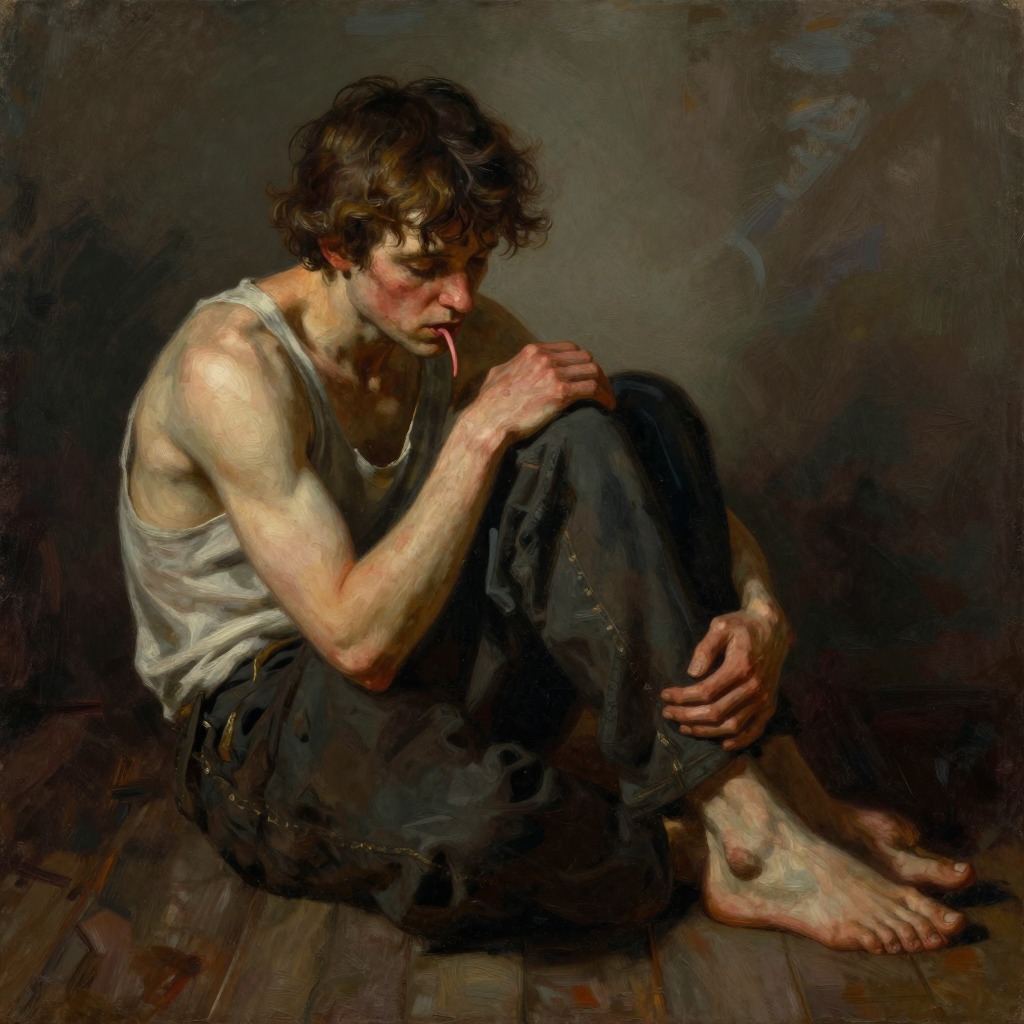
The Protagonist's Descent into Starvation
Traces the protagonist's progressive physical and mental decline due to chronic hunger in Christiania.

The Pursuit of Ylajali
The protagonist's obsessive, erratic relationship with the woman he names Ylajali, from first sight to final rejection.
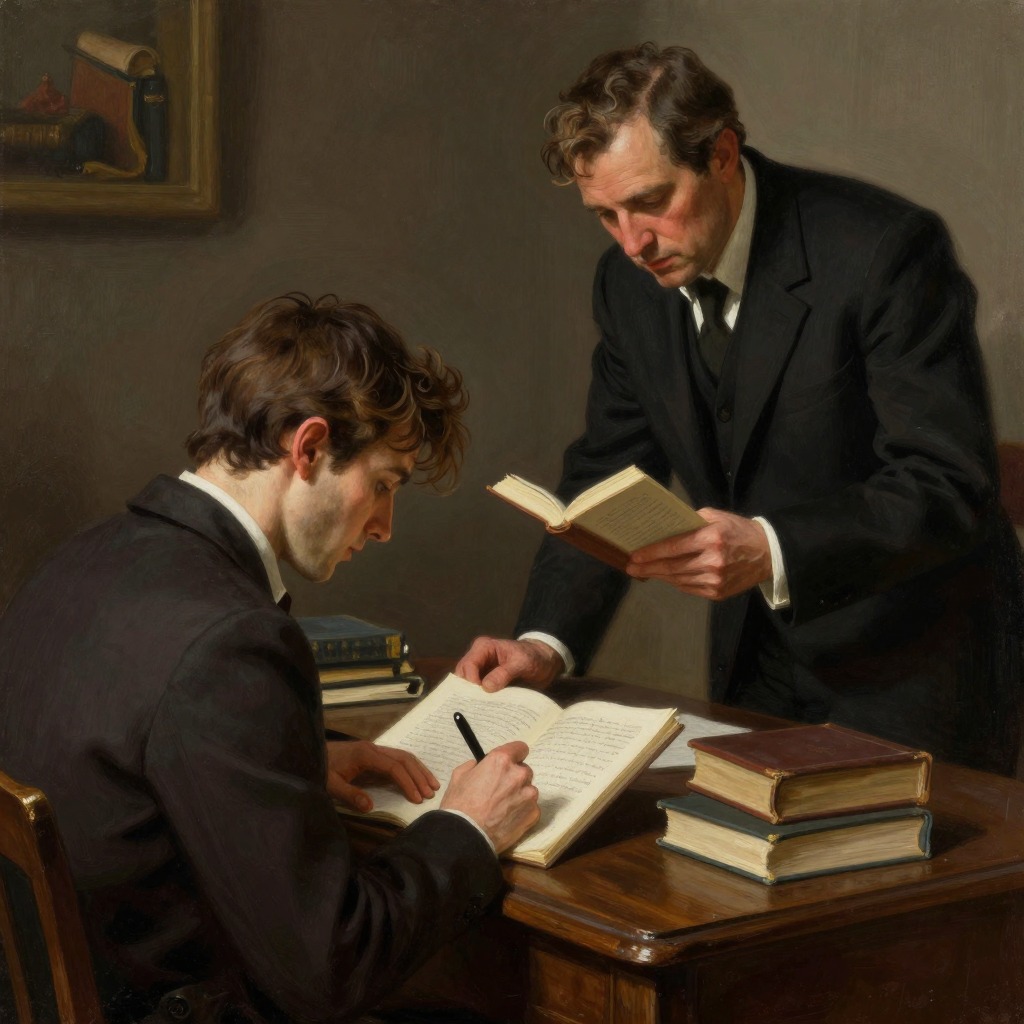
The Struggle with Writing and the Editor
The protagonist's repeated attempts to write for a living and his interactions with the Commandor.
