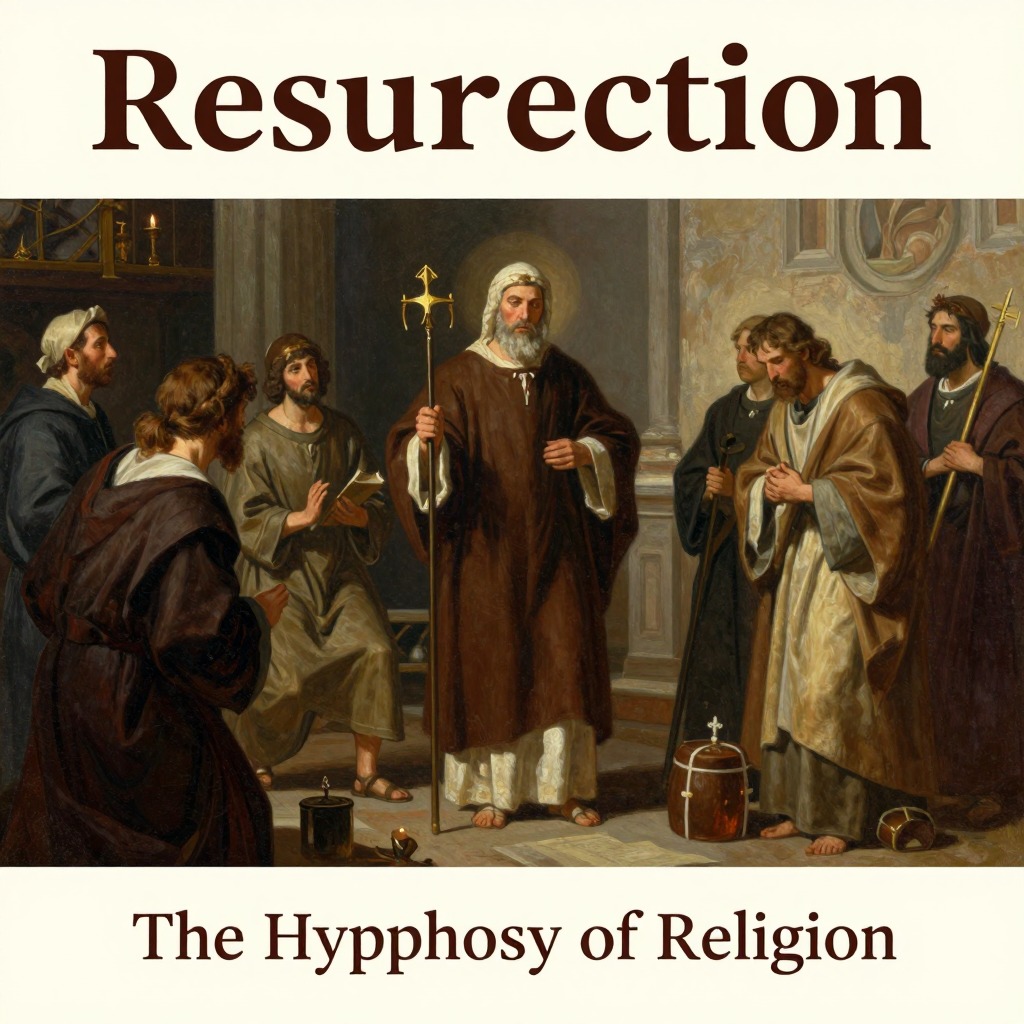
Russian Orthodox Church
The Russian Orthodox Church appears in Resurrection not as a source of spiritual truth but as a bureaucratic arm of the state, complicit in the very injustices that the novel condemns. Its rituals are performed mechanically, its priests are preoccupied with income and career, and its services are used to pacify prisoners rather than to comfort or liberate them. The Church's institutional presence—from the prison chapel to the icons in every cell—forms a constant backdrop to the suffering of the convicts, yet it offers no genuine moral challenge to the system that produces that suffering. The novel's most powerful religious moment comes not in a church but in Nekhludoff's solitary reading of the Sermon on the Mount, where he discovers a Christianity radically opposed to the one the Church preaches.
Ritual and Hypocrisy in the Prison Church
The most extended depiction of Orthodox worship occurs during the Sunday service in the prison, described in excruciating detail. The priest, dressed in a "strange and very inconvenient garb, made of gold cloth," performs the liturgy mechanically: he cuts bread, puts it into wine, and repeats prayers at great speed, while the deacon reads Slavonic texts "difficult to understand in themselves, and rendered still more incomprehensible by being read very fast." The service's central claim—that bread and wine are transformed into the flesh and blood of God—is presented as a piece of theatrical manipulation: the priest waves a cloth over the vessels, and "it was supposed that, at this point, the bread and the wine turned into flesh and blood." The congregation of convicts, including Maslova, bows and crosses itself on cue, but the narrative makes clear that no one present—neither the priest, the deacon, the inspector, nor the prisoners—truly believes in the literal transformation. The priest himself "did not believe that the bread turned into flesh," but he performed the rites because they provided his income. The deacon believed "even more firmly" because he knew the fixed prices for prayers for the dead and masses. The inspector and warders believed because the faith "defended their cruel occupations" and allowed them to torment people with a quiet conscience.
The Church's Alliance with State Violence
The prison church is physically and symbolically integrated into the apparatus of punishment. The service includes prayers for the welfare of the Emperor and his family, repeated many times, and the icon of Christ crowned with thorns hangs in the same building where prisoners are flogged and die of sunstroke. The novel draws a direct line between the Church's blessing of state authority and the atrocities committed in its name. The gilt cross that the priest holds out for the convicts to kiss is, Nekhludoff reflects, "nothing but the emblem of that gallows on which Christ had been executed for denouncing just what was going on here." The priests who imagine they are eating Christ's flesh and blood are in reality "eating and drinking His flesh and His blood" by "ensnaring 'these little ones' with whom He identified Himself, by depriving them of the greatest blessings and submitting them to most cruel torments." No one present, from the inspector down to Maslova, seems conscious of this blasphemy. The Church thus functions as a tool of what Nekhludoff later calls "the seal of Antichrist"—the state's claim to judge and punish.
The Church as a Class Institution
The Church's alignment with the ruling class is evident from the earliest pages of the novel. Maslova's mother, an unmarried peasant woman, gives birth to a child every year, and five of these children die because they are "baptised and then not sufficiently fed, and just left to die." The baptism is performed, but no care follows; the sacrament is a formality that does not interrupt the cycle of poverty and death. Later, when Maslova enters the brothel, the narrative describes her life as "a life of chronic sin against human and divine laws," a life "not merely tolerated but sanctioned by the Government." The Church, as an arm of that Government, offers no protest. The same Church that condemns Maslova for her profession does nothing to prevent the conditions that drove her into it. The hypocrisy is systemic: the Church blesses the rich and punishes the poor, while the actual teachings of Christ—forgiveness, non-judgment, love of enemies—are ignored.
The Old Man's Defiance and the Gospel Alternative
The most direct challenge to the Church's authority comes from the mysterious old man Nekhludoff meets on the ferry and later in prison. This old man, who has been persecuted for twenty-three years, refuses to recognize any human authority: "I have no name, no place, no country, nor anything. I am just myself." He calls the prison inspector "one of Antichrist's army" and declares that the laws are a fraud written by those who "first robbed everybody, took all the earth, all the rights away from men, killed all those who were against him, and then wrote laws, forbidding robbery and murder." The old man's faith is radically individual: he believes in no one but himself, because "the spirit is one—in me and in you and in him." This anarchic Christianity, which rejects all institutional mediation, stands in stark contrast to the state Church. Nekhludoff's own spiritual awakening follows a similar path. He does not turn to the Church or its priests; he reads the Gospels alone in his hotel room and discovers the five commandments of the Sermon on the Mount—do not be angry, do not commit adultery, do not swear oaths, turn the other cheek, love your enemies—as practical laws that, if obeyed, would establish "the Kingdom of Heaven on Earth." This is a Christianity without hierarchy, without ritual, without state sanction: a direct, personal relationship with the divine that bypasses the Church entirely.
The Church's Failure and the Novel's Critique
Throughout Resurrection, the Russian Orthodox Church is shown to be not merely irrelevant but actively harmful. It provides the ideological cover for a system of punishment that destroys souls. It performs empty ceremonies while real suffering goes unaddressed. It teaches submission to authority while Christ taught resistance to injustice. The novel's title itself is a religious metaphor, but the resurrection it describes—Nekhludoff's moral awakening, Maslova's spiritual rebirth—occurs entirely outside the Church's walls. The Church, as an institution, is part of the old world that must be left behind. Nekhludoff's final discovery is that the only true religion is the one that demands forgiveness without limit and love without exception, a religion that the state Church has betrayed at every point.