Buddhist community
The Buddhist community, the Sangha of monks who followed Gotama the Buddha, appears in the narrative as the organized embodiment of the path to salvation that Siddhartha ultimately rejects. It is first introduced through rumor and myth, then encountered directly in the Jetavana grove, and finally becomes the lifelong home of Siddhartha's childhood friend Govinda. The community functions as a foil to Siddhartha's individual quest, highlighting the tension between received teachings and personal enlightenment.
Origins and Reputation
The Buddhist community enters the story as a distant rumor that spreads through the land like a myth. News of Gotama, "the exalted one, the Buddha," who "had overcome the suffering of the world in himself and had halted the cycle of rebirths," reaches Siddhartha and Govinda after they have spent about three years among the Samanas. The reports describe him wandering "surrounded by disciples, without possession, without home, without a wife, in the yellow cloak of an ascetic, but with a cheerful brow, a man of bliss." The myth is said to have "sweet" scent, with "magic" flowing from the reports, and it draws young men from across the lands of India who feel "a longing, felt hope." The community's physical center is the grove of Jetavana in the town of Savathi, which the rich merchant Anathapindika, "an obedient worshipper of the exalted one," had given to Gotama and his people as a gift. Every house in Savathi is prepared to fill the alms-dish of Gotama's disciples, "the silently begging ones."
Encounter and Initiation
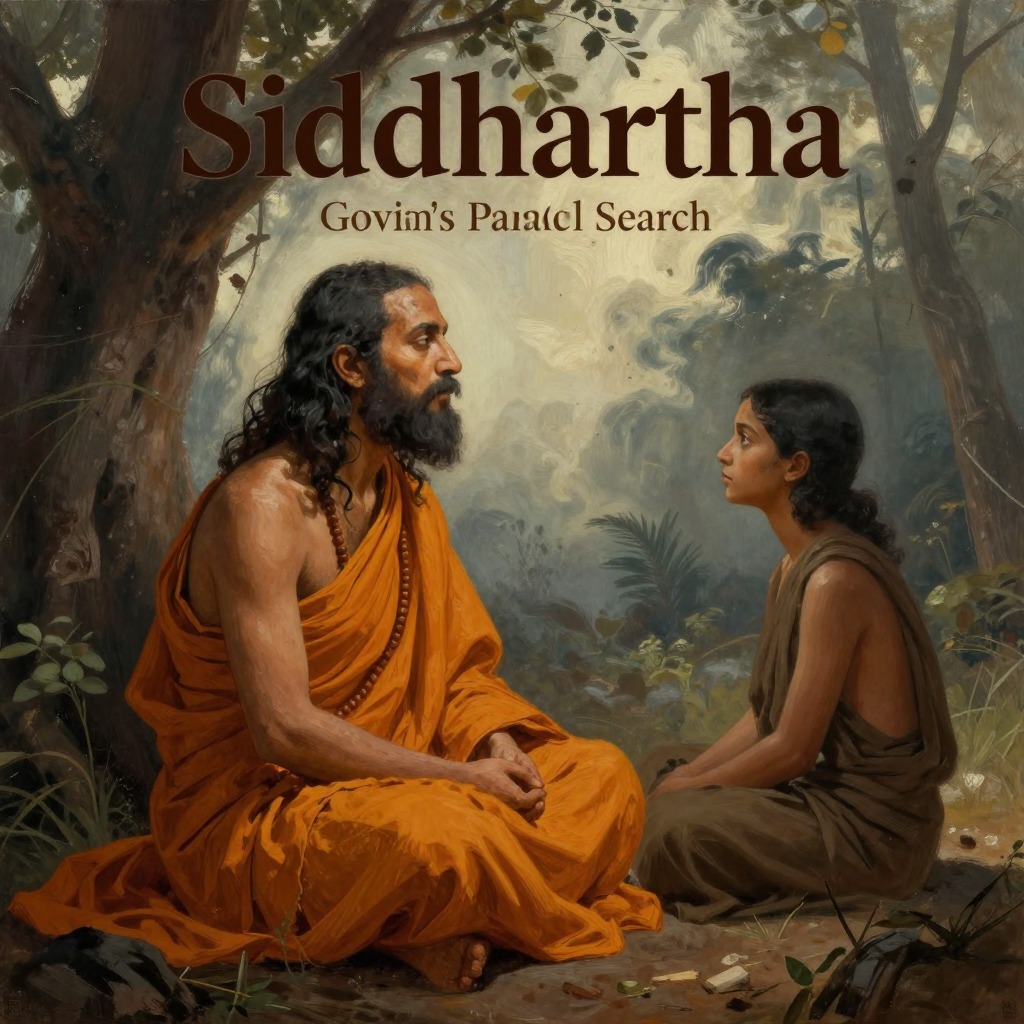
When Siddhartha and Govinda arrive at Jetavana, they find a large crowd of believers and curious people. Monks in yellow robes walk on all paths, sitting under trees in deep contemplation or engaged in spiritual conversation; the shady gardens look "like a city, full of people, bustling like bees." The majority of the monks go out with their alms-dish to collect food in town for their lunch, the only meal of the day. After hearing Gotama's sermon on suffering, its origin, and the way to relieve suffering—the four main doctrines and the eightfold path—many pilgrims step forward to be accepted into the community. Govinda, "the shy one," also steps forward and speaks: "I also take my refuge in the exalted one and his teachings," and he is accepted. The next morning, one of Gotama's oldest monks calls all the novices together to dress them in the yellow robe and instruct them in their first teachings and duties. Govinda breaks loose, embraces Siddhartha, and leaves with the novices.
Siddhartha's Rejection of the Community
Siddhartha, however, does not join. In his conversation with Gotama, he explains that while he admires the teachings' clarity and logical chain of cause and effect, he sees a "small gap" through which the teachings of salvation break the uniform law of the world. He tells the Buddha that he has not doubted for a single moment that Gotama has reached the highest goal, but that "nobody will obtain salvation by means of teachings!" He fears that if he became a disciple, he would only seemingly calm his self, replacing it with the teachings, his duty to follow Gotama, his love for the Buddha, and the community of the monks. After leaving the grove, Siddhartha reflects that the Buddha has deprived him of his friend Govinda, "who had been my shadow and is now Gotama's shadow," but has given him Siddhartha, himself.
The Community as a Continuing Presence
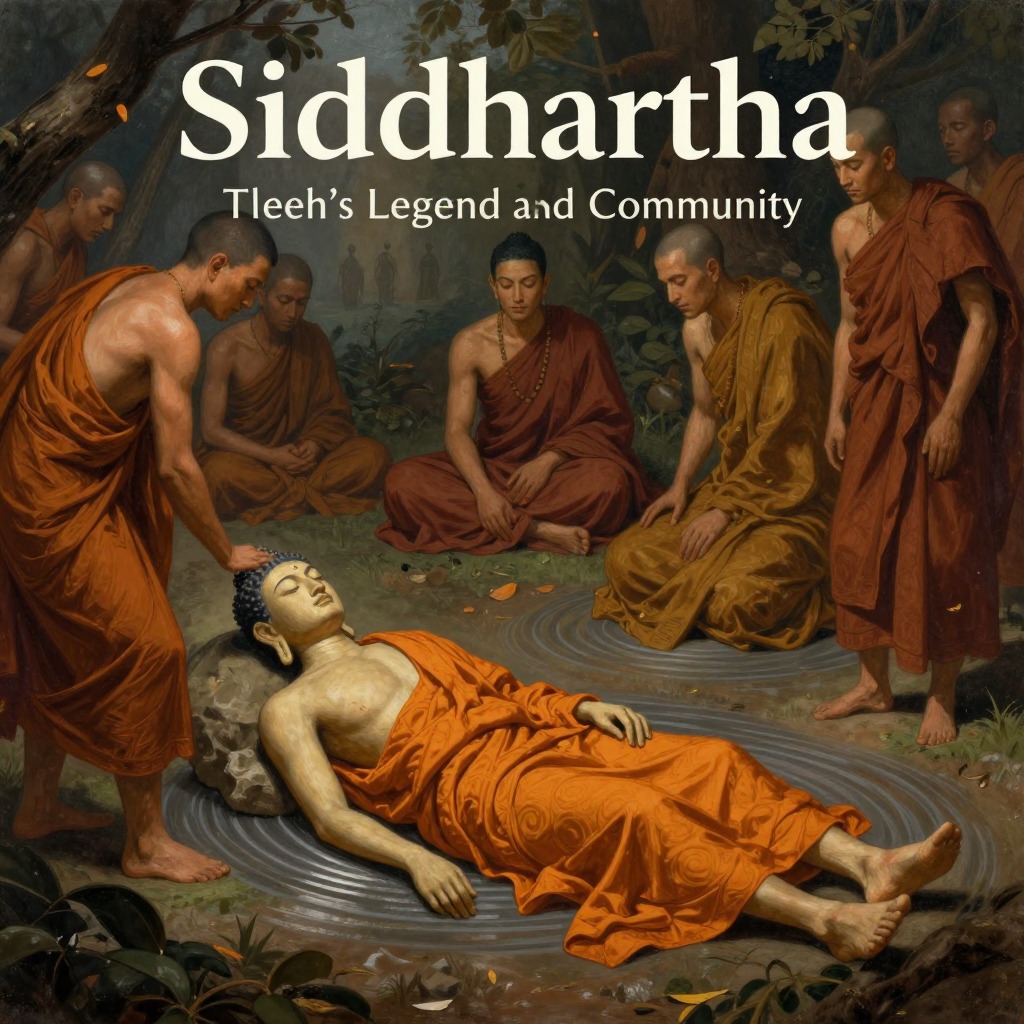
Though Siddhartha does not join, the Buddhist community remains a presence in the narrative. Years later, when Siddhartha is living as a ferryman with Vasudeva, monks on pilgrimage pass by, hurrying back to their dying teacher. The news spreads that Gotama is "deadly sick and would soon die his last human death, in order to become one with the salvation." People flock from everywhere "like being drawn on by a magic spell" to where the great Buddha is awaiting his death. Kamala herself, having retired from her former life, gives her garden to the monks of Gotama as a gift and takes refuge in the teachings. She sets out on a pilgrimage to see the dying Buddha, accompanied by her son, and it is on this journey that she is bitten by a snake and dies in Siddhartha's hut. In the final chapter, Govinda, now an old monk, is still part of the community, spending the time of rest between pilgrimages in the pleasure-grove that Kamala gave to the followers of Gotama. He hears talk of an old ferryman who is regarded as a wise man, and he goes to see him, still carrying "the restlessness and the searching" in his heart despite a lifetime of following the rules.
Significance
The Buddhist community represents the organized, doctrinal path to salvation that Siddhartha considers and rejects. It provides a home for Govinda, who finds refuge in its teachings and robes, but it cannot satisfy Siddhartha's deeper thirst. The community's presence throughout the novel—from its mythic origins to its institutional reality at Jetavana, and from its continuing pilgrimage to its final encounter with Siddhartha through Govinda—serves as a constant counterpoint to Siddhartha's solitary, experiential journey. The community embodies the very thing Siddhartha comes to distrust: teachings that can be conveyed in words, as opposed to the wisdom that can only be lived and found within oneself.