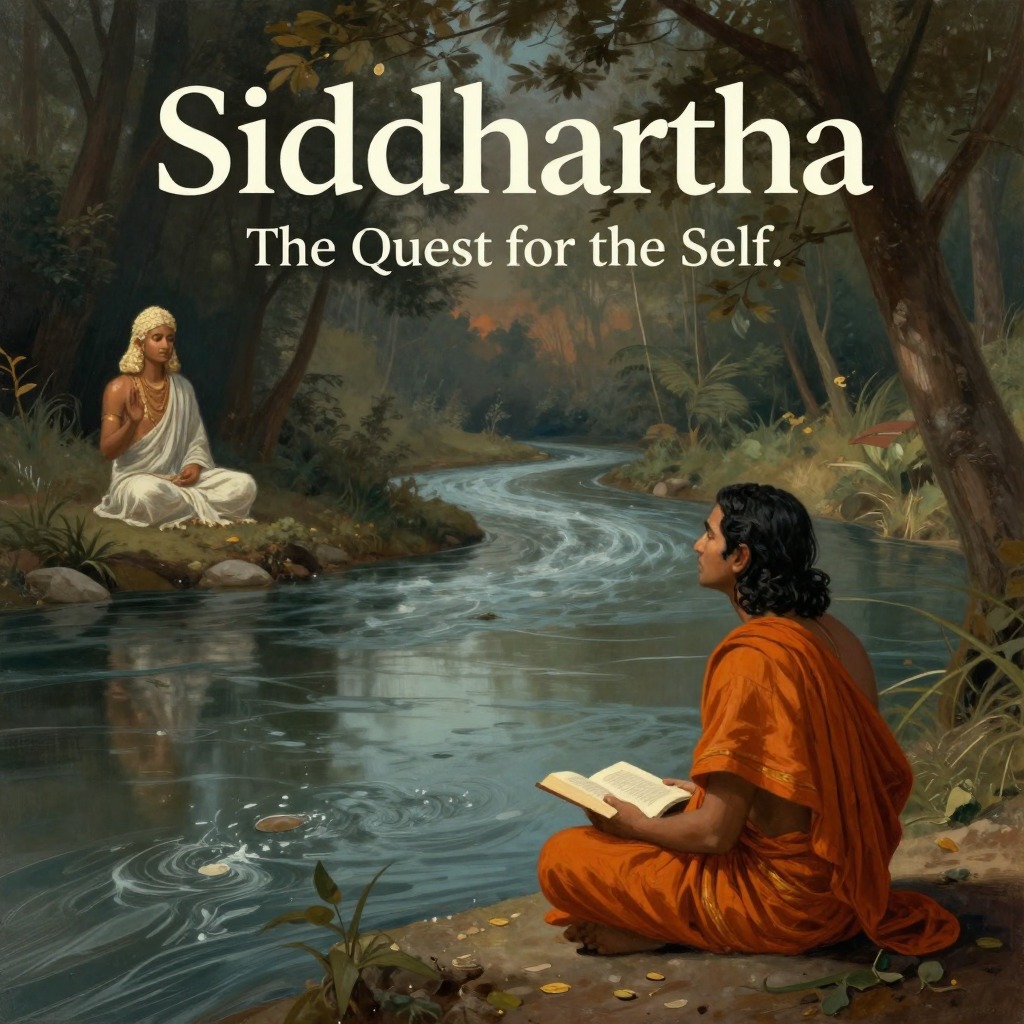
Gotama
Gotama, the exalted one, the Buddha of the family of Sakya, appears in the narrative as the perfected teacher whose fame spreads across the land like a fragrant myth, drawing seekers from every corner. He is said to have overcome the suffering of the world in himself, halted the cycle of rebirths, and attained the highest enlightenment, remembering his previous lives. He wanders without possession, home, or wife, wearing the yellow cloak of an ascetic, yet with a cheerful brow, a man of bliss before whom Brahmans and princes bow. His enemies, however, call him a vain seducer who lives in luxury, scorns offerings, and knows neither exercises nor self-castigation. The myth of Buddha sounds sweet, full of magic and noble promises, and everywhere in the lands of India young men listen up, feeling longing and hope. Gotama's favorite place to stay is the grove of Jetavana near the town of Savathi, given to him and his people by the rich merchant Anathapindika. There, in the evening when the heat cools, he teaches the teachings of suffering, of the origin of suffering, and of the way to relieve suffering, his quiet speech flowing calmly and clearly, teaching the four main doctrines and the eightfold path with patience, repetitions, and examples, his voice hovering over the listeners like a light, like a starry sky.
Appearance and Presence
When Siddhartha first sees Gotama walking silently to collect alms, he instantly recognizes him, as if a god had pointed him out. Gotama is a simple man in a yellow robe, bearing an alms-dish, seeming in no way different from the hundreds of other monks. Yet his face and his walk, his quietly lowered glance, his quietly dangling hand and every finger of it express peace, perfection, an untouchable calm. There is no searching, no desire, no imitation, no effort to be seen in him—only light and peace. Siddhartha feels that every joint of every finger of Gotama's hand speaks of, breathes of, glistens of truth. Never before has Siddhartha venerated a person so much, never before loved a person as much as this one. Gotama's voice, when he teaches, is also perfected, of perfect calmness, full of peace. His smile, which Siddhartha sees when they speak alone, is quiet, with an unwavering openness and kindness, and it remains forever etched in Siddhartha's memory. Siddhartha later reflects that he has never before seen a person glance and smile, sit and walk this way—so free, so venerable, so concealed, so open, so child-like and mysterious. Only a person who has succeeded in reaching the innermost part of his self could glance and walk this way.
Encounter and Dialogue with Siddhartha
When Siddhartha meets Gotama alone after the sermon, he respectfully asks permission to speak. Siddhartha admires the perfect clarity and irrefutability of Gotama's teachings, which present the world as a perfect chain of causes and effects, never broken, without gaps, clear as a crystal. But he points out a small gap: the teachings of overcoming the world and of salvation break the unity and necessary sequence of all things, introducing something alien that cannot be demonstrated or proven. Gotama listens quietly, unmoved, then speaks with his kind, polite, clear voice, warning Siddhartha against the thicket of opinions and arguing about words. The teachings, Gotama says, are not an opinion; their goal is not to explain the world but salvation from suffering. Siddhartha insists he has not doubted for a single moment that Gotama is Buddha, that he has reached the highest goal. But he argues that Gotama found salvation through his own search, thoughts, meditation, realizations, and enlightenment—not by means of teachings—and that nobody will obtain salvation by means of teachings. The teachings do not contain the mystery of what the exalted one experienced for himself, he alone among hundreds of thousands. Siddhartha therefore continues his travels, not to seek other teachings, but to depart from all teachings and teachers and to reach his goal by himself or to die. Gotama, with half a smile and unwavering openness, bids him leave with a hardly noticeable gesture, saying, "You are wise, oh Samana. You know how to talk wisely, my friend. Be aware of too much wisdom!"
Gotama's Role in Siddhartha's Journey
Gotama's presence and teachings become a permanent reference point for Siddhartha's development. After leaving Gotama, Siddhartha realizes that he has left the last teacher who appeared on his path, the highest and wisest teacher, the most holy one. He feels that Gotama has deprived him of his friend Govinda, who now believes in Gotama, but has given him Siddhartha, himself. Later, by the river, Siddhartha remembers his own words to Gotama and realizes that what he had said—that the Buddha's treasure and secret was not the teachings but the unexpressable and not teachable thing he experienced in enlightenment—was exactly what he himself now needed to experience. In his final years as a ferryman, Siddhartha thinks kindly of the dying wise man, seeing his path to perfection before his eyes, and remembers with a smile his proud and precocious words to him. He knows that there is nothing standing between Gotama and him anymore, though he was still unable to accept his teachings. He reflects that he who has found can approve of any teachings, every path, every goal. Kamala, on her deathbed, thinks of her pilgrimage to see Gotama's face and breathe his peace, but finds that peace in Siddhartha instead, feeling it is just as good as if she had seen the other one. In the final vision, Govinda sees that Siddhartha's smile is precisely the same as the quiet, delicate, impenetrable, thousand-fold smile of Gotama, the smile of the perfected ones.
The Teachings and Their Limitations
Gotama's teachings are presented as perfectly clear, proven, and irrefutable, presenting the world as a perfect chain of causes and effects. He teaches the four main doctrines and the eightfold path, patiently going through the usual path of teachings, examples, and repetitions. His voice is soft yet firm, bright and quiet, hovering over the listeners like a light. The teachings command benevolence, clemency, sympathy, and tolerance, but not love; they forbid tying the heart in love to earthly things. Siddhartha later tells Govinda that Gotama, in his teachings, had to divide the world into Sansara and Nirvana, into deception and truth, into suffering and salvation—it cannot be done differently for one who wants to teach. But the world itself is never one-sided. Siddhartha comes to prefer the thing over the words, placing more importance on Gotama's acts and life than on his speeches, on the gestures of his hand than his opinions. He sees Gotama's greatness not in his speech or thoughts, but in his actions and his life. Gotama's teachings, for all their clarity, cannot convey the mystery of enlightenment; they are a path, but not the destination itself.