Learning love from Kamala
Siddhartha's education in love from the courtesan Kamala is the central transformative relationship of his worldly years, a deliberate apprenticeship that reverses his Samana's denial of the senses and leads him into the deepest pleasures and pains of human attachment. Having left the forest and the teachings of Gotama, Siddhartha enters the city of Savathi with a single goal: to learn from Kamala, the first woman he addresses with his eyes not turned to the ground. What begins as a calculated pursuit of sensual knowledge becomes a long, consuming entanglement that teaches him not only the art of love but also the nature of his own heart—and its incapacity, until the very end, to truly love another person.
Identity and First Encounter
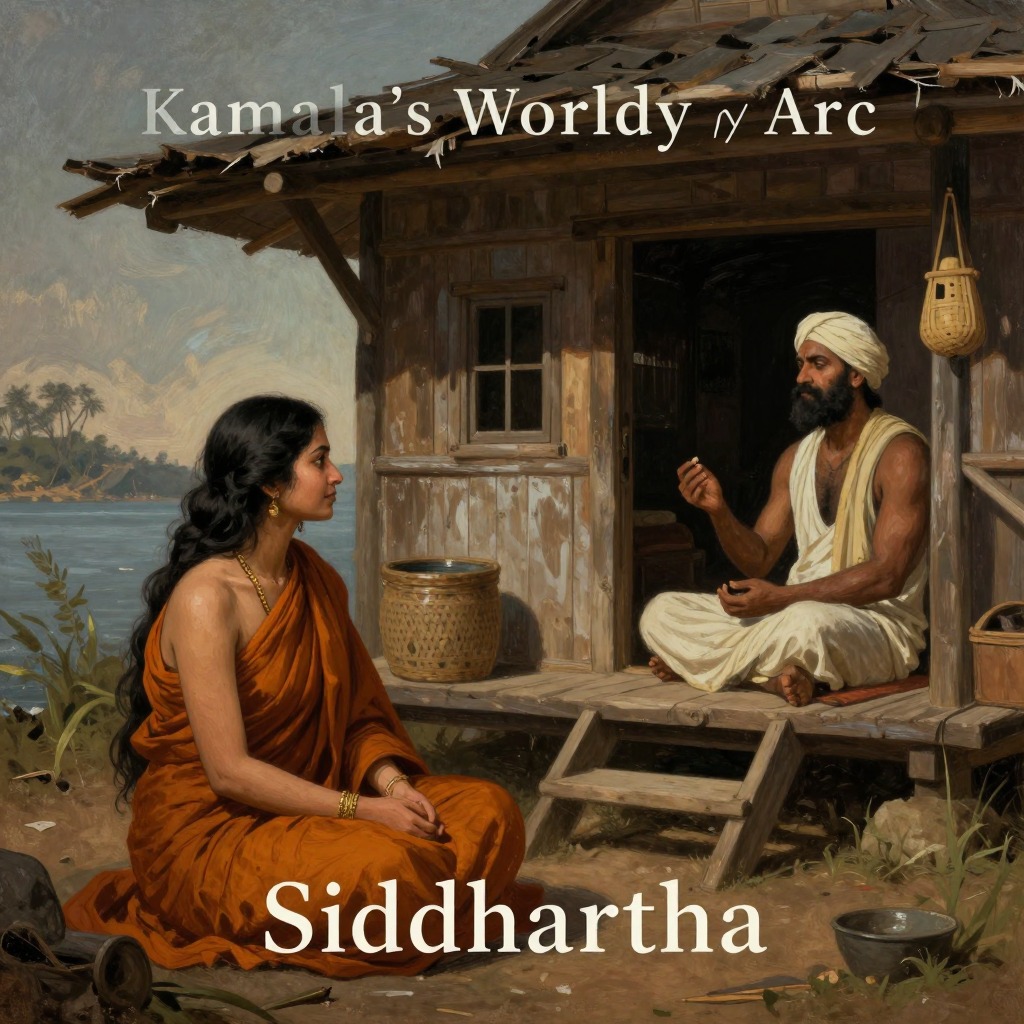
Siddhartha first sees Kamala as she is carried through the entrance of her pleasure-garden in an ornamental sedan-chair, surrounded by servants and maids carrying baskets. He is struck by her appearance: under black hair piled high on her head, a very fair, very delicate, very smart face, a brightly red mouth like a freshly cracked fig, eyebrows painted in a high arch, and smart, watchful dark eyes. Her clear, tall neck rises from a green and golden garment, and her fair hands, long and thin, rest with wide golden bracelets over the wrists. Siddhartha's heart rejoices at the sight. He bows deeply as the sedan-chair passes, and Kamala nods with a smile before disappearing into the grove. The next day, having shaved his beard, cut his hair, and anointed it with fine oil, he presents himself at the grove's entrance and asks to speak with her. When they meet, he declares that he has come to ask her to be his friend and teacher, for he knows nothing yet of that art which she has mastered in the highest degree. Kamala laughs aloud, noting that never before has a Samana from the forest come to her with long hair and a torn loin-cloth; the young men who come to her wear beautiful clothes, fine shoes, perfume in their hair, and money in their pouches. Siddhartha replies that he has already begun to learn from her—he has taken off his beard, combed his hair, and put oil in it—and that he has set harder goals for himself than such trifles and reached them. He asks her to advise him where to find clothes, shoes, and money most quickly, and when she asks what he can do, he answers: "I can think. I can wait. I can fast." He also offers to write a poem for a kiss. After a moment's thought, he recites verses: "Into her shady grove stepped the pretty Kamala, / At the grove's entrance stood the brown Samana. / Deeply, seeing the lotus's blossom, / Bowed that man, and smiling Kamala thanked. / More lovely, thought the young man, than offerings for gods, / More lovely is offering to pretty Kamala." Kamala claps her hands, the golden bracelets clanging, and gives him a long kiss. With deep astonishment, Siddhartha feels how she teaches him, how wise she is, how she controls him, rejects him, lures him, and how after this first kiss there is to be a long, well-ordered, well-tested sequence of kisses, each different from the others.
The Apprenticeship in Love
Kamala becomes Siddhartha's teacher in the art of love, and he visits her daily at the appointed hour, wearing pretty clothes and fine shoes, soon bringing her gifts as well. She teaches him thoroughly, starting with the basics, about that school of thought which holds that pleasure cannot be taken without giving pleasure, and that every gesture, every caress, every touch, every look, every spot of the body, however small, has its secret, which brings happiness to those who know it and unleash it. She teaches him that lovers must not part from one another after celebrating love without one admiring the other, without being just as defeated as they have been victorious, so that neither feels fed up or bored or gets that evil feeling of having abused or having been abused. Siddhartha spends wonderful hours with the beautiful and smart artist, becoming her student, her lover, her friend. He learns many forms of lust and many secrets; her body is flexible like that of a jaguar and like the bow of a hunter. For a long time, she plays with him, entices him, rejects him, forces him, embraces him, enjoys his masterful skills, until he is defeated and rests exhausted by her side. She tells him thoughtfully that he is the best lover she ever saw, stronger than others, more supple, more willing, and that he has learned her art well. But she also observes: "And yet, my dear, you've remained a Samana, and yet you do not love me, you love nobody." Siddhartha agrees tiredly, saying that he is like her—she also does not love, for how else could she practice love as a craft? He adds that the childlike people can love; that is their secret.
The Nature of Their Bond
Siddhartha and Kamala share a deep understanding. He tells her that she is like him, different from most people, that inside her there is a peace and refuge to which she can go at every hour of the day and be at home in herself, as he can also do. Few people have this, he says, and yet all could have it. Kamala replies that not all people are smart, but Siddhartha disagrees, pointing out that Kamaswami is just as smart as he and still has no refuge in himself, while others who are small children with respect to their mind do have it. He compares most people to falling leaves, blown and turning through the air, wavering and tumbling to the ground, while a few—like stars—go on a fixed course, no wind reaches them, in themselves they have their law and their course. He tells her of Gotama, the perfected one, whom he will never forget, and says that thousands of followers listen to his teachings every day but are all falling leaves, not having teachings and a law in themselves. Kamala looks at him with a smile and says, "Again, you're talking about him, again, you're having a Samana's thoughts." Siddhartha says nothing, and they play the game of love.
The Limits of Love as Craft
Despite the intensity of their physical relationship, a fundamental distance remains. Kamala recognizes that Siddhartha, though he has learned her art perfectly, has never truly loved her. She tells him that he is the best lover she ever saw, but that he has remained a Samana and does not love anyone. Siddhartha acknowledges this, saying that people of their kind cannot love; the childlike people can, and that is their secret. This insight foreshadows the transformation that will come only after Siddhartha has experienced the blind, suffering love for his own son—a love that finally makes him, too, a childlike person. Years later, when Kamala, on a pilgrimage to the dying Buddha, is bitten by a snake and dies in Siddhartha's hut by the river, she looks into his eyes and says, "Now I see that your eyes have changed as well. They've become completely different. By what do I still recognise that you're Siddhartha? It's you, and it's not you." She asks if he has achieved peace, and he smiles and places his hand on hers. She says she too will find peace, and he whispers, "You have found it." As she dies, Siddhartha sits for a long time looking at her peacefully dead face, remembering how in the spring of his years he compared her mouth to a freshly cracked fig, and he feels the indestructibility of every life and the eternity of every moment.
Thematic Significance
Siddhartha's learning of love from Kamala is the crucible in which his ascetic self is dissolved and his capacity for human connection is forged—but only partially. The relationship teaches him the art of pleasure, the mutuality of giving and receiving, and the profound difference between craft and genuine love. Kamala, as teacher, is both a liberator and a mirror: she opens the world of the senses to him, yet she also reflects back to him his own emotional detachment. Their bond, though deeply intimate, remains a kind of elegant transaction until the very end, when Kamala's death and the arrival of their son force Siddhartha to confront the wound of love that he had avoided all his life. In this sense, Kamala's lessons are incomplete until Siddhartha learns to love not as a star but as a falling leaf—blindly, sufferingly, and without reservation.