
Aomamé’s Conflicted Justice
1Q84This flow traces how Aomamé’s belief in protecting victims evolves into a clandestine practice that leaves her wrestling with guilt, danger, and self-justification.
increasing Bearing strength in each event
 decreasing
Bearing strength in each eventdecreasingA Rule of Self-Defense
A Rule of Self-Defense
A practical doctrine
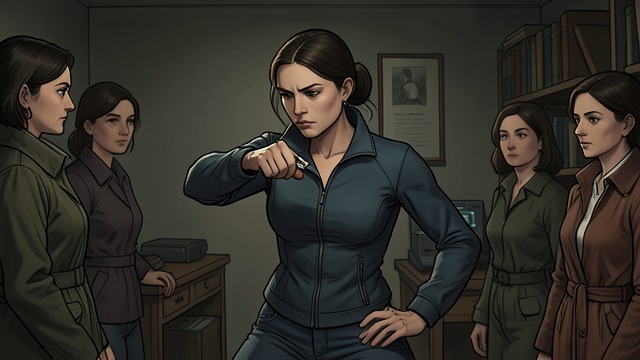
Aomamé teaches women to strike an attacker’s weakest point and distrusts techniques that work only in demonstrations. She sees physical readiness as protection against helplessness.
A challenge to respectability
The club restricts her training because male members find it undignified. The conflict reveals that institutions may prioritize comfort and reputation over women’s safety.
Tamaki’s Death
Tamaki’s Death
A friend lost
Aomamé learns that Tamaki has endured severe domestic violence and died by suicide. The husband has not been prosecuted, despite evidence of abuse.
A demand for action
Aomamé concludes that someone must stop the man from hurting another woman. Grief changes into a determination that she will act where the legal system has not.
The Needle Method

The Needle Method
A trained capability
Aomamé develops a fine needle and practices placing it at a precise point in the neck. She believes the method can cause an apparently natural death without visible evidence.
Justice and secrecy
The method turns her conviction into a covert lethal capacity. Its precision limits detectable evidence, but it also deepens the gap between her private sense of justice and public law.
Miyama’s Death
Miyama’s Death
An operation executed
Aomamé kills Miyama in his hotel room, believing that he has repeatedly abused his wife. She cleans the scene and leaves it to appear like a sudden heart attack.
No simple absolution
Madame and Tamaru frame the result as protection and justice, but Aomamé still carries the weight of intentionally taking a life. The operation succeeds without resolving its moral cost.
A Harder Target
A Harder Target
An escalating request
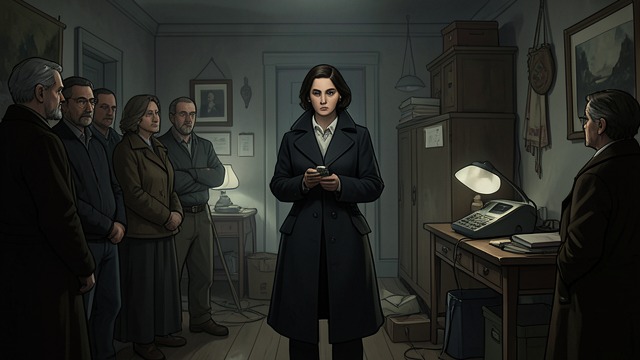
Madame identifies the Pioneers’ leader as a serial abuser of children and asks Aomamé to consider stopping him. Unlike Miyama, he is protected by a closed organization.
Justice meets uncertainty
Aomamé accepts the moral urgency but recognizes the practical danger. She does not yet act, and the conflict remains open at the book’s end.
before her work with Madame
when Aomamé is twenty-six
after Tamaki’s funeral period
early April 1984
near the end of the book
