Event 1
Rishyasringa’s arrival in Anga
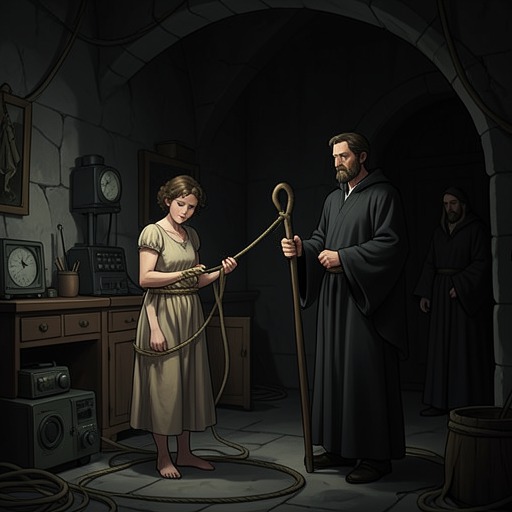
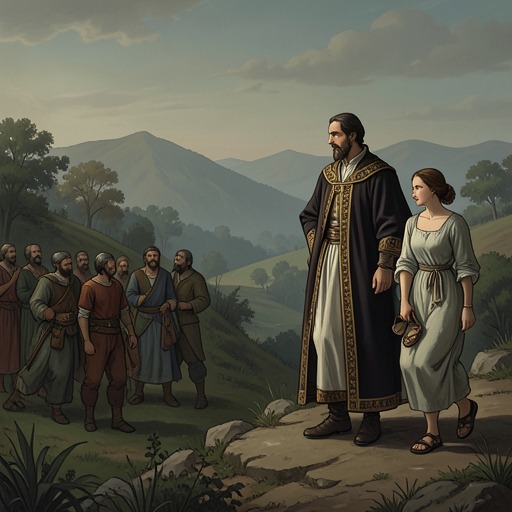
[Rishyasringa’s arrival in Anga](entity:event-recall-event-rishyasringa-s-arrival-9a1f6415aa46) is the turning point at which the kingdom’s drought gives way to rain, and the hermit youth’s passage into royal life begins. The poem links the return of rain to his movement from the forest toward the town: showers begin as he follows his guides, and a mighty downpour meets him at his destination. His welcome then becomes a marriage alliance, as the king gives him [Śántá](entity:character-recall-character-nt-181270dc3496), his own daughter, for a bride.
## From the forest toward the royal town
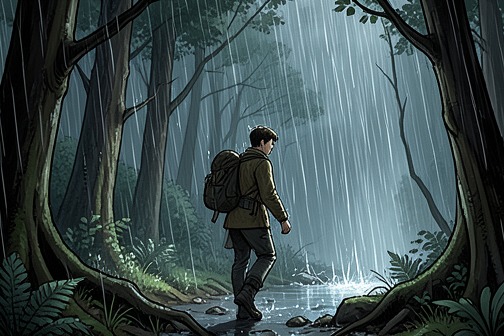
The episode identifies [Rishyasringa](entity:character-recall-character-rishyasringa-ba925de3f764) through his parentage and upbringing: he is the son of the sage [Vibháṇdak](entity:character-recall-character-vibh-dak-aecab288e554) and is described as a hermit boy. When the women who have come to meet him see him approaching, they hurry to greet him. Pleased by their gracious words, he follows where they lead. The poem places the first change in the weather at this moment of departure: as he bends his steps with his guides, rain is sent from heaven. His movement away from the forest is thus accompanied by a change that reaches beyond his own circumstances.
The journey continues by ship. At early morning, a stately vessel bears the hermit’s son away; clouds roar as he travels, and the sky darkens overhead. The sequence makes the rain’s return vivid through successive signs rather than a single announcement: first the showers begin as Rishyasringa follows his guides, then the clouds gather and the sky blackens, and finally the storm breaks over the royal town. The account connects his arrival with the end of [Anga](entity:location-recall-location-7f39fcc5ef82)’s drought, while the narrated details emphasize how the weather changes along the route.
## Rain at the threshold
The culmination comes when Rishyasringa reaches the king’s town. The poem marks the arrival with a mighty flood of rain, so that entry into the royal space coincides with the restoration of the element the kingdom had lacked. The passage does not describe the rain as a result of a deliberate act by Rishyasringa; instead, it binds the event to his presence and progress. The town receives him at the same moment that the skies finally release their burden.
That structure gives the journey a public consequence. Rishyasringa begins as a forest-dwelling youth guided toward an unfamiliar destination, but his arrival is measured by what it means for the kingdom: the drought ends in rain. The narrative’s attention to the ship, the darkening sky, and the downpour makes the transition legible in concrete stages. The change in weather is not detached from the human action; it unfolds alongside the journey and reaches its full force at the town.
## Welcome and marriage
The king’s reception is marked by anxious care. He ministers to the Brahmin, watching closely lest anger rise in his breast. The detail gives the welcome a note of tension: Rishyasringa is a revered guest whose feelings matter to the ruler, not simply a stranger carried into the city by the storm. The king’s response is to give him his own fair daughter as a bride. The marriage joins the hermit youth to the royal household and turns his arrival into a lasting personal bond as well as a moment of relief for the kingdom.
The poem names Śántá as Rishyasringa’s beloved wife and says that he passes his life in the royal town with her, loved and honoured by the king. The arrival therefore does not end with the downpour. It redirects Rishyasringa’s life from the forest to the town, where royal favour and marriage establish his new place. The rain marks the immediate change; his union with Śántá gives that change a continuing human form.
## Narrative significance
The episode moves through linked thresholds: Rishyasringa leaves his forest setting, travels by ship, reaches the royal town, and is received into the king’s family. At each threshold the scale widens. The first welcome is personal, but the rain at the destination answers Anga’s larger need; the king’s marriage gift then converts public gratitude and welcome into kinship. The event’s significance rests in that joined movement from relief to incorporation.
The weather also gives the scene its clear progression. Showers accompany Rishyasringa’s first steps with his guides; thunderous clouds and a darkening sky gather during the voyage; a great rain falls as he reaches the town. The poem thus presents his arrival not as a bare change of location but as an event whose consequences are visible in the kingdom and lasting in the life he shares with Śántá.
Event 2
Dasharatha’s sacrifices for an heir
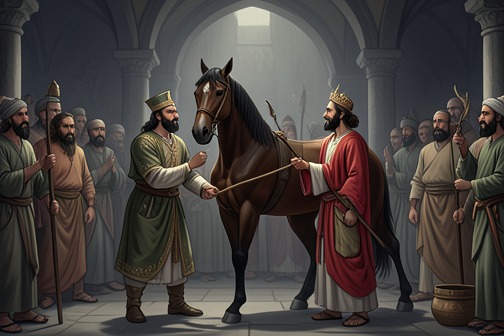
[Dasharatha’s sacrifices for an heir](entity:event-recall-event-dasharatha-s-sacrifices-3cd0594deee7) are a sequence of royal rites that turn the king’s desire for a successor into a formal appeal to the [Devas](entity:character-recall-character-devas-f5bcab1c71d9). The central horse offering is described through its scale, prescribed observances, and three-day duration; a further rite then brings a promise of four sons and heavenly nectar for the queens. Together, the ceremonies connect dynastic continuity with exact ritual performance and divine favor.
## Purpose and Ritual Order
The account makes the purpose explicit: [Dasharatha](entity:character-recall-character-dasharatha-b9552a8b18f7) has offered the votive steed to gain a son. The horse sacrifice is therefore not merely a display of royal ceremony; it is directed toward the continuity of his royal line. The assurance that four sons will uphold that line gives the rite a dynastic outcome as well as a sacred one.
The narrative distinguishes the completed horse offering from the rite that follows it. After the account marks the sacrifice finished, a sage announces that another rite will be begun to obtain the sons the king desires. The second ceremony extends the first rather than replacing it: the horse has already been offered, but the son-winning purpose still requires its own ritual action. This sequence makes the desired result dependent on a further observance, not on the horse sacrifice alone.
## The Horse Offering
The horse is singled out among the creatures sacrificed. The account says that it alone required a pile of cane, and that the Offering of the Steed lasted three days as prescribed. Its description also emphasizes that the steed was devoted to the host of the Devas and honored as their foremost treasure; it was duly sprinkled as part of the rite. These details give the offering a defined place within a larger sacrificial order, rather than presenting it as an undifferentiated act of slaughter.
The scale of the ceremony is made explicit: three hundred victims were bound according to scriptural prescription. At the same time, the account stresses attention to the rules, saying that the rites were conducted with care and in accordance with Veda law. It adds that during those days no one was seen oppressed by hunger or distressed by toil. The ceremony is thus represented both as a demanding, regulated undertaking and as an occasion during which hardship among those present was absent.
## The Further Rite and the Promise
After the horse offering, the sage proposes another rite, with the stated aim of winning the sons Dasharatha seeks. The king’s earlier austerities and his firm faith are recalled as part of the appeal to the Devas: the sacrifice and penance are presented as acts through which he has relied on divine response. The rite’s promise is precise. Four sons will uphold the royal line, turning the king’s hope for an heir into a prediction of a four-son succession.
The account then gives that promise a tangible form. A speaker announces that the Devas accept the king’s worship and offers heavenly nectar, declaring that it will give him sons and wealth. The nectar makes divine favor something conveyed within the ceremony, while the stated gifts extend beyond the immediate problem of succession. The passage does not describe the drink as an ordinary reward: its heavenly origin and promised effects mark the outcome as a sacred grant.
## Distribution and Outcome
Dasharatha distributes portions of the drink among his three queens, and [Sumitrá](entity:character-recall-character-sumitr-3aa9efc30c7f) is specifically mentioned as receiving a share from what remains. The narrative thereby links the promised sons to the royal household through a concrete act of allocation. The queens are not named individually in this passage as a complete list, but the distribution is clearly shared among all three.
The account places the princes’ birth after an interval: six seasons have passed since the rite, and eleven months have elapsed. That measured passage of time separates the sacrificial promise from its fulfillment instead of making the result instantaneous. The rite’s narrative consequence is therefore carried forward into the birth episode: what begins as a royal appeal for an heir becomes the promised continuation of Dasharatha’s line.
## Significance
The sequence rests on a contrast between prescribed human action and a result granted by the Devas. The horse is sprinkled, victims are bound according to scriptural rules, and the offering lasts the required three days; yet the desired sons arrive in the narrative through a further rite and the gift of heavenly nectar. Ritual precision and divine favor are presented as connected stages in the same process.
The ceremonies also give the succession story a public and sacred foundation. Dasharatha’s wish is not left as a private concern: it is pursued through a royal sacrifice, an additional rite, and a promise that names four sons as upholders of the line. The later interval before their birth preserves the distinction between promise and fulfillment, while making the princes’ arrival the consequence toward which the entire sequence has been directed.
Event 3
The gods’ appeal for Vishnu to defeat Ravana
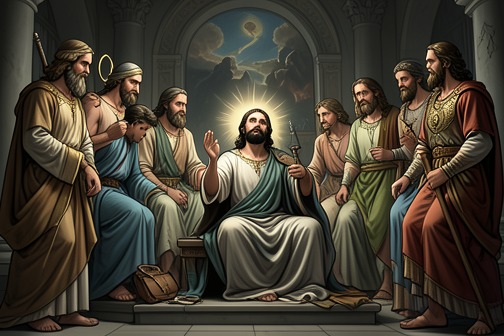
[The gods’ appeal for Vishnu to defeat Ravana](entity:event-recall-event-the-gods-appeal-for-vis-dc3cacbe8990) is the turning point at which a divine crisis becomes a plan for human intervention. [Ravana](entity:character-recall-character-ravana-f2652ae52080)’s protections have made the gods unable to overcome him directly, but a limit in the boon he requested leaves one path open: a mortal can kill him. The gods recognize that opening and ask [Vishnu](entity:character-recall-character-vishnu-4fe080f11b04) to enter the human world, linking the later struggle against Ravana to a deliberate act of divine incarnation.
## Causes and the overlooked limit
The episode begins with the gods assembled before [Brahma](entity:character-recall-character-brahma-39f8aa187fff). They report that [Rávaṇ](entity:character-recall-character-r-va-06a1d00141e6), ruler of the giant race, torments them in his pride. Their appeal is not simply a complaint against his conduct: his power has placed the gods themselves in danger, and they need Brahma to identify a remedy that can work within the protection Rávaṇ has obtained.
Brahma considers the terms of that protection. Rávaṇ had asked to be guarded from gods and spirits of earth and air, and Brahma had granted the request. But Rávaṇ did not reckon with a man or woman born into the mortal world. The omission defines the crisis’s narrow solution: no other foe can take his life, but a human being can. His confidence has secured him against powerful supernatural enemies while leaving open the very category he scorned.
That distinction makes the boon more than background information. It explains why the gods cannot simply destroy their enemy by force and why the answer must cross the boundary between divine and human existence. Rávaṇ’s own request supplies the terms of the counter-plan; his pride creates the vulnerability that his strength was meant to eliminate.
## The gods’ appeal and Vishnu’s response
Once Brahma identifies the human exception, the assembled gods rejoice. The scene then turns from diagnosis to petition. The gods approach Vishnu as a friend of suffering worlds and ask for help; Vishnu asks what he can do to grant their request. Their response is specific: he must regard the world of men, assume mortal birth, and slay the gods’ formidable foe.
The sequence gives the appeal the character of a reasoned strategy. The gods do not ask Vishnu to overpower Rávaṇ in his own divine form, which would leave the terms of the boon intact. Instead, they ask him to meet Rávaṇ as a human being, precisely where the protection fails. Their request turns the apparent weakness of mortality into the necessary instrument of victory.
The two stages of counsel also matter. Brahma establishes what the boon permits; Vishnu is then asked to act within that limit. The gods’ joy after Brahma’s explanation signals that the discovery has changed the crisis from seemingly insoluble to actionable, but the decisive step remains the willingness of Vishnu to enter the mortal world.
## Mortal birth and the promised royal line
The plan connects Vishnu’s incarnation to [Daśaratha](entity:character-recall-character-da-aratha-ffdd8279512e)’s household. In the narrative sequence, the gods direct Vishnu toward the human world and the king whose line will provide the setting for his birth. A nearby promise makes the dynastic consequence explicit: Daśaratha is told that four sons will uphold his royal line. The appeal therefore opens not only a mission against Rávaṇ but also the birth of a royal generation through which that mission can unfold.
Vishnu’s response enlarges the scale of the undertaking. He declares that he will reign as a human king for ten thousand years and a hundred more. The promise joins the immediate purpose of killing Rávaṇ to an extended human kingship: the divine answer will not be a momentary intervention from outside the world, but a mortal life situated within a royal line and measured in years of rule.
This choice gives the episode its central paradox. A human birth is required because Rávaṇ has left humanity outside his protections, yet the figure who accepts that birth is Vishnu, the god whom the petitioners have approached for aid. The solution does not erase the distinction between divine power and human vulnerability; it makes that distinction the means by which the enemy can be defeated.
## Consequences and narrative significance
The appeal establishes the governing cause behind Vishnu’s human incarnation: Rávaṇ’s boon excludes the very kind of opponent who will confront him. It also fixes the gods’ role as petitioners whose knowledge of the danger prompts intervention. Their collective appeal converts suffering into a course of action, while Brahma’s account of the boon explains why that course must take human form.
The episode is a promise of a future conflict, not the conflict’s resolution. Rávaṇ remains the gods’ foe at the close of the appeal; what changes is the shape of the possible response. Vishnu’s consent and the connection to Daśaratha’s four sons prepare the narrative for the arrival of a human champion without making the later struggle seem accidental. The threat, the loophole, the petition, and the royal birth are presented as parts of one design.
Its dramatic force lies in the reversal of Rávaṇ’s apparent security. He has sought protection from powers he recognizes, and that success encourages him to dismiss mortal beings. The gods’ answer comes through the unguarded category he overlooked. His protection thus contains its own boundary, and the divine appeal turns that boundary into the opening through which his defeat can eventually come.
Event 4
The creation of the Vanara hosts
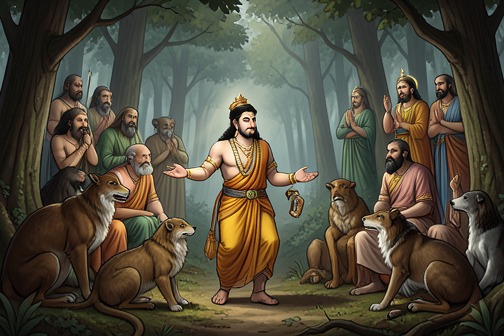
[The creation of the Vanara hosts](entity:event-recall-event-the-creation-of-the-van-03201dfebc28) prepares a supernatural army for [Vishnu](entity:character-recall-character-vishnu-4fe080f11b04)’s earthly mission. When Vishnu has gone to earth, [Brahma](entity:character-recall-character-brahma-39f8aa187fff) summons the gods and directs them to make helpers for the coming war. Their response produces not a single champion but a vast, varied population of warriors, among them monkey chiefs and bears, whose extraordinary bodies and powers make them a force suited to the scale of the conflict.
## Divine commission
The episode begins with Vishnu’s descent and Brahma’s response to the need for aid. The self-existent creator addresses the gods, presenting the creation of allies as service to Vishnu, who seeks the good of all. The task is explicitly martial: the helpers are to lend him aid in war. This instruction makes the hosts’ origin purposeful. They are not simply inhabitants of the forest who later happen to enter the story; their creation anticipates their role as a coalition supporting Vishnu on earth.
Brahma’s command extends across different kinds of beings. His address invokes [Apsaras](entity:character-recall-character-apsaras-edd30fbca10c), maidens of the Gandharva race, monkeys, snakes, and night-roving beings. The range of those named gives the force a composite character: it draws on varied supernatural and animal forms rather than on a single people. The gods hear the command and obey, turning Brahma’s announcement into an act of collective generation.
## The making of the hosts
The account emphasizes abundance. The gods produce their offspring in countless swarms, and the resulting population is too numerous to count. [Snakes](entity:creature-recall-creature-snakes-d4ceb51e2460), bards, spirits, and serpents also have sons beyond reckoning. Creation therefore proceeds through multiplication: the promised assistance is a multitude, not merely a small band gathered around one hero.
The bear host has a distinct origin within this broader creation. Brahma says that he himself shaped the lord of bears, born from his mouth as he opened it wide. The detail singles out the bear leader as a direct product of the creator’s action, while the surrounding account describes the larger process by which the gods generate their many descendants. The bears consequently belong to the same coalition as the monkey warriors, but the narrative gives their leader a particular place in its account of origins.
The monkey warriors are created with powers beyond ordinary animal life. They possess unmatched strength and can change their forms at will. Their physical scale is equally conspicuous: the leading sylvan chiefs are described as towering, with [Rama](entity:character-recall-character-rama-fdac9c17dd0c)’s champions spreading across the earth like hills and clouds. Their arrival transforms the natural world into the setting for a force assembled on a mythic scale.
## Leaders, powers, and scale
Among the named leaders, [Bali](entity:character-recall-character-bali-4ed36663458c) is identified as the child of [Indra](entity:character-recall-character-indra-9cdc4e2c85c7). His parentage links a prominent woodland chief directly to the divine world, making the alliance a meeting point between divine descent and forest power. The account places him among the foremost leaders, not as an incidental member of the multitude, but as one of the chieftains honored above the rest.
The hosts’ strength is expressed through both capacity and effect. Their bodies are likened to thunderbolts, and the chiefs’ furious shouts can frighten birds dead upon the earth. These details enlarge the army beyond a conventional gathering of animal allies: its members possess force that changes the atmosphere around them, while their ability to assume different forms makes them less fixed than ordinary creatures. The emphasis on size, sound, speed, and transformation establishes a catalogue of powers rather than describing a single battle.
Although the multitude is immense, it is not represented as wholly without order. The poem distinguishes honored leaders from the thousands who swarm behind them, and says that beings of different shapes, races, and kinds are assigned proper homes. The arrangement joins diversity to organization: the hosts are widely distributed, yet their chiefs and assigned places make them a prepared body of allies rather than an undifferentiated crowd.
## Narrative role
The creation scene explains why Vishnu’s earthly struggle will draw support from forces beyond the human royal family. Its sequence is clear: Vishnu goes to earth, Brahma calls on the gods, the gods obey, and countless powerful descendants populate the world as potential allies. The resulting hosts connect divine action to the forest realm and provide the story with a large-scale coalition before the war unfolds.
The passage also gives the alliance a distinctive texture. Its members are diverse in origin and form, but their creation is gathered under one purpose: aid to Vishnu in war. The poem balances this common purpose with individual distinction, especially in the separate account of the bear lord and in the identification of Bali as Indra’s child. In this way, the creation of the hosts is both a moment of divine planning and an account of how a vast, ranked, and extraordinary body of champions comes into being.
Event 5
The birth of Rama and his brothers
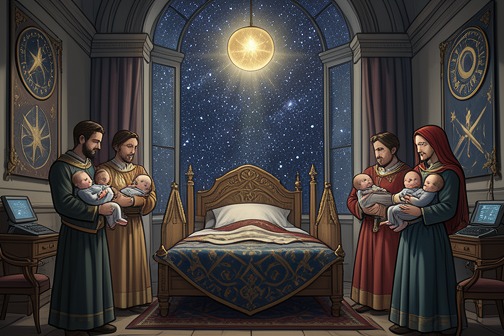
The birth of [Ráma](entity:character-recall-character-r-ma-2db51e45ae4a) and his brothers fulfills the promise that [Daśaratha](entity:character-recall-character-da-aratha-ffdd8279512e) would have four sons to uphold his royal line, but the episode also gives the births a cosmic significance: Ráma is presented as an embodiment of [Vishṇu](entity:character-recall-character-vish-u-50c288dea3c5)’s power, destined to destroy [Rávaṇ](entity:character-recall-character-r-va-06a1d00141e6) and help the worlds. The princes arrive in a sequence marked by ritual time, auspicious celestial signs, and the distinct roles of their mothers; their birth is both a family event and the beginning of the purpose for which Ráma has come.
## Ritual Promise and Chronology
The births follow the great rite associated with Daśaratha’s hope for heirs. An earlier assurance had promised him four sons who would uphold his line, and the birth account makes that assurance tangible: the royal household receives not one successor but four princes. Their arrival answers the king’s dynastic need while preparing the narrative for Ráma’s future conflict with Rávaṇ.
The poem gives the interval after the rite in more than one measure. It says that the six seasons had passed in rapid flight and also that eleven months had elapsed. It then places the births on [Chaitra](entity:time-recall-time-chaitra-30e052b692b1)’s ninth returning day. These details make the event feel calendrically and ceremonially appointed: the princes are not introduced at an unspecified moment, but within a sequence whose elapsed time and auspicious date are made conspicuous.
The celestial description further distinguishes the occasion. The passage places the moon in [Cancer](entity:time-recall-time-cancer-0cea32d0e74c) and names [Vṛihaspati](entity:character-recall-character-v-ihaspati-69fdea8402bf) among the lights accompanying the birth. The account therefore frames the children’s arrival through signs in the heavens as well as through events in the palace. That framing is especially consequential for Ráma, whose birth is immediately connected to divine power and a purpose extending beyond Daśaratha’s household.
## Four Births and Their Mothers
[Kauśalyá](entity:character-recall-character-kau-aly-f8fa3c3ce87b) bears Ráma, described as lotus-eyed and beautiful. [Kaikeyí](entity:character-recall-character-kaikey-bfffeff04c04) bears [Bharat](entity:character-recall-character-bharat-6395f3ef7f4e), whose birth is associated with courage and princely virtue. [Sumitrá](entity:character-recall-character-sumitr-3aa9efc30c7f) bears the pair [Lakshmaṇ](entity:character-recall-character-lakshma-7aad0629b677) and [Śatrughna](entity:character-recall-character-atrughna-60f42e73f771), described as high in enterprise and devoted. The sons are born to their mothers at different times, but the poem gathers them into one royal generation: all four are presented as glorious, virtuous, and like their father.
The arrangement gives the brothers distinct maternal lines without dividing the succession into competing households. Each queen has a son or sons, and all four births contribute to the continuation of Daśaratha’s family. The account does not treat the princes as interchangeable, however. It emphasizes Ráma’s special destiny and gives Bharat a separate share in the divine conception, while presenting Lakshmaṇ and Śatrughna as a devoted pair. Their different descriptions establish the brothers’ identities at the moment the family they will form is introduced.
## Ráma’s Divine Purpose
Ráma’s birth is described in terms that exceed ordinary royal genealogy. He is called the lord of the universe and said to be born from half of Vishṇu’s vigor. The passage states the purpose directly: he has come to destroy Rávaṇ and aid the worlds in distress. The prince’s human place in Daśaratha’s house and his divine role in the larger conflict are thus joined at the outset.
Bharat, too, is linked explicitly to Vishṇu: he is presented as one fourth of Vishṇu manifest, alongside praise of his courage and princely virtue. The account does not assign a corresponding divine fraction to Lakshmaṇ or Śatrughna in the surviving description, so their significance here rests on their birth to Sumitrá and their characterization as capable and devoted. This distinction concentrates the episode’s explicit cosmic language on Ráma and Bharat without erasing the importance of the other two princes.
The birth sequence consequently changes how the future conflict is understood. Ráma’s confrontation with Rávaṇ is not merely a later consequence of events in the royal family; the account presents the destruction of Rávaṇ as a purpose already attached to Ráma’s arrival. The promised heir is also the figure through whom the worlds are to be helped.
## Naming and Narrative Place
When each child reaches twelve days of age, the time comes for the naming rite. [Vaśishṭha](entity:character-recall-character-va-ish-ha-033580f29400) appears in the account as the sage associated with that ceremony, extending the princes’ introduction from birth into the formal recognition of their identities. The passage also records ritual generosity nearby: Brahmins carry away much wealth, and many thousands dine. These details place the royal births within a public and ceremonial setting rather than presenting them as a private family occurrence alone.
The canto heading, The Birth Of The Princes, marks the transition from the rite and its promises to their fulfillment. The episode closes this stage of anticipation by making the four children present in the royal household, naming the mothers who bear them, and distinguishing Ráma’s divine mission from the brothers’ shared princely status. It establishes the family and the cosmic stakes together: Daśaratha’s line has its heirs, and the destined opponent of Rávaṇ has been born.
Event 6
Shiva burns Kama
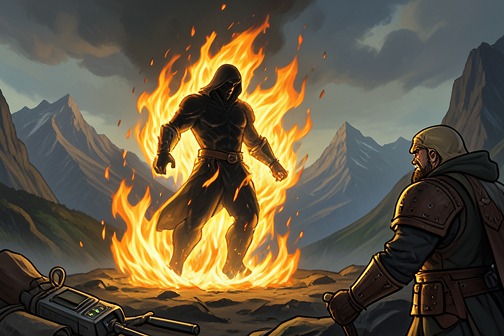
[Shiva burns Kama](entity:event-recall-event-shiva-burns-kama-ab3635dbf991) in an embedded tale that turns a brief act of divine violence into an explanation of names: [Kama](entity:character-recall-character-kama-e3543946f8a4) loses his bodily form, becomes known as Ananga, and the land associated with his destruction is called [Anga](entity:location-recall-location-7f39fcc5ef82). Viśvāmitra tells the episode to [Ráma](entity:character-recall-character-r-ma-2db51e45ae4a) and [Lakshmaṇ](entity:character-recall-character-lakshma-7aad0629b677), presenting it not as part of their immediate adventures but as the remembered history of the retreat they are visiting.
## Causes and Setting
The story begins when Ráma and Lakshmaṇ ask to hear the truth about the retreat’s earlier history. Viśvāmitra responds by recalling that it had once been possessed by [Kandarpa](entity:character-recall-character-kandarpa-6086316ecb2e), whom the wise also call Kama. This framing makes the tale an explanation of place as well as a story about a god: the retreat’s past is bound to the event that destroyed Kama’s form.
Kama’s approach is an act of defiance. In the account, he takes an apparent form and dares to advance upon [Shiva](entity:character-recall-character-shiva-a32afbfe6397), who has newly wed [Umá](entity:character-recall-character-um-7acf9e29f2b3). Shiva warns him away, but Kama nevertheless raises his hand. The brief sequence gives the encounter its decisive tension: a warning is issued, crossed, and answered by overwhelming divine force.
## The Destruction of Kama
Shiva’s eye fixes Kama with a terrible glare. The beauty of the form Kama had assumed dissolves, and the fire of Shiva’s wrath consumes his limbs. The telling moves from the visible figure to its sudden disappearance: the defining consequence is not merely defeat but the loss of bodily shape itself.
The episode’s naming explains the lasting consequence. Because Shiva’s rage destroys Kama’s form, Kama bears the name Ananga in succeeding ages—the bodiless one. The narrative thus carries the immediate destruction forward as a change in how the figure is known, making the event endure in its altered identity.
## Aftermath and Significance
The place also preserves the event in its name. The account says that the land is called Anga because Kama’s lovely form decayed there. That explanation links bodily ruin, remembered history, and geography: the vanished figure leaves a trace not in a surviving body but in names attached to both the victim and the site.
As an embedded tale, the episode answers the boys’ request for the retreat’s history while giving the setting a mythic past. Its structure is compact and causal: Kama’s defiance follows Shiva’s warning; Shiva’s gaze destroys the assumed form; that destruction accounts for Ananga and for Anga. The story’s force lies in how one irreversible act produces two enduring names.
Event 7
Rama’s exile
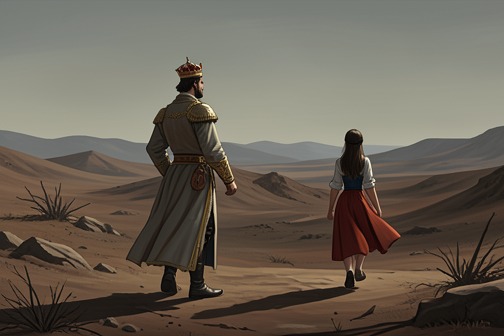
[Rama’s exile](entity:event-recall-event-rama-s-exile-62ac5ab5bf6d) turns a prospective coronation into a fourteen-year separation from the kingdom. The decision is imposed at [Kaikeyi](entity:character-recall-character-kaikeyi-2477fd7cdcbf)’s demand, but [Rama](entity:character-recall-character-rama-fdac9c17dd0c) makes it his own by treating obedience to his father’s promise as binding. His departure carries him from royal succession into forest life, with [Sita](entity:character-recall-character-sita-1913dd4978f6) and Lakshman sharing the wandering, and sets a defining tension between worldly rank and duty that the poem sustains throughout the episode.
## Causes and the reversal of succession
The exile is presented against the expectation that Rama will take the throne. The narrative recalls the choice of Rama for kingship and then gives that prospect its abrupt contrary: he is driven out as a banished man. The force of the reversal lies not only in the loss of a crown. A prince identified as [Daśaratha](entity:character-recall-character-da-aratha-ffdd8279512e)’s heir and as his people’s darling is removed from the place where his public role should have begun. Royal succession gives way, in a single decision, to absence and dispossession.
Kaikeyi, identified as the youngest queen, is the immediate agent of that change. She bids the king grant what she has demanded and specifies that Rama should flee to the woods. The surrounding account associates the demand with the king’s promise to her; a note on the episode characterizes it as Daśaratha’s rash oath and fatal promise. The available telling thus places the king between a prior commitment and the consequences of carrying it out. It does not make the decision a calm transfer of power: the command takes the intended heir away from the throne and sends him into exile.
The narrative’s language of duty makes the constraint explicit. Daśaratha is described as bound by chains of duty, while Rama’s response is framed as a choice to please Kaikeyi and honor his father’s promise. In his reply, he accepts the sentence for that promise’s sake. The distinction matters: Kaikeyi initiates the banishment, but Rama does not answer it with a competing claim to authority. His acceptance makes the succession crisis into a test of conduct. The expected reward of kingship is replaced by the harder obligation to submit to a command whose consequence he must personally endure.
## The sentence and Rama’s response
The order sends Rama to spend his life in [Daṇḍaka forest](entity:location-recall-location-da-aka-forest-0749c0f39fbb) and directs him to take the path into its wilds. Elsewhere the sentence is given a precise term: fourteen years. These details establish the exile as both a destination and a duration. It is not a brief withdrawal from court or an unspecified journey beyond the city. The forest becomes the place where the prince must live, and the long term makes the cost of the command impossible to mistake.
Rama’s answer is characterized by steadiness rather than resistance. The account says that he goes to please Kaikeyi; another passage makes his reason explicit in his commitment to his father’s promise. That repeated emphasis gives the decision its moral shape. The story does not require Rama to approve of the political reversal in order to obey it. Instead, it places his obedience beside the loss of the throne, making fidelity to the paternal obligation the principle by which he acts when rank and expectation have been taken from him.
The exile also restricts where he may go. Rama explains that for fourteen years he cannot break his father’s mandate, and that he may not tread the streets of a town or village until the term has passed. Forest residence is therefore not merely a change of scenery: the sentence bars a return to settled civic life for its entire duration. The specificity of the prohibition extends the command beyond the initial departure. Even a temporary visit to a town would violate the terms he has undertaken to keep.
## Companions and the altered life of the royal household
Rama does not make the journey alone. The account describes him in hermit dress and says that Lakshman and Sita share the wanderings of the exile. Their presence changes the departure from an individual punishment into a separation carried by a small royal household. The heir leaves his place in the kingdom, while his wife and brother accompany him into the life imposed by the sentence. The text’s compact description of all three moving together gives the exile a relational dimension without altering its central cause: the king’s command and Rama’s decision to obey.
The loss is measured against the identities they leave behind. Rama is still described as Daśaratha’s heir and a prince of exceptional stature, but the outward sign of his new condition is hermit dress. The contrast makes the change visible: royal standing remains part of who he is, yet it no longer determines his clothing, residence, or freedom of movement. The two royal brothers appear together in the forest account, while Sita shares the same wandering. Their company does not cancel the banishment; it shows who bears its consequences alongside Rama.
The narrative associates the departure with grief as well as resolve. One passage evokes fires of woe consuming a figure in the aftermath of the order, and another reports that the hero’s senses fail. These brief signs register the emotional shock around the exile, though the excerpts do not identify every speaker or supply a full account of each reaction. Set beside Rama’s declared acceptance, they create a marked contrast: the command is carried out through his self-command, but its human cost is not thereby made slight. The poem holds obedience and suffering in the same frame.
## Duration, geography, and return
The exile’s scale emerges most fully in the account of its geography. A critical discussion of the poem says that Rama spends more than thirteen years wandering among Brahmanical settlements scattered through the country between the [Ganges](entity:location-recall-location-ganges-13554a03c098) and the [Godavari](entity:location-recall-location-godavari-f8f46fb459b9). It traces the range from [Chitrakuta](entity:location-recall-location-chitrakuta-553d13ef69b9) in Bundelkund to the modern town of Nasik, on the western side of India near the source of the Godavari. This is a wide itinerary, not a single fixed forest dwelling. The stated fourteen-year term and the report of more than thirteen years spent moving among settlements together convey how much of Rama’s life the sentence occupies.
The prohibition on entering a town or village sharpens the contrast between that long journey and ordinary civic residence. The account nevertheless describes visits to forest settlements and hermitages, each associated with a sage known in Brahmanical tradition. The distinction in the evidence is important: the exile removes Rama from the public and settled life of the kingdom, while the route described in the commentary passes through communities and sites linked to religious teachers. The forest journey is therefore represented both as banishment from the royal world and as movement through a landscape of ascetic establishments.
The story’s later horizon points toward the end of this separation. A passage looks ahead to Rama receiving the kingdom of his ancestors after his weary wanderings are over; another recalls the distance of [Ayodhya](entity:location-recall-location-ayodhya-ef190b6473a9) and the beginning of the dreary years when he was expelled from home. These references make return the measure by which the exile is understood. The sentence temporarily suspends the heir’s relation to his kingdom, but does not erase it. The kingdom remains his inheritance in the account, waiting beyond the completed term.
## Narrative and interpretive significance
The poem makes the exile consequential through a paired reversal: Rama is selected for the throne, then sent away, and the same prince who loses the prospect of immediate rule becomes exemplary through his response to the command. The action’s decisive value-change is plain. A future of public authority becomes a life of imposed withdrawal; filial fidelity, rather than possession of the crown, becomes the standard by which Rama’s conduct is presented. The story’s emphasis falls not simply on what Kaikeyi’s demand takes from him, but on the obligation he chooses to honor once that demand has been made.
The separation also gathers several registers of feeling without resolving them into a single mood. The loss of home and the signs of woe give the departure a grief-stricken charge; the forest sentence and the long journey lend it severity; Rama’s consent supplies a heroic composure. Sita and Lakshman’s shared wandering makes the hardship collective, while the eventual prospect of reclaiming the ancestral kingdom gives the separation a defined endpoint. The emotional movement is therefore not a simple passage from royal life to a new, untroubled ascetic existence. The exile remains a deprivation even as it becomes the setting for duty fulfilled.
A critical note accompanying the text cautions that the jungle exile is among the most obscure portions of the Ramayana. It argues that little trace of an original tradition or of actual life and manners can be recovered from the account beyond its presentation of self-mortification and self-denial among Brahman sages. The same discussion observes that the hermitages lie far south of the kingdom of [Kośala](entity:location-recall-location-ca521c30bc03) and questions whether the named sages could have been contemporaries of Rama, or even have flourished in the same period. These are the commentator’s historical reservations, not facts resolved by the narrative itself.
That criticism also explains why the episode merits attention beyond the uncertain historical picture it offers. The commentator sees the exile as illuminating the poem’s significance and the kind of hero its Brahmanical author wished to portray. Within the story, the defining evidence is concrete: a king’s heir is banished after Kaikeyi’s demand, the term is fourteen years, Rama accepts it in the name of his father’s promise, and Sita and Lakshman share the forest wandering. Together these elements make the exile the poem’s sustained test of whether authority is expressed by holding power or by bearing its loss in obedience to duty.
Event 8
Dasharatha’s death
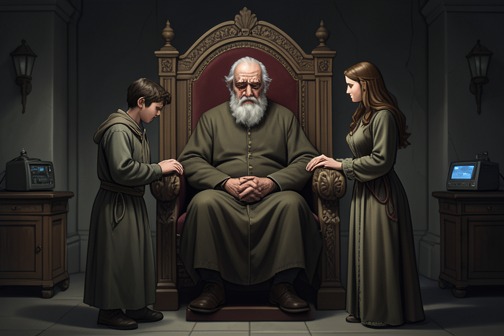
[Dasharatha’s death](entity:event-recall-event-dasharatha-s-death-68ec514192e0) is the human cost of [Ráma’s exile](entity:state-recall-state-r-ma-a94ec8a82327): the aged king, unable to bear separation from his son, declines into anguish and dies. In his final hours, the pain becomes inseparable from an earlier warning. He remembers a hermit’s prediction that he would grieve for a dear son and that this sorrow would end his life; the prediction now seems to name the very fate unfolding around him.
## Causes and Background
The immediate cause of [Dasharatha](entity:character-recall-character-dasharatha-b9552a8b18f7)’s suffering is [Ráma](entity:character-recall-character-r-ma-2db51e45ae4a)’s departure. The poem presents the old king as pining for his son, with grief so complete that he gives up the earth for the heavens. This compressed account makes the link between separation and death unmistakable: the loss is not a passing sorrow but the force that carries him toward his end.
The death also completes a warning Dasharatha himself recalls. In the midst of his distress, the hermit’s words return to him: he was to suffer for a beloved son, and that sorrow would take his life. The recollection gives the scene a second frame. Dasharatha experiences his grief as immediate and overwhelming, yet he also understands it as the fulfillment of a prediction made earlier. The narrative thus connects his present suffering to an older cause without diminishing the force of the loss he now feels.
## The King’s Final Hours
As the remembered warning comes back to him, Dasharatha speaks through tears. He says that he cannot see his wife and that his eyes are failing; he also describes his memory as leaving him. These details make his decline both physical and inward. Sight, recollection, and command of himself are all slipping away while the grief remains sharply present.
Dasharatha identifies the sorrow as a consequence of his own hand and presents himself as powerless to resist its flood. His words turn the scene from a lament over Ráma’s fate into an acknowledgment of the king’s own part in the suffering that overwhelms him. The passage does not set out a full account of that responsibility here; instead, it places his sense of helplessness beside his recognition that his actions have brought him into this extremity.
[Kauśalyá](entity:character-recall-character-kau-aly-f8fa3c3ce87b) and [Sumitrá](entity:character-recall-character-sumitr-3aa9efc30c7f) keep watch beside him as he weeps. Their presence gives the final scene a quiet, domestic setting: the king is surrounded not by the public forms of rule but by those who remain with him as his strength fails. He groans and sighs, still grieving for his beloved Ráma, and dies in that grief. The poem offers no recovery or reconciliation before his death; the separation that began his anguish remains unresolved.
## Consequences and Narrative Significance
The episode closes the arc of an aged king whose love for Ráma cannot protect him from the consequences of the prince’s exile. A later summary joins the same facts in a stark sequence: Dasharatha pines for Ráma and leaves the earth. The brevity of that account contrasts with the dying scene’s attention to returning memory, failing sight, and the vigil kept by Kauśalyá and Sumitrá. Together, the accounts make his death both a personal loss and a decisive change in the royal household.
His death also leaves the question of rule exposed. The narrative records that [Bharat](entity:character-recall-character-bharat-6395f3ef7f4e) refuses to reign, even when urged by the twice-born. This refusal does not undo Dasharatha’s loss or bring Ráma back; instead, it shows that the king’s death is followed by a succession problem that cannot be settled simply by placing another son on the throne. Dasharatha’s passing therefore changes the political situation as well as the family’s: the father who once stood at the center of the royal order is gone, while Ráma remains away and Bharat declines the crown.
The scene’s emotional force lies in the convergence of present grief and remembered foreknowledge. Dasharatha recognizes the hermit’s prediction at the moment when it can no longer be escaped, and the poem lets that recognition intensify rather than explain away his suffering. His death is at once the result of separation, the fulfillment of a warning, and the end of his own capacity to endure the loss.
Event 9
Bharata’s meeting with Rama and the sandals
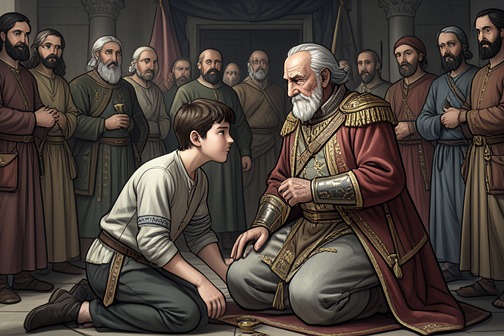
[Bharat](entity:character-recall-character-bharat-6395f3ef7f4e)’s meeting with [Ráma](entity:character-recall-character-r-ma-2db51e45ae4a) at [Chitrakúṭa](entity:location-recall-location-chitrak-a-63502c96da20) turns a disputed succession into a reluctant arrangement for rule: Bharat asks his elder brother to return, but Ráma honors [Daśaratha](entity:character-recall-character-da-aratha-ffdd8279512e)’s decree and sends him back with the sandals that signify Ráma’s right. The brothers’ appeal and refusal end in separation, while the sandals make Ráma’s absent authority visible in the kingdom Bharat governs.
## Causes and Background
Daśaratha has died after pining for Ráma, and Bharat is urged to reign. He refuses, despite pressure from the twice-born, and travels to the woods to meet his brother. The meeting follows Ráma’s establishment at Chitrakúṭa, where he has built a woodland dwelling; the contrast between that exile and the empty throne gives Bharat’s journey its urgency.
The poem presents Bharat’s claim not as a bid for power but as a plea that Ráma take the place others recognize as his. Bharat falls at his brother’s feet and appeals to the agreement of the people: Ráma’s right is acknowledged, he says, and Ráma should come back as their lord and king. His gesture makes the request at once familial and political. He approaches as a younger brother seeking the return of the rightful ruler, not as a rival proposing a new settlement.
## The Appeal and Ráma’s Answer
Bharat’s supplication does not change Ráma’s decision. Ráma chooses to observe his father’s decree, placing filial obligation above the immediate restoration of his position. The narrative makes the obstacle explicit: Bharat’s appeal may be earnest, and his brother’s right widely accepted, but neither is enough to release Ráma from the command he has undertaken to obey.
Ráma answers with an object rather than a return. He places his sandals in Bharat’s hand as a pledge connected to his right to rule, then tells him to go back. The gesture does not erase the disagreement about what ought to happen; it gives the brothers a way to act despite it. Ráma remains in the forest, and Bharat can return with a tangible emblem of the authority he has been asked to uphold.
## The Sandals and the Regency
Bharat takes the sandals when he finds that further prayer is vain. The transfer is significant precisely because it is not Ráma’s return or a personal claim by Bharat to the throne. The sandals stand for Ráma’s right, while the practical work of governing falls to his brother. In the poem’s account, they function as a pledge and as emblems of that right: a material sign that links the absent Ráma to the realm without ending his exile.
Bharat does not remain in [Ayodhyá](entity:location-recall-location-ayodhy-08bd0b6815c4). He goes instead to [Nandigráma](entity:location-recall-location-980d3e33554b), where he rules the land with watchful care. The account also emphasizes the duration of this arrangement, recalling the years he spends there. His refusal to reign and his subsequent administration are therefore not contradictory: he accepts responsibility for the kingdom while the sandals preserve the distinction between governing in Ráma’s place and claiming Ráma’s position as his own.
## Parting and Narrative Significance
The encounter closes with departure rather than reconciliation through compromise. Bharat leaves with the sandals, and Ráma remains in the woods; their shared recognition of Ráma’s right does not overcome his commitment to Daśaratha’s decree. The scene’s resolution depends instead on a divided arrangement: one brother keeps the exile, the other watches over the realm, and the sandals mark the connection between them.
The episode gives a concrete form to the conflict between succession and obedience. Bharat’s appeal voices the claim that Ráma should rule, while Ráma’s answer shows that acknowledged entitlement cannot by itself cancel a binding paternal command. The sandals hold these positions together without pretending that the conflict has vanished. They make Ráma’s absence politically legible, and Bharat’s careful rule sustains the kingdom during the separation. In the poem’s compressed sequence, the journey, supplication, transfer, and years at Nandigráma shape one continuous outcome: Bharat does not take the throne for himself, but neither does he leave the land unattended.
Event 10
The breaking of Shiva’s bow and Rama’s marriage to Sita
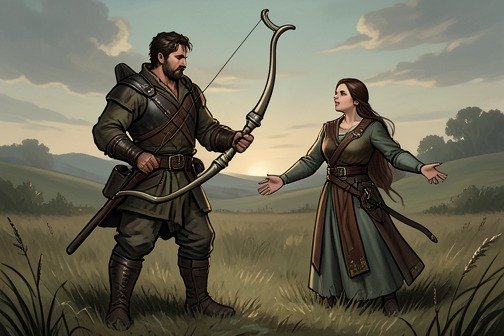
[The breaking of Shiva’s bow and Rama’s marriage to Sita](entity:event-recall-event-the-breaking-of-shiva-s-46ac331cef82) is the episode in which [Ráma](entity:character-recall-character-r-ma-2db51e45ae4a) wins [Janak](entity:character-recall-character-janak-b1843f7c4081)’s child, [Sítá](entity:character-recall-character-s-t-0be56374418b), by breaking a bow said to yield to no one. Its importance lies in the linked outcome: the feat is not presented merely as a display of strength, but as the deed by which Ráma wins Sítá and the narrative proceeds to their nuptials.
## Recounted by [Viśvámitra](entity:character-recall-character-vi-v-mitra-92f43e905a92)
The surviving account places the episode within Viśvámitra’s telling of old tales. In the poem’s summary of those stories, the account of how Ráma wooed and won Janak’s child is immediately paired with the breaking of the unyielding bow. The event thus reaches the reader through retrospective narration rather than through a detailed scene in the supplied passage.
## The Bow and the Nuptials
The canto sequence names Janak’s speech and the breaking of the bow before the later canto titled “The Nuptials.” The concise recap gives the decisive connection between these moments: Ráma breaks the bow and wins Janak’s child. The available lines do not describe the contest’s mechanics or the wedding ceremony itself, but the headings and recap establish the episode’s central progression from feat to marriage.
## Courtly and Dynastic Framing
The surrounding canto titles place the nuptials amid material concerned with Janak’s court and household: Janak’s pedigree and the gift of kine are named in the cantos immediately preceding the nuptials. Afterward, the sequence turns to “Ráma With The Axe” and “The Parle.” This arrangement sets the marriage within a larger progression of courtly and family events, while also moving the narrative beyond the wedding.
## Place in the Epic
Viśvámitra’s retelling makes the bow-breaking and marriage a memorable part of Ráma’s story: the hero’s strength and his union with Sítá are compressed into one linked account. The poem’s wording emphasizes both the bow’s resistance and the outcome of Ráma’s action. In the evidence available here, that pairing—not a detailed description of the ceremony—is the episode’s defining feature.
Event 11
Rama’s alliance with Sugriva
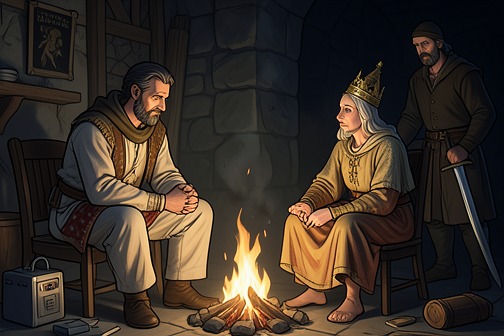
[Rama’s alliance with Sugriva](entity:event-recall-event-rama-s-alliance-with-su-73db3807e297) is the turning point at which the search for [Sita](entity:character-recall-character-sita-1913dd4978f6) becomes a partnership with a displaced ruler who has his own urgent claim for justice. At [Pampá](entity:location-recall-location-pamp-cfee6d24001a), [Rama](entity:character-recall-character-rama-fdac9c17dd0c) shares his grief with [Sugriva](entity:character-recall-character-sugriva-bd875ea369d2) and swears a pact before sacred fire; Sugriva, in turn, recounts the wrong he has suffered from [Bali](entity:character-recall-character-bali-4ed36663458c). The compact binds a personal quest to a political conflict, setting the terms for the action that follows.
## Meeting at Pampá
After receiving counsel from [Shabari](entity:character-recall-character-shabari-707c74464e77), Rama reaches the waters of Pampá. There he gains the steadfast friendship of [Hanuman](entity:character-recall-character-hanuman-83c726a7b662), the son of the Wind God. Hanuman acts as intermediary: he advises Rama to tell Sugriva of his grief, bringing the two men into direct contact. The meeting is not simply a chance encounter between potential allies. Each has been separated from what matters to him, and each meets someone able to act on the other’s behalf.
Rama’s need is immediate. Sita is missing, and his search has brought him into unfamiliar territory. Sugriva, meanwhile, is an exiled former king, wandering on Rishyamúka with four faithful former ministers. Bali, the king in fact, is his brother and the source of the injury Sugriva describes. Their first exchange therefore places two kinds of vulnerability side by side: Rama’s inability to find his wife and Sugriva’s loss of his home and kingship.
## The covenant before sacred fire
Before the sacred flame, Sugriva and Rama swear their alliance. The ritual gives the agreement a public and religious witness: in the book’s accompanying explanation, fire used for sacred purposes is made by rubbing two pieces of wood together, and fire witnesses solemn agreements, including marriage and other covenants. The scene thus marks their friendship not only through spoken assurances but through a rite that makes their commitment binding in the presence of a sacred power.
The account emphasizes reciprocity. Sugriva tells his story from beginning to end, explaining his hatred of Bali and the wrong and insult he has endured. Rama listens willingly and promises to relieve his fear. Neither man’s crisis is incidental to the other’s: the pact gives Sugriva a powerful ally against the ruler who has displaced him, while drawing Rama into a relationship that can assist his search for Sita. Their friendship is founded on an exchange of trust and promised help, rather than on shared origin or an existing political bond.
## Two conflicts joined
The pact joins Rama’s search to Sugriva’s struggle with Bali. The alliance’s consequences unfold through action: Rama intervenes in the conflict between the brothers, Bali is killed, and Sugriva is restored to the throne. This outcome gives the agreement a concrete political result, changing Sugriva from an exile into a ruler again. The compact is therefore more than comfort offered to two figures in distress; it creates a means for each to affect the other’s circumstances.
The exchange also establishes the relationship on which the later search for Sita depends. As king, Sugriva can mobilize the [Vánars](entity:creature-recall-creature-v-nars-66c23f0e487a), and he sends search parties in different directions to look for her. The effort extends the private grief that first brought Rama to Pampá into a large-scale undertaking. In this sequence, the movement from friendship to alliance, from alliance to Sugriva’s restoration, and from restoration to the dispatch of search parties makes the compact an essential link between Rama’s loss and the wider campaign to find Sita.
## Narrative and thematic significance
The alliance is built through a parallel of injuries, but it does not leave either man merely lamenting what he has lost. Rama listens to Sugriva’s history and offers action; Sugriva’s welcome and later mobilization connect Rama to a force capable of extending the search. Their agreement thus shifts the story from isolation toward cooperation. Its emotional premise is friendship, while its narrative force lies in converting that friendship into reciprocal obligation.
The sacred fire gives the bond solemnity, and the reciprocal promises give it direction. The subsequent restoration of Sugriva and the search for Sita show the two sides of the compact in sequence: aid to Sugriva answers the wrong he has narrated, while the Vánar search advances Rama’s purpose. The scene establishes a pattern in which trust is proved through deeds, and makes cooperation—not solitary strength—the means by which the separated crises begin to move toward resolution.
Event 12
The slaying of Bali
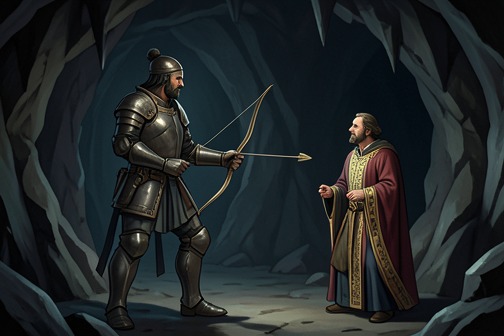
The slaying of [Báli](entity:character-recall-character-b-li-40ae88ddddbf) is the turning point that converts [Ráma](entity:character-recall-character-r-ma-2db51e45ae4a) and [Sugríva](entity:character-recall-character-sugr-va-f4b2f7927084)’s alliance into a change of rule. At the cave of [Kishkindhá](entity:location-recall-location-kishkindh-075c7eae31c0), Báli answers Sugríva’s summons, enters the fight, and falls to one arrow from Ráma’s bow. Ráma then tells Sugríva to reign in place of the slain king. The poem gives the decisive action in a few tightly ordered beats: a champion arrives, a king comes out to meet the challenge, a single shaft settles the conflict, and authority passes to a successor.
## The Encounter at Kishkindhá
With Ráma beside him, Sugríva travels to the vast cave of Kishkindhá. His shout summons Báli, who comes out in fury. Before turning to the contest, Báli first comforts his trembling wife; the detail briefly places a domestic gesture beside the impending violence. The scene does not dwell on the mechanics or duration of the fight. Instead, it moves directly from Báli’s entrance into the conflict to Ráma’s arrow and the king’s fall.
That compressed sequence makes Ráma’s intervention the decisive force in the encounter. The poem specifies that one shaft from his deadly bow lays Báli low, rather than presenting the death as the outcome of a prolonged exchange. The contrast between the king’s furious arrival and the abruptness of his defeat gives the moment its sharp reversal: Báli enters as the reigning power, but does not leave the scene alive.
## From Victory to Rule
Báli’s death is followed immediately by a political consequence. Ráma directs Sugríva to reign in place of the king who has been slain. The succession is therefore shown not as a separate development left implicit after the battle, but as the action’s explicit result. The arrow ends Báli’s rule; Ráma’s command identifies who is to take his place.
The passage thus binds the personal outcome of the fight to a transfer of sovereignty. Sugríva’s arrival with a new champion and his rise to kingship form the two ends of a compact reversal. The episode gives no further account here of the practical arrangements of the new reign; its emphasis is the decisive restoration itself. Ráma’s role extends beyond defeating Báli: he directs the political consequence of that defeat by bidding Sugríva rule.
## The Episode Recalled
The poem later places the killing within a broader recollection of the alliance. After journeying to [Rishyamúk](entity:location-recall-location-39ec2cffb756), the speakers recount the friendship the two allies had sought, the conflict between Báli and Sugríva, Báli’s death, and Sugríva’s accession. This retrospective sequence supplies a frame for the event: the slaying belongs to a chain that moves from sought alliance, through battle, to a changed kingship.
That recap also shows how the narrative preserves the episode beyond its immediate scene. The death is not recalled alone; it is paired with the friendship and the restoration that followed. In the same compressed list, the poem mentions the treaty and [Tára](entity:character-recall-character-t-ra-0a0055608a37)’s wild lament. These references give the victory a larger human and political aftermath without expanding those moments in this passage. The remembered event therefore carries both the public consequence of Sugríva’s rise and the grief signaled by the lament.
## Narrative Significance
The scene’s economy is part of its effect. A shout brings Báli out; a single arrow kills him; a direct command names the successor. The sequence makes the transfer of power legible without pausing over battle tactics or the details of governance. Its emphasis falls on the clear reversal from reigning king to slain opponent, and from Sugríva’s alliance with Ráma to Sugríva’s rule.
The later retelling changes the emphasis without changing the outcome. Where the first account concentrates on the encounter and its immediate political result, the recollection gathers the killing together with alliance, treaty, accession, and lament. The event consequently functions both as a sharply staged death and as the hinge of a wider narrative transition: Sugríva’s fortunes change, and the alliance is remembered through the consequences it produced.
Event 13
Ravana’s abduction of Sita
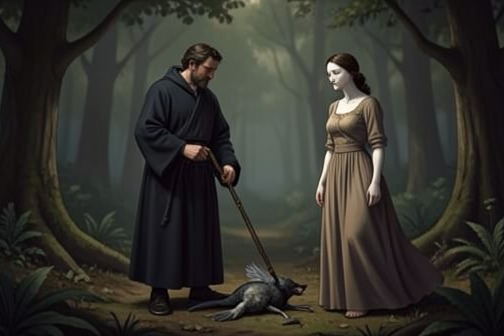
[Ravana’s abduction of Sita](entity:event-recall-event-ravana-s-abduction-of-s-18d1a2f11634) is the rupture that turns [Ráma](entity:character-recall-character-r-ma-2db51e45ae4a)’s forest sojourn into a search for his missing wife. [Rávaṇ](entity:character-recall-character-r-va-06a1d00141e6) arrives at Ráma’s hermitage driven by fate and rage, and uses [Márícha](entity:character-recall-character-m-r-cha-ad86b029a502)’s magic to draw the princely youths apart. In their absence, [Jaṭáyu](entity:character-recall-character-ja-yu-feaa8c7732e2) is killed defending [Sítá](entity:character-recall-character-s-t-0be56374418b), and Rávaṇ carries her away. Ráma returns to find the bird dead and Sítá gone: the domestic refuge has become the scene of loss, and the rescue to come begins with absence rather than knowledge.
## Causes and Background
The epic’s compressed account connects the abduction to an escalating chain of vengeance. A later synopsis places it after the mockery and disfigurement of Rávaṇ’s sister, the deaths of Triśirá and [Khara](entity:character-recall-character-khara-de406d3d61b8), and Rávaṇ’s awakening to a call for revenge. It also describes Márícha as doomed, without escape. The abduction is therefore not presented as an isolated encounter: it follows earlier injuries and defeats, and Rávaṇ’s rage carries those conflicts into Ráma’s hermitage.
The narrative gives fate and anger closely joined roles in Rávaṇ’s arrival. That framing does not erase his actions: the next beats are deliberate, as he uses Márícha’s magic to separate the princes and takes advantage of their absence. The sequence makes separation the practical condition for the abduction. Magic alters the immediate circumstances; Jaṭáyu’s intervention shows that Sítá is not wholly undefended, but it cannot prevent Rávaṇ from carrying her away.
## The Abduction and Jaṭáyu’s Defense
The account makes the divided household its decisive circumstance. Márícha’s magic draws the princely youths away from the hermitage; while they are apart, Rávaṇ takes Sítá. The poem’s summary states the action directly, without dwelling on its mechanics. Its emphasis falls instead on the consequences: Jaṭáyu, described in the accompanying note as a semi-divine bird and friend of Ráma, fights in Sítá’s defense and is killed.
Jaṭáyu’s death gives the abduction a second loss. He is not simply a witness to Sítá’s disappearance: he acts against it, and his defense costs him his life. The event thus leaves Ráma with two absences to confront when he returns—the wife he sought and the friend who tried to protect her. The paired losses make the scene a hinge between the failed defense at the hermitage and Ráma’s subsequent search.
## Discovery, Grief, and the Turn to Search
Ráma finds Jaṭáyu on the ground, rushes into the leafy dwelling, and searches for Sítá. The order matters: the dead bird is the first visible sign of what has happened, while the empty refuge confirms that Sítá is missing. Ráma’s senses fail; he weeps and wails in despair. The narrative moves from external action to an immediate collapse of composure, making grief the first response to the abduction’s consequences.
Ráma then places Jaṭáyu on a funeral pyre. The gesture gives the dead defender a funeral and marks the bond between the bird and Ráma as more than a passing acquaintance. At the same time, it delays neither the reality of Sítá’s disappearance nor the need to search for her: the scene holds mourning and the unresolved loss together. The abduction’s immediate aftermath is therefore not a single reaction, but a sequence of recognition, grief, and funeral duty, from which the search must proceed.
## Narrative Reach and Significance
The epic’s own later recapitulation gathers the disfigurement, the fall of Triśirá and Khara, Rávaṇ’s vengeance, Márícha’s doomed part in the plot, Sítá’s abduction, Ráma’s grief, and Jaṭáyu’s death into one connected run of events. That condensed ordering clarifies the episode’s structural force: the kidnapping is the point at which a chain of retaliations becomes a personal separation, and the separation sets Ráma’s next actions in motion. The story’s focus shifts from the defense of a hermitage to the effort to recover Sítá.
The episode also belongs to a poem presented as both recitable and musical. Its account of the epic describes a carefully wrought pattern of notes and measure, and names tenderness and surprise among the feelings its verse can hold. The abduction’s place in that larger design depends on contrast: the security of Ráma’s dwelling gives way to separation; the heroic attempt to defend Sítá ends in Jaṭáyu’s death; and Ráma’s despair becomes the starting point of a search. The narrative does not resolve the loss here. It establishes the stakes that the subsequent story must answer.
Event 14
Hanuman’s leap to Lanka and discovery of Sita

[Hanuman’s leap to Lanka and discovery of Sita](entity:event-recall-event-hanuman-s-leap-to-lanka-4d2b0ac0468c) transforms a distant search into a confirmed connection between the separated spouses. Guided by [Sampati](entity:character-recall-character-sampati-286582a41b86)’s counsel, [Hanuman](entity:character-recall-character-hanuman-83c726a7b662) makes a tremendous crossing, finds [Sita](entity:character-recall-character-sita-1913dd4978f6) beneath the [Ashoka Grove](entity:location-recall-location-ashoka-grove-d19d45180627)’s trees, and gives her [Rama](entity:character-recall-character-rama-fdac9c17dd0c)’s ring. She entrusts him with a token in return. His mission then turns from clandestine contact to open violence: he damages the garden, kills five captains, and burns the city before flying back to Rama with news of the encounter and Sita’s gem.
## The Crossing and the Search
The mission begins with a direction supplied by Sampati. Hanuman is led by that counsel to the edge of the sea and undertakes a leap described as spanning two hundred leagues. The scale of the crossing gives the search a decisive physical threshold: Sita is not merely missing from Rama’s immediate surroundings but held in [Lanka](entity:location-recall-location-lanka-4b3ac7e9a824), and reaching her requires a journey across the deep. Hanuman’s courage is presented through action, as he mocks at dread and springs forward rather than allowing the danger of the passage to stop him.
The account also preserves the approach as a task of infiltration, not simply a spectacular flight. In the poem’s later summary of the episode, Hanuman makes his way through the city square toward chambers where the women are, before entering the Ashoka Grove. The movement from the town’s public spaces to the grove narrows the search toward its particular object: finding Rama’s captive wife. The leap carries him into Lanka; the careful passage through the city carries him to Sita.
## Recognition and Exchange
Hanuman finds Sita pensive beneath the Ashoka trees. The meeting is consequential because it replaces uncertainty with direct knowledge: she is alive, captive in Lanka, and reachable. Hanuman approaches her with Rama’s ring, a token from her husband and king. The object gives the encounter a material means of recognition and ties the distant search party to Rama himself. Hanuman does not return with a report based only on what he has seen; he brings something that connects the captive Sita to the person waiting for her.
Sita answers with a token of her own, described in the account as a pledge from her hand and, in the later recap, as a gem she gives overjoyed. The exchange makes the communication reciprocal. Rama’s ring travels into captivity; Sita’s gem travels back out. Each object crosses the separation in the direction its sender cannot, carrying assurance between the two. The episode’s emotional turn rests on this contact: a search that had been driven by absence now yields evidence from Sita herself.
## From Secret Contact to Assault
After meeting Sita, Hanuman batters down the garden door and destroys the grove. The account places this destructive action alongside his killing of five captains of Lanka’s host. The shift is sharp: the visitor who arrived in secrecy and delivered a small ring now becomes a force the city must confront. The encounter expands from a private exchange beneath the trees into an attack with consequences for Lanka’s defenders and its garden.
Hanuman then sets the town alight with hostile flame. Before leaving, he speaks again with Sita, so the assault does not replace the purpose of his mission or sever his contact with her. The order matters: after the city has been burned, he returns to the captive woman and then flies back across the sea. His destructive actions make his presence impossible to treat as an unseen visit, while his renewed conversation with Sita keeps her message at the center of what he carries away.
## Return and Consequence
Hanuman flies swiftly back to Rama with tidings of the interview. He shows Rama the gem from Sita’s brow and consoles him. The object that had left Sita’s hand now answers the uncertainty of the search: Rama receives a message grounded in a personal exchange, not an unverified report. The account’s earlier description of Rama losing his senses in despair when he returned to find his wife gone gives this reassurance particular weight; the gem and Hanuman’s news stand against the anguish of her absence.
The episode therefore completes one stage of the search while making the separation more concrete. Sita has been found, but she remains captive in Lanka; the exchange confirms contact without ending her confinement. Hanuman’s leap establishes a route across the sea, his return carries Sita’s token back to Rama, and the burning of the city adds open conflict to the rescue mission. Its decisive change is from not knowing where Sita is to knowing where she is and receiving evidence from her, while the need to reach and free her remains unresolved.
Event 15
Hanuman’s burning of Lanka
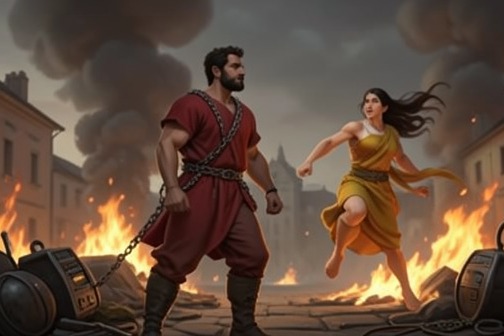
[Hanuman’s burning of Lanka](entity:event-recall-event-hanuman-s-burning-of-la-f8c11c3bdfa2) turns a mission of discovery into open destruction. After crushing [Aksha](entity:character-recall-character-aksha-bdb96ac442f0) and being seized, [Hanuman](entity:character-recall-character-hanuman-83c726a7b662) is freed from his bonds but does not treat release as a reason to defy [Brahmá](entity:character-recall-character-brahm-8b6ab0d9402f)’s decree. He endures his captors’ insults, then burns the town, speaks again with [Sita](entity:character-recall-character-sita-1913dd4978f6), and flies back to [Ráma](entity:character-recall-character-r-ma-2db51e45ae4a) carrying news of their interview.
## From the grove to captivity
The burning belongs to a sequence of escalating actions. Hanuman destroys the grove, and the disturbance sends the giantesses fleeing while servants are struck down. He is then captured. The narrative does not make his capture the end of his agency: the episode moves from the grove’s destruction to the restraints placed on him, and then to the moment when those bonds no longer hold.
The surrounding account also places Hanuman’s defeat of Aksha before his surrender to his captors. The juxtaposition matters: he has demonstrated force in combat, yet, once captured, he chooses to yield. His conduct is not simply a continuation of battle; it changes according to the circumstance.
## Release, decree, and the burning
Hanuman soon becomes free of his bonds. The account connects his next choice to a decree Brahmá had pronounced long before: Hanuman honors it and calmly bears the insults directed at him. It does not explain the decree’s full terms, so the event presents his restraint as deliberate without specifying more about the rule than the narrative supplies.
That restraint does not prevent retaliation against the city. Once the town is burning, Hanuman speaks again with Sita. The sequence therefore sets patient endurance beside destructive action: he accepts the insults under the authority of the decree, but the episode still culminates in [Lanka](entity:location-recall-location-lanka-4b3ac7e9a824) ablaze. The account identifies the hostile fire and the burning, without describing how it was kindled or itemizing the damage beyond the town’s destruction.
## Return and significance
After speaking with Sita, Hanuman flies back to Ráma with tidings of their interview. The return across the sea closes the episode’s immediate arc: the mission has produced both direct contact with Sita and a report delivered to Ráma. A retrospective account reinforces the scale of the encounter, recalling the ruined grove, the fleeing giantesses, the captured Hanuman, the burning of Lanka, and his leap across the sea once more.
The burning is thus more than an isolated act of damage. It marks the point at which Hanuman’s successful contact with Sita is followed by a conspicuous assault on the city that holds her, while his return carries the encounter’s news back to the opposing side. The movement from capture to freedom, from insults endured to a city in flames, and from Lanka back to Ráma gives the episode its sharp reversals. It ends not with Hanuman remaining amid the destruction, but with the messenger returning to report what he has learned.
Event 16
The building of Rama’s bridge to Lanka
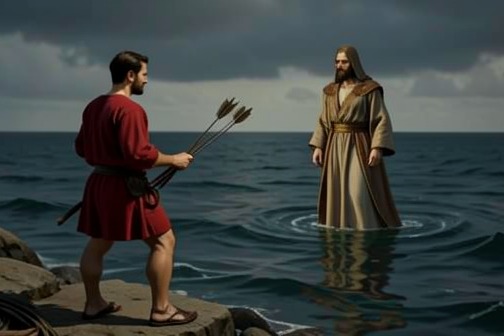
[The building of Rama’s bridge to Lanka](entity:event-recall-event-the-building-of-rama-s-6b025390be13) is the decisive passage from the shore where [Ráma](entity:character-recall-character-r-ma-2db51e45ae4a)’s expedition has arrived to the enemy city across the sea. The poem presents the bridge through a compact chain of actions: Ráma confronts the ocean, the [Ocean King](entity:character-recall-character-adee9e34d896) appears, [Nala](entity:character-recall-character-nala-b1bf0c261172) builds the crossing, and the party reaches [Lanká](entity:location-recall-location-lank-4c2ae5988d40). What had separated the expedition from its destination becomes a traversable route.
## The Sea as an Obstacle
Ráma comes to the ocean with [Sugríva](entity:character-recall-character-sugr-va-f4b2f7927084) as his guide. Rather than describing a search for a natural crossing, the account makes the encounter a confrontation: Ráma strikes the sea with arrows bright as high summer sunbeams. The Ocean King then appears, obedient to the summons. The bridge’s immediate background is therefore not merely geography but a meeting in which force calls forth a response from the sea itself.
## Nala Builds the Crossing
The poem assigns the bridge’s construction to Nala, who throws it across the narrow sea from shore to shore. It gives the achievement in a single, direct statement, without detailing the materials, labor, or duration. That compression keeps attention on the result: a continuous way across where the sea had been a barrier. Ráma’s action brings the Ocean King to appear; Nala’s work makes passage possible.
## Crossing to Lanká
With Sugríva accompanying him, Ráma crosses toward Lanká. A related account of the sequence dwells on the crossing and the party’s night encampment around the city. The bridge thus does not end the journey at the opposite shore: it delivers the expedition to the perimeter of Lanká, where arrival becomes a military confrontation. The route links the ocean-side interview to the approach to the city and its siege.
## Consequences and Narrative Role
The bridge stands at the hinge between summons and assault. Once the crossing has been made, Ráma’s hand brings down [Rávaṇ](entity:character-recall-character-r-va-06a1d00141e6), and [Vibhíshaṇ](entity:character-recall-character-vibh-sha-c9947292780b) is left to reign in Lanká; the account also recalls a treaty with Vibhíshaṇ among the events surrounding the approach. The bridge is therefore more than a feat of construction in the poem’s sequence: it enables the passage into the conflict and precedes a change of ruler. Its spare narration gives the crossing a clear function, turning distance into access and access into the possibility of victory.
Event 17
The slaying of Ravana
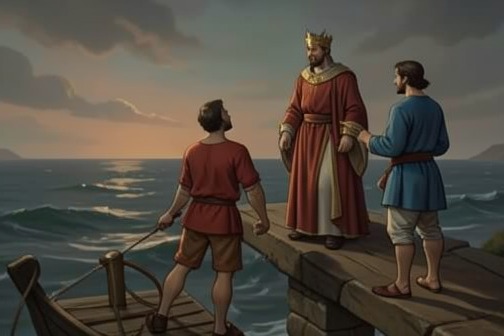
[The slaying of Ravana](entity:event-recall-event-the-slaying-of-ravana-cf0f3e3e6954) is the decisive turn in the battle for [Lanka](entity:location-recall-location-lanka-4b3ac7e9a824): the crossing of [Nala](entity:character-recall-character-nala-b1bf0c261172)’s bridge brings [Rama](entity:character-recall-character-rama-fdac9c17dd0c)’s forces to the golden city, Rama strikes [Ravana](entity:character-recall-character-ravana-f2652ae52080) down, and [Vibhishana](entity:character-recall-character-vibhishana-48b5fde5e908) succeeds to the defeated king’s domain. The account gives the victory a double consequence. It restores [Sita](entity:character-recall-character-sita-1913dd4978f6) from captivity, while replacing Ravana’s rule with that of his brother, whom Rama has made an ally.
## Causes and Approach
The episode belongs to a sequence of crossing, alliance, and attack. Nala throws a bridge across the narrow sea from shore to shore, creating the passage by which Rama’s side reaches Lanka. The bridge is presented as the necessary threshold between the separated shores and the confrontation at the city; the crossing itself is a major action, not merely a change of setting.
Before the killing, Rama makes a treaty with Vibhishana. The sung account places this agreement beside the plan to destroy Ravana, linking the military objective to a political realignment within Lanka’s royal family. Vibhishana is not simply named after the victory: his agreement precedes it, and the ending of the battle will give him a new role in the defeated kingdom. The compact thus anticipates the transfer of rule that follows Ravana’s death.
## The Battle and Its Turning Point
The narrative compresses the fighting into a sequence of losses and a final decisive blow. [Kumbhakarna](entity:character-recall-character-kumbhakarna-993814df073f) and Meghanada fight and die; then Ravana himself is slain. Their deaths mark the destruction of the principal resistance described in this account, but the focus falls most sharply on the king’s fall. The phrase that Rama’s hand smites Ravana down makes the outcome direct and conclusive: the conflict reaches its turning point through the defeat of the ruler at its center.
The change is stark. Before the blow, Ravana holds Lanka and Sita remains a captive; after it, the king is dead, Sita is brought back, and the rule of his domain is assigned to another. The brief narration does not detail the tactics or duration of the combat. Instead, its ordered succession—bridge, treaty, deaths in battle, Ravana’s slaying—makes the outcome legible through the consequences attached to each step.
## Rescue and Transfer of Rule
Ravana’s death is followed by the return of captive Sita. Her restoration gives the victory its personal consequence: the military crossing and the destruction of the enemy’s power culminate in the recovery of the person whose captivity has made the conflict urgent. The account places this return alongside the political settlement, joining the end of the battle to the repair of what Ravana’s rule had ruptured.
Vibhishana is left to reign over his brother’s wide domain. This succession is more than a final note of triumph. The ally established by treaty becomes the new ruler, so the victory alters the government of Lanka as well as its immediate military fortunes. The narrative moves from an alliance made before the attack to a kingship secured after it, giving the event a clear political aftermath rather than ending at the moment of Ravana’s death.
## The Event in the Sung Narrative
The battle is recounted as part of a larger sung account of Rama’s life, which presents his princely birth, kindness, heroic worth, patience, gentleness, and truth alongside the story of his deeds. Within that larger portrait, the slaying of Ravana completes an arc from heroic character to decisive action: the same figure praised for constancy and care is also the agent who ends the king’s rule and brings Sita back.
The broader description of the song emphasizes its musical construction and its range of feeling, including tenderness, surprise, contentment, anger, mirth, and terror. The battle therefore belongs to a narrative capable of holding violence and restoration together. Its ending does not leave the listener only with Ravana’s death: it turns from the fallen king to Sita’s return and Vibhishana’s accession. That movement from conflict to recovery and succession gives the episode its defining shape.
Event 18
Sita’s trial by fire
[Sita’s trial by fire](entity:event-recall-event-sita-s-trial-by-fire-cc6f3a66f5f5) is the public ordeal that interrupts [Sítá](entity:character-recall-character-s-t-0be56374418b) and [Ráma](entity:character-recall-character-r-ma-2db51e45ae4a)’s reunion after the victory over [Rávaṇ](entity:character-recall-character-r-va-06a1d00141e6). Rather than allowing their meeting to resolve the separation, the poem stages a confrontation before a watching crowd: Ráma addresses his wife with bitterness, and Sítá answers the challenge by giving her body to the fire. Divine testimony clears her honor, and the couple are reunited. The episode’s decisive movement is from public doubt to public vindication, but its ending does not erase the pain of the accusation that made the ordeal necessary.
## The reunion becomes a public confrontation
The scene begins with Sítá coming to meet her husband. The reunion is not private: the crowd presses around them as Ráma speaks, making his words a public act rather than an exchange confined to the couple. The poem describes him as stung by ire and shame and characterizes his address as bitter. It does not explain those feelings further in this passage, so the scene’s immediate emphasis falls on the harshness of the words and the audience before whom they are spoken.
That setting changes the stakes. Sítá is not merely returning to Ráma; her honor is placed under scrutiny in front of witnesses. The crowd makes the confrontation visible, while her answer makes the question of honor the center of the episode. The reunion thus turns sharply: the expectation of restored closeness gives way to an ordeal, and the crowd that surrounds the couple becomes the audience for her vindication.
## Sítá enters the fire
Sítá responds with what the poem calls noble ire and gives her body to the fire. This is the episode’s central action: she does not meet Ráma’s words with a matching speech in the surviving lines, but with an act that places her honor before a divine witness. The choice is presented as a decisive answer to the public challenge, not as a quiet reconciliation or a withdrawal from the crowd.
The poem’s language holds indignation and exposure together. Sítá’s anger is described as noble, while the act leaves her body to the judgment of the fire. That combination makes the ordeal more than a demonstration of endurance: it is also her forceful response to the accusation. The passage does not provide a detailed account of the fire’s physical course, so its emphasis remains on the act and the testimony that follows, rather than on the mechanics of the trial.
## Divine testimony and reunion
The account then brings divine authority into the public scene. It says that [Váyu](entity:character-recall-character-v-yu-b18a1f1350d5) appeared and that words from heaven cleared Sítá’s honor. The fire also remains part of the resolution: the passage describes her as obedient to [Agni](entity:character-recall-character-agni-c62fbffdea27), and says that Ráma embraced her again when she emerged unharmed and pure. Together, these details make the ending more than a private change of heart. Her honor is cleared through testimony from beyond the human crowd, and her uninjured return supplies the visible counterpart to that declaration.
A later summary of the episode presents the heavenly intervention differently in emphasis: it names [Brahmá](entity:character-recall-character-brahm-8b6ab0d9402f) and the gods as appearing and clearing Sítá’s doubted honor. The two accounts share the crucial outcome—divine testimony resolves the doubt—but do not identify the intervention in exactly the same way. The distinction matters to the shape of the story: the scene’s shorter poetic presentation foregrounds Váyu and the words from heaven, while the later summary gathers the vindication under Brahmá and the gods. In both, the final movement is from a contested reputation to an honor publicly affirmed.
Ráma’s embrace completes the immediate action, but the sequence preserves the weight of what preceded it. Sítá is restored to him only after the bitter address, her passage into the fire, and the declaration that clears her name. The ending therefore joins reunion with a record of injury: the couple are together again, yet the public ordeal remains the condition through which the poem has made that reunion legible.
## Place in the larger account
The ordeal appears within the account of the victory’s aftermath. [Vibhíshaṇ](entity:character-recall-character-vibh-sha-c9947292780b) is left to reign over his brother’s domain, and the poem’s later summary moves from the clearing of Sítá’s honor to the journey in the flying chariot toward [Bharadvája](entity:character-recall-character-bharadv-ja-87bd3d82bdf6)’s dwelling. This sequence places the fire ordeal at a hinge between the conquest and the homeward return: political rule has changed hands, but the personal reunion still requires resolution.
The episode also survives as part of the poem’s performed and retold story. The larger account describes the heroic song being sung in a king’s seat and a crowded hall, where Ráma happens to hear it. That detail does not specify a separate performance of the fire ordeal, but it places the episode within a narrative made to travel through public recitation. The scene itself is already organized around witnesses; its later place in the song extends that public dimension, carrying the dispute and its divine resolution before new audiences.
Its force comes from the sequence rather than from spectacle alone: bitter words before the crowd, Sítá’s indignant act, testimony from above, and Ráma’s embrace. The reunion is restored, but only after honor has been challenged and answered in public. The fire ordeal thus marks both an ending to the immediate separation and the cost attached to that ending.
Event 19
Rama’s return to Ayodhya and coronation
[Ráma](entity:character-recall-character-r-ma-2db51e45ae4a)’s return to [Ayodhyá](entity:location-recall-location-ayodhy-08bd0b6815c4) and coronation bring his period away from the kingdom to a decisive close: he reaches the city in a magical flying car, meets [Bharat](entity:character-recall-character-bharat-6395f3ef7f4e), and is ordained king. The episode makes homecoming more than a private reunion. The returning hero is received by his brother, restored to his father’s kingdom, and consecrated in a ceremony attended by Brahman sages; the account then gives his reign a ten-thousand-year span. The movement from journey to meeting to ritual makes the restoration of kingship the event’s defining outcome.
## Return and arrival
The return is associated with a magical car, the vehicle that carries Ráma toward Ayodhyá. In the later canto titled “The Magic Car,” [Vibhishaṇ](entity:character-recall-character-vibhisha-e07caf5116fd) speaks before the car is brought; the narrative then marks its arrival with a brief, decisive transition. The vehicle is thus not incidental transport: it signals that the long journey is turning toward its conclusion and enables the movement from the distant scene of exile to the royal city.
The account’s earlier formulation gives the journey a clear destination and result. Ráma travels in the magic car, reaches Ayodhyá, and rules over his father’s kingdom. The sequence is spare, but its order matters: arrival precedes accession, and the return to the city is the necessary public threshold between an absent heir and a reigning king. The language of regaining the kingdom presents the change as restoration rather than the creation of a new claim.
The episode also appears in the poem’s account of the heroic song. Its subject is the journey in the flying car and the meeting between Bharat and the car’s arriving party, followed by Ráma’s ordination as king. By placing return, reunion, and accession together in that recited sequence, the poem treats them as connected stages of one resolution: the journey brings the brothers together, and their meeting leads into the restoration of the throne.
## The meeting with Bharat
Bharat’s presence gives the return a familial as well as political meaning. The account identifies him as meeting the flying car, while another passage describes Ráma as met by his faithful brothers. That emphasis on fidelity makes the homecoming reciprocal: Ráma does not simply reappear before a waiting kingdom but returns to the company of brothers whose loyalty is part of the episode’s resolution.
The meeting also mediates between travel and rule. Before Ráma is described as ordained king, Bharat’s recognition of the returning party establishes the relationship that the public accession will formalize. The sequence gives no extended account of what the brothers say or do together, so its force rests on placement and emphasis rather than dialogue: the brotherly reunion stands immediately beside the transfer from return to kingship. The throne is not presented as an isolated prize; its restoration belongs to a family order in which Bharat’s meeting and Ráma’s return are joined.
The public staging associated with this meeting enlarges that reunion beyond the royal household. A description of the advancing car pictures spectators filling streets and squares, balconies and rooftops. Priceless jewels shine in their turbans; flowers fall upon the car; music, shouting, and joy fill the scene. These details belong to the account of the meeting’s vivid public presentation, not to a surviving transcript of private conversation. They show how the arrival can be imagined as a civic spectacle: the vehicle is seen, the crowd responds, and the brothers’ reunion becomes visible to the city.
## Consecration and restored rule
After the return and meeting comes Ráma’s ordination as king. The canto devoted to the consecration places him among many Brahman sages, whose holy hands perform the rite in ordered fashion. The emphasis on number, sacred standing, and orderly action frames kingship as something publicly conferred, not merely assumed upon reaching Ayodhyá. The gathered sages give the event a ritual setting, while the sequence confirms that the returning prince has become the kingdom’s consecrated ruler.
The concise earlier account states the political outcome directly: Ráma gains Ayodhyá and reigns over his father’s kingdom. That wording joins his accession to continuity with the preceding generation. He does not receive an unnamed or newly founded realm; the kingdom is specifically his father’s, and the return restores its rule to him. The consecration therefore resolves both the physical absence of the heir and the question of who occupies the royal place.
The account extends the consequence far beyond the day of the ceremony: Ayodhyá is blessed under Ráma’s reign for ten thousand years. This immense duration turns the coronation into the beginning of an idealized period of rule. The narrative moves from the bounded actions of arrival, meeting, and ritual to a timespan that exceeds ordinary political succession. The return closes the immediate journey, but the long reign gives that closure a larger promise of stability and flourishing.
## Song, spectacle, and remembrance
The poem treats its own telling as a performance. It calls for the heroic song to be recited in a king’s seat and crowded hall, and describes the song through the seven notes of music and the tenderness, surprise, and contentment it evokes. Those features connect the episode’s public subject matter with the conditions of its transmission: a royal return and coronation become material to be voiced before an assembled audience, not merely events remembered in private.
The crowd surrounding the advancing car supplies a parallel between narrated event and performance. Within the description of the meeting, spectators occupy the city’s streets and high vantage points, flowers descend, and music and shouting register collective joy. In the recitation frame, listeners gather in a royal hall to hear the heroic song. These are distinct scenes, but each makes the return public through an assembled audience. The episode’s meaning is consequently carried by more than Ráma’s arrival: it includes the recognition of Bharat, the ritual presence of the sages, and the city’s witnessing response.
The narrative’s structure gives the event a carefully staged completion. The magical car makes return possible; Bharat’s meeting supplies recognition; the consecration establishes Ráma’s rule; and the ten-thousand-year reign projects that rule into an idealized future. The poem then preserves the sequence as a heroic song, capable of being performed in a crowded royal hall. Homecoming thus becomes both a political restoration within the story and a shared, repeatable memory of the rightful king’s arrival.
Event 20
Rama’s abandonment of Sita

[Rama’s abandonment of Sita](entity:event-recall-event-rama-s-abandonment-of-s-f145eff3927b) is presented as a late and decisive rupture in the account of [Rama](entity:character-recall-character-rama-fdac9c17dd0c)’s life. The poem’s compressed sequence places the king’s separation from his queen beside the people’s growing affection for him, setting private loss against public esteem without explaining the causes or circumstances of the abandonment.
## Place in Rama’s Life
The episode appears after Rama has been ordained king and the legions have received their discharge. In that sequence, the abandonment follows the restoration of royal order: the coronation and demobilization give way to the queen’s removal from the story’s royal household. The account identifies [Sita](entity:character-recall-character-sita-1913dd4978f6) as Rama’s queen but offers no scene describing how he sends her away.
## Private Rupture and Public Affection
The poem places Rama’s act beside the statement that the people’s love grows each day. This contrast is striking, but the text does not say that the public knows of the abandonment, approves of it, or responds to it. Instead, the juxtaposition holds two outcomes together: a marriage broken by the king’s decision and a ruler whose popular affection continues to increase.
## Narrative and Poetic Frame
[Válmíki](entity:character-recall-character-v-lm-ki-6e665def9561)’s account is described as telling whatever befell Rama, and the abandonment forms part of that broad life narrative. The work is also presented as a composition made for music, with seven notes and three measures, and its emotional range includes tenderness and surprise. These features frame the episode within a poem designed for recitation and song, but the available account does not specify how those emotional qualities are applied to this particular event.
Event 21
Rama’s horse sacrifice and the recitation of the Ramayana
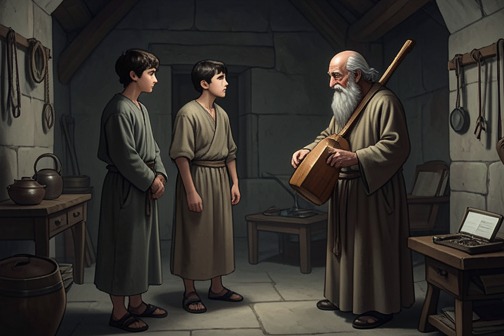
[Ráma](entity:character-recall-character-r-ma-2db51e45ae4a)’s horse sacrifice and the recitation of the Ramayana joins a royal rite to an act of poetic transmission: while Ráma prepares to sacrifice the votive horse, he hears [Kuśa](entity:character-recall-character-ku-a-080b9ea19afc) and [Lava](entity:character-recall-character-lava-58c876878914) sing the epic [Válmíki](entity:character-recall-character-v-lm-ki-6e665def9561) has taught them. The scene moves the poem from the sage’s instruction to a king’s hall, where its young performers become the means by which the ruler encounters the story. The narrative places the sacrifice’s beginning in spring, but leaves the episode focused not on the rite’s completion, but on the song and the audience it gathers.
## Preparation in the Hermitage
The performance begins with teaching. Kuśa and Lava, dressed in the garments of hermits, come to greet their master and embrace his feet. Válmíki regards the twins as especially well suited to the task: they are skilled in sacred learning, and he teaches them the Ramayana, described as a heroic song rich in divine lore. Their training makes the recitation more than a spontaneous display. The twins have received the poem from its author and are prepared to carry it beyond the hermitage.
Válmíki directs them to recite in the quiet places where sages gather and where good people resort. He kisses their heads as they bow before him. The gesture places affectionate recognition beside formal instruction: the poet entrusts his work to pupils who honor him as their master, while the song is meant for listeners beyond their immediate circle. Its circulation begins with disciplined learning, but is not confined to a private or scholarly audience.
## The Song’s Form and Emotional Range
The poem’s performance is presented through sound as well as subject. Its seven musical notes and triple measure are carefully fashioned, with melody, tone, and time contributing to its effect. The twins are praised for the sweetness and strength of their voices, and for the skill with which they blend tone and accent. Recitation and song meet in the episode: the Ramayana is a composed verbal work, but it reaches its listeners through trained voices and musical arrangement.
Its emotional reach is similarly broad. The song moves through contrasting states, including rejection of what is false and base, anger, mirth, terror, tenderness, surprise, and contentment. That range helps explain why the listeners find it both joyful to hear and sweet to recite and sing. The recitation is not described as a bare report of deeds; its measured form and changing emotional colors shape how those deeds are received. Elsewhere, the work describes verse as measured language made with even lines and feet, rhythm, time, and tone, a formal emphasis that complements the twins’ musical performance.
## The Royal Hearing
The twins’ song passes from the hermitage into the public world of kings. They sing in a royal hall, where their performance is praised. Ráma happens to hear the poem while the votive horse is to be sacrificed. He sends suitable messengers to bring the pair before him, turning an accidental hearing into a formal audience. The ritual setting supplies the occasion, but the action shifts toward listening: the king summons performers whose song has already attracted acclaim.
When the twins arrive, Ráma addresses his brother [Lakshmaṇ](entity:character-recall-character-lakshma-7aad0629b677) and the others, inviting them to attend to the remarkable strain. His response makes the court a second audience within the scene. The brothers sing with sweet, strong voices, carrying the poem’s full tide through deftly blended tone and accent. The episode thus enlarges the song’s reach in stages: Válmíki teaches it, the twins perform it before listeners in a royal hall, and Ráma gathers his household to hear it. The account establishes the encounter and the attention it receives; it does not, in these passages, describe the sacrifice’s completion or what Ráma says after listening.
## Recitation and Public Memory
The episode gives the Ramayana a place inside its own narrative as a work that can be learned, performed, and heard. Válmíki’s authority as teacher is carried forward by Kuśa and Lava, whose voices bring the poem to the ruler whose story it tells. The movement from the hermitage to the hall changes the scale of the audience without changing the song’s identity: trained recitation remains the link between composition and public hearing.
The accompanying account also describes a distinct public afterlife for the epic in the [Bharat](entity:character-recall-character-bharat-6395f3ef7f4e)-Miláp, the annual dramatic meeting of Ráma and [Bharata](entity:character-recall-character-bharata-72e56a1f79da) that closes a representation of Ráma’s victory and return. It reports that the open-air Rám-Lalá lasts fifteen successive days, with one day’s break, and that in Benares three performances take place at nearly the same time: one near the Maharajah of Benares’s palace at Ramnaggur, another near the Missionary settlement at Sigra and elsewhere in the city, and a third near the College at Chowká Ghát, organized by leading residents. The account describes the brothers’ meeting as a crowded civic spectacle, with processions of elephants, richly adorned riders, flowers falling on the advancing car, music, and spectators filling streets, squares, balconies, and rooftops. This later reenactment is not the horse-sacrifice scene itself; it shows how the epic’s recitation and performance could extend beyond the court into shared public memory.
Event 22
Rama’s mission with Vishvamitra
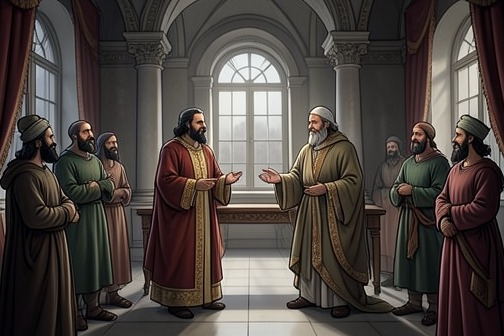
[Viśvámitra](entity:character-recall-character-vi-v-mitra-92f43e905a92)’s mission with [Ráma](entity:character-recall-character-r-ma-2db51e45ae4a) is the episode in which a threatened sacred rite draws the young prince out of [Ayodhyá](entity:location-recall-location-ayodhy-08bd0b6815c4) and into the company of the sage. Its decisive turn is not a battle but a choice: [Daśaratha](entity:character-recall-character-da-aratha-ffdd8279512e) must weigh his fear for his eldest son against his duty to protect a suffering guest and the consequences of refusing a request he has undertaken to honor. The king ultimately entrusts Ráma to Viśvámitra, while [Lakshmaṇ](entity:character-recall-character-lakshma-7aad0629b677) joins them; family blessing and public ceremony mark the brothers’ departure as a passage from the royal household into the sage’s service.
## The sage’s request and the danger to his rites
Viśvámitra arrives before Daśaratha as a renowned holy man. The danger that brings him to the king is specific: fiends who roam by night have been disturbing his sacred rites, using their strength and frenzy to obstruct the observances. His visit therefore turns a threat to religious practice into a matter of royal responsibility. A rite that the sage cannot safely continue requires protection from the ruler, who is asked to act on behalf of a guest and petitioner.
Viśvámitra does not ask for an unspecified force or a general pledge of support. He requests Ráma, Daśaratha’s eldest-born son, whose youth and heroic promise are emphasized in the appeal. The request gives the episode its sharp personal stake: the remedy for the sage’s vulnerability is to place the king’s son in danger. It also sets the protection of a sacred rite beside the protection a father owes his child, making the mission a test of how competing duties are to be ranked.
## Duty, promise, and the king’s decision
The argument for sending Ráma rests on the king’s obligations. Viśvámitra invokes Daśaratha’s duty to defend a suffering guest and a suppliant friend. When Daśaratha hesitates, [Vaśishṭha](entity:character-recall-character-va-ish-ha-033580f29400) addresses the cost of refusal: if the king has sworn and then withdraws, he will lose the store of merit he has gained. The counsel shifts the question from whether Daśaratha is afraid to whether he can honor his word and his responsibilities as protector.
The resolution does not erase the danger; Viśvámitra tells the king not to fear for Ráma and assures him that the fiends will have no power to harm the prince. That assurance helps make the request bearable, but the account also presents Daśaratha’s answer as freely chosen. Once Vaśishṭha has finished speaking, the monarch acts of his own will, with zeal and cheer, and orders both Ráma and Lakshmaṇ to come. The change from a father’s apprehension to a king’s assent gives the episode its central reversal: the prince is released to answer a public and sacred obligation, rather than kept within the household by paternal fear.
## Blessing and departure
The sending is framed as a family rite, not a private arrangement between the king and the sage. Ráma’s mother and father speed him on his way with ceremony and prayer, and Vaśishṭha gives his blessing before Daśaratha bends over his beloved son. The king then formally entrusts Ráma to Viśvámitra, with Lakshmaṇ close behind. These gestures distinguish consent from indifference: the family lets the brothers go while making their affection and the gravity of the separation visible.
The departure also has a public, ceremonial sound. Shells and tambourines accompany Ráma as he goes forth; Viśvámitra leads, and the bow-armed prince follows. The arrangement captures the new relationship in a compact image: the sage sets the direction, while Ráma carries the weapons of a defender. Lakshmaṇ’s presence makes the mission a shared departure by the brothers, although the request and the king’s decision have centered on the eldest son.
## Place in the narrative
The episode is placed under the canto title The Spells, but the evidence here centers on the request, the deliberation, and the brothers’ departure rather than detailing what instruction follows. Its narrative work is to move Ráma from Ayodhyá’s protected royal setting into a task defined by danger and service. The sage’s interrupted rites establish the need for action; the appeal to duty supplies the reason Daśaratha must agree; and the blessings and handover give that agreement a human cost.
The mission thus links religious protection, royal obligation, and filial attachment without treating them as identical claims. Daśaratha sends his son because the king’s duty to a petitioner and the force of his sworn commitment outweigh his wish to delay the parting. Yet the prayers, blessing, and farewell preserve the emotional reality of what that choice entails. The episode’s threshold is therefore both political and familial: Ráma leaves not as a prince repudiated by his household, but as a son entrusted by his parents to the sage whose rites require protection.
Event 23
The slaying of Tataka
[The slaying of Tataka](entity:event-recall-event-the-slaying-of-tataka-1c0496a0d6a1) is a turning point in [Ráma](entity:character-recall-character-r-ma-2db51e45ae4a)’s expedition with Viśvāmitra: the hermit’s report of a long-running threat leads to Ráma’s first decisive attack on the demon. The episode frames the killing both as the removal of a danger and as an act of protection demanded of those who bear the weight of a kingdom.
## Causes and Background
Viśvāmitra presents [Tataka](entity:character-recall-character-tataka-699fd5992328) as a shape-shifting spirit of immense strength and a persistent scourge on two prosperous lands. She lives in a dark dwelling about a league away, where she blocks the road; the account also associates her violence with the place where [Agastya](entity:character-recall-character-agastya-57db2c7eeb00) once dwelt. This description makes the threat concrete: Tataka is not merely a distant adversary, but an active danger along the travelers’ route and to the surrounding country.
The hermit urges Ráma to kill her, arguing that the protection of the realm belongs among the duties of those who rule. He further claims that the law does not shield Tataka’s life, invoking the precedent that lawless women have been struck down. His appeal thus casts the coming encounter as more than a test of strength: it asks Ráma to accept lethal force as the means of ending a danger that, in Viśvāmitra’s account, has long afflicted the land.
## The Encounter and Death
The encounter turns on Ráma’s ability to fight an enemy he cannot readily see. The account notes that giant foes are especially difficult to slay at the joints of night and day; Ráma directs an arrow by sound and checks [Táḍaká](entity:character-recall-character-t-ak-6cb043ce483c) with a volley of shafts. He then meets her rising attack directly: as she lifts her vast arms, he strikes her in the heart with a crescent-shaped dart.
The wound proves fatal. Blood pours from Táḍaká’s mouth and side, and she falls to the earth dead. Her death resolves the immediate threat described by Viśvāmitra and makes the expedition’s demand for protection concrete: Ráma has answered the hermit’s appeal not merely with skill, but with decisive force.
## Political and Narrative Significance
The episode makes royal responsibility the measure of Ráma’s action. Viśvāmitra links the danger to the obligations of those who bear a kingdom’s weight, presenting protection not as an optional display of strength but as a duty with consequences for the land. Ráma’s victory therefore marks more than the defeat of a formidable opponent: it shows him acting within the public role the sage has invoked, while still on an expedition under the sage’s guidance.
That framing also gives the killing its moral and political force. Viśvāmitra grounds his appeal in the harm he says Táḍaká has inflicted and in his claim that the law does not protect her; the decisive violence follows from this counsel rather than from a private quarrel. The scene thus turns a journey into a test of responsibility, establishing protection of the realm as one of the standards by which Ráma’s strength is judged.
## Counsel, Law, and the Limits of the Scene
Viśvāmitra’s justification is presented as counsel addressed to Ráma, not as a general rule developed independently of this encounter. He joins two claims: those who bear a kingdom’s weight must protect its lands, and Táḍaká’s lawlessness leaves her life unsheltered by law. The episode therefore makes the killing legible through the sage’s stated grounds, while leaving the authority for that judgment within the scene’s own exchange. Its resolution is decisive, but its moral framing remains specific: Ráma acts against the danger Viśvāmitra describes, under the duty Viśvāmitra invokes.
Event 24
Vishnu’s Three Strides
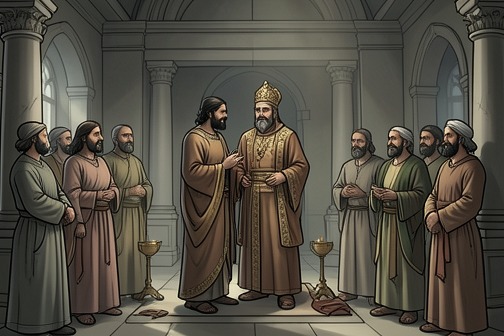
[Vishnu’s Three Strides](entity:event-recall-event-vishnu-s-three-strides-9018f633fa1b) is the episode in which [Vishnu](entity:character-recall-character-vishnu-4fe080f11b04) answers the [Devas](entity:character-recall-character-devas-f5bcab1c71d9)’ fear of [Bali](entity:character-recall-character-bali-4ed36663458c) by taking a dwarfish form, securing a seemingly modest gift, and using it to reclaim the universe. The exchange turns Bali’s sacrifice into a cosmic reversal: the king grants three steps of land, and Vishnu’s transformed body makes that measure vast enough to subdue him and restore the worlds.
## The Sacrifice and the Devas’ Appeal
Bali, the mighty son of Virochan, has begun a sacrifice. The account presents him as a demon king of boundless wealth, and the Devas approach Vishnu in fear, asking him to assume a dwarfish form and rescue them from danger. Their appeal establishes the stakes before Vishnu acts: Bali’s sacrifice is the immediate occasion for divine intervention, though the passage does not specify a particular threat beyond the Devas’ fear.
## The Three-Step Request
Vishnu comes before Bali in the requested dwarfish shape and asks for three steps of land. Bali grants the boon. The request’s small measure and the scale of what follows create the episode’s decisive contrast: the Devas’ appeal has produced no open battle at this point, but a gift that permits Vishnu to act through Bali’s own agreement.
## Expansion and Restoration
Once the boon is obtained, Vishnu’s form grows immense, extending through the worlds. With the third stride he passes through heaven. The account then describes Bali as hurled into the netherworld and the universe as restored. The strides thus resolve both the immediate appeal and the larger cosmic disorder: Vishnu’s transformation converts a three-step grant into the means of overcoming the king and re-establishing the universe.
Event 25
Rama Receives the Celestial Weapons
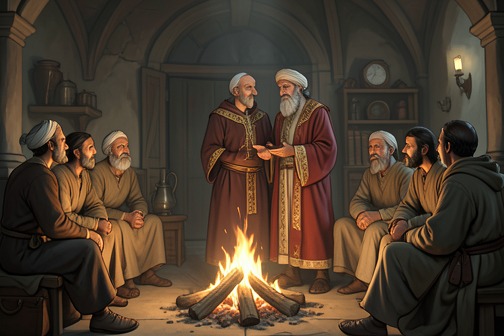
[Ráma](entity:character-recall-character-r-ma-2db51e45ae4a) Receives the Celestial Weapons is the episode in which the sage Viśvāmitra turns instruction into a gift of divine arms. After a night’s rest, the sage teaches Ráma their difficult lore and entrusts them to him. The scene presents martial power not simply as something possessed, but as something transmitted by a teacher through knowledge, spells, and a formal act of giving.
## Setting and Preparation
The episode appears in Canto XXIX, titled “The Celestial Arms.” Its opening places the encounter after a night in which the travelers have slept and rested. The pause matters to the scene’s shape: rest gives way to Viśvāmitra’s teaching, and teaching culminates in the transfer of the weapons. The narrative moves from repose to address, from address to instruction, and from instruction to a visible encounter with the arms themselves.
Viśvāmitra approaches Ráma with a pleasant smile and mild speech. The manner of the address frames the instruction as a deliberate act of guidance rather than a sudden test or a battle. The account does not describe Ráma using the weapons in this passage; its focus is their reception and the knowledge required to wield them. The decisive action is therefore preparatory: the sage equips Ráma before any use of the arms is narrated here.
## The Gift of the Arms
Viśvāmitra names several powers among the weapons he gives, including the arms of Vengeance, [Fate](entity:concept-recall-concept-fate-d44b11c54b5b), and Right. Their names place different forces alongside one another: retaliation, destiny, and a principle of rightful action. The passage identifies these as divine arms but does not explain their separate effects or recount their deployment. Their significance within the episode rests on their being named, entrusted, and placed within Ráma’s reach.
The sage makes the gift personal as well as practical. He says that these and other arms are being given because Ráma is very dear to him, then invites him to receive them from his hand. The act establishes a relationship between giver and recipient: Viśvāmitra’s authority as teacher is joined to an expression of affection, while Ráma receives the weapons as a direct trust rather than as an impersonal store of equipment.
## Instruction and Manifestation
The transfer includes more than possession. Facing east, Viśvāmitra consigns a host of spells to Ráma and teaches him the arms’ lore, which the poem describes as difficult even for the gods to attain. The weapons are thus presented as requiring knowledge as well as physical receipt. The episode links their power to instruction: Viśvāmitra passes on both the arms and the means by which they can be wielded.
After the teaching, the arms appear before Ráma in visible forms. They stand before him and speak in a reverent manner, addressing him with exultation. This manifestation makes the gift an encounter: what had been transmitted through the sage’s words and spells becomes present before the recipient. The passage does not specify the appearance of each weapon or give the full content of their speech, but it emphasizes that the arms are not merely named objects. They arrive as a host capable of appearing and addressing Ráma.
## Narrative Significance
The episode establishes Ráma’s access to powers whose lore is represented as exceptionally difficult, and it does so through a sequence of personal instruction and formal bestowal. Viśvāmitra’s role is central: he is at once the teacher who makes the knowledge available and the giver who places the arms in Ráma’s hands. Ráma’s reception marks a change in what has been entrusted to him, even though this episode itself does not narrate a subsequent use of the weapons.
The scene also preserves a distinction between the weapons’ names and their operation. Vengeance, Fate, and Right are identified, but their individual powers are not explained here; instead, the text stresses the difficulty of their lore, the spells taught by the sage, and the arms’ visible, reverent appearance. The episode’s emphasis falls on transmission and readiness: divine force becomes available to Ráma through Viśvāmitra’s teaching and gift.
Event 26
The Defense of Vishvamitra’s Sacrifice
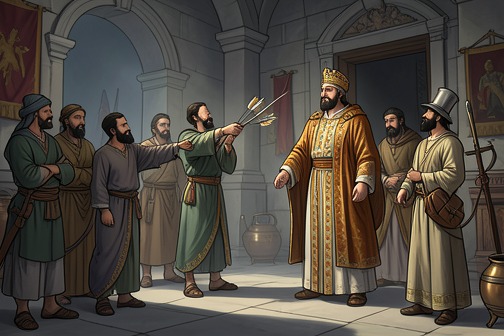
[The Defense of Vishvamitra’s Sacrifice](entity:event-recall-event-the-defense-of-vishvami-53c522fb5607) turns a ritual obligation into a test of protection: [Ráma](entity:character-recall-character-r-ma-2db51e45ae4a) and [Lakshmaṇ](entity:character-recall-character-lakshma-7aad0629b677) stand watch while [Viśvámitra](entity:character-recall-character-vi-v-mitra-92f43e905a92)’s sacred ceremony is threatened by demons. The assault breaks into the rite at its most vulnerable moment, but Ráma’s measured use of force clears the danger and allows the ceremony to reach its successful conclusion.
## The Watch and the Assault
The hermits set the watch to last until the fifth day had passed, while Viśvámitra began his Dikshá. The high rite proceeded again with its sacred texts, but a loud, fearful roar soon echoed through the sky. The sound marks the shift from ordered ritual to direct danger: the demons seek to disrupt the ceremony, and the princes’ task is to keep the rite from being broken.
## Force and Completion of the Rite
Ráma answers the attack with two distinct shots, and their different outcomes shape the defense. One arrow, empowered by a mystic spell, hurls an unnamed foe a hundred leagues away into the ocean rather than killing him. Ráma then takes another shaft, described as glowing with living flame, and strikes [Suváhu](entity:character-recall-character-suv-hu-aeba48455257) in the chest. The sequence moves from removal of an attacker to the killing blow against another: the immediate threat is broken by force directed at the intruders.
The result is decisive. The demons who disturbed the holy rites are overthrown, and the saints are no longer afraid. They give the princes due honour, comparing their recognition of the victory to the worship offered to [Indra](entity:character-recall-character-indra-9cdc4e2c85c7) after a glorious triumph. With every side at rest, the rite is at last crowned with success, and Viśvámitra looks around upon the security the defense has restored. The episode thus closes not with combat alone but with the ritual order made possible again: the attack fails, the hermits’ fear ends, and the ceremony reaches its intended completion.
## Ritual Order and Martial Force
The episode makes the purpose of combat the restoration of a rite rather than victory for its own sake. Its two arrows produce sharply different consequences: one drives an attacker into the ocean, while the other kills Suváhu. The distinction gives the defense a measured shape, removing one threat and stopping another, until the saints’ fear has ended and the ceremony can succeed. Martial power is therefore shown through what it makes possible: the return of safety around Viśvámitra’s sacred undertaking.
## The Ritual’s Vulnerable Interval
The watch is defined by ritual time: the hermits require it to continue until the fifth day has passed, while Viśvámitra’s Dikshá is underway. The threat arrives after the high rite and its sacred texts have begun anew, making the interruption a challenge not only to the participants’ safety but to the continuity of the ceremony. Its successful ending therefore confirms that the vigil has fulfilled its purpose: the rite can proceed through danger and reach completion.
Event 27
The Birth of Ganga
[The Birth of Ganga](entity:event-recall-event-the-birth-of-ganga-5d4b506f3c5f) is presented not as a detailed scene of childbirth but as a sacred genealogy that leads to a divine request. [Himálaya](entity:location-recall-location-him-laya-ba41e4e04d97) and [Mena](entity:character-recall-character-mena-7ebb9c08e2d9)’s elder daughter is sought by the [Devas](entity:character-recall-character-devas-f5bcab1c71d9), and her passage into their service is associated with the river’s power to purify sinners and with its threefold course. The episode makes [Ganga](entity:character-recall-character-ganga-1ee81508ea3e)’s divine family origin the beginning of a story about her wider cosmic role.
## Genealogy and Setting
The account is introduced as a sage’s narration of both Ganga’s birth and her growth. Its opening establishes her parentage: Himálaya, described as the lord of the mountains, is her father, and Mena is her mother. Ganga is born first; [Uma](entity:character-recall-character-uma-759ef0e955fd) follows as her younger sister. The poem therefore places two figures who become divine powers within one family, while distinguishing their roles in this particular episode: Ganga is the daughter the gods need.
This genealogy is stated compactly rather than dramatized through a labor or infant scene. The emphasis falls on who Ganga is and why her origin matters. She is not merely a river encountered in the landscape: she is Himálaya’s daughter, with a divine identity that makes an appeal to her family consequential.
## The Devas’ Appeal
The Devas come to Himálaya because they need Ganga’s help to bring their vows to fulfillment. Their approach is an appeal, not a contest: the episode turns on divine need and the mountain father’s response to those who seek his daughter’s aid. The text does not elaborate the vows themselves in this passage, so their importance remains defined by the gods’ stated need rather than by a narrated account of what the vows involve.
The request links family and cosmic obligation. Ganga’s parentage gives the appeal a personal setting, but its purpose reaches beyond the household: the gods’ ability to fulfill their vows depends upon her help. Her emergence into this role is thus represented as a transition from daughter of the mountain king to a power whose movement and purifying capacity serve a wider divine order.
## The River’s Course and Power
Ganga is described as roaming freely and reaching the sea, while purging sinners along her course. The account also identifies her as three-pathed. These details give the episode a scale beyond the family genealogy: Ganga’s movement connects divine realms and the mortal world, and her purifying action gives that movement religious consequence. The passage names the threefold course without specifying its separate routes, so its significance rests here on the river’s expansive, more-than-terrestrial reach.
Once the three-pathed Ganga has been obtained, the Devas regain their heavenly homes. The sequence makes her aid consequential: their return follows the securing of her presence. The episode does not describe the mechanics of that return, but it clearly places Ganga’s service between divine petition and restored access to heaven.
## Narrative Frame and Significance
As an embedded account told by [Viśvámitra](entity:character-recall-character-vi-v-mitra-92f43e905a92), the episode supplies sacred history within the larger narrative rather than unfolding as an independently staged action scene. Its movement is concise and purposeful: genealogy establishes Ganga’s identity, the Devas’ appeal explains why she is needed, and her river-course and purifying power show what her role entails. The shift from Himálaya’s household to the gods’ heavenly homes gives the story its central scale change.
The episode’s significance lies in presenting a river as both kin and cosmic resource. Ganga’s authority is grounded in her divine birth, but her importance is measured by what her movement makes possible for the Devas and by the purification she brings. The narrative joins family descent, sacred geography, and religious power without supplying a separate account of her physical birth or detailing the vows that occasion the gods’ request.
Event 28
The Death of Sagara’s Sons
[The Death of Sagara’s Sons](entity:event-recall-event-the-death-of-sagara-s-s-ecca11d82b01) is the fatal turning point in [Sagar](entity:character-recall-character-sagar-69e62b1b8a8b)’s search for the stolen sacrificial horse: a royal recovery mission becomes an assault on a divine figure, and the princes who dig across the earth meet their end when they attack [Kapila](entity:character-recall-character-kapila-49b2272d35c8). The episode is told within [Vishvamitra](entity:character-recall-character-vishvamitra-df735521f72c)’s larger narrative and turns on a terrible misrecognition: the sons see the supposed robber and the object of their search, but fail to understand who stands before them.
## The King’s Charge
Sagar receives a report from the priests in his crowded court and acts on it by summoning his sons. He orders them to pursue the horse’s robber, kill him, and bring the charger back. The command gives the princes a clear objective, but also sends them beyond the ordinary bounds of a search: they are to explore the whole broad earth, including places where the thief might hide beneath the ocean’s tide.
The mission thus begins under royal authority and with the sacrificial horse as its prize. The sons do not merely follow a trail across the surface. In obedience to their father, they force their way through the earth, digging beneath the soil with unflinching effort. The poem measures the scale of their labor in leagues, making their search a literal penetration of the ground rather than a conventional pursuit along roads or settlements.
## The Search Beneath the Earth
The princes’ digging becomes a disturbance felt beyond their own expedition. As Sagar’s children pierce the ground, a great tempestuous sound continues to rise; the gods, described as freed from fear, return to their bright homes while the digging goes on. The passage sets divine relief against the continuing violence of the search: what may seem to the princes a determined service to their father is also an upheaval large enough to affect the celestial order.
That upward-reaching sound gives the search a cumulative force. The sons keep driving through the earth rather than turning back, and their progress brings them at last to the figure they believe they have been pursuing. Their effort has brought them to the horse and to its apparent captor, but arrival does not produce recognition or restraint. It precipitates the fatal encounter.
## Kapila and the Fatal Misrecognition
The princes see Vásudeva standing there in the form of Kapila, near the everlasting God. The poem identifies the figure’s divine nature even as it presents the princes’ mistaken understanding: they perceive the supposed robber and the prize they seek, and rush at him as a furious band. Their accusation and attack follow directly from the king’s command to find and slay the horse-thief, but the command cannot protect them from the error of treating a god as an ordinary quarry.
Kapila answers their rush with a sharp rebuke: “Avaunt! avaunt!” His anger rises, and his power destroys the proud array. The account therefore makes the princes’ death the consequence of both their relentless pursuit and their failure to recognize the person before them. The decisive reversal is abrupt: the sons who had been digging through the earth to recover the horse become the victims of the encounter at the end of their search.
## Consequence and Narrative Significance
The episode closes the princes’ effort in destruction rather than recovery. Sagar’s sons have obeyed their father and traversed the earth, but their violence toward Kapila ends their mission. The horse and its supposed robber have brought them into the presence of divine power; the search’s physical progress does not yield the understanding needed to survive that encounter.
As an embedded episode, the account also links scale to consequence. The princes’ expedition expands from the king’s court to the whole earth, then descends beneath its surface, while the sound of their labor is registered in the heavens. Yet the final crisis is concentrated around a single act of mistaken identification: the princes see a thief where the narrative reveals Kapila, [Vishnu](entity:character-recall-character-vishnu-4fe080f11b04) in Kapila’s form. Their deaths give the pursuit its tragic endpoint and establish that obedience and force, however resolute, cannot substitute for discernment before the divine.
Event 29
Bhagiratha Brings Ganga to Earth
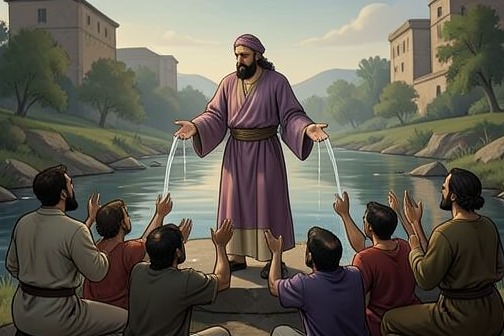
[Bhagiratha Brings Ganga to Earth](entity:event-recall-event-bhagiratha-brings-ganga-9c81591a103f) is the fulfillment of a long-delayed duty to the dead: the king secures [Ganga](entity:character-recall-character-ganga-1ee81508ea3e)’s descent, guides her toward the ocean, and pours a funeral libation over his kinsmen’s dust. The episode makes that passage possible only through a chain of effort and divine intervention. [Bhagiratha](entity:character-recall-character-bhagiratha-52c4008070aa)’s austerity wins the aid he needs; [Shiva](entity:character-recall-character-shiva-a32afbfe6397) contains the river’s overwhelming force; and Ganga’s waters finally transform an uncompleted rite into the release of [Sagara](entity:character-recall-character-sagara-419e97ec7220)’s sons.
## The king and the delayed obligation
The poem presents Bhagiratha as a royal sage, noting that he has no son to gladden his age. His defining task in this episode, however, reaches beyond his own household: the funeral rites of his kinsmen have long been delayed. Their remains lie as dust, awaiting the arrival of the river that can make the rites effective. The narrative therefore places the king between an ancestral past that has not been properly resolved and a future in which the dead may receive release.
Bhagiratha’s undertaking is not simply to bring a celebrated river into the world. The account connects the river’s descent to a specific responsibility toward the dead, and its conclusion returns directly to that responsibility: when the waters reach the kinsmen’s dust, Bhagiratha pours the funeral libation. The distance between the delayed rites and their completion gives the journey its purpose. The river’s immense scale matters, but the episode measures its achievement by the fate of the dead.
The account also locates Ganga in a divine geography. Her waves flow in [Svarga](entity:location-recall-location-svarga-cb82af3667bb), and she is described as the daughter of the Lord of Snow. Bringing her to earth requires more than a king’s desire or royal command. Bhagiratha must seek divine assistance, making his personal persistence the beginning of a work whose forces exceed human control.
## Austerity and the need for Shiva
Bhagiratha raises suppliant hands and asks that his long toil bear fruit. The appeal joins effort to grace: he has laboured, but the success he seeks depends on divine favour. He is then directed to win Shiva’s aid. The instruction identifies a further obstacle within the task itself. Ganga’s descent is possible, but her force must be met by a power able to receive it.
Bhagiratha undertakes a severe, sustained discipline. He stands still as a post, keeps an unsleeping gaze, takes the air for food, and has the open sky for a roof. The poem marks the duration precisely: a year passes before Shiva, lord of [Umá](entity:character-recall-character-um-7acf9e29f2b3), speaks to him. That interval gives the king’s petition its weight. The descent does not follow an instantaneous request; it follows a year of bodily endurance in which Bhagiratha remains fixed on the object of his undertaking.
The sequence balances two kinds of agency. Bhagiratha supplies constancy and direction, but Shiva’s participation is necessary to prevent Ganga’s arrival from becoming destructive. The king can pursue the river and the rite, yet he cannot safely control the descending torrent on his own. The episode’s successful action depends on cooperation across those unequal powers: human persistence brings the request forward, and divine strength makes its fulfillment possible.
## Ganga’s descent and Shiva’s restraint
When Ganga rushes down from her heavenly channel, she does so with tremendous force and furious wrath. Her descent is not presented as a gentle flow from one realm to another. She intends to overwhelm Shiva, whirl him in the flood, and carry him down into the deepest hell. The river’s arrival thus becomes a contest of power as well as the answer to Bhagiratha’s prayer.
Shiva holds Ganga on his head and keeps her wandering there, among dense expanses compared to the woods of the [Himálaya](entity:location-recall-location-him-laya-ba41e4e04d97). His intervention changes the character of the descent: the force that threatened to sweep him away is contained rather than allowed to fall unchecked. The episode does not make Bhagiratha’s success depend on diminishing Ganga’s power. Instead, Shiva’s capacity to receive and restrain that power creates a passage through which her waters can eventually be released.
Once Ganga is set free by the god, seven noble rivers come from her. Her waters also descend into Vindu’s lake. The account briefly opens the result beyond a single stream, then returns to the route that matters to Bhagiratha: he reaches the ocean, and Ganga hurries behind him. The king’s guidance gives the river’s vast, branching movement a destination tied to the unfinished rites.
## The rite completed and the dead released
At the ocean’s side, Bhagiratha seeks the depths that lie open before him. Ganga follows there, and the episode arrives at the purpose that has governed its stages. Over the dust of his kinsmen the king pours the funeral libation. The gesture is concrete and final: the long-deferred obligation is performed only after the river has crossed from its heavenly course to the place where the dead await it.
The result follows immediately. As soon as the flood has moistened their bed of dust, the spirits of Sagara’s sons attain beatitude and appear in heavenly bodies. The transformation from dust to liberated spirits completes the episode’s movement from delay to release. The river’s descent is therefore both a cosmic event and the means of fulfilling a family duty; the king’s success is confirmed not merely by Ganga’s arrival but by what her waters accomplish for the dead.
The narrative’s sequence gives each participant a distinct role: Bhagiratha perseveres and leads, Shiva restrains, Ganga descends and follows, and the king performs the libation. No single action suffices by itself. That ordered collaboration makes the conclusion more than a triumph of royal will. Bhagiratha’s achievement is measured by his ability to bring divine force to bear on an obligation that had remained unfinished, and by the release of his kinsmen once the rite is done.
Event 30
Jahnu Releases Ganga

[Jahnu Releases Ganga](entity:event-recall-event-jahnu-releases-ganga-d8bcbb6edbdc) is an episode in which a river’s passage interrupts a sacred rite, and a sage’s anger turns a flood into a brief act of containment. The intervention of gods, sages, and bards then brings about [Ganga](entity:character-recall-character-ganga-1ee81508ea3e)’s release. The episode explains why the river is also called Jahnavi: Jahnu not only releases her, but is asked to regard her as his own child.
## The Flood and the Interrupted Offering
Ganga is introduced in terms of her immense stature and cleansing power: she is the “best of floods,” the “rivers' queen,” and a stream whose waters wash the wicked clean. That description makes the disturbance at Jahnu’s sacrificial ground more than a passing inconvenience. A river associated with purification and sacred life now floods a place where offerings are being made.
Jahnu is engaged in holy offerings when Ganga spreads her waves around and floods the ground. The account gives the conflict a precise setting and cause: the waters intrude upon the site of a rite. It does not describe a prolonged contest or a negotiation before Jahnu acts. The movement from flood to response is immediate, and the force of the river is answered by the sage’s exceptional power.
## Jahnu’s Anger and the River’s Arrest
Jahnu marks Ganga’s conduct as prideful and acts in anger. At one draught, he dries up her stream. The striking scale of the gesture reverses the scene: the river that had spread beyond her banks and overwhelmed the sacrificial ground is suddenly contained within the sage. The narrative presents the act as a decisive interruption of Ganga’s onward flow, not as a gradual retreat of the flood.
The reversal also changes who must seek a remedy. Ganga’s waters had entered Jahnu’s ritual space; after Jahnu drinks them, the gods, sages, and bards become afraid and approach him in prayer. Their appeal recognizes his power to keep the river withheld and makes her return dependent on his response. In this compact sequence, the sacred disturbance is resolved not through another display of force, but through collective supplication.
## Petition, Release, and Kinship
The petitioners ask Jahnu to regard the holy stream as his own dear child. Their request offers a new relationship as the means of reconciliation: Ganga is no longer only the river that flooded his ground, but can be received as a daughter. Moved by their appeal, Jahnu soothes their fears and releases the waters from his ears.
The release answers the earlier act of swallowing with a distinct bodily image. Ganga’s disappearance into Jahnu had made his anger visible through the sudden drying of her stream; her emergence from his ears makes his consent visible in turn. The account does not describe the river as defeating or escaping him. It emphasizes that Jahnu is moved by the petition and lets her waters go, so the restoration of her flow follows a change from anger to accommodation.
## The Name Jahnavi and the Episode’s Place
The narrative makes the consequence explicit: Ganga is known throughout the world both as Jahnavi and as Jahnu’s child. The name preserves the episode’s central change in relationship. It recalls the sage who first arrested the river and then released her, while the description of her as his child gives that release a familial meaning. The explanation is not separate from the action; it is the lasting result by which the episode is remembered.
After the release, Ganga continues onward. The episode therefore interrupts, but does not end, her course. Its structure turns on a contained sequence: a flood disrupts a sacrifice, Jahnu drinks the river, the divine and poetic community petitions him, and he restores her waters. The result holds together two images of sacred power—the sage able to stop the river and the river whose flow resumes when he accepts her as kin. The name Jahnavi carries both actions forward in a single epithet.
Event 31
The Churning of the Ocean
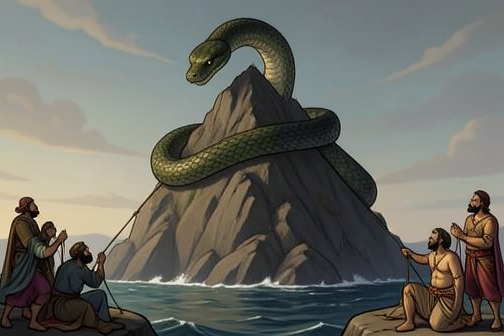
[The Churning of the Ocean](entity:event-recall-event-the-churning-of-the-oce-8deda20db8b0) is a creation myth in which the [Devas](entity:character-recall-character-devas-f5bcab1c71d9) and [Asuras](entity:character-recall-character-asuras-c4a554cce85f) undertake a vast, shared labor to obtain the life-giving [Amrit](entity:object-recall-object-amrit-884e694d61e8). Their work releases poison as well as marvels: the sea yields divine beings, a celebrated horse, a radiant jewel, [Soma](entity:character-recall-character-soma-eb1677ab6e1e), and [Lakshmi](entity:character-recall-character-lakshmi-4d9520b17871). When the sought-after drink appears, cooperation gives way to conflict. [Vishnu](entity:character-recall-character-vishnu-4fe080f11b04) uses illusion to remove it from the rivals’ sight, and the struggle ends with the Devas victorious. The episode makes the pursuit of immortality both a cosmic undertaking and the cause of a new contest for power.
## Purpose and undertaking
The account begins with the two groups gathered in a council. They plan to escape age and time and preserve their youthful prime by churning the [Milky Sea](entity:location-recall-location-1ae65458e34a) to release the life-bestowing drink. The enterprise is therefore presented as deliberate and collective: Devas and Asuras, despite their rivalry, initially share the same objective and join the work needed to achieve it.
To churn the sea, they seize the Serpent King and use [Mount Mandara](entity:location-recall-location-34f0cad63d5a) as the pole. The scale of the task is measured not in ordinary labor but in a thousand seasons of drawing the serpent back and forth. The mountain, serpent, and sea form a single working apparatus; the repeated effort is essential to the production of the coveted reward. Yet the means of obtaining life also bring danger. As the serpent’s heads bite against the rocks, they shed deadly venom, and a pestilential poison bursts forth from the sea. The account thus complicates the promise of the quest: the path to immortality first releases a force that threatens destruction.
## Poison and the sea’s yield
The poison becomes an immediate crisis within the larger undertaking. [Śiva](entity:character-recall-character-iva-3f46107bbd95) hears the speech of the bearer of the mighty bow and drinks the poisoned flood as though it were the heavenly Amrit. The contrast is stark: the drink sought as the source of life has not yet emerged, while a deadly substance has already appeared and must be taken up. The episode places this intervention within the churning’s course, presenting the labor as a source of both peril and extraordinary consequence.
The churning continues after the danger, and its yield arrives in stages. At the close of a thousand years, [Dhanvantari](entity:character-recall-character-dhanvantari-0f8b75889d29) rises calmly from the ocean, identified in the account’s explanatory note as the physician of the Devas. While the churning still goes on, sixty million [Apsarases](entity:character-recall-character-apsarases-2faecadb0f67) emerge from the foam and water. These arrivals extend the episode beyond its initial search for a single drink: the sea becomes the source of numerous beings and wonders, and the continuing work repeatedly alters what the participants can claim to have produced.
Among the later treasures are Uchchaihśravas, the generous horse associated with [Indra](entity:character-recall-character-indra-9cdc4e2c85c7); Kaustubha, described as the foremost of gems; and Soma, the Moon God. Lakshmi then rises on a lotus bed after many years have passed. Her appearance is singled out as a significant emergence from the foamy sea, and an explanatory note identifies her by the ancient name Kshírábdhi-tanayá, daughter of the Milky Sea. The account’s sequence gives the ocean a generative role: the Amrit is the declared objective, but it is not the only precious or divine thing drawn from the waters.
## Amrit and the change from cooperation to combat
Even after these appearances, the Devas, Asuras, and minstrel train continue churning the troubled main. At last the prize they had pursued, the Amrit, comes into view. Its arrival changes the character of the enterprise. The groups that had coordinated their effort now contend for the rich spoil, and their shared purpose gives way to a struggle over possession. The narrative links this reversal directly to the object of the original agreement: the drink meant to overcome mortality becomes the focus of conflict as soon as it is obtained.
When the combatants grow weary and ruin threatens them all, Vishnu intervenes with the aid of illusion and removes the Amrit from their sight. The text presents this as a decisive change in the contest: the drink is no longer simply a prize visibly available to both sides, and Vishnu’s deceptive action turns the balance. Vishnu then strikes his foes, and the account describes the sons of light, the race of [Aditi](entity:character-recall-character-aditi-74ada5fb0fb9), defeating the brood of [Diti](entity:character-recall-character-diti-5ad8405261fb). Indra gains prominence in the aftermath. The episode therefore closes not with a shared distribution of the reward but with the defeat of one side and the success of the other.
## Significance within the myth
The event is structured around a sharp contrast between cooperation and rivalry. The Devas and Asuras can combine their strength when the goal is immortality, but the appearance of the Amrit exposes the limits of that alliance. Their joint labor creates a common opportunity; it does not produce a common settlement. The decisive resource instead intensifies the division that the project temporarily bridged.
The sequence also balances abundance with danger. The churning produces a deadly poison, which Śiva drinks, as well as the Apsarases, Dhanvantari, the horse, the jewel, Soma, Lakshmi, and finally the Amrit. The order matters: the sea’s gifts are not presented as a simple or harmless reward, and the most coveted result arrives only after prolonged work and conflict. The myth’s conclusion places the gained drink alongside a military victory, making immortality inseparable, in this telling, from the struggle over who will possess it. Its outcome is not merely that the ocean has yielded wonders, but that the Devas emerge from the contest with advantage over the Asuras.
Event 32
Diti’s Penance and the Birth of the Maruts
[Diti’s Penance and the Birth of the Maruts](entity:event-recall-event-diti-s-penance-and-the-9e690d4eac54) turns a mother’s demand for vengeance into a settlement that changes the purpose of the child she hopes to bear. [Diti](entity:character-recall-character-diti-5ad8405261fb) asks [Kashyapa](entity:character-recall-character-kashyapa-00baeab7c1ab) for a son powerful enough to kill [Indra](entity:character-recall-character-indra-9cdc4e2c85c7); after a thousand-year period of penance, Indra divides the unborn child, and Diti accepts a future for the resulting spirits within the heavens and under Indra’s command. The episode resolves a divine conflict not through the victory Diti originally seeks, but through an agreement between mother and son.
## Causes and Stakes
The story begins with loss. Diti’s sons have been slain, and the text presents her response as a mother’s grief: she is overcome by pain at being childless. Her appeal to Kashyapa is therefore both a request for a child and a demand that the next generation redress the violence that has already occurred. She specifically wants a mighty son who will kill Indra, making the hoped-for birth the intended instrument of revenge.
Kashyapa answers that her prayer is heard and tells her to remain. The promise sets a long condition on the desired child: the account later measures the ordained period as a thousand years. Diti’s hope thus becomes bound to an extended act of endurance. The stated purpose remains vengeance against Indra, but the long interval gives the story room to alter the relationship among the people involved before the child’s fate is settled.
## Penance and the Final Ten Years
The episode marks the late stage of Diti’s ordeal with unusual precision: only ten years of the thousand remain. That number makes the moment a threshold. The promised period is nearly complete, but the text does not present its ending as the simple arrival of the avenging son Diti had requested. Instead, Indra is present in a scene of tenderness, comforting her with affection and easing her pain and weariness.
This care complicates the hostility built into Diti’s original prayer. Indra is the person her future son is meant to destroy, yet he is also shown close to her in the final stretch of the long period. The account does not explain this tenderness as a change of motive, nor does it erase the danger between them. Its effect is to place intimacy beside the threat of vengeance: the story’s resolution will emerge from that proximity rather than from a narrated battle between Diti and Indra.
The poem introduces the next stage under the canto title [Sumati](entity:character-recall-character-sumati-473758ceb1a1). Diti addresses Indra gently, and the child she had hoped would be born as a single avenger appears instead as a blighted bud that Indra has cleft into seven. The decisive action is therefore a division, not the fulfilment of her original request in its original form. The account gives no further description of the act; its consequence is made legible through the mother’s response and the agreement that follows.
## Division and Settlement
Diti does not answer Indra’s action with a renewed demand to kill him. She tells him that he is not at fault and asks that seven fair spirits rise from the damaged bud to rule the regions of the skies. The change is consequential: the child’s division becomes the basis for a new collective identity and a heavenly role, rather than simply the defeat of the enemy Diti had named.
The passage also assigns the four remaining spirits to roam through space in obedience to Indra. These terms place the new beings within an order that includes the very god Diti had hoped her son would destroy. The account’s wording preserves both the number seven and its reference to four remaining; its emphasis is on the settlement’s outcome, not on explaining the arithmetic between those statements. Indra, identified as the Thousand-eyed and as the slayer of [Bali](entity:character-recall-character-bali-4ed36663458c), joins his hands in supplication and replies to Diti’s proposal. His gesture frames the conclusion as an agreement rather than a unilateral decree.
The [Maruts](entity:character-recall-character-maruts-7d963d15b4de)’ origin is thus presented through a reversal of purpose. Diti’s grief first produces a wish for a weapon against Indra; the divided bud becomes spirits whose place is among the regions of the heavens, with some explicitly subject to his command. The episode does not say that Diti’s loss is undone. It shows instead how her request is redirected into a compact that both acknowledges her maternal claim and establishes a new relationship between her offspring and Indra.
## Meaning and Narrative Role
The ending returns to the place where the agreement is made: the hermits’ holy shade. There mother and son complete their compact and are content. The final emphasis is not on Indra’s power to divide the child, but on the terms reached after that act. Diti’s acceptance and Indra’s joined hands give the close a reciprocal quality, even though the settlement places the spirits under Indra’s authority.
The episode’s central contrast is between the intended and achieved outcome. Diti begins by asking for a son to kill Indra; the story concludes with spirits who roam through heaven in obedience to him. That reversal gives the birth its narrative force: the conflict does not disappear, but its form changes from anticipated vengeance into negotiated affiliation. The Maruts’ origin is inseparable from this transformation, and Diti’s role remains decisive at the end, when she proposes a future for the divided child instead of insisting on the destruction that first shaped her prayer.
Event 33
Ahalya’s Curse and Redemption

[Ahalya’s Curse and Redemption](entity:event-recall-event-ahalya-s-curse-and-rede-3f8581d09d0e) is the episode in which [Gautama](entity:character-recall-character-gautama-f6ae5b2188cd)’s punishment separates [Ahalya](entity:character-recall-character-ahalya-6ab3e0b7e9d2) from the world for countless years, and [Rama](entity:character-recall-character-rama-fdac9c17dd0c)’s arrival at the hermitage fulfills the condition that releases her. Its decisive movement is from a concealed encounter to an all-knowing sage’s judgment, then from prolonged isolation to reunion. The same event that exposes [Indra](entity:character-recall-character-indra-9cdc4e2c85c7)’s impersonation also makes Ahalya’s eventual restoration part of Rama’s path: Gautama’s decree explicitly names the future arrival that will end her seclusion.
## The encounter and its discovery
Gautama is engaged in ascetic practice with Ahalya at his side, and the narrative measures the duration of that life in thousands of years. The turning point comes on a day when the sage has gone away. Indra sees Ahalya’s beauty and assumes Gautama’s form, using the appearance of her husband to approach her. The disguise gives the episode its central uncertainty: outwardly, the visitor resembles Gautama, but Ahalya recognizes that he is Indra. The account therefore does not present the disguise as successful concealment from her. It states that she knows who stands before her and is nevertheless touched by illicit desire.
When Gautama returns, he understands what has happened and his anger breaks out against the offender. The discovery converts a private encounter into a judgment with consequences for both participants. The episode’s brief change in circumstance—from Gautama’s absence to his return—sets in motion a punishment that will last far longer than the encounter itself. Indra’s assumed identity is also central to the wrong: Gautama condemns him for taking the sage’s form, so the deception is not incidental to the curse but part of what makes the transgression punishable.
## The curses and their different consequences
Gautama’s anger falls on Indra first. The punishment strips away Indra’s might and godlike vigor, leaving his body deprived of its former strength. The account presents this as an immediate reversal of divine power: the god who had entered the hermitage under another person’s appearance is himself made physically diminished by the sage’s curse. His consequence is bodily and direct, attached to the exposure of his assumed form.
Gautama then turns to Ahalya and condemns her as a disloyal spouse. Her sentence is defined not only by its duration but by its social and perceptual isolation. For countless years, a lonely grove will be her home, and no eye will see her form. The curse removes her from the ordinary company of gods and mortals; the narration later describes her as hidden from both. Unlike Indra’s immediate loss of vigor, Ahalya’s punishment unfolds as an extended absence from the visible world. Its terms also contain a future condition: when Rama, identified as the child of [Dasharatha](entity:character-recall-character-dasharatha-b9552a8b18f7), comes to those desolate shades, his arrival will remove her stain. The sentence thus joins punishment to a promised possibility of release.
## Rama’s arrival and Gautama’s return
The condition is fulfilled when Rama reaches the hermitage. The account marks the change with the end of Ahalya’s long removal from the sight of gods and mortals: Gautama’s decree has reached its appointed moment, and Rama comes to set her free. The sons of Raghu greet her with reverence, and Ahalya remembers Gautama’s word. Her release is presented as the realization of the curse’s own terms, not as an unrelated interruption of it. What had confined her to the lonely grove had also specified the arrival through which her condition would change.
Gautama, whose perception extends beyond the immediate scene, knows that Rama is lodged beneath the shade and hastens to pay him homage. He then takes Ahalya to his side, and the narration describes her as purified from sin and folly. The ending is therefore not limited to her reappearance: it restores the marital relationship, with Gautama receiving her back as his consort. The movement from condemnation to reconciliation is explicit, but it follows a long interval in which the promised release remained unfulfilled.
## Narrative significance
The episode is organized around contrasts of appearance and knowledge, sudden judgment and immense duration, and divine status and vulnerability. Indra can imitate Gautama’s form, but the disguise does not fool Ahalya; Gautama, in turn, knows the truth and imposes consequences that extend beyond the moment of discovery. The different sentences distinguish the offenders’ outcomes: Indra suffers the loss of vigor, while Ahalya endures years of invisibility and separation before the foretold release.
Rama’s role is crucial but carefully bounded by the stated condition. His arrival answers Gautama’s decree, ends Ahalya’s exclusion, and leads into her reconciliation with her husband. Gautama’s homage to Rama follows that restoration, placing the episode’s personal resolution alongside a gesture of reverence toward the arriving prince. The scene consequently links an old transgression and its punishment to a future event already specified within the curse. Ahalya’s return is not simply the end of an isolated ordeal: it completes the sequence Gautama set in motion, from discovery and sentence to release and reunion.
Event 34
Vishvamitra’s Conflict with Vasishtha
[Vishvamitra’s Conflict with Vasishtha](entity:event-recall-event-vishvamitra-s-conflict-0edbe749dc31) turns a dispute over [Dapple-skin](entity:character-recall-character-dapple-skin-ab14958df7ab), a cow of extraordinary plenty, into a contest between royal force and a sage’s power. [Viśvámitra](entity:character-recall-character-vi-v-mitra-92f43e905a92) first tries to obtain the cow by purchase; when [Vaśishṭha](entity:character-recall-character-va-ish-ha-033580f29400) refuses to surrender her, the king resorts to force. The conflict reverses the apparent balance of power: the monarch’s army is routed, and his hundred sons are burned to ashes by the sage’s cry and glance.
## The Cow and the Bargain
The episode presents Dapple-skin not as ordinary property but as the source of abundance attached to Vaśishṭha’s hermitage. When the sage calls, the cow responds obediently. Viśvámitra then offers a hundred thousand kine in exchange for her, a price that acknowledges her value while treating her as something a king might acquire through wealth. His appeal is direct: Vaśishṭha should give him the cow he regards as his own.
Vaśishṭha refuses. His reason is bound to the cow’s continuing service: she provides what he asks for each day, and he will not give away the one who sustains him. The refusal makes the disagreement more than a negotiation over a valuable possession. Viśvámitra’s offer assumes that a sufficiently grand payment can settle the matter; Vaśishṭha’s answer asserts that the cow’s place in his life and hermitage cannot be reduced to a sale price. The exchange establishes the terms of the ensuing conflict: royal wealth and authority confront a relationship the king cannot simply purchase.
## From Refusal to Battle
The narrative marks the transition with the title “The Battle.” Vaśishṭha has refused to part with Dapple-skin, and Viśvámitra turns to force as a last resource. The confrontation therefore follows a clear escalation: the monarch first makes an offer, receives a refusal, and then tries to secure by arms what he could not obtain through exchange.
Dapple-skin does not remain a passive object of the dispute. She flees at extraordinary speed and returns to Vaśishṭha, her rightful master. The account gives her movement the force of a decision: when the king’s power threatens to carry her away, she goes back to the sage. Her return shifts the action from a contest between a monarch and a hermit into a defense of their bond, with Vaśishṭha responding to her arrival by calling for a force able to meet the enemy.
At his command, the cow gives rise to a mighty host. The episode describes the opposing troops being overwhelmed; it names Kambojas, Barbars, and Yavans among those driven to flee and fall. The king’s military power, which seemed sufficient to enforce his claim, proves unable to overcome the force produced by the cow. The reversal is not achieved through a larger royal army or a counteroffer: the source of Vaśishṭha’s protection is the very being Viśvámitra tried to take from him.
## The Sage and the King’s Sons
The defeat does not end the violence. Viśvámitra’s hundred sons witness the rout, arm themselves, and rush upon Vaśishṭha in rage. Their attack makes the confrontation more personal and carries it beyond the king’s attempt to seize Dapple-skin: the sons turn their anger on the sage himself.
Vaśishṭha answers with almost startling economy. He raises one cry and casts one glance; the sons fall, scorched on the spot and reduced to ashes. The contrast in scale is decisive. The king’s forces have required a battle, while Vaśishṭha’s single act ends the sons’ assault immediately. The account does not describe a prolonged exchange between the sage and his attackers. Instead, the speed and finality of their destruction establish how completely the royal household has misjudged the power it challenged.
The episode thus records two linked defeats: first, the rout of Viśvámitra’s host by the force called forth through Dapple-skin, and then the destruction of the king’s sons by Vaśishṭha. The cow’s return and the sons’ attack are distinct turns in the same conflict. One restores her to the sage; the other shows that even after the army has been defeated, aggression against him brings a still more immediate consequence.
## Narrative Significance
Dapple-skin’s abundance gives the conflict its material starting point, but the episode makes possession inseparable from power. Viśvámitra tries to translate royal authority into ownership, first through an enormous purchase offer and then through force. Neither approach succeeds. Vaśishṭha’s refusal holds, the cow returns to him, and the military response she produces overturns the king’s advantage.
The narrative also distinguishes different forms of power without reducing the conflict to a contest of armies. Viśvámitra commands troops and has sons able to rush armed into battle; Vaśishṭha’s strength appears through the cow’s capacity to summon a host and through the sage’s own devastating cry and glance. The outcomes expose the limits of the king’s coercion at each stage. In the first, his forces are routed; in the second, the royal sons who attack the sage are killed.
The ending is uncompromising rather than conciliatory. Vaśishṭha keeps Dapple-skin, and Viśvámitra’s sons do not survive the attack. The episode’s sequence—refusal, attempted seizure, reversal, renewed assault, and sudden destruction—makes the original dispute consequential well beyond the offer of a price. What begins as a king’s demand for a cow becomes a demonstration that royal rank and armed strength cannot guarantee possession or protect those who attack the sage.
Event 35
Vishvamitra’s Quest for Brahminhood
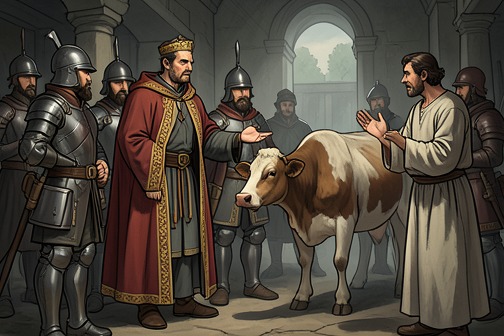
[Vishvamitra’s Quest for Brahminhood](entity:event-recall-event-vishvamitra-s-quest-for-337afc2b37d9) marks a decisive change in [Viśvámitra](entity:character-recall-character-vi-v-mitra-92f43e905a92)’s life: the king who had been shaped by royal and warrior power gives up his empire and undertakes severe penance to attain the standing of a Brahmin sage. His achievement is not secured by ascetic effort alone. The gods recognize the force of his austerities, but the final confirmation comes when [Vaśishṭha](entity:character-recall-character-va-ish-ha-033580f29400) accepts his new status, turning a personal quest into a publicly acknowledged transformation.
## Renunciation and the Beginning of the Quest
The narrative presents Viśvámitra’s departure from kingship as the result of a profound reversal. Reft of his sons and host, and no longer fired by ambition or the pride of war, he transfers his empire to his son. He then seeks a hermitage, traveling toward the [Himalayas](entity:location-recall-location-himalayas-0617e3ba26f1) to earn the grace of [Śiva](entity:character-recall-character-iva-3f46107bbd95). The sequence makes the change concrete: Viśvámitra does not merely adopt a new discipline while retaining royal authority; he relinquishes his kingdom and turns away from the military identity that had defined his power.
That renunciation gives the quest its central tension. Viśvámitra begins as a king, but the goal he sets himself is a spiritual rank associated with a different kind of authority. The narrative frames his departure from political life as the opening of a longer effort, not as an instant conversion. His transfer of the empire establishes what he has left behind, while his movement toward the hermitage signals the demanding practice through which he hopes to change what he is.
## Conflict and Recognition of Limits
The account also places Viśvámitra in continued confrontation with Vaśishṭha. At one perilous moment, Vaśishṭha calls urgently to those around him not to flee and declares that Gādhi’s son will die that day. The excerpt gives the crisis through Vaśishṭha’s alarm and prediction, underscoring that Viśvámitra’s pursuit unfolds amid an active struggle rather than in undisturbed retreat.
Afterward, the king is described as overwhelmed and ashamed. He recognizes the inadequacy of warriors’ strength and resolves to begin an austere discipline with controlled senses and a tranquil heart, aiming to win Brahminhood. This recognition provides the quest with its inward turning point: defeat is not simply a loss to be avenged by greater force. It changes Viśvámitra’s understanding of what kind of power can meet the challenge before him. The resolve to master himself and pursue another form of authority follows directly from that reassessment.
## Penance and Divine Acknowledgment
Viśvámitra remains intent on penance as many seasons pass. The narrative stresses duration rather than a quick reward: he perseveres through a thousand years of severe austerity, and [Vishnu](entity:character-recall-character-vishnu-4fe080f11b04) and the gods regard the labor with awe. Their attention establishes that the discipline has become more than a private undertaking. His sustained effort is visible to the divine assembly and prompts deliberation about the status he should receive.
The gods counsel that Kuśik’s son be recognized as a mighty sage. Their judgment is an important stage in the quest, but it does not end the matter. They approach Vaśishṭha and seek his participation in confirming Viśvámitra’s standing. The arrangement gives the recognition a double force: divine authority supports the claim, while the sage with whom Viśvámitra has been in conflict is asked to affirm it. The story thus distinguishes the accumulation of ascetic power from its acceptance as a settled spiritual status.
Vaśishṭha ultimately addresses Viśvámitra as a Brahmin sage and declares his title secure. With that acknowledgment, the long effort reaches its stated goal. The conclusion is not presented merely as the gods granting a reward from above; it includes the recognition of Vaśishṭha, whose approval resolves the opposition that has shadowed the change in Viśvámitra’s identity.
## Meaning of the Transformation
The quest is structured as a movement from outward authority toward disciplined spiritual power. Viśvámitra first relinquishes a kingdom and the ambitions associated with war; later, after a crisis exposes the limits of warrior strength, he commits himself to restraint and prolonged penance. The scale of a thousand years makes the cost of that change explicit, while the gods’ attention and Vaśishṭha’s final acknowledgment mark its successive stages.
The ending also preserves the importance of relationship and recognition. Viśvámitra’s transformation is his own labor, but the narrative does not treat his self-declaration as sufficient. The gods debate his standing, and Vaśishṭha’s assent makes the title secure. The quest therefore ends not with the restoration of his former political power, but with a new identity confirmed by those whose judgment matters within the story’s spiritual order.
Event 36
Trishanku’s Ascension
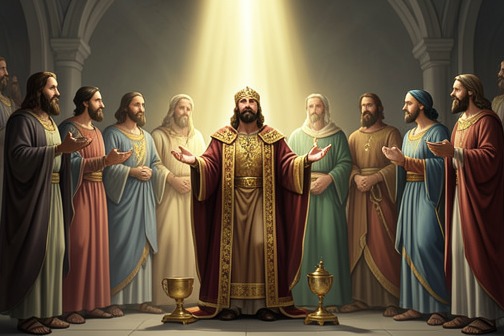
[Trishanku’s Ascension](entity:event-recall-event-trishanku-s-ascension-ca049e18bec9) turns a king’s wish to reach heaven alive into a contest over who can command the boundary between earth and the divine realm. The gods refuse the sacrifice intended to carry him upward, but [Viśvámitra](entity:character-recall-character-vi-v-mitra-92f43e905a92)’s power first sends him into the sky and then halts his fall when heaven rejects him. The final settlement is neither ordinary admission nor simple expulsion: [Trishanku](entity:character-recall-character-trishanku-3b5ef47117f1) remains among the stars, head downward, in a heaven made for him.
## A king’s purpose and the failed sacrifice
The episode introduces its protagonist as a monarch of the [Ikshváku](entity:character-recall-character-ikshv-ku-075374a4475b) line, remembered in connection with the name Triśanku. He is described as a ruler who keeps his senses under control, yet within him rises an intense desire: to make great offerings to the gods and attain heaven while still alive. The combination matters. His aim is not simply to perform a royal rite or to secure a destination after death; bodily ascent is part of the request itself.
The sacrifice becomes the first test of that ambition. Its prayer is that all the gods will come and share in the offering, but the Immortals refuse to heed it. The ritual therefore fails at the point where divine participation is needed. The refusal does not end the king’s effort; instead, it transfers the story’s focus from the offering and its intended recipients to Viśvámitra, whose intervention makes the ascent possible by another means.
Viśvámitra tells Trishanku to rely on the virtue of the rite and promises that he will reach the sky in his own body. The king rises immediately after the assurance. This sequence gives the ascent a clear causal shape: the gods’ refusal blocks the sacrifice, Viśvámitra asserts an alternative source of efficacy, and Trishanku’s body begins the journey the rite was meant to accomplish. The promised result is not deferred to death or left as a spiritual hope; the narrative makes it visible as a rapid upward movement.
## Heaven refuses the newcomer
Trishanku’s rise does not secure his welcome. The gods, accompanied by the army of the blessed, order the unbidden guest to flee and declare that no home has been prepared for him. Their response establishes a limit that Viśvámitra’s promise has not erased: reaching the sky and being accepted into heaven are separate matters. Trishanku has crossed upward, but the celestial assembly denies that his arrival gives him a place there.
The rejection turns ascent into descent. As Trishanku falls, he cries out for the hermit to save him. That cry makes Viśvámitra’s role more than that of the ascetic who first enabled the journey. He is now the figure on whom the king depends to prevent the gods’ decision from becoming final. The movement of the scene reverses sharply: the king who had risen swiftly toward heaven is thrown back toward earth, and the outcome hangs on whether Viśvámitra will answer.
Viśvámitra hears him and marks his fall. The narrative places this recognition at the hinge of the episode: Trishanku is not allowed to land, but neither is he permitted to complete the ascent into the gods’ established heaven. Viśvámitra’s power suspends the downward movement and makes room for an alternative outcome. The resolution thus preserves both sides of the conflict—the gods have refused the king, while the hermit refuses to let that refusal return him to the ground.
## A second heaven among the stars
Viśvámitra’s answer is creative as well as defensive. Through ascetic power and sacred knowledge, he fixes seven other seers high in the southern sky as stars. The detail expands the scale of the intervention: rather than merely stopping Trishanku’s body, Viśvámitra begins to establish a celestial arrangement of his own. The southern sky becomes the setting for a new order shaped by his authority.
The gods eventually answer Viśvámitra’s request with consent. They allow his countless stars to remain in heaven, and Trishanku is to shine among them as a divine figure, hanging head downward. The final image is deliberately unlike the upward course that began the episode. Trishanku does reach a lasting heavenly place, but not by joining the gods in their own prepared home and not in a normal orientation. His suspended, inverted position records the refusal that preceded it even as it prevents that refusal from becoming a complete defeat.
The settlement gives the episode a double ending. Trishanku’s original desire is fulfilled in the specific sense that he remains in the sky while alive, yet the manner of fulfillment bears the mark of the conflict: he is set apart, suspended among stars made through Viśvámitra’s power, and displayed head downward. The gods’ agreement does not undo their rejection; instead, it makes room for a distinct celestial arrangement. Viśvámitra’s intervention likewise does not simply overpower heaven. Its conclusion is a negotiated place in which his creation can endure and Trishanku can remain.
## Narrative and thematic significance
As a tale told by Viśvámitra, the episode places his ascetic power at the center of an escalating sequence of cause and consequence. His assurance launches the king upward; the gods’ refusal precipitates the fall; Trishanku’s appeal calls forth a rescue; and Viśvámitra’s power creates the stars and secures divine consent. The narrative therefore presents ascension not as a solitary miracle but as a chain of promises, refusals, and interventions, each of which changes what the next action must accomplish.
The story also distinguishes ritual authority from the power that can act when ritual does not achieve its purpose. The great offering is directed toward the gods, but their refusal prevents it from delivering the requested result. Viśvámitra’s ascetic might then becomes the force that carries Trishanku upward and keeps him from falling. The episode does not explain this power through a detailed system of rules; instead, it shows its reach through successive outcomes—first bodily ascent, then the arrest of descent, and finally a new stellar arrangement.
That progression gives the ending its lasting tension. Heaven is at once a destination the king can approach, a community that can reject him, and a space whose order can be altered by Viśvámitra. Trishanku’s inverted place among the stars embodies the compromise: exclusion becomes a separate form of permanence. Rather than erase the clash between the king’s ambition and the gods’ refusal, the ending fixes that clash in the sky as the defining condition of his place there.
Event 37
The Rescue of Shunahshepa
[The Rescue of Shunahshepa](entity:event-recall-event-the-rescue-of-shunahshe-8dc82a344532), also known as [Ambarisha](entity:character-recall-character-ambarisha-9621cddc71fd)’s Sacrifice, is a story of a royal rite brought to the brink of human sacrifice and halted through a boy’s prayer. When [Indra](entity:character-recall-character-indra-9cdc4e2c85c7) steals King Ambarisha’s sacrificial horse, the officiating priest presents a terrible alternative: recover the horse or provide a human victim. Shunahshepa, the middle son of [Richika](entity:character-recall-character-richika-bce16239e359), volunteers to be that victim, then seeks help from Viśvāmitra. Bound at the sacrificial post, he praises the gods; his worship brings divine aid and saves him. The episode makes the ritual’s demand for an acceptable offering collide with the life of a frightened child, and gives prayer a decisive force within that ritual order.
## The Sacrifice in Crisis
King Ambarisha has begun a sacrificial rite when Indra forcibly takes the charger intended for it. The loss is not a minor interruption: the priest treats the missing horse as a defect in the rite that must be repaired. His stark prescription is that the horse must be found, or a man must bleed in its place. The story thus moves from the theft of a royal animal to the threat of a human life, as the requirements of the sacrifice press upon the king and those around him.
The account also frames the crisis as a failure of royal protection. The warning that kings destroy themselves through heedless faults, and through failing to guard what they possess, links the missing charger to Ambarisha’s responsibility for the rite under his care. The immediate remedy, however, does not come through recovering the horse in the surviving episode. Instead, the search for a human substitute brings the king’s priest to Richika, whom he meets beneath the sacred trees on [Bhrigu](entity:character-recall-character-bhrigu-6b4d901155c3)’s holy height.
## A Son Offers Himself
Richika’s family is asked to surrender one of its sons. The parents resist giving up either the eldest or the youngest: the father refuses to part with his firstborn, while the mother will not abandon her youngest. Their disagreement leaves the middle son between them. Shunahshepa, without being urged, offers himself. The choice is his own in the immediate scene, but it takes place inside a family crisis in which his parents have already made clear that they will protect the other two children.
Shunahshepa then flees to Viśvāmitra, weeping as he reaches the sage and pleading for shelter. He presents himself as having no father, mother, or kin to comfort him—not as a literal account of his birth, but as the cry of a child who feels abandoned by the family’s decision. The contrast between Richika’s contested sons and the boy’s appeal to the hermit makes the rescue personal before it becomes ritual: Shunahshepa is not merely an offered victim, but a frightened child seeking someone who will respond to his fear.
Viśvāmitra hears the plea, soothes Shunahshepa’s grief, and dries his tears. He does not remove the boy from the impending rite in the scene that follows. Instead, he gives him a means to act within it, instructing him in the prayers to use when bound at the post. The intervention shifts the boy from helpless supplicant to participant in the ceremony, while placing the possibility of rescue in the words he is taught to recite.
## At the Sacrificial Post
The assembly declares Shunahshepa free of blemish for the ritual, dresses him in red, and binds him beside the sacrificial pillar. These details establish that the threat has become immediate: he has been accepted as the substitute victim, formally prepared, and tied in place. The rite has not been resolved by a change of plan or by an escape from the assembly. Shunahshepa faces the danger at the appointed post, with Viśvāmitra’s instruction as his resource.
Bound there, he raises a hymn to [Fire](entity:character-recall-character-fire-b3a40eeb15fa) and praises Indra and Upendra. The appeal is therefore not a refusal of the ritual in words; it is a prayer uttered from within its prescribed setting, at the point where its victim is about to be offered. The account describes [Vishnu](entity:character-recall-character-vishnu-4fe080f11b04) hearing the mystic praise and being moved to save. Shunahshepa’s worship changes the course of the scene: the human victim does not die, and divine attention interrupts the sacrificial outcome that the assembly had prepared.
## Meaning and Narrative Shape
The episode joins two kinds of obligation without treating them as interchangeable. The priest’s demand arises from the threatened integrity of the sacrifice; the boy’s appeal arises from the danger of being made its substitute. Viśvāmitra’s response neither denies the crisis nor leaves Shunahshepa alone to face it. He comforts him and gives him the prayers with which he can call upon divine aid. The rescue consequently turns not on force, but on a relationship of instruction and protection that equips the endangered child to speak within the ritual.
The sequence also gives distinct weight to Shunahshepa’s agency. He is chosen from among the sons by a family decision, yet the account marks his offer as unprompted. Later, once bound, he performs the prayer himself. His initiative does not erase the vulnerability that brought him to Viśvāmitra, but it makes him more than a passive object of sacrifice. In the episode’s movement from stolen horse, to family dispute, to the boy at the post, the threatened offering becomes a scene of appeal—and the appeal, heard by the divine, becomes a rescue.
Event 38
Vishvamitra and Menaka

[Viśvámitra](entity:character-recall-character-vi-v-mitra-92f43e905a92) and Menaká is an episode of temptation, suspended ascetic discipline, and belated recognition. After Viśvámitra has turned his mind toward sterner penance, Menaká comes from Paradise to bathe at [Pushkara](entity:location-recall-location-pushkara-dbd15a734c0b). He sees her, falls under the power of desire, and asks her to remain with him. Their life together lasts ten years, during which his fervent rites are stayed. When he wakes to shame and understands how much time has passed, he sends Menaká away without harshness and goes north to renew his resolve.
## The Ascetic’s Retreat and Menaká’s Arrival
The episode begins with Viśvámitra’s attention directed away from ordinary life. He has become more intent on penance, and the passing of seasons establishes that his austerity is a sustained undertaking rather than a momentary impulse. Into this secluded interval comes Menaká, described as a beautiful celestial nymph who descends from Paradise to bathe in Pushkara’s waters. The narrative gives her entrance a setting of withdrawal and natural beauty, but it does not state here that she has been sent on a mission or explain an external plan behind her arrival.
Viśvámitra sees her in that retreat and is overcome by desire. The change is immediate: the sage whose mind had been bent toward sterner discipline now appeals to Menaká for favor because love has stirred in him. His request turns the encounter into a shared domestic interval. Menaká stays with him, and the secluded grove becomes the setting for a relationship that will occupy ten years of the sage’s life.
## Ten Years in the Golden Chain
The poem renders the lapse of time through an image of enchantment and confinement: Menaká’s charms bind Viśvámitra in a golden chain, while five years pass and then five more. The image makes the duration legible as both pleasure and restraint. The bond is golden, not a scene of physical imprisonment, but it holds the ascetic away from the work to which he had recommitted himself. What begins in desire becomes a decade-long suspension of his fervent rites.
The account places the cost not in an outside judgment but in Viśvámitra’s own later recognition. He wakes to shame, and memory returns with anguish. He reckons the lost time precisely: ten years have gone by, day and night, unheeded in what he now regards as delusion. His rites have been stayed for that whole period. The contrast is sharp between the extended, seemingly uncounted years of pleasure and the instant in which their duration becomes newly visible to him. The episode treats ascetic discipline as vulnerable not only to a single act of desire but to time slipping away while the practitioner is absorbed in another life.
## Recognition, Dismissal, and Withdrawal
Once Viśvámitra understands what has happened, shame and anger accompany his recognition. Menaká stands near him with suppliant hands and a trembling eye. The scene thus gives the separation a visible emotional imbalance: his resolve has returned, while her posture is one of appeal. He does not answer her with a curse or violence. Instead, he speaks gently and tells her to go. That restraint distinguishes the ending from a simple outburst of ascetic rage, even as the decision ends their shared life.
After dismissing Menaká, Viśvámitra seeks the snowy northern hills of the [Himálaya](entity:location-recall-location-him-laya-ba41e4e04d97). His movement away from the grove marks a practical return to the path of penance: he leaves the place associated with the decade-long interruption and turns toward renewed austerity. The passage closes with firm resolve, making departure the hinge between his lapse and his renewed effort. It does not describe the eventual completion of that effort here; its emphasis is the decision to resume it after recognizing the cost of the years just passed.
## Narrative Significance
The episode turns on a reversal in Viśvámitra’s sense of time. For ten years, the duration of his attachment has escaped his attention; once memory returns, the same interval becomes an undeniable measure of interrupted religious work. The golden-chain image holds the two sides of the episode together: attraction can be sweet and binding, and what feels like an absorbing present can also estrange the sage from his chosen discipline.
The separation is consequently neither a triumph over Menaká nor a denial that Viśvámitra desired her. The narrative acknowledges his appeal, their decade together, his shame, and the cost to his rites before showing him choose renewed penance. Its ending is a departure rather than a completed spiritual victory: Viśvámitra leaves for the Himálaya with his purpose restored, while the interruption remains part of the story of that purpose.
Event 39
Vishvamitra and Rambha
[Vishvamitra and Rambha](entity:event-recall-event-vishvamitra-and-rambha-3cc4cf035b06) is an episode in which [Indra](entity:character-recall-character-indra-9cdc4e2c85c7) tries to break [Vishvamitra](entity:character-recall-character-vishvamitra-df735521f72c)’s ascetic discipline through seduction rather than force. [Rambha](entity:character-recall-character-rambha-5b856e756a81) is made the instrument of the scheme, and the sage’s recognition of it does not amount to an untroubled victory: in anger, he curses her, then grieves that his own response has undone the merit of his restraint. The encounter turns an apparent test of the ascetic’s resolve into a double defeat, punishing Rambha while exposing the cost of Vishvamitra’s anger.
## The plan against Vishvamitra
The episode begins with Indra devising a way to spoil the fruits of Vishvamitra’s austerities. He summons Rambha and presents her task as a great undertaking for the safety of the gods: she is to bind the son of Kuśik with love’s lure. The language frames seduction as a strategic intervention. Indra is not challenging the sage openly; he seeks to redirect his attention and thereby undo the spiritual gains his disciplined practice has earned.
Rambha replies fearfully to Indra’s command. Her response makes clear that the assignment is not a willing romantic pursuit but an order she dreads carrying out. Indra nevertheless directs her to draw Vishvamitra away from his rites, and she obeys. The episode thus gives the plan two levels of pressure: Indra’s purpose is to interfere with the sage’s austerities, while Rambha herself approaches the task under fear of the one who commands her.
## The encounter and recognition
Rambha appears adorned in her loveliest charms, using winning ways and a smile to attract the sage. At first, Vishvamitra experiences rapture as he looks at her. The scene allows the temptation to register as a real disturbance before it becomes a recognized plot; his achievement is not that he feels nothing, but that he identifies what is being attempted. The bird’s prolonged song and Rambha’s inviting appearance are the circumstances immediately preceding his recognition that Indra has plotted against his peace.
That recognition changes the meaning of the encounter. Rambha’s beauty is no longer simply an invitation: it is evidence, to Vishvamitra, of Indra’s design to divert him from his spiritual effort. The sage responds not by yielding to the seduction, but by pronouncing a curse. He condemns Rambha to remain transformed into stone for ten thousand years, while also declaring that a powerful Brahmin will eventually release her from that altered state. The curse therefore fixes both a severe punishment and a limit to it: Rambha’s condition is prolonged, but not eternal.
## The cost of anger
Vishvamitra’s curse does not leave him triumphant. After speaking it, his breast burns with grief, and he mourns the loss of the long effort he had made to restrain himself. The reversal is central to the episode: he sees through Indra’s stratagem, yet the anger provoked by that discovery defeats the very discipline he was trying to protect. The narrative distinguishes recognition from mastery. Knowing that a provocation is a trap does not prevent the sage from being caught by his own response to it.
The account makes the consequence explicit: his fall beneath passion’s sway has taken away the reward of his austerity. [Kandarpa](entity:character-recall-character-kandarpa-6086316ecb2e) hears the sage’s words and quickly flees from his presence, a brief movement that closes the immediate scene without undoing its damage. Rambha is left under the curse, while Vishvamitra is left grieving that his accumulated effort has been lost. The episode’s outcome is therefore not simply the punishment of a tempting nymph, but a setback for the ascetic whose anger converts discernment into renewed failure.
## Narrative significance
The episode makes austerity vulnerable from two directions. Indra’s intervention targets Vishvamitra’s desire, but the sage’s anger supplies a second route to the same result: even after he recognizes the danger, his reaction costs him the merit his restraint was meant to secure. Rambha’s transformation gives that conflict a visible consequence, while the promised release keeps the curse from being presented as endless. The contrast between the long period named in the curse and the brief moment of anger sharpens the episode’s emphasis on control: years of effort can be undone in a single response.
The scene also complicates a simple victory narrative. Vishvamitra resists the lure in the sense that he recognizes and rejects Indra’s plan, but the narration records the price of his rejection rather than celebrating it as complete success. His grief shows that he understands what his anger has cost. The encounter consequently advances the larger contest over his austerities while preserving its unresolved tension: the plot can be recognized, and its immediate seduction refused, without the sage yet achieving freedom from the passions that threaten his purpose.
Event 40
Sita’s Discovery
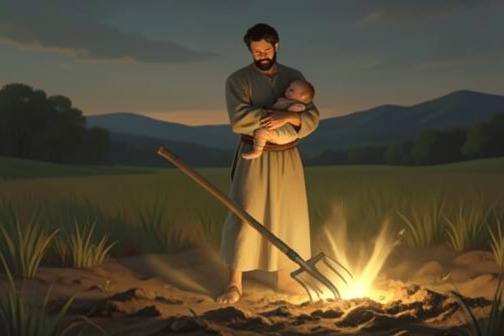
[Sítá](entity:character-recall-character-s-t-0be56374418b)’s Discovery establishes her extraordinary origin and the bond that follows: [Janak](entity:character-recall-character-janak-b1843f7c4081) finds her as an infant emerging from the earth, raises her as his beloved daughter, and makes her future a matter of heroic worth. The poem presents the event through Janak’s retrospective account rather than as a scene witnessed directly by the reader.
## Discovery in the Furrow
Janak recalls that he was ploughing the ground when an infant appeared beneath the ploughshare. The suddenness of the discovery, set amid an ordinary act of cultivation, gives the moment its force: the child is not introduced through a known mortal parentage but as one who springs from the earth. Janak says that he named her Sítá because of this secret birth.
## Janak’s Daughter and His Vow
The foundling grows in strength and grace, and Janak describes her as his cherished daughter. His account therefore joins an extraordinary origin to a personal relationship: Sítá is earth-born in the story he tells, but she is also the child he has lovingly raised. Janak’s response is not merely to preserve the infant; he welcomes her into his family and gives her a place in his household.
Janak also says that he vowed her as a prize worthy of the noblest hero. The discovery thus leads beyond the circumstances of her birth: it shapes how he presents her future, linking her exceptional status to the worth of the person who might win her.
## Narrative Significance
Because Janak recounts the discovery as something that happened while he was ploughing, the episode reaches the audience as remembered history embedded in his speech. That framing makes his testimony the source both for Sítá’s earth-born origin and for his claim upon her as a father. The episode’s defining contrast—an infant appearing unexpectedly from the soil, then growing into a cherished daughter—gives her identity two connected dimensions: extraordinary birth and familial belonging.
Event 41
Rama Breaks Shiva’s Bow
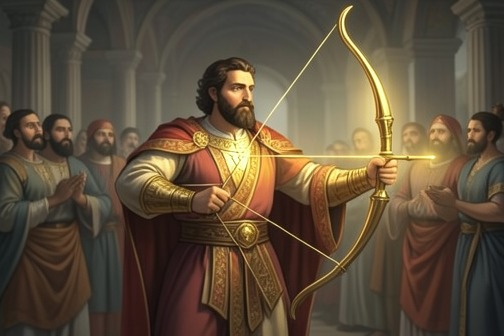
[Rama Breaks Shiva’s Bow](entity:event-recall-event-rama-breaks-shiva-s-bow-96bb9abdb41a) is the public test through which [Ráma](entity:character-recall-character-r-ma-2db51e45ae4a) demonstrates his strength before King [Janak](entity:character-recall-character-janak-b1843f7c4081) and becomes the intended husband of [Sítá](entity:character-recall-character-s-t-0be56374418b). The scene turns a marriage pledge into a visible trial: Janak’s daughter is to be given in marriage as he has sworn, and Ráma’s effortless-seeming handling of the bow establishes him as the man who can fulfill that condition. The bow does not merely test the prince; its breaking makes the promise actionable before the assembled court.
## The Pledge and the Bow
Janak’s words connect the contest to both Sítá’s identity and his obligation as her father. He describes her as not born of a woman and says that he gives her to Ráma as he has sworn. The passage does not dwell on the circumstances of her birth, but places that remarkable origin beside the king’s promise, making Sítá’s marriage a matter of public commitment rather than a private arrangement.
At the recluse’s request, Janak orders his attendants to bring out the great bow. It has been adorned with garlands and scents, and its power has been kept within a chest. The order and the careful presentation make the bow the focus of the court’s attention before Ráma touches it. The test is set in a ceremonial gathering, with Janak’s promise and the weapon’s imposing presence held together in the same scene.
## Ráma Breaks the Bow
The recluse invites Ráma to behold the bow, and Ráma opens the chest that contains it. After the hermit wishes him good fortune and the king tells him to attempt the task, Ráma lifts the weapon by its middle. He does so, the narration says, as if in sport, before thousands at court. The ease of the gesture is central to the contrast: what has been presented as a formidable test appears almost playful in his hands.
Ráma draws the string with a steady arm, and the bow breaks in two. Its snapping produces a clang compared to the shriek of tempests; the sound is so tremendous that the earth shakes. The scene thus enlarges a physical feat into a public spectacle. The assembled crowd has watched Ráma handle and string the weapon, while the break supplies an unmistakable result: the trial ends not with a measured display of strength, but with the bow itself shattered.
## Janak’s Recognition and the Marriage Pledge
After the break, Janak addresses the recluse with suppliant hands and reverent posture. He recognizes Ráma’s peerless might and calls the achievement a marvel beyond belief. His response makes the courtly consequence explicit: he proposes that his daughter be wed to Ráma and says that this will bring new glory to his line. He also affirms that his promise will stand.
The event’s decisive change is therefore from pledged marriage to publicly demonstrated eligibility. Janak’s vow has been associated with Sítá and the bow; Ráma’s feat gives the king grounds to announce that he will fulfill it. The episode establishes Ráma’s strength through action witnessed by the court, while treating the marriage as the consequence of a promise kept. It records Janak’s offer and recognition, rather than narrating the wedding itself.
Event 42
The Marriage of Rama and Sita
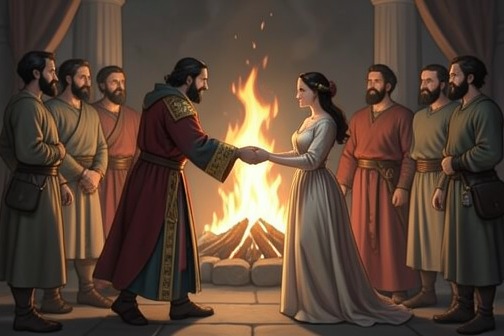
[The Marriage of Rama and Sita](entity:event-recall-event-the-marriage-of-rama-an-69a6273bb88d) is the ceremony in which [Janak](entity:character-recall-character-janak-b1843f7c4081) gives his daughter [Sita](entity:character-recall-character-sita-1913dd4978f6) to [Rama](entity:character-recall-character-rama-fdac9c17dd0c) and joins the other three princes in marriage to royal brides. The episode makes the four unions part of one public rite: each couple receives its own pairing, while Janak’s charge to the princes and their ritual actions place vows, family duty, and solemn observance at the center of the celebration.
## Ritual Setting and Janak’s Gift
The ceremony unfolds around a sacred fire. Holy grass has been laid out in equal lengths and prayers recited before [Vaśishṭha](entity:character-recall-character-va-ish-ha-033580f29400), identified as the next chief of the saints, comes forward and places the offering in the flame. This preparation gives the marriages a ritual setting before the personal acts of betrothal begin: the fire and prayers frame the unions as more than a private exchange between families.
Janak then takes Sita by the hand. She is described as beautiful and richly dressed, and sacred drops have flowed over her before he presents her to Rama. The action gives the scene a clear sequence: ritual preparation, the father’s leading of his daughter, and her formal bestowal. Janak identifies Sita as his daughter and offers her to Rama to share the duties of his life. His words make the marriage a commitment of shared obligations, not simply a celebration of the couple’s affection.
## Four Couples, One Ceremony
The ceremony extends beyond Rama and Sita. Janak turns next to [Lakshmaṇ](entity:character-recall-character-lakshma-7aad0629b677) and offers him [Urmila](entity:character-recall-character-urmila-44027d85d9ac), urging him to take her hand before the auspicious hour passes. He then calls [Bharat](entity:character-recall-character-bharat-6395f3ef7f4e) forward to take [Mandavi](entity:character-recall-character-mandavi-a437d82488ab)’s hand, and gives [Śatrughna](entity:character-recall-character-atrughna-60f42e73f771) [Shrutakirti](entity:character-recall-character-shrutakirti-f5c3b74438db) as his bride. The successive pairings make the occasion a collective dynastic celebration, with the marriages of the four princes arranged within a single formal sequence.
Janak’s final charge addresses all four brothers together. He tells them to be gentle and faithful to their wives and to keep the vows made that day. The counsel links the personal bond of each marriage to an enduring obligation: the promises are made at the ceremony, but their worth depends on being kept afterward. The princes obey, taking the maidens’ hands. The narrative thus presents their consent through a visible act of joining, while Janak’s instructions define the conduct expected of them as husbands.
## Vows, [Fire](entity:character-recall-character-fire-b3a40eeb15fa), and Public Acclaim
The couples’ unions are witnessed and celebrated beyond the immediate family. Gods and sages raise a joyful acclaim as Sita is bestowed, and the wedding day is marked by signs of exultation. The heavenly music continues while the princes circle the fire three times, each with a reverent head. The repeated movement gives the ceremony a shared ritual form: the couples do not merely receive their partners, but take part in an act of reverence before the assembled witnesses.
The fire, the offering, the prayers, the vows, and the circling belong to a connected progression. Janak’s spoken charge gives the marriages their ethical content; the princes’ clasping of hands and circumambulation enact their participation; and the response of the gods and sages makes the occasion publicly affirmed. The celebration therefore joins family arrangement with sacred observance without treating either as incidental.
## Significance of the Wedding Scene
The passage gives the wedding both an intimate and a collective scale. Its most personal gesture is Janak leading Sita by the hand and entrusting her to Rama. Around that moment, the other three marriages unfold, and the same father addresses all four princes with a common expectation of gentleness, fidelity, and kept promises. The scene’s structure moves from a specific father-daughter transfer to a wider statement about how the newly married brothers should live.
The episode also makes the vows consequential by placing them at the heart of the celebration. Janak does not only name the brides or arrange the pairings; he explicitly charges the princes to remain true to their wives and to the promises made that day. The public rite supplies witnesses and ceremony, while the instruction points forward to conduct beyond the wedding. Its decisive significance lies in this joining of four royal marriages under a single standard of duty, marked by sacred offerings and reverent passage around the fire.
Event 43
Rama and Parashurama’s Encounter
[Rama and Parashurama’s Encounter](entity:event-recall-event-rama-and-parashurama-s-4af8187a83b8) turns [Ráma](entity:character-recall-character-r-ma-2db51e45ae4a)’s celebrated prowess into a public test. [Parashurama](entity:character-recall-character-parashurama-130266e9a650), the son of [Jamadagni](entity:character-recall-character-jamadagni-7e4707b1b343) and descended from [Bhrigu](entity:character-recall-character-bhrigu-6b4d901155c3), appears carrying his father’s bow and insists that Ráma prove his strength by drawing it. The proposed test could lead to single combat, while [Dasharatha](entity:character-recall-character-dasharatha-b9552a8b18f7)’s fearful response makes clear that the challenge threatens more than a contest of skill: it places the royal party before a figure associated with the destruction of warriors.
## The encounter’s setting
The scene begins after the company’s wits have returned beneath a gloomy, ash-covered pall. In that suspended aftermath, they see Jamadagni’s son and regard him with dread. The description gives the entrance a stark physical force: his long hair is twisted around his head, and he stands firm as [Kailasa](entity:location-recall-location-kailasa-f6f396a0e4f4), glowing like the fire of doom. The setting does not soften his arrival; gloom, ash, and the fearful reaction of those present frame it as an interruption by a dangerous power.
Parashurama carries the signs of his identity openly. An axe rests on his shoulder, and his bow is ready for battle, with arrows accustomed to flight. These are not ornamental emblems: the weapons make visible the threat implicit in his arrival. The assembled people respond softly by repeating Ráma’s name. Parashurama accepts a gift without speaking, and only then breaks his silence to address Ráma. That pause separates the wary welcome from the demand that follows.
## Parashurama and his claim
Parashurama introduces himself through his knowledge of Ráma’s reputation. He says that reports of Ráma’s fame—and of the remarkable deed in which a mighty bow was bent and broken—have stirred him to seek Ráma in person. The encounter therefore begins not as an accidental meeting between strangers, but as the consequence of a feat that has travelled ahead of its performer. Report makes Ráma’s strength a matter of public renown; Parashurama arrives to put that renown to a test.
The bow Parashurama brings is his father’s: Jamadagni owned the powerful weapon. This inheritance gives the challenge a personal and ancestral dimension. Parashurama is not merely asking Ráma to demonstrate strength against an arbitrary object; he presents a weapon bound to his father and to his own claim as its bearer. The bow makes the test material, while its provenance makes it a contest of standing as well as physical capacity.
The book’s explanatory note identifies this Parashurama as a different figure from Ráma, the son of Jamadagni, also called Ráma with the Axe. It further characterizes him as a terror of the warrior caste and associates his name with long and fierce struggles between the sacerdotal and military orders, in which the latter suffered severely. That context sharpens the danger of his appearance: the man confronting Ráma carries a reputation that reaches beyond one personal dispute.
## The proposed test
Parashurama sets out a sequence rather than making an immediate attack. First, Ráma must draw the bow and demonstrate his might. Parashurama then proposes that the two test their strength in single combat. The bow is thus the threshold of the confrontation: before any duel can begin, Ráma must meet the challenge on Parashurama’s terms by handling the inherited weapon.
The offer is framed as both proof and public vindication. Parashurama presents the trial as a way for Ráma to show what his strength amounts to, and says that success will raise Ráma’s glory. The praise is edged with provocation. Ráma’s reputation has drawn Parashurama to him, but reputation alone does not satisfy the challenger; it must be confirmed through an act before the proposed fight. In this way, fame becomes the cause of the encounter and the thing placed at stake within it.
The scene also distinguishes the two bows and the achievements attached to them. The earlier feat concerns a bow already bent and broken; the weapon Parashurama now offers is his father’s bow, which he calls peerless and mighty. His challenge transfers attention from the celebrated deed to a new test, making the arrival of one weapon answer another. The encounter’s dramatic pressure lies in that succession: a public feat generates a report, the report brings an armed challenger, and the challenger demands a further demonstration.
## Dasharatha’s alarm and the encounter’s stakes
Dasharatha hears Parashurama’s speech with dread. The narrative marks his fear at the moment the challenger announces the test and single combat, before the scene’s outcome is established in the cited passage. His reaction supplies a counterpoint to Parashurama’s confident invitation: what the challenger casts as a route to heightened glory sounds to the king like an immediate danger.
The encounter consequently places royal vulnerability beside heroic reputation. Ráma is addressed as the man whose fame has preceded him, while Dasharatha responds as a father and king confronted by the prospect of violence. The scene does not treat the challenge as harmless praise or a ceremonial compliment. Parashurama arrives armed, sets a physical trial, and names combat as its possible next step; Dasharatha’s dread registers the cost that may follow if the encounter becomes a fight.
## Narrative significance
The episode makes reputation active in the plot. Ráma’s earlier bow feat is no longer only an accomplishment: it has become news capable of summoning a formidable opponent. Parashurama’s arrival converts renown into exposure, so that public praise brings not rest but another demand to prove strength. The bow he carries concentrates this reversal in a single object—an inherited weapon that must be drawn before the threatened duel can proceed.
The scene also sets different kinds of authority against one another without reducing the encounter to a completed battle. Parashurama’s lineage through Bhrigu, his father’s weapon, and the book’s note about conflict between sacerdotal and military orders give his challenge a broader historical resonance. At the immediate level, however, the action remains concrete: a feared, armed figure addresses Ráma, offers the bow, and proposes single combat; Dasharatha listens in alarm. The passage’s force comes from holding that threat open at the point where reputation must meet a test.
Event 44
Breaking of Shiva’s bow
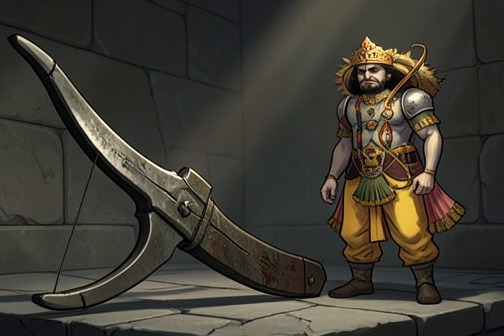
The [Breaking of Shiva’s bow](entity:event-recall-event-breaking-of-shiva-s-bow-595b15b5b8f0) joins a divine weapon’s earlier history to [Ráma](entity:character-recall-character-r-ma-2db51e45ae4a)’s decisive feat. Once wielded by [Shiva](entity:character-recall-character-shiva-a32afbfe6397) against Tripura, the bow is eventually broken by Ráma; the act’s significance extends beyond the destruction of the weapon, as it leads into [Parashurama](entity:character-recall-character-parashurama-130266e9a650)’s challenge.
## The Bow’s Divine History
The account first recalls the bow’s association with Shiva. The Three-eyed God received it, and, armed with it, slew Tripura. Its history therefore begins not as a royal emblem or an object of ceremony, but as a weapon used in a divine conflict.
## The Break and Its Counterpart
The narrative makes the bow’s destruction the decisive turn: the weapon Shiva had wielded is broken by Ráma. In the same account, a second bow is distinguished from it and said to have been given to [Vishṇu](entity:character-recall-character-vish-u-50c288dea3c5) by the highest gods. The contrast preserves the separate identities and divine associations of the two bows rather than treating them as a single weapon.
## Challenge and Consequence
The event’s framing connects Ráma’s feat with Parashurama’s challenge. The break thus carries the action forward: a deed that demonstrates Ráma’s extraordinary strength also becomes the occasion for a new confrontation. The supplied passage establishes the divine history of the bow and its destruction, while the event’s title identifies the challenge that follows as its immediate narrative consequence.
## Narrative Significance
The episode compresses a long history into a sharp reversal. A weapon once used by Shiva to defeat Tripura is no longer intact after Ráma’s act, and the account sets that feat beside the distinct bow entrusted to Vishṇu. The break is therefore both an ending for the first bow and a hinge in the story, turning a display of strength into a challenge.
Event 45
Battle of Shiva and Vishnu over the divine bows
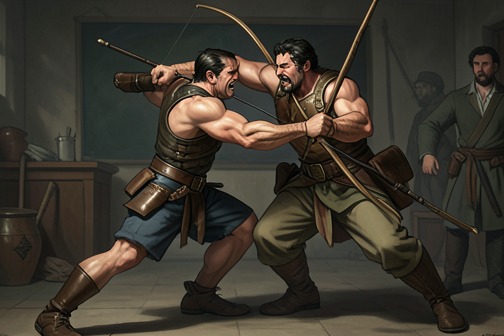
The [Battle of Shiva and Vishnu over the divine bows](entity:event-recall-event-battle-of-shiva-and-vis-c34893d4fed7) is a divinely arranged contest that turns a question of praise into a visible test of power. Its resolution is not the destruction of either rival but the failure of [Shiva](entity:character-recall-character-shiva-a32afbfe6397)’s bow, the recognition of [Vishnu](entity:character-recall-character-vishnu-4fe080f11b04)’s pre-eminence, and the transfer of Shiva’s weapon to Devarát. The episode thus moves from challenge to public judgment, then from divine conflict to the bow’s passage into a human lineage.
## The Question That Prompts the Contest
The encounter begins with the gods seeking an unerring proof. They want to know whether praise for might is due to Vishnu or to Shiva, whom the poem identifies through his blue-stained neck. The question is framed as a comparison between two divine powers, not as a dispute over territory or a personal grievance. The gods’ appeal makes the contest a test whose result is meant to settle how the two should be praised.
[Brahma](entity:character-recall-character-brahma-39f8aa187fff) knows what the gods wish to establish and causes the rivals to meet as foes. The scene therefore presents the confrontation as deliberately brought about by a higher authority: the antagonism is arranged to answer the gods’ question. This setup matters to the outcome. The battle functions as proof, with the gathered divine assembly able to witness what happens, rather than as an open-ended struggle whose purpose is simply victory over an enemy.
## The Contest and Its Turning Point
The meeting quickly becomes a fierce battle. The poem conveys its intensity through the image of hair bristling in dread, giving the confrontation a bodily sign of the danger and awe surrounding it. It does not describe a sequence of blows or a prolonged exchange of tactics. Instead, it concentrates the decisive action in the contrast between Vishnu’s force and Shiva’s bow: Vishnu raises his voice, while Shiva’s bowstring twangs in vain.
The failed bowstring marks the turn in the contest. Shiva, described as the master of the Three bright Eyes, remains fixed in fury and surprise. The moment registers both the weapon’s failure and its owner’s astonishment; the poem does not treat the result as an ordinary defeat in battle, but as the revelation that Shiva’s bow cannot answer Vishnu’s power in this test. That limited, sharply staged sign supplies the proof the gods had requested.
The poem’s emphasis on the bow gives the encounter a concrete measure of otherwise immense divine strength. Rather than explain the rivals’ powers abstractly, it lets the weapon’s failure carry the comparison. The contest is therefore brief in its decisive mechanism even as its scale is cosmic: the weapon sounds, fails, and makes the difference between the two claims legible to the watching assembly.
## Intervention and Public Judgment
As the confrontation reaches its decisive point, the dwellers in the sky draw near: minstrels, sages, and gods all come to witness it. They pray for the strife to cease, and the great rivals meet in peace. Their intervention prevents the proof of strength from becoming an endless conflict. The scene’s resolution depends not only on the bow’s failure but also on the assembled community’s appeal for an end to violence.
The judgment follows the visible result. Shiva’s bow has failed under Vishnu’s assault, and the gods and heavenly sages accordingly give pre-eminence to Vishnu. The ordering is specific: the passage establishes Vishnu’s superiority in the contest and in the praise sought by the gods. It does not say that Shiva is annihilated or stripped of divine standing; the rivals reconcile, and both remain present at the close of the episode. The settlement answers the question without turning the comparison into the destruction of one of its subjects.
That public witness also gives the contest a formal shape. The gods first ask for proof, Brahma arranges the encounter, the assembly watches the test, and the result is acknowledged. The judgment is not left as an unspoken implication of combat: the narrative states that the assembled gods and sages recognize Vishnu’s pre-eminence. Their recognition converts a moment of force into a settled conclusion about the praise due to him.
## The Bow’s Transfer and the Episode’s Significance
After the rivals have met in peace and Vishnu’s pre-eminence has been acknowledged, the narrative turns from the divine contest to the history of the weapon. Shiva gives his bow to Devarát. The handoff carries the scene beyond its immediate judgment: the bow that failed in the contest does not disappear from the story but passes from a god to a sage. The poem thereby links the divine encounter to the later human possession of the weapon, without making the transfer itself another battle.
The sequence holds together two different outcomes. In the contest, the bow’s failure provides proof of Vishnu’s greater might; in the aftermath, the weapon remains a significant object capable of being transmitted. The contest settles the gods’ stated question, while the gift establishes a line of custody that continues beyond the reconciliation. The episode’s importance lies in this conjunction of adjudication and transmission: a divine rivalry is resolved before witnesses, and its emblematic weapon becomes part of a continuing human story.
Event 46
Murder of Jamadagni
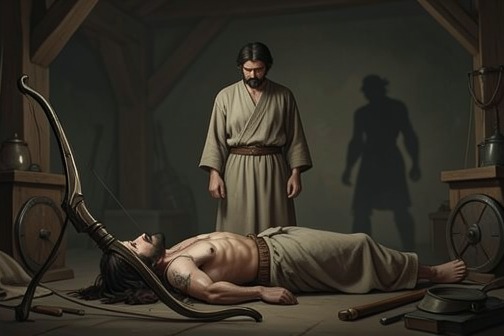
[Murder of Jamadagni](entity:event-recall-event-murder-of-jamadagni-4b6401ab4fa1) is presented as a treacherous killing whose consequences outlast the death itself: [Jamadagni](entity:character-recall-character-jamadagni-7e4707b1b343)’s son, [Parashurama](entity:character-recall-character-parashurama-130266e9a650), links the loss of his father to an enduring campaign against warriors across generations. The account also places the killing beside Jamadagni’s ascetic power and the divine bow he inherited, making the murder both a family catastrophe and the origin of a prolonged cycle of vengeance.
## Background and Inheritance
The recollection traces the bow’s passage before describing Jamadagni’s death. [Vishnu](entity:character-recall-character-vishnu-4fe080f11b04) had entrusted it to [Richika](entity:character-recall-character-richika-bce16239e359) as a pledge and an ornament; Jamadagni, Richika’s heir, then inherited it. The sequence gives the weapon a history within the family and connects Jamadagni to a divine gift before the account turns to violence. The passage does not say that the bow caused the murder or that it was taken afterward, so its significance here rests on inheritance and association rather than a stated role in the killing.
Jamadagni is identified not only as Parashurama’s father but as a Brahmin whose penance had gained formidable strength. The account also says he retained the God-given bow. These details establish the man who was killed through two kinds of distinction: religious power acquired through austerity and possession of a divine inheritance. They do not describe the circumstances of the encounter in detail, but they make clear that his death is remembered as the loss of a father endowed with both spiritual authority and a sacred weapon.
## The Killing
Parashurama attributes Jamadagni’s death to [Karttavirya Arjuna](entity:character-recall-character-karttavirya-arjuna-98fc8cf4039c) and characterizes the act as treacherous. The account offers no further description of the attack, its location, or what immediately preceded it. Its emphasis falls instead on the perceived injustice: the victim is presented as a father with the strength of penance, while the manner of his death is named as guile rather than an honorable contest.
That contrast shapes the event’s moral weight. The account does not frame Jamadagni’s death as an ordinary loss in battle; it identifies deception as the means and treats that means as part of the injury. Nor does it present the killing as an isolated misfortune. By recounting it through the surviving son’s later response, the narrative makes the murder a turning point: the event enters the story not only as something that happened to Jamadagni, but as the cause Parashurama gives for what he does afterward.
## The Son’s Recollection and Vengeance
Parashurama says he heard of his father’s fall and remembers it as a sorrowful fate. The brief account thus distinguishes the killing from the moment of learning about it. It does not establish exactly when or how the news reached him, but it makes the report of the death the hinge between the family loss and his subsequent fury. Jamadagni’s murder is therefore conveyed through retrospective testimony rather than through a scene depicting the killing itself.
Parashurama connects that remembered loss to his vengeance against warriors. He describes his fury as continuing from the time he learned of Jamadagni’s death and extending to warriors across successive generations. The scope is consequential: retribution does not remain confined to Karttavirya Arjuna, the man named as responsible, but becomes a recurring conflict with a broader class. The account supplies Parashurama’s stated cause for this campaign, though it does not detail its individual episodes or specify how each later target was connected to the original murder.
## Narrative Significance
The passage’s compact sequence—divine gift, inheritance, treacherous killing, news of the death, and continuing revenge—turns a family murder into a generational cause. Its structure also preserves the difference between what is reported and what follows: Jamadagni’s death is attributed to Karttavirya Arjuna, while the violence that continues afterward is presented as Parashurama’s response to that loss. The account explains the origin of his hostility without making the later campaign identical to the original crime.
The bow and the language of penance keep Jamadagni’s inherited and spiritual standing in view, while the description of treachery makes the manner of his death central to its remembered injustice. Yet the narrative’s decisive consequence is not an account of the weapon’s fate or a full history of the conflict. It is the transformation of grief into enduring vengeance: Parashurama’s recollection carries the killing forward, giving one death repercussions that reach beyond the father and son to generations of warriors.
Event 47
Parashurama’s donation of the earth to Kashyapa
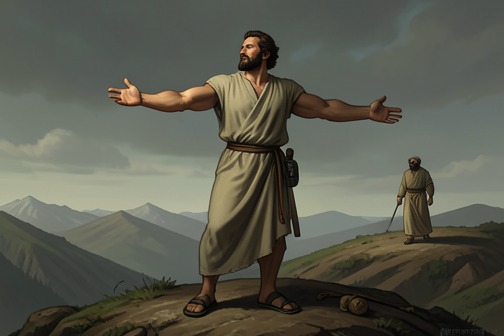
[Parashurama’s donation of the earth to Kashyapa](entity:event-recall-event-parashurama-s-donation-b80247483e36) is the decisive transfer that follows his conquest: after warring against generations of warriors, [Parashurama](entity:character-recall-character-parashurama-130266e9a650) says he brought the whole earth under his sway and gave it to [Kashyapa](entity:character-recall-character-kashyapa-00baeab7c1ab) as payment for the sage’s completed rites. The gift does not simply conclude a campaign. It changes who holds the land and places the giver under a lasting restriction, which Parashurama later describes as an obligation he still observes.
## Conquest and the gift
Parashurama presents the donation against the background of an extended conflict. As generations of warriors arise, he says, he wars them down in continuing strife. The account links this repeated violence to his eventual mastery of the earth: he does not describe a single victory or a limited territory, but says that he brought all the earth beneath his sway. The breadth of the conquest matters because the gift that follows is equally comprehensive.
The land is given to Kashyapa after the rites performed by the sage are over. Parashurama characterizes the earth as the meed and payment for those completed rites, placing ritual service and the transfer of conquered territory in a direct relation. The account does not specify the rites’ procedures or describe a public ceremony of donation. Its emphasis is instead on the sequence and terms as Parashurama remembers them: Kashyapa performs the rites; when they are complete, Parashurama gives him the land.
The recipient is identified as the holy Kashyapa, not as a rival whom Parashurama defeats. The change of possession is therefore narrated as a gift made in recompense, rather than as another conquest. At the same time, the scale of the payment gives the act political weight: the earth that Parashurama had brought beneath his power passes into Kashyapa’s sway. The narrative makes that consequence explicit again when Parashurama later calls it the whole broad land he gave to Kashyapa.
## The command and its continuing force
The transfer also produces a lasting condition for the giver. In his later account to [Rama](entity:character-recall-character-rama-fdac9c17dd0c), Parashurama explains that Kashyapa charged him never to remain within the limits of the sage’s reign. The command follows the gift closely in his telling: because the land has been given to Kashyapa, Parashurama cannot stay within the realm now under the sage’s authority. The donation thus changes not only the holder of the territory but also where its former conqueror may remain.
Parashurama presents his subsequent conduct as obedience to his guide’s instruction. He says that by night he never rests on earth, connecting that claim to the prohibition against remaining within Kashyapa’s domain. The statement gives the past transaction an ongoing consequence: although the gift and the rites are long completed, their terms still govern Parashurama’s movement and rest. His account supplies no further itinerary or description of how he observes the restriction, so the consequence is conveyed through the stark rule he says he follows.
The donation therefore marks a reversal in Parashurama’s relation to the earth. He had described himself as having subdued it; afterward, he cannot treat it as a place where he may settle at will. The narrative places his submission to Kashyapa’s command beside his account of the strength acquired through penance. His capacity to conquer does not cancel the obligation created by the gift: he presents himself as bound to honor the sage’s instruction.
## [Mahendra Mountain](entity:location-recall-location-mahendra-mountain-cc9cb2a9b210) and the later recollection
After describing the completed rites and the donation, Parashurama says that he turned to Mahendra Mountain. He associates his strength with the penance he had earned and describes the mountain’s lofty summit as visited by the [Devas](entity:character-recall-character-devas-f5bcab1c71d9). This is the next destination named in his account after he has given away the earth. The passage thus sets the relinquished territory against a mountain where he continues his penance, without suggesting that the gift itself ends his ascetic practice.
The transaction returns to the foreground when Parashurama explains his position to Rama. His voice is described as low and weak as he recalls giving the land to Kashyapa and recounts the prohibition that followed. In this later speech, the donation serves as more than a report of past conquest: it explains the limits under which Parashurama now acts. His memory of the gift joins a sweeping claim of former dominion to a present acknowledgment of another’s authority.
The account’s movement—from generations of warfare, to the surrender of all the earth, to a command that still constrains the giver—makes the donation a turning point in Parashurama’s story. Its significance lies in both the extent of what changes hands and the obligation that remains afterward. The land becomes Kashyapa’s realm; Parashurama’s own account makes clear that he cannot simply reclaim the freedom to dwell within it.
Event 48
Parashurama’s challenge to Rama
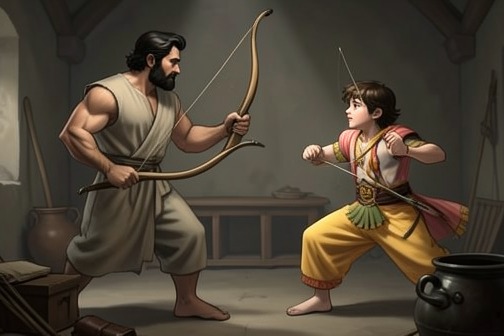
[Parashurama’s challenge to Rama](entity:event-recall-event-parashurama-s-challenge-40739675d263) turns a test of bowmanship into a contest over power won by arms and austerity. [Parashurama](entity:character-recall-character-parashurama-130266e9a650) presents a bow once owned by [Vishnu](entity:character-recall-character-vishnu-4fe080f11b04), invites [Rama](entity:character-recall-character-rama-fdac9c17dd0c) to string it and set an arrow to its head, then declares that he will test Rama’s strength in single combat. Rama takes up the weapon and answers with a shot whose consequence is not Parashurama’s death but the loss of the heavenly worlds he had gained through penance. The challenger’s departure, after he has praised and circumambulated Rama, marks a decisive reversal: the test ends with Parashurama acknowledging the power he had come to challenge.
## The Bow and the Terms of the Challenge
Parashurama frames the encounter around a specific weapon and a specific test. He offers Rama what he calls the best of bows and identifies it as one that belonged to Vishnu. Its history is also personal: Parashurama says that his father and grandfather loved to hold it. The bow therefore carries a lineage of possession and esteem, not merely the practical promise of force. By asking Rama to take it, string it, and bring a town-destroying arrow to its head, Parashurama makes the act of stringing a visible measure of capacity; the subsequent single combat is the proposed proof of what that capacity means.
The challenge is presented as an invitation to demonstrate prowess before a rival who expects to judge it. Parashurama says he will try Rama’s strength in a single fight if Rama can complete the feat. The condition makes the weapon a threshold: before combat can begin, Rama must show that he can handle a bow associated with Vishnu. But the encounter does not proceed to a narrated exchange of blows. Rama’s successful handling of the bow and his answer with its arrow settle the test by changing the terms from threatened combat to an immediate exercise of power.
## Rama’s Answer and the Arrow’s Aim
Rama takes the mighty bow and shaft with apparent ease, strings the weapon, and lays the arrow on it. The sequence is spare but decisive: what Parashurama has framed as a challenge requiring proof becomes an action Rama performs. The narrative gives no extended contest over technique. Instead, the completed bow and ready arrow make Rama’s capacity plain before he states what he will do with it.
Rama then addresses Parashurama’s status as a Brahmin and as a figure deserving reverence. He says that he would not shoot at him to end his life, and gives two grounds for that restraint: Parashurama’s Brahmin standing and respect owed for [Vishvamitra](entity:character-recall-character-vishvamitra-df735521f72c)’s sake. This qualification matters to the force of the response. Rama does not treat the challenger’s threat as permission to kill him, even while holding an arrow that can inflict a grave loss. He distinguishes between sparing Parashurama’s life and sparing him from every consequence.
The target Rama names is what Parashurama has gained through ascetic practice: either the power to wander freely won by penance or the glorious worlds won through the same long effort. The text presents the choice as a deliberate redirection of force. Rama’s purpose is not to answer a challenge with indiscriminate destruction, but to take away a form of power or reward. His description of Vishnu’s dart as unable to fall in vain, and as striking the mighty and checking the arrogance of the haughty, casts the arrow as an instrument of judgment as well as a weapon. The threat is thus answered on terms that preserve Parashurama’s life while putting his hard-won attainments at risk.
## The Shot and Its Consequences
After Parashurama has indicated what he will do when the fatal shaft is shot, the wondrous arrow flies. Parashurama then recognizes that the glorious worlds he had reached through prolonged penance are barred to him. The consequence is specific and consequential: the loss falls not on his body but on the spiritual reward that his austerities had secured. The episode contrasts the long duration of his effort with the speed of Rama’s answer. Years of penance had won those worlds; one arrow makes them inaccessible.
The account does not describe the arrow as killing Parashurama, and Rama has expressly rejected that outcome. Instead, the shot resolves the encounter through the loss of the worlds. This distinction gives the episode its particular severity. Parashurama is not simply defeated in a contest of physical strength; the very achievement on which his standing rests is shown to be vulnerable. His recognition of the result confirms that Rama’s action has taken effect, while the clearing of the airy quarters and the brightening of the middle regions accompany the shift from confrontation to public acknowledgment.
Gods, saints, and the heavenly choir, led by [Brahma](entity:character-recall-character-brahma-39f8aa187fff), appear in the aftermath. The divine and ascetic witnesses who had attended the encounter now praise Rama for raising the mighty bow. Their response widens the meaning of the test: its outcome is not left as a private disagreement between two powerful figures. The narrative makes Rama’s performance visible to a heavenly assembly, and its praise follows the arrow’s demonstrated consequence rather than Parashurama’s initial claim to judge him.
## Recognition and Departure
Parashurama’s response completes the reversal. Overawed, he praises Rama’s name, walks reverently around him, and then hastens away by his airy road. He leaves the immediate scene and rests on Mahendra. Each action registers a different part of the change: praise acknowledges Rama, circumambulation expresses reverence through a formal gesture, and departure ends the confrontation. The challenger who proposed to test Rama’s strength now treats him with deference.
The encounter therefore concludes without Parashurama’s death or a continuing duel. Its decisive result is a transfer of authority within the scene: Parashurama has supplied the bow and set the test, but Rama’s act with the weapon determines the outcome. The restraint Rama declares is as important as the force he demonstrates. He spares the challenger’s life while making the loss of his penance-won worlds the consequence of the shot; Parashurama, in turn, accepts the result through praise and departure. The narrative’s movement from challenge, to measured threat, to arrow, to reverent exit makes the episode a compact demonstration of power bounded by restraint.
Event 49
Manthara’s plot against Rama’s succession
[Manthará](entity:character-recall-character-manthar-14976bc75d2f)’s plot against [Ráma](entity:character-recall-character-r-ma-2db51e45ae4a)’s succession begins with a public celebration that she recasts as a danger to Queen [Kaikeyí](entity:character-recall-character-kaikey-bfffeff04c04) and her son, [Bharat](entity:character-recall-character-bharat-6395f3ef7f4e). Her warnings move the news of Ráma’s planned consecration from the streets of [Ayodhyá](entity:location-recall-location-ayodhy-08bd0b6815c4) into the queen’s private chamber, where she presents succession not as a joyful family occasion but as an impending loss of status, power, and security.
## Setting and news of the consecration
The episode opens in Canto VII, “Manthará’s Lament,” with Manthará identified as a handmaid of slave birth who was brought up with Queen Kaikeyí. She climbs to a terrace and surveys Ayodhyá. The city’s appearance makes the scale of the preparations unmistakable: water cools the streets; flowers, flags, and pennons decorate them; covered walkways and awnings have been set up; and sandal-scented water has been sprinkled over the routes filled with newly bathed crowds. Brahmin groups carry wreaths and sweetmeats, instruments sound, and temple doors gleam. The scene presents the city as collectively preparing for an important royal occasion.
From the terrace Manthará sees Ráma’s nurse, dressed in white and visibly joyful. She asks whether Ráma’s mother, [Kauśalyá](entity:character-recall-character-kau-aly-f8fa3c3ce87b), is distributing gifts, whether some cause for special happiness has arisen, or whether the king is celebrating a triumph. The nurse answers that [Daśaratha](entity:character-recall-character-da-aratha-ffdd8279512e) will consecrate his eldest son the following morning and raise Prince Ráma to royal power at the auspicious hour of [Pushya](entity:time-recall-time-pushya-0bc0e8db8193). The announcement gives Manthará both the immediate occasion for her intervention and its political stakes: the succession is imminent, not a distant possibility.
## From celebration to alarm
The nurse’s glad report provokes rage in Manthará. She leaves the terrace and goes to Kaikeyí, who is asleep. Her first move is to awaken the queen with a warning of imminent peril. Manthará contrasts Kaikeyí’s apparent ease with the danger she claims is gathering around her, insisting that the king’s affection is only a show and will not protect her. The change in setting sharpens the contrast: outside, the city’s decorations and music express public anticipation; inside, Manthará translates that same occasion into a private threat.
Kaikeyí responds with concern rather than immediate suspicion. She asks what evil news has arrived and reads Manthará’s altered expression as a sign of danger. The queen’s question gives Manthará an opening to direct her attention away from the public celebration and toward her own position in the royal household. The account describes Manthará as speaking with deliberate art and as bent on alienating Kaikeyí’s affection from Ráma. Her persuasiveness therefore rests not simply on delivering news but on shaping how Kaikeyí interprets it.
## The argument Manthará constructs
Manthará presents Daśaratha’s decision to make Ráma heir apparent as a threat to Kaikeyí and Bharat. She tells the queen that Kauśalyá will receive the wealth, substance, and power of the household, while Bharat will be sent away to dwell among distant relations and Ráma will assume authority. These are Manthará’s allegations and predictions, not facts independently confirmed in the excerpt. The distinction matters: the scene shows a political reading being pressed upon Kaikeyí, not a neutral account of Daśaratha’s intentions toward Bharat or the queens.
To make that reading persuasive, Manthará attacks the trust Kaikeyí places in her husband. She describes Daśaratha’s kindness and soothing words as deceptive, and portrays his apparent favour as a cover for betrayal. She also argues that Kaikeyí’s affection for Ráma has left her vulnerable: what the queen regards as familial love, Manthará recasts as a misplaced attachment to someone who will participate in her displacement. Her imagery of a serpent cherished unknowingly at the breast gives emotional force to this accusation, while her repeated appeals to Kaikeyí’s royal birth and rights frame the matter as one of status as well as maternal concern.
Manthará also presents herself as acting out of loyalty. She claims that Kaikeyí’s grief would be her own and that the queen’s gain would be her greatest gain; she says that concern for Kaikeyí’s welfare has brought her to speak. Yet the narration explicitly characterizes her purpose as wicked and her effort as an attempt to estrange Kaikeyí from Ráma. The tension between Manthará’s self-presentation as a devoted attendant and the narrator’s account of her hostile design is central to the episode’s portrayal of persuasion.
## Immediate effect and narrative significance
Manthará’s appeal is framed as an urgent choice: Kaikeyí must act while there is still time to preserve herself, her son, and Manthará. The warning converts a succession announcement into a crisis before the consecration can take place. By the episode’s last visible moment, Kaikeyí is delighted by Manthará’s words and rises from her bed. That response marks a shift from sleep and uncertainty to active attention, but the excerpt does not yet show what Kaikeyí decides or what measures follow.
The episode’s decisive movement is thus interpretive. The city’s preparations announce Ráma’s elevation as a public celebration; Manthará makes them evidence, in Kaikeyí’s eyes, of a threatened household position. The difference between the nurse’s uncomplicated joy and Manthará’s alarm exposes how political action can begin not with a changed royal decree, but with a changed account of what that decree means. The passage establishes the immediate trigger for the plot against Ráma’s succession while leaving its next steps beyond the scene presented here.
Event 50
Rama’s exile and the aborted coronation
[Ráma’s exile](entity:state-recall-state-r-ma-a94ec8a82327) and the aborted coronation is the turning point in which [Kaikeyí](entity:character-recall-character-kaikey-bfffeff04c04) uses two long-promised boons to redirect the succession: the rites begun for [Ráma](entity:character-recall-character-r-ma-2db51e45ae4a) are to be transferred, and Ráma is to live for fourteen years in the [Daṇḍaka forest](entity:location-recall-location-da-aka-forest-0749c0f39fbb). The demand leaves [Daśaratha](entity:character-recall-character-da-aratha-ffdd8279512e) bound by his pledge and Ráma facing a conflict between the expected royal succession and obedience to his father’s word.
## Background: a promise made in battle
The crisis rests on an earlier battle between the [Devas](entity:character-recall-character-devas-f5bcab1c71d9) and demons. Kaikeyí reminds Daśaratha that, when he was near death in the fighting, she preserved him. In return for her care, he promised her two boons. He had not yet granted them; she now presents them as a debt due, rather than as a new request for favor.
Her account gives the demand a history that precedes the preparations for Ráma’s consecration. What had once been an act of gratitude by a husband to the woman who saved him becomes the means of changing the royal succession. The past promise is thus not incidental background: it supplies the authority on which Kaikeyí bases both demands.
## The demand and Daśaratha’s pledge
Kaikeyí initially asks Daśaratha to pledge that he will grant her wish before she identifies it. He responds with affection, assuring her that she is dear to him and affirming Ráma’s place as his beloved son and heir. He then swears by Ráma that her request will be done. Only after this assurance does Kaikeyí make the terms public.
She calls on the gods, the sun and moon, the planets, heaven, the quarters, day and night, the earth, heavenly bards, demons, spirits, and household deities to witness the oath. The widening circle of witnesses makes the promise more than a private exchange between spouses: Kaikeyí represents it as an obligation heard by the whole world. Daśaratha is consequently caught between his paternal love for Ráma and the promise he has just renewed before this invoked audience.
Kaikeyí then recalls the two boons from the battle and specifies their use. The rites already begun in Ráma’s name are to be transferred, and her son is to be enthroned. Ráma, meanwhile, is to be driven into the Daṇḍaka forest for nine years and five—fourteen years in all. He is to live there as a hermit, wearing a deerskin coat and matted hair. Her two requests therefore work together: one installs her son without a rival, while the other removes Ráma from the succession and sends him into forest life.
## Ráma and the duty to keep a promise
In a later exchange, Kaikeyí tells Ráma that Daśaratha’s silence does not arise from anger or sudden distress. She says his father is afraid to speak because Ráma is so dear to him. She makes the father’s reluctance part of her appeal: Ráma must, she insists, fulfil the promise his father made to her. In this account, the obstacle is not that Daśaratha has ceased to love Ráma, but that his love makes the demanded course painful to state.
Kaikeyí argues that a king must not break his word, even in anger or for the sake of a beloved son. She presents faithfulness as the source of virtue and merit, then asks Ráma to pledge that his father’s promise will not fail. The order of her appeal is important: before telling him the whole account, she asks him to bind himself to the obligation. The event thus shifts from a private bargain between the king and queen to a test of whether Ráma will accept the consequences of his father’s pledge.
## Consequences and significance
The immediate consequence of Kaikeyí’s demands is that the planned consecration in Ráma’s name is to be displaced by her son’s enthronement, while Ráma is ordered into fourteen years of exile. The specified clothing and unopposed rule sharpen the contrast between the two outcomes: the son who is to rule receives the empire, while Ráma is assigned the marks and conditions of a hermit. The scene turns succession into separation and makes a political change inseparable from a family obligation.
The episode’s central conflict is structured through promises at different moments. Daśaratha’s earlier promise of two boons creates the claim Kaikeyí invokes; his fresh oath, made before he knows what she wants, reinforces it; and Kaikeyí then calls on Ráma to uphold his father’s word. The account therefore frames the exile not simply as a contest for the throne but as a collision between affection and fidelity to a pledge. Ráma’s exile and the cancelled consecration acquire their force from this repeated demand that a promise, once given, must be honoured.
Event 51
Kaikeyi's demand for Rama's exile
[Kaikeyi](entity:character-recall-character-kaikeyi-2477fd7cdcbf)’s demand for [Rama’s exile](entity:event-recall-event-rama-s-exile-62ac5ab5bf6d) turns a promise [Dasharatha](entity:character-recall-character-dasharatha-b9552a8b18f7) had made to his queen into a crisis of succession and separation. Its decisive force lies not only in the requested change of ruler, but in the choice it imposes on [Rama](entity:character-recall-character-rama-fdac9c17dd0c): accept the throne when his father offers it, or preserve the promise by leaving for fourteen years and yielding rule to [Bharata](entity:character-recall-character-bharata-72e56a1f79da).
## The Boons Become a Succession Crisis
The demand rests on boons Dasharatha had granted Kaikeyi. When he later addresses Rama, he admits that he gave her the boons she had asked for and describes himself as misled by her influence. His confession makes the king’s predicament explicit: the order sending Rama away is not simply a settled royal preference, but the consequence of an earlier pledge that Dasharatha now regrets.
The stakes are dynastic as well as personal. Kaikeyi’s demand places Bharata in line to rule while removing Rama, the son Dasharatha had intended to succeed him. Yet the account also shows that Kaikeyi is concerned with what Bharata will inherit. She objects that her son must not gain an empty realm or rule a waste. Her words frame the contest as more than a transfer of the crown: the kingdom itself, with its people and resources, matters to the settlement she seeks.
## Rama Accepts the Exile
Rama answers the crisis by distinguishing his own wishes from the obligation created by Dasharatha’s promise. He asks that the boon granted to the queen be fulfilled and that Bharata reign. He then states that he will live in the woods for fourteen years, among those who dwell in the forest. The fixed term gives the demand a precise political and personal cost: Rama does not merely yield the immediate succession, but accepts a long absence from the kingdom.
His response is presented as deliberate obedience rather than defeat in a contest for power. He says that hopes of power cannot move his heart and treats his father’s spoken command as binding. The contrast is sharp: Dasharatha’s later offer that Rama become ruler cannot erase the promise already made to Kaikeyi, because Rama chooses fidelity to that promise over the restored opportunity to reign.
## Dasharatha’s Reversal and the Demand’s Consequences
Dasharatha’s confession reveals the emotional reversal within the episode. Having acknowledged that Kaikeyi’s demand arose from the boons he granted, he tells Rama to rule in his stead. The offer exposes the conflict between a father’s wish to restore his son and a king’s obligation to honor his word. Rama does not take the opening. He maintains that the queen’s boon should be fulfilled and that Bharata should receive the rule.
The result is a settlement in which the succession and the exile are joined: Bharata is to reign, and Rama is to leave for the forest for fourteen years. Kaikeyi’s objection to an emptied realm further underscores that the political outcome cannot be reduced to who wears the crown. The demand threatens both the family’s unity and the continuity of the kingdom, while Rama’s acceptance makes the promised transfer possible without a struggle for rule.
## Narrative Significance
The episode makes a private promise the hinge of a public succession. Dasharatha’s regret does not release him from the consequences of his pledge, and Rama’s willingness to depart turns that constraint into action. The episode’s central tension is therefore not simply between Kaikeyi and Rama, but between competing claims made within the royal household: a father’s renewed wish, a queen’s demand, a son’s obedience, and a kingdom’s need for a ruler.
The fourteen-year term also gives the demand a lasting shape. What begins as a claim upon boons becomes an extended separation from the court and the life Rama was expected to inherit. Rama’s choice resolves the immediate question of whether he will accept the throne, but it does so by carrying the cost of succession into the forest. The exile is thus both the consequence of Dasharatha’s promise and the measure of Rama’s commitment to keep it.
Event 52
Sita insists on accompanying Rama into exile
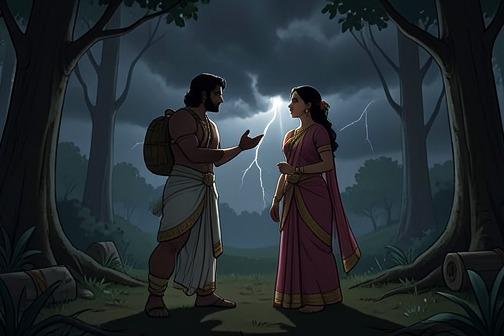
[Sita](entity:character-recall-character-sita-1913dd4978f6)’s insistence on accompanying [Rama](entity:character-recall-character-rama-fdac9c17dd0c) into exile turns a decision about where he will go into a dispute over whether his wife can be left behind. She presents their marriage as a shared obligation, not a bond that ends at the edge of the forest. Her urgent appeal changes Rama’s position: having first intended that she remain behind, he finally agrees to take her to [Dandaka Forest](entity:location-recall-location-dandaka-forest-2a53e179ca8b) and protect her there.
## The Dispute Over Separation
[Rama’s exile](entity:event-recall-event-rama-s-exile-62ac5ab5bf6d) places Sita before a choice he has not initially invited her to make. He does not wish her to dwell in the forest, and his first reluctance to take her becomes the point she challenges. For Sita, remaining behind would not be a neutral alternative to accompanying him. It would mean being separated from her husband precisely when his life is being reshaped by exile.
She grounds her claim in their marriage. Sita recalls that she became Rama’s wife when she was young and has remained blameless in their married life; she rejects the prospect of being treated as someone who may simply be entrusted to others while he goes away. Her argument makes separation itself the injury at stake. She is not asking for a privilege distinct from Rama’s fate, but insisting that their shared life gives her a claim to go with him.
## Sita’s Appeal and Resolve
Sita does not present the forest as comfortable or deny that exile will bring hardship. Instead, she argues that hardship apart from Rama would be harder to bear than the suffering of going with him. She invokes the long span of the exile—fourteen years—and makes clear that she cannot accept that period of separation as an obligation she must endure silently.
Her appeal becomes desperate. Sita says that if Rama will not take her, she would rather die than remain behind. The threat conveys the extremity of her distress without making her decision a casual preference: she treats being excluded from his journey as an unbearable rupture. The scene therefore shifts from a disagreement about danger and hardship to a plea about companionship, marital duty, and the consequences of leaving her behind.
Sita also turns Rama’s own obedience against the idea that she should be left behind. He is going because he must honor his father’s wish; she urges him to obey that wish, while challenging the further implication that it requires entrusting his wife to others. Her reasoning distinguishes the command that sends Rama into exile from the choice about whether the couple must be separated. She accepts the first as binding on him but contests the second as a conclusion he need not impose on her.
## Rama Changes His Decision
Rama responds to Sita’s distress with gentleness and reassurance. He tells her that he would not purchase heavenly happiness at the cost of her sorrow. He also admits that he had not fully understood her heart and that this was why he had not wished her to live in the forest. The admission marks the turn in the scene: his reluctance has rested on a mistaken understanding of what she wants, not on a settled refusal to share the journey.
His answer joins recognition to practical assurance. Rama says that his arm can guard her in the woods, addressing the danger that had made him reluctant to take her. Protection does not erase the hardship ahead, but it changes the terms on which he considers the decision: Sita’s resolve is now acknowledged, and he offers to face the forest with her rather than decide her fate from a distance.
He ultimately accepts that taking Sita to Dandaka Forest is the right course. The decision is a concrete reversal of his initial intention that she stay behind. Sita’s plea has not made the exile shorter or removed its dangers; it has secured her participation in the life the exile entails.
## Significance of the Choice
The episode makes companionship an active choice rather than a silent consequence of marriage. Sita argues for her place in Rama’s journey, stating what separation would mean to her and refusing to let concern for her become a decision made without her. Rama’s changed response, in turn, acknowledges both her agency and his responsibility to protect her once he accepts her choice.
The scene’s emotional movement is carefully balanced: Sita’s appeal begins in anguish and approaches despair, while Rama’s reply restores the possibility of shared action. His promise cannot make the forest safe or undo the exile, but it replaces an imposed separation with an agreed journey. The decisive outcome is therefore not simply that Sita goes into the forest. It is that Rama recognizes the depth of her commitment and consents to meet the coming hardship together.
Event 53
Lakshmana joins Rama's exile
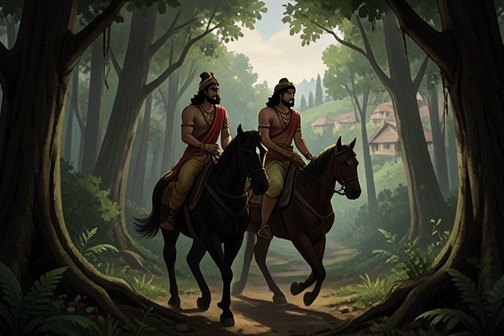
[Lakshmaṇ](entity:character-recall-character-lakshma-7aad0629b677)’s decision to join [Ráma’s exile](entity:state-recall-state-r-ma-a94ec8a82327) turns brotherly loyalty into a practical undertaking. He refuses to imagine a life of power or comfort apart from [Ráma](entity:character-recall-character-r-ma-2db51e45ae4a), and offers to share the forest journey as an armed companion, trail-maker, provider, and guard. Ráma receives the offer with joy and authorizes him to prepare to leave.
## The Decision to Accompany Ráma
Lakshmaṇ makes his choice in response to Ráma’s prospect of living in the woods. If Ráma makes the forest his home, Lakshmaṇ says he will take up his bow that very day and go ahead of him along the route. The promise is immediate: he does not describe a later visit or a temporary act of assistance, but places himself within the journey from its beginning.
His resolve is also expressed as a rejection of rank and reward. Lakshmaṇ says that he would not wish to rule the three worlds if Ráma were absent. The contrast gives his decision its force: exile means leaving the ordinary protections and status of royal life, but separation from his brother would be worse. His stated preference is not for a different share of power, but for a life organized around Ráma’s company.
Lakshmaṇ presents following Ráma as something that carries no sin. The claim answers the prospect of abandoning other obligations or comforts by making the purpose of his choice explicit: he wants to accompany his brother, and doing so is, in his view, morally permissible. His speech thus frames companionship not as a passing impulse but as an action he can defend as right.
## The Work He Offers
Lakshmaṇ gives his promise a concrete shape. He will carry arrows at his side, but his service is not limited to bearing arms. He offers to prepare the path for Ráma’s feet, bringing a spade and basket for the work. The pairing of weapons with tools presents him as both protector and attendant: he is ready for danger, yet also for the daily labor of making a route through forest country.
He undertakes to find roots, berries, and the woodland food eaten by hermits. Rather than treating the forest journey as an occasion for heroic combat alone, the offer attends to its ordinary requirements: food must be gathered, paths made passable, and a place to live found. Lakṣmaṇ describes this labor as his own responsibility, allowing Ráma and his Videhan spouse to rest on the mountain heights while he works for them.
His promise culminates in watchfulness. Lakṣmaṇ will keep guard whether Ráma is awake or asleep. The pledge extends beyond a single task or moment of danger into continuous care. Preparing the way, providing food, and keeping watch are distinct duties, but together they define the role he offers to take on during the exile.
## Ráma’s Response and the Departure
Ráma is filled with joy and pride by Lakṣmaṇ’s speech. His answer accepts the offer rather than treating it as merely an emotional declaration: he tells his brother to go and bid farewell to his friends and retinue. The instruction moves the exchange from intention toward preparation for departure, while acknowledging that Lakṣmaṇ must leave the people attached to his former life.
The scene’s movement is therefore from decision to service and then to practical leave-taking. Lakṣmaṇ first rejects a future separated from Ráma, then specifies the work he will do in the forest, and finally receives Ráma’s assent. The episode establishes that the exile will not be undertaken by Ráma alone: Lakṣmaṇ means to accompany him as an armed escort and as the person responsible for much of the journey’s material care.
## Narrative Significance
The offer broadens the meaning of Lakṣmaṇ’s loyalty. His readiness to follow is not expressed only through affection or a dramatic declaration; it is measured in the tasks he volunteers to perform, from clearing a way with tools to finding food and keeping watch through the night. The forest becomes a setting in which devotion must be maintained through labor as well as resolve.
The exchange also places companionship beside royal ambition and finds the latter wanting. Lakṣmaṇ explicitly sets aside the prospect of sovereignty over the three worlds if it would mean life without Ráma. His choice does not change the terms of Ráma’s exile, but it changes who will bear its conditions with him. Ráma’s joyful consent confirms their shared undertaking and sends Lakṣmaṇ to make the separation from his retinue real.
Event 54
Rama's departure from Ayodhya
[Rama's departure from Ayodhya](entity:event-recall-event-rama-s-departure-from-a-59ffd4491997) is the point at which exile ceases to be a disputed command and becomes a journey shared by [Rama](entity:character-recall-character-rama-fdac9c17dd0c), [Sita](entity:character-recall-character-sita-1913dd4978f6), and [Lakshmana](entity:character-recall-character-lakshmana-1b97114243c1). Rama keeps faith with his father's word and accepts fourteen years in the forest; the change of clothing and the departure at the king's feet make that decision visible. The city responds not as a distant audience but as a community watching its royal household break apart.
## Causes and the decision to leave
The scene places Rama's composure beside [Dasharatha](entity:character-recall-character-dasharatha-b9552a8b18f7)'s anguish. The king is distressed by the fate that has befallen his beloved son, while Rama listens calmly to his father's words. The contrast establishes the emotional cost of the order without making Rama's obedience seem effortless or incidental: the father's suffering is present, but it does not displace the obligation Rama has chosen to honor.
Rama states the consequence plainly: he will dwell in the woods for fourteen years. His decision translates the command into a definite term and a particular way of life among the forest's glades and dells. Rather than pursuing power or contesting the order, he makes the period of banishment the measure of his own response. The departure therefore begins as an act of obedience, but also as a deliberate acceptance of what that obedience entails.
## The garments of exile
The change from royal life to forest banishment is marked by bark clothing. [Kaikeyi](entity:character-recall-character-kaikeyi-2477fd7cdcbf) herself takes the hermit's garments and hands them over. Her role in the moment is materially direct: the person associated with the demand for exile also supplies the visible sign by which it is imposed. The passage's emphasis on her unblushing manner sharpens the contrast between the distress surrounding the decision and the confidence with which she carries out this particular act.
Lakshmana also throws off his garment and changes into the clothing of exile in his father's presence. His action makes clear that Rama does not leave alone. The text gives the change a public witness: the king sees not only Rama's acceptance but Lakshmana's choice to share the forest life. The bark garments are more than practical dress in the scene; they register a sudden passage from the royal household to the conditions of banishment, while binding the brothers' departures together.
## The leave-taking and the city's grief
Before going, Rama, Sita, and Lakshmana bow at the king's feet. Their leave-taking brings the family separation into a single gesture of respect, followed by their sad departure. The movement from the king's feet to the road gives the scene its emotional hinge: filial deference is expressed immediately before the household is divided by the command Rama has undertaken to obey.
The departure unfolds in a chariot drawn by swift horses. As the son of Raghu goes forth for banishment, the narration turns from the traveling party to the town's response. The horses neigh and shake their bells; elephants answer with roars. These sounds accompany a city in motion, not a quiet or private exit. People of every age, overcome by sorrow, rush toward the chariot as it goes.
The crowd's response makes the consequences of the decision communal. Rama's exile removes him from [Ayodhya](entity:location-recall-location-ayodhya-ef190b6473a9), but the departure also draws the city's inhabitants into the scene as witnesses to his loss. The poem gives their grief physical expression in the rush toward the vehicle and sets it alongside the animals' cries and the chariot's onward movement. The procession thus carries two opposing motions at once: the people move toward Rama, while the journey carries him away.
## Significance of the departure
The passage's emotional force rests on the contrast between firmness and grief. Rama is described as calm when he hears his father, yet the leave-taking is sad, Dasharatha is anguished, and the city cannot contain its sorrow. His steadiness does not erase the pain surrounding the choice; it gives that pain a clear cause and consequence. The exile proceeds because Rama treats his father's word as binding even when the result is separation from home and family.
The narrative also turns an imposed sentence into a shared departure. Kaikeyi provides the bark garments, Lakshmana changes into them, and Sita is named among those who bow and go. The event is therefore not merely Rama's departure from the city: it is the beginning of a forest life undertaken by the three together, witnessed by the king and mourned by Ayodhya. The image of the chariot leaving amid the city's cries fixes the change in public memory, while the stated fourteen years give the separation its appointed duration.
Event 55
The citizens follow Rama and return to Ayodhya
The citizens follow [Ráma](entity:character-recall-character-r-ma-2db51e45ae4a) and return to [Ayodhyá](entity:location-recall-location-ayodhy-08bd0b6815c4) in a scene of separation shaped by two forms of care: the people’s devotion draws them after their exiled prince, while Ráma’s concern for his subjects leads him to slip away unseen. At the [Tamasa River](entity:location-recall-location-tamasa-river-0add1ef9afd1), their attachment becomes a burden he cannot allow them to carry into the forest with him. Their return to Ayodhyá gives the departure a second, sorrowful movement: Ráma continues toward exile, while the people retrace their steps without him.
## Causes and Background
As Ráma sets out from Ayodhyá with [Sítá](entity:character-recall-character-s-t-0be56374418b) and [Lakshmaṇ](entity:character-recall-character-lakshma-7aad0629b677), the citizens follow. The poem presents their pursuit as an expression of tender love: they are drawn to follow the prince, not ordered to accompany him. His departure is already bound to filial duty, but the people’s response makes its public cost visible. The exile is not only a separation within the royal family; it draws the city’s inhabitants onto the road behind Ráma.
Ráma recognizes that the crowd’s loyalty may turn into further suffering. He fears that if he remains in the forest while they stay with him, [Daśaratha](entity:character-recall-character-da-aratha-ffdd8279512e)’s heart will suffer over the people as well as over his son. His concern thus reaches in two directions: he must honor his father’s command, but he also considers the pain his continued presence on the road may cause both his father and his subjects.
## The Departure at the Tamasa River
At the Tamasa River, the travelers stop for the night, and the people lie down around Ráma. Once they are asleep, he looks upon the sleeping crowd and tells Lakshmaṇ that they should leave while the people remain unconscious. The decision is deliberate: rather than openly ask the citizens to turn back, Ráma uses the quiet of the night to continue the journey without them.
He and Lakshmaṇ set out by chariot with Sítá. The choice transforms the sleeping crowd into the scene’s sharpest image of separation: the citizens have followed as far as they can, yet the very rest that briefly gathers them near Ráma enables him to go on alone with his companions. Their affection is not rejected; it is the reason he tries to spare them a forest life they did not have to undertake.
## Ráma’s Duty Toward His Subjects
Ráma explains his decision as part of a prince’s responsibility. A ruler should heal the troubles his people bring upon themselves through devotion, he reasons, not let them share his own hardship. His departure in secret is therefore more than a practical escape from a persistent crowd. It expresses a model of care in which the ruler accepts his own exile but refuses to make loyal subjects bear its consequences beside him.
That principle gives the episode its moral tension. The citizens’ conduct is an act of loyalty, but Ráma does not treat loyalty as permission to expose them to needless hardship. He does not change his course or abandon the exile; instead, he separates himself from the people so that they may return home. In this way, obedience to the command that sends him away coexists with attention to the welfare of those who follow.
## The Citizens’ Return
When morning comes, the people wake and find that Ráma is gone. They search for him but find no trace, and their loss becomes immediate and collective: they are left bereft of the wise prince they had followed. Their return is not a willing reversal of their loyalty but the consequence of having no way to continue after he has slipped beyond their reach.
With weary hearts, grief, and shame, they take the road back and reach Ayodhyá. The journey thus divides into two paths: Ráma continues toward the hermit-haunted forest with Sítá and Lakshmaṇ, while the citizens return to the city he has left. The episode makes that separation a measure of his character and of his bond with the people. Their devotion draws them after him; his concern sends them home.
Event 56
Rama crosses the Ganges with Sita and Lakshmana
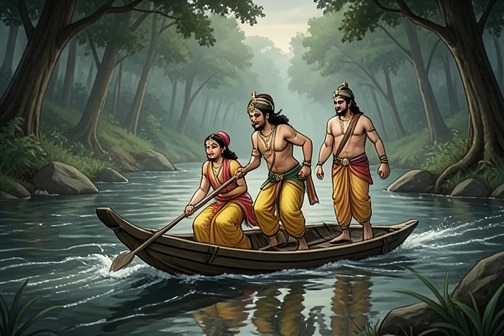
[Rama crosses the Ganges with Sita and Lakshmana](entity:event-recall-event-rama-crosses-the-ganges-a9c3bbe48c80) at a decisive threshold in their exile: the journey leaves behind the royal road and its attendants, and continues on foot into the forest. The passage is both a practical river crossing, arranged by [Guha](entity:character-recall-character-guha-e60e5ac6790a), and a sequence of farewells. [Sita](entity:character-recall-character-sita-1913dd4978f6)’s prayer midway across gives the crossing its stated purpose: that the river protect [Rama](entity:character-recall-character-rama-fdac9c17dd0c) as he fulfills [Daśaratha](entity:character-recall-character-da-aratha-ffdd8279512e)’s will.
## Exile Reaches the River
The crossing follows a change in how the exiles travel. [Ráma](entity:character-recall-character-r-ma-2db51e45ae4a) tells [Sumantra](entity:character-recall-character-sumantra-63fb393e2ea4) that the charioteer has guided them thus far, but should now return to [Ayodhyá](entity:location-recall-location-ayodhy-08bd0b6815c4) and keep watch over the king. Ráma and his companions will leave the horses and chariot behind and proceed on foot into the forest. The decision marks more than a change of transport: the royal vehicle and the attendant who drove it belong to the journey’s earlier stage, while the route ahead is explicitly a forest journey.
The separation is not abrupt. Sumantra asks what remains for him to do, and Ráma answers by giving him a responsibility: return and attend carefully to the king. In the same exchange, Ráma touches his friend with his right hand. The gesture accompanies a clear instruction, but the instruction is also a parting. Sumantra is not sent away as an unwanted presence; he is entrusted with a duty that connects the exiles to the father and king they are leaving behind.
The crossing therefore carries the force of Daśaratha’s command into the landscape. Sita later names that obligation directly in her prayer, asking that Ráma, protected by [Gangá](entity:location-recall-location-gang-9009c842330c), fulfill his prudent father’s royal will. The river is not presented as a reason to abandon the exile or evade its terms. Instead, Sita’s appeal places the passage under the same filial purpose that has set the journey in motion.
## Guha Arranges the Passage
After the night, Guha hears Ráma’s request and agrees to help. He promptly calls for a boat to be made ready at the shore, specifying that it should be swift and strong, with a rudder, oars, and men. The arrangements make the crossing a coordinated undertaking rather than a solitary feat: Guha supplies the vessel and its crew, while the river’s current and the helmsman’s guidance remain part of the passage.
Ráma acknowledges Guha’s care before boarding. The relationship is marked by hospitality and friendship, but the scene also has a boundary built into it: Guha can provide safe transport to the far bank, while Ráma’s party must continue beyond that assistance. Ráma gives Guha a final farewell, then, together with [Lakshmaṇ](entity:character-recall-character-lakshma-7aad0629b677) and [Sítá](entity:character-recall-character-s-t-0be56374418b), sets out toward the boat. Guha’s help enables the journey, but it does not remove the necessity of separation.
The sequence also completes Sumantra’s role. Ráma has already directed him to return with the chariot and horses; before the boat leaves, Ráma says farewell to Sumantra as well as to Guha and the train accompanying him. Thus the crossing follows two distinct leave-takings: the return of the royal attendant and the parting from the friend who has arranged the boat. The river divides the party’s immediate paths, even as Ráma’s charge to Sumantra preserves a connection with the king.
## Sita’s Prayer Midstream
Once aboard, Ráma urges the vessel away from the land. Strong strokes propel it, and the helmsman guides it through the waves of Gangá. The narrative marks a specific pause in the crossing: halfway across, Sítá joins her hands in reverence and addresses the river. Her prayer asks for the protection of the prince descended from Daśaratha, so that he may fulfill his father’s royal will.
That prayer makes Sítá an active interpreter of the journey’s stakes. The crossing is not merely a movement of bodies between banks: in her appeal, its success is bound to Ráma’s obedience and to the completion of the exile. The river becomes the immediate power to which she entrusts his safety, while Daśaratha’s command remains the human obligation the journey must honor. The prayer does not claim that the danger is over or that the exile has been fulfilled; it asks for protection as the party continues onward.
The narrative returns from prayer to movement. Sítá speaks for her husband’s sake, and the vessel carries the group to the right bank. The passage’s physical details—the joined hands, the boat in midstream, the helmsman steering through the waves—give the transition a measured shape: departure from land, a pause of reverence, and arrival on the opposite shore. The crossing ends not with a return to the world left behind, but with the party safely on the far bank.
## A Threshold, Not a Return
The episode turns departure into a visible change of stage. Ráma has relinquished the chariot and sent Sumantra back; Guha’s boat carries the remaining travelers across Gangá; Sítá’s prayer binds their onward passage to Daśaratha’s will. Each action marks a different aspect of the break: the royal means of travel are left behind, personal companions are farewelled, and the river is crossed under the sign of filial duty.
The far bank is the immediate outcome, not the end of the exile. Ráma, Sítá, and Lakshmaṇ remain together, and their journey continues on foot into the forest. Guha’s assistance and Sumantra’s return make the crossing a hinge between relationships as well as places: one friend helps the travelers onward, while another is sent back to serve the king. The episode’s quiet force lies in that orderly division. No conflict interrupts the passage, yet the crossing makes the separation concrete and carries the exiles into the next stretch of their journey.
Event 57
Rama settles at Chitrakuta
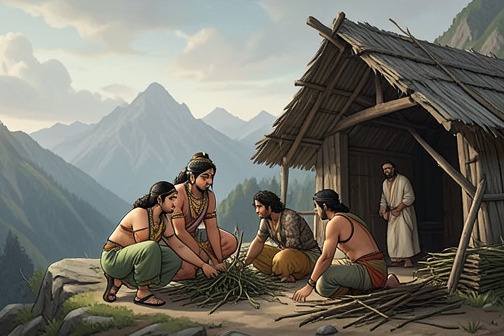
[Rama settles at Chitrakuta](entity:event-recall-event-rama-settles-at-chitrak-26ea1830d703) when the journey through the forest gives way to the making of a home. Guided first by [Bharadvája](entity:character-recall-character-bharadv-ja-87bd3d82bdf6) and then by his further directions the next morning, [Ráma](entity:character-recall-character-r-ma-2db51e45ae4a), [Sítá](entity:character-recall-character-s-t-0be56374418b), and [Lakshmaṇ](entity:character-recall-character-lakshma-7aad0629b677) reach the mountain, receive the sage’s hospitality, and establish a leafy hut. The episode turns a place of temporary lodging into a deliberately prepared refuge: Lakshmaṇ gathers branches and builds at Ráma’s request, and the household enters only after making its ritual offerings.
## Directions and Arrival
At Bharadvája’s dwelling, the travellers are received by the hermit among his disciples. The account presents him as a settled figure of spiritual discipline, and his hospitality gives the travellers a pause in their movement through the forest. Ráma asks where they might live; Bharadvája points him toward a hill ten leagues away, describing it as a beautiful and holy place. His advice is practical as well as devotional: a destination is named not merely as scenery, but as a possible dwelling.
The guidance continues the following morning. Bharadvája directs Ráma to [Chitrakúṭa](entity:location-recall-location-chitrak-a-63502c96da20), where berries grow and sweetness is abundant, and says that he believes it will suit them as a home. The recommendation joins the natural provision of the landscape to its sacred character. The group moves onward, and the canto heading identifies their destination as Chitrakúṭa. That sequence matters: they do not simply stumble into a shelter, but follow a sage’s counsel from one stopping place toward a chosen settlement.
The poem marks the arrival through the prospect of a suitable place to lodge for the night, with smooth ground and fairness around them. This is a modest description, but it prepares the event’s shift in scale. The travellers have reached a place where they can stop; the next actions will make that stop habitable. The account thus moves from a route and its directions to a particular site, then from the site to the labour and observances that turn it into a home.
## Welcome and the Choice to Stay
Bharadvája receives the visitors with honour and welcomes them to sit and rest. Ráma tells him that they would gladly remain there for a while and pass a season in cheerful company. The stated wish establishes the stay as temporary, but more substantial than a single night’s shelter. The forest journey is not over; within it, however, the travellers seek a place where life can take on a regular shape.
The sage’s welcome and Ráma’s decision perform distinct parts in the settlement. Hospitality makes rest possible, while Ráma’s expressed intention makes clear that the group will stay rather than simply accept directions and continue at once. The passage does not describe a dispute or a forced choice at Chitrakúṭa. Instead, it gives the episode a measured progression: advice, arrival, welcome, a declared wish to remain, and preparation of a dwelling.
That movement also distinguishes the hermit’s home from the travellers’ own. Bharadvája offers a welcome at his dwelling; Ráma then directs Lakshmaṇ to build a hut beneath the mountain, in a remote place supplied with water. The new home is therefore neither a permanent return to settled royal life nor merely an extension of the sage’s hospitality. It is a forest residence made for the three travellers, situated according to the conditions Ráma specifies.
## Lakshmaṇ Builds the Hut
Ráma addresses Lakshmaṇ as his brother and asks him to bring wood from the forest. Lakshmaṇ obeys, gathering trees and cutting branches to make the leafy hut as Ráma directs. The construction is presented as shared household work, but its particular labour falls to Lakshmaṇ: Ráma states what is needed and where the dwelling should stand; Lakshmaṇ supplies the materials and shapes them into shelter.
The description combines simplicity with care. The structure is leafy, made from branches cut in the forest, yet the poem calls it firmly built and walled with wood. It is placed beneath the mountain’s side, away from the more immediate setting of the sage’s dwelling, and the chosen spot has a good supply of water. These details define the dwelling through its materials, position, and practical provision rather than through ornament. A forest shelter becomes a usable home because it is deliberately located and built, not because its occupants cease to live in the forest.
The exchange between the brothers gives the settlement its human action. Lakshmaṇ’s prompt obedience turns Ráma’s request into a material structure, while the reference to their relationship keeps that work within the intimacy of family life. The hut is not attributed to an unnamed group of builders: the narrative makes Lakshmaṇ’s service visible and places Ráma’s direction at the centre of the scene. The resulting dwelling embodies both the constraints of forest residence and the care with which the brothers arrange it.
## Ritual Entry and Significance
Before entering, Ráma, Lakshmaṇ, and Sítá make offerings to the gods and the shades. The account associates the observance with muttered prayer and the prescribed ritual materials—water, grass, wood, and fire—and then records their entry into the pleasant hut. The order is significant: construction alone does not complete the act of settling. The three mark the transition into their new dwelling through religious observance, bringing the household’s sacred obligations into the place they have prepared.
The episode’s decisive change is therefore small in outward form but clear in narrative structure. The travellers move from Bharadvája’s hospitality to a home of their own; Ráma chooses the site, Lakshmaṇ builds, and all three participate in the offerings before crossing into the hut. The sage’s guidance connects the settlement to the landscape’s sacred reputation, while the hut’s wood, branches, and water supply make that landscape a practical place of residence.
Chitrakúṭa is established here as a temporary forest home rather than a final destination. The stated intention is to remain for a season, and the scene closes not with departure or conflict but with the three entering the dwelling they have prepared. Its quiet sequence—counsel, welcome, construction, offering, entry—gives the forest sojourn a domestic and ritual centre, showing how Ráma’s party makes a place of refuge within the ongoing journey.
Event 58
Dasharatha Accidentally Kills Shravana and Is Cursed
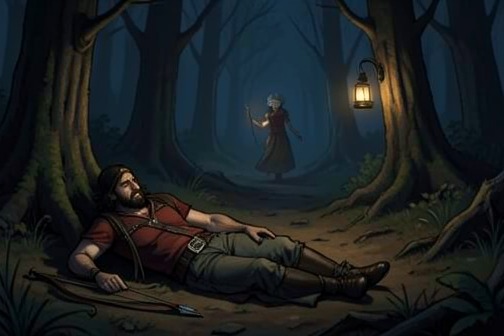
[Dasharatha](entity:character-recall-character-dasharatha-b9552a8b18f7)’s accidental killing of Shravana turns a moment of mistaken judgment into a lasting moral debt: the king’s unintended act takes a son from his parents, and the father’s curse foretells that Dasharatha himself will die overwhelmed by grief. Recounted as a past event, the episode links an error made in darkness to a consequence that arrives much later, when sorrow over [Rama](entity:character-recall-character-rama-fdac9c17dd0c) will become the defining trial of Dasharatha’s life.
## Causes and Circumstances
The event begins at a river in darkness. Dasharatha hears the sound of a pitcher being filled and, unable to see what is making it, takes the sound for an elephant at the water’s edge. The setting matters to the mistake: his judgment is based on a noise interpreted in obscurity, not on a clear view of a target. He draws and releases an arrow, acting on that mistaken identification.
The episode describes the killing as unintended. Dasharatha is moved by duty when he hears a lament and goes to find out what has happened. That response brings him face to face with the consequence of his shot: the person he had imagined as an animal is a human being, Shravana, whose aged parents depend on him. The contrast is decisive. A hunter’s expectation has given way to the reality of a family bereaved, and the action cannot be undone by Dasharatha’s lack of intent.
## Recognition and Confession
Dasharatha’s account follows the passage from misjudgment to recognition. He first hears a sound and assigns it a familiar explanation; only afterward does he learn that the shot has struck a son. The discovery turns an apparently ordinary act of hunting into a personal catastrophe for the family and a source of guilt for the shooter.
He approaches the wounded Shravana and removes the arrow. The account gives particular weight to the son’s attachment to his parents: even at the end, he laments for them. His death therefore reaches beyond the immediate victim. The parents lose the child they loved, while Dasharatha must confront the fact that his action has brought suffering upon people who were not his enemies. He acknowledges that he killed their son unknowingly and appeals to the father, making his admission part of the scene’s moral reckoning rather than concealing what he has done.
## The Father’s Curse
The father’s response gives the accident its lasting consequence. He grieves for the son he loved and declares that Dasharatha’s heedless arrow has caused the deaths of all three members of the family. The curse arises from that loss: Dasharatha is to suffer a comparable grief and die under its weight. It does not predict an immediate punishment. The father explicitly places the fulfillment in the future, so the curse becomes a deferred judgment attached to the king’s act.
The episode thus distinguishes intent from consequence without treating good intent as an escape from responsibility. Dasharatha did not know whom he was shooting, but the family’s suffering remains real, and his remorse cannot restore what was lost. The father’s grief also gives the curse its force: it is spoken by someone whose own bereavement supplies its terms, not by an abstract authority pronouncing a penalty without personal cost.
## Delayed Fulfillment and Narrative Role
The memory gains further significance when set beside Dasharatha’s later anguish over Rama’s fate. The book marks the father’s distress at the prospect of Rama’s suffering, echoing the curse’s prediction that grief will eventually crush Dasharatha. The earlier scene therefore makes the later sorrow feel both immediate and fated: the king’s loss is still his own, but it also recalls a consequence declared in the past.
As a flashback, the account changes how Dasharatha’s suffering can be understood. His grief is not presented only as a response to events in his household; it also completes the long-delayed pattern established by his encounter with Shravana’s parents. The episode holds two truths together: the fatal shot was an accident, and the harm it caused carries consequences beyond the moment of error. Its force lies in that interval between act and reckoning, as a misheard sound at a river becomes a wound that returns through memory and, later, through grief.
Event 59
Bharata’s Return to Ayodhya
[Bharata](entity:character-recall-character-bharata-72e56a1f79da)’s return to [Ayodhya](entity:location-recall-location-ayodhya-ef190b6473a9) is a homecoming transformed by what he learns there: [Dasharatha](entity:character-recall-character-dasharatha-b9552a8b18f7) is dead, and [Rama](entity:character-recall-character-rama-fdac9c17dd0c) has gone into the wilderness with [Lakshmaṇ](entity:character-recall-character-lakshma-7aad0629b677) and [Sítá](entity:character-recall-character-s-t-0be56374418b). The news, disclosed by [Kaikeyí](entity:character-recall-character-kaikey-bfffeff04c04), makes Bharata’s arrival a scene of recognition rather than celebration, joining private grief to the rupture of the royal family.
## The Road Home and the City
Seven nights pass on the journey before Bharata sees Ayodhya at sunrise. The city is described as built and planned by [Manu](entity:character-recall-character-manu-91d5f38f8c61), its ancient royal founder. That history gives the returning prince a place associated with dynastic continuity, but the welcome it offers is shadowed by a present crisis in the royal household.
The narrative places Bharata’s approach beside his memory of a strange vision of the king, which still weighs on his heart. The recollection makes the homecoming feel troubled before the central news is spoken. His unease is not yet knowledge: the vision and the ominous feeling that follows it prepare the reader for a disclosure that will turn his expectation of reunion into mourning.
## Foreboding Before the News
Bharata’s sense of danger gathers around what he takes to be grave sins and ominous signs. The account gives these forebodings a place in the sequence rather than treating the revelation as wholly unanticipated. Yet the signs do not tell him plainly what has happened. The difference between apprehension and confirmed knowledge sustains the scene’s tension as he returns to the city still unaware of his father’s fate.
That delay matters because the news comes through Kaikeyí, not through an impersonal announcement. Bharata approaches the household expecting to find his family; instead, his mother becomes the messenger of the loss and the exile. The private setting makes the disclosure a family rupture as well as a change in the kingdom’s condition.
## Kaikeyí’s Disclosure
Kaikeyí reveals Dasharatha’s fate to her son. The account marks the painful mismatch between the substance of her message and the manner in which she gives it: she tells the sad news as though it were glad. Her apparent intention is to please Bharata, but the effect is to sharpen the difference between what she expects him to welcome and what he actually hears.
Bharata is described as pious, pure, and true, and the news pierces him. His grief is for the father he loved. The emphasis falls not on political advantage but on filial attachment: the death that Kaikeyí presents as part of a changed succession is, for Bharata, first a personal bereavement. His reaction establishes the moral distance between his mother’s understanding of the situation and his own response to it.
## The News of Rama’s Exile
Kaikeyí also tells Bharata that Rama has gone in hermit dress to the great [Daṇḍaka](entity:location-recall-location-0348343cba9e) wilderness, with Lakshmaṇ and Sítá sharing his exile. This detail makes the absence more than a temporary departure from the city. Rama has left the royal household for forest life, and his wife and brother have gone with him.
The disclosure joins two losses in Bharata’s hearing: his father’s death and his brothers’ altered fortunes. When the queen has related both his brothers’ doom and his father’s fate, the narrative records Bharata speaking to his mother. The sequence gives his response its full cause: he is not reacting to a single piece of bad news, but to the combined revelation that Dasharatha is gone and Rama’s household has been driven from Ayodhya.
## Recognition and Narrative Significance
The return is structured as a gradual passage from foreboding to knowledge. The remembered vision and the sense of omens precede Kaikeyí’s direct account; her words then replace uncertainty with the concrete facts of death and exile. The movement gives the arrival its dramatic force without making Bharata the narrator: the events are presented in third-person narration, while his unease and grief are registered within the scene.
Ayodhya’s association with Manu and royal continuity stands in contrast to the fractured present Bharata encounters. The heir’s homecoming does not restore what has been lost or immediately resolve Rama’s absence. Instead, it reveals the personal cost of the family’s political crisis and establishes Bharata’s grief as the first consequence of learning what has happened in his absence.
Event 60
Bharata Rejects the Throne and Sets Out to Restore Rama
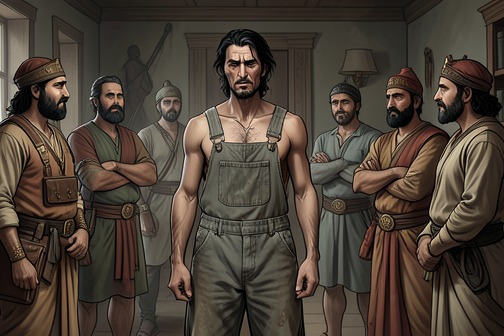
[Bharata](entity:character-recall-character-bharata-72e56a1f79da)’s refusal turns a contested succession into a declaration of loyalty: he denies that he wants the throne, insists that [Ráma](entity:character-recall-character-r-ma-2db51e45ae4a) is the rightful king, and makes restoring his brother his purpose. His departure is not a bid to rule from elsewhere, but a journey to persuade Ráma to return; if that fails, Bharata says he will share the forest exile.
## Absence and Discovery
Bharata’s response begins with an insistence that he did not know what had happened in his absence. Speaking before the lords and ministers, he says, “I with [Śatrughna](entity:character-recall-character-atrughna-60f42e73f771) all the time / Was dwelling in a distant clime:” and explains that he knew nothing of [Ráma’s exile](entity:state-recall-state-r-ma-a94ec8a82327). He also says he knew nothing of Ráma’s consecration. The distinction matters: Bharata presents neither the succession nor the banishment as decisions he supported or helped arrange. He had been away, and the decisive events took place without his knowledge.
His account also reaches beyond the political change. Bharata says he did not know how [Sítá](entity:character-recall-character-s-t-0be56374418b) went with Ráma. The statement places the separation of the royal household within the same unwelcome revelation as the lost consecration: he had not witnessed the preparations, the departure, or the choice to go into the forest. The passage does not make his absence an excuse for claiming the throne. Instead, the knowledge that the crown has been turned toward him becomes the occasion for him to reject it.
## A Public Refusal
Bharata speaks before the assembled lords and ministers, and his refusal is framed as a rebuke rather than a private reservation. He declares, “No lust have I for kingly sway, / My mother I no more obey:” The two claims work together. He repudiates the kingship, and he also refuses to treat his mother’s action as binding simply because she is his mother. His words distinguish family authority from the justice of the demand: the throne cannot rightfully be his merely because she has sought it for him.
The rebuke is sharpened by Bharata’s judgment of his mother’s act as a sin that weighs on him. He says that he will go to Ráma in the pathless shade with his hands joined. The gesture makes his purpose one of appeal and submission, not a display of force against his brother. The public setting gives that intention political consequence: before the court, Bharata disowns the advantage created by the exile and makes clear that he will not consent to Ráma’s removal from the succession.
A holy priest’s response reinforces the difference between Bharata and the accusation that he would seize power. The priest asks how Bharata could dare to tear authority from Ráma, whom the passage describes as wise, devout, true, and chaste. In this exchange, the question is not whether Bharata can take the throne, but whether such a man would wrong the rightful king. Bharata’s own words and the priest’s defense converge: his conduct is presented as fidelity to Ráma, not ambition disguised as duty.
## The Claim of Birthright
Bharata grounds his refusal in the rule of succession, not merely in personal affection. He tells the gathered people, “[The eldest son is ever king](entity:expression-recall-expression-the-eldest-son-is-833d4da76001): / So rules the house from which we spring:” He then identifies Ráma as eldest-born and says that Ráma shall rule the land. The argument links an established family custom to a particular claimant: the general rule determines the right, and Ráma’s position as the eldest son applies it.
The passage thus makes Bharata’s choice more than a renunciation of personal reward. If he accepted the kingship, he would contradict the principle he states in public and take the authority he says belongs to his brother. His appeal to custom gives the refusal a constitutional weight within the family’s own order. Ráma’s claim is not represented as something that Bharata may waive on his behalf; Bharata treats it as the rule that governs the succession.
## The Journey to Bring Ráma Back
Having declared who should rule, Bharata acts on that judgment. He announces, “Now to the woods will I repair, / Five years and nine to lodge me there.” The stated duration is fourteen years. He does not present the forest as a temporary refuge from court politics, but as the place he will go to find Ráma and seek his return. He orders a great force assembled, naming chariots, elephants, infantry, and horse, and says he will follow Ráma’s track and bring his eldest brother back.
The scale of the preparations makes the expedition public and organized, while its declared goal remains personal and restorative. Bharata sends labourers and pioneers ahead to make and clear the road. The detail gives the journey a practical beginning: before the royal party and force proceed, workers are already preparing the route. The text does not describe this as a campaign against Ráma. Bharata’s stated intention is to reach him and restore him to the place the succession rule assigns him.
Bharata also defines what he will do if persuasion fails. He says that if he lacks the power to bring his brother back, he will dwell in the forest and share the exile. That vow makes his offer conditional in one respect but unwavering in another: he may not be able to change Ráma’s decision, yet he will not use that failure as a reason to accept the throne. The episode ends with the effort to reach Ráma set in motion, the road being cleared and Bharata’s choice made plain: if his brother cannot be restored, Bharata will accompany him rather than rule in his stead.
Event 61
Dasharatha’s Funeral
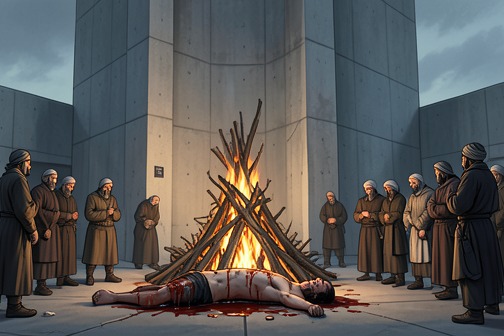
[Daśaratha](entity:character-recall-character-da-aratha-ffdd8279512e)’s Funeral is the royal cremation and mourning that follow the king’s death. Guided by [Vaśishṭha](entity:character-recall-character-va-ish-ha-033580f29400), [Bharat](entity:character-recall-character-bharat-6395f3ef7f4e) moves the household from grief into prescribed action: Daśaratha’s body is brought from the oil in which it has been kept, placed on a pyre built with fragrant woods, and committed to the sacred fires. The women’s lament and the later gathering of the bones make the funeral both a public expression of loss and a sequence of duties that carries the royal family from death toward its aftermath.
## The call to perform the rites
Vaśishṭha addresses those overcome by grief and urges them to be comforted: the time has come to place the monarch’s body on the pyre. His words do not deny the family’s sorrow; they mark the moment when mourning must give way to action. The funeral begins because the king has died, but its immediate order comes from the sage’s reminder that the rites cannot be indefinitely delayed.
The poem makes the transition concrete. The attendants raise Daśaratha’s body from the oil and place it, still dripping, on the ground before laying it on a bed. This handling of the body is part of the funeral’s visible preparation, rather than a detail passed over between death and cremation. The sequence gives the king’s remains a changed status: they are brought out of their temporary preservation and moved toward the pyre.
## Bharat arranges the cremation
Bharat listens to Vaśishṭha’s counsel and summons the chaplain, priests, and holy guides. He also orders that the sacred fires be brought. His role is practical and ceremonial: in the absence of his father, he gathers the people and ritual elements needed to carry out the king’s funeral. The scene places the bereaved prince within the duties of the royal household without making his grief disappear.
The pyre is furnished with sandalwood, cedar, aloe, pine, and other fine perfumes. Priestly hands then place Daśaratha upon it, and the sacred fires are tended. The account records both the materials and the officiants, joining the physical work of cremation to its religious order. Fragrant timber does not soften the fact of death; it belongs to the carefully conducted rite through which the king’s body is consigned to the flames.
## The household’s mourning
The queens, including [Kauśalyá](entity:character-recall-character-kau-aly-f8fa3c3ce87b), are present in grief, and the poem gives particular force to the women’s voices. Their cries, compared to the calls of curlews, rise from many mouths and strike the scene with a sound that contrasts with the priests’ measured work. The funeral therefore holds two responses together: the formal tending of fire and the uncontrolled expression of bereavement.
The women weep until their grief is stilled. That phrasing marks a change in the scene, but not a reversal of the loss: Daśaratha remains dead, and the rite continues into its later observances. The narrative gives mourning space as an event in its own right, rather than treating it as a brief accompaniment to the cremation. The gathered family’s sorrow is heard before the account turns to the aftermath of the fire.
## From pyre to gathered bones
The rites extend beyond the burning. After the tenth day has passed, Bharat is described as free from legal stain; the narrative thus tracks a period of ritual observance rather than ending with the pyre. In the subsequent scene, Bharat approaches the bottom of the pyre sobbing and addresses his father. The gesture brings filial grief close to the remains, even as the funeral’s next obligation comes into view.
The instruction is to delay no longer but to gather whatever bones remain, as the rules ordain, after the flames have consumed Daśaratha’s body. The movement from the preserved body, to the pyre, to the bones gives the episode its full ritual arc. Cremation is not presented as the end of the family’s responsibilities: the remains must still be gathered, and Bharat’s obedience to that instruction carries the funeral into its final recorded stage.
Event 62
Bharata’s Expedition to Chitrakuta
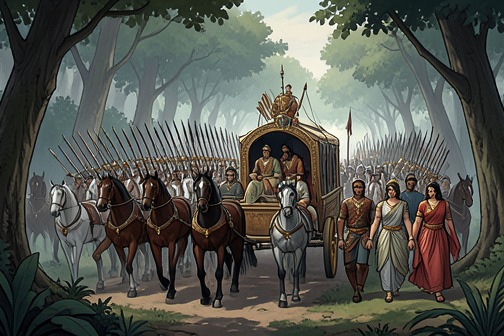
[Bharat](entity:character-recall-character-bharat-6395f3ef7f4e)’s Expedition to [Chitrakuta](entity:location-recall-location-chitrakuta-553d13ef69b9) is the journey Bharat undertakes to find [Ráma](entity:character-recall-character-r-ma-2db51e45ae4a) in exile and ask him to return. Its scale makes the expedition politically ambiguous: Bharat travels with a formidable royal host, and [Guha](entity:character-recall-character-guha-e60e5ac6790a) initially regards the force at the [Gangá](entity:location-recall-location-gang-9009c842330c)’s shore with anger. Bharat’s denial of treachery and his stated purpose turn the march from a possible threat into an appeal to his elder brother.
## Purpose and departure
At early morn, Bharat rises and sets out in his chariot. The expedition is not described as a campaign against Ráma: its stated object is to bring his banished brother home. The journey therefore carries a tension between the means of royal power and the purpose Bharat claims for them. He approaches Ráma with an army, yet presents himself not as a rival claimant but as a younger brother seeking his elder’s return.
The expedition’s size is made concrete in its military detail. A hundred thousand archers are among the force, with horses riding in extended lines; the account also describes a mighty host accompanying Bharat. [Kaikeyí](entity:character-recall-character-kaikey-bfffeff04c04) and [Sumitrá](entity:character-recall-character-sumitr-3aa9efc30c7f) are present as the party moves out. These details make the journey a public royal undertaking, not a private visit, and help explain why its arrival can provoke suspicion before Bharat has spoken.
## Guha’s suspicion and Bharat’s answer
At the Gangá’s shore, Guha sees the host spread across the riverbank and reacts with anger. The scene makes the expedition’s imposing appearance consequential: a force of this size could be read as a danger to the exiles, even though Bharat’s purpose is to restore Ráma rather than displace him. The narrative thus places intention and appearance in direct contrast.
Bharat answers Guha plainly. He asks not to be suspected of plotting a foul crime and identifies Ráma as his eldest brother. The denial matters because the expedition’s political circumstances invite precisely that interpretation: with Bharat travelling at the head of the royal force, Guha needs assurance that the march is not an attempt to seize or overpower Ráma. Bharat’s appeal to their kinship and birth order supplies his explanation for coming, while his aim of bringing Ráma home gives the journey its declared direction.
## Crossing the Gangá
Once Guha hears Bharat’s request, the exchange turns from suspicion to cooperation. Bharat asks that boats be prepared to carry his servants and the army across the river. Guha’s people respond quickly, and five hundred boats are secured and moored. The fleet’s number underscores the practical scale of the crossing: this is not a small group of relatives travelling together, but a large expedition whose passage depends on organized local assistance.
With Guha’s help, the army crosses the Gangá and reaches the woodland at [Prayag](entity:location-recall-location-prayag-a7b419e00b4d) at an auspicious hour. The river crossing is a turning point in the route: Guha, who first sees the host as a possible threat, now enables it to proceed. Bharat’s party then approaches the hermitage, with the prince seeing the sage’s dwelling from a league away. The itinerary carries the royal expedition out of the riverbank encounter and into the forest setting where news of Ráma’s refuge can guide its next movement.
## Directions to [Chitrakúṭa](entity:location-recall-location-chitrak-a-63502c96da20)
At the hermitage, Bharat explains that he has come to win Ráma’s favor and cast himself at his brother’s feet. The declaration makes the journey’s personal purpose explicit: the prince seeks an audience and reconciliation, not a victory over the exile. The sage confirms that Ráma, his brother, and his wife live at Chitrakúṭa, then gives Bharat directions. The mountain lies less than four leagues away, amid a vast forest; Bharat is told to lead the army south and continue farther south to find the solitary retreat.
The episode ends with a route toward Ráma rather than a completed reunion. Its progression—from a vast host seen with suspicion, through Bharat’s assurance and Guha’s aid, to the sage’s precise directions—recasts the expedition as a journey of supplication. The scale of the force remains striking, but the stated purpose, the crossing made possible by Guha, and Bharat’s willingness to seek his brother’s favor define what the march is meant to accomplish.
Event 63
Bharadvaja’s Miraculous Feast for Bharata’s Army
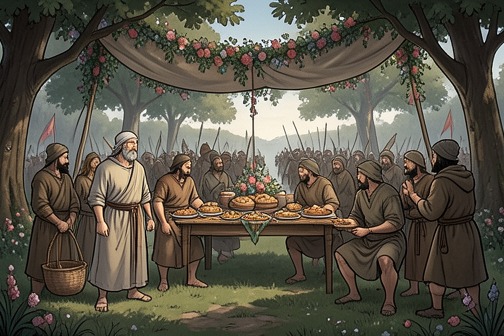
[Bharadvája](entity:character-recall-character-bharadv-ja-87bd3d82bdf6)’s Miraculous Feast for [Bharata](entity:character-recall-character-bharata-72e56a1f79da)’s Army transforms a brief halt on [Bharat](entity:character-recall-character-bharat-6395f3ef7f4e)’s journey to [Chitrakuta](entity:location-recall-location-chitrakuta-553d13ef69b9) into an immense act of hospitality. At first, Bharat approaches the sage with only the priests, wary that a large force might damage the hermitage’s springs and cottages. Bharadvája insists that he bring the whole host. The feast that follows makes the hermit’s welcome spectacularly larger than the prince’s cautious expectations: with [Viśvakarmá](entity:character-recall-character-vi-vakarm-1aea8b792d3f)’s aid, the army encounters a landscape and abundance fashioned for its comfort, and the soldiers’ orderly journey gives way to a night of celebration.
## A Visit Meant to Be Brief
The episode takes place as Bharat travels with a royal party and army to find [Rama](entity:character-recall-character-rama-fdac9c17dd0c). His purpose is not to claim the throne for himself but to bring his elder brother back; the expedition’s scale, however, makes even a hospitable stop potentially burdensome. Bharat therefore comes to Bharadvája’s hermitage with the priests alone. He explains his restraint through concern for the place itself: the army might spoil the springs or overturn the hermits’ cottages. The prince’s caution recognizes that the needs of a marching host could conflict with the fragile routines of an ascetic settlement.
Bharadvája answers that concern by refusing to limit his welcome to Bharat’s smaller party. He urges the prince to bring all the troops, and Bharat gladly agrees. The change matters: hospitality is no longer simply a personal exchange between a sage and a royal visitor. It must now extend to the many people and animals accompanying the expedition, on a scale that the ordinary resources of a hermitage could not readily provide. The sage’s insistence turns the challenge into the occasion for the miracle.
## Ritual Preparation and Viśvakarmá’s Work
After the army has been invited, Bharadvája goes to the chapel. He first purifies his lips with sips of water, then prays to Viśvakarmá for help in preparing the feast. The sequence gives the marvel a ritual frame: the sage’s extraordinary hosting begins with a customary act of purification and an appeal for divine assistance, rather than with the practical preparations Bharat had feared would be necessary.
The troops soon see what Viśvakarmá’s art has raised. For five leagues around, the ground lies smooth and level, covered with fresh green grass. This cleared, comfortable expanse answers the particular problem posed by the arriving host: there is room for the multitude without making the hermitage’s vulnerable springs and cottages the price of its reception. The setting is not merely a table laid for a guest; the very terrain has been made fit for an army’s encampment.
Abundance also reshapes the landscape’s ordinary resources. At the sage’s order, the rivers roll with milk and curds, described as divinely sweet. Stores of roasted grain, honey, and sugar cane are present as well. These concrete provisions give the feast its legendary scale, while retaining the practical logic of feeding a vast company: the army is offered food and drink in profusion, not only an impressive welcome for its leaders. The miracle supplies what Bharat’s cautious approach could not have asked the hermitage to furnish unaided.
## The Army at Rest
The change in scale is registered through the soldiers’ astonishment. When the minstrels cease playing and the celestial airs fall silent, the troops look upon what Viśvakarmá has made. The feast thus unfolds through both spectacle and consumption: music and performance accompany the transformation, then the assembled army encounters the prepared grounds and plentiful provisions directly. The narrative presents wonder not as a private vision but as a shared experience witnessed by the host as a whole.
The welcome also shifts the army’s mood from disciplined travel to unrestrained pleasure. Roasted grain, honey, and sugar cane contribute to the excitement spreading among Bharat’s warriors; that night, the countless host revels in delight. The text singles out the damsels beside the warriors, whose encouragement helps animate their cries that they will not seek [Ayodhyá](entity:location-recall-location-ayodhy-08bd0b6815c4). Their response marks the feast’s temporary power to suspend the expedition’s purpose: for the moment, the pleasures of Bharadvája’s grove seem more compelling than continuing the road.
The episode ends with the troops spending the night in the hermit’s grove amid joy and merriment, likened to the ease of the [Devas](entity:character-recall-character-devas-f5bcab1c71d9). The comparison enlarges the scene without changing its human center: the army, newly fed and entertained, has been granted a night of exceptional comfort. Nothing in the episode cancels Bharat’s journey or resolves his appeal to Rama. Instead, the halt offers a complete interval of repose within that larger undertaking.
## Hospitality and Narrative Contrast
The feast’s central contrast is between Bharat’s fear of imposing on an ascetic refuge and Bharadvája’s generous insistence that no part of the host be excluded. The prince initially protects the hermitage by limiting his party; the sage answers not by accepting that limit, but by making a larger welcome possible. Viśvakarmá’s intervention reconciles the two needs in the scene: the army receives room, food, and delight, while the springs and cottages Bharat hoped to spare remain distinct from the provision made for the visitors.
The abundance is therefore both a marvel and an enactment of hospitality. A level stretch of green ground, rivers bearing milk and curds, plentiful stores, and music turn the hermitage into a temporary resting place for a multitude. The warriors’ reluctance to resume the road gives that hospitality a measure of its effect, while the feast’s ending keeps the pleasure bounded: it is one night on Bharat’s passage toward Chitrakuta, not a substitute for the journey or its purpose.
Event 64
Rama’s Arrow and the Crow That Attacked Sita
[Ráma](entity:character-recall-character-r-ma-2db51e45ae4a)’s Arrow and the Crow That Attacked [Sítá](entity:character-recall-character-s-t-0be56374418b) turns a brief disturbance between husband and wife into a test of force, flight, and mercy. A crow’s repeated attack draws Ráma from laughter to anger; once he releases a mystically charged arrow, even the bird’s power to travel through the worlds cannot protect it. The episode ends not with the crow’s death but with its submission and the loss of one eye, as Ráma preserves the life of a suppliant without allowing his weapon to return without effect.
## A domestic disturbance becomes a threat
The scene begins with the crow troubling Sítá while she is with Ráma. At first, Ráma laughs at the way the bird has stirred her to anger. The lightness of that response matters: the crow’s first intrusion appears to belong to a small, intimate disturbance, not a battle. The mood changes when the bird, undeterred by Ráma’s rebuke, flies at Sítá again. Its persistence turns teasing into an assault, and the change in Ráma’s response—from amusement to fury—marks the point at which the episode’s stakes become serious.
The crow’s repeated approach also makes Ráma’s intervention a response to a continuing danger rather than to a single, finished provocation. He first rebukes the bird; only when it attacks again does he take up his weapon. The sequence gives the scene its sharp escalation: warning, renewed attack, anger, and action. Sítá remains present as the person whose safety has been threatened and as a witness to what follows.
## The arrow and the limits of flight
Ráma speaks a mystic charm over a shaft, lays the weapon on his bow, and launches it at the crow. The poem emphasizes the disparity between the bird’s extraordinary mobility and the force now set against it: empowered by the [Devas](entity:character-recall-character-devas-f5bcab1c71d9), the crow can pass through the earth and roam the sky. It flees in terror, but flight does not end the pursuit. As it travels, weapons fill the air around it; no direction offers a lasting escape.
This movement enlarges a local attack into a pursuit across the three worlds. The crow’s power is real—it can flee with remarkable speed and range—but it cannot make the arrow disappear or leave its intended effect behind. The weapon’s unrelenting pursuit changes the meaning of escape: what seemed to be the bird’s advantage becomes an extended ordeal, ending only when it turns back toward the one who launched the shaft.
## Return and appeal for refuge
Unable to find shelter, the crow returns to Ráma, bows its head at his feet, and pleads for its life as Sítá looks on. Its return reverses the direction of the scene. The bird that had repeatedly flown at Sítá now comes helpless and prostrate before Ráma. The poem places its appeal after a flight through the worlds, so that submission follows the failure of every attempted escape rather than a change in the weapon’s power.
Ráma hears the crow’s entreaty, and pity moves him. He acknowledges the bird’s appeal for forgiveness and protection, but the arrow cannot simply be allowed to fly in vain. The scene therefore sets two obligations beside one another: the weapon must have an effect, while the defeated attacker who seeks refuge must not be denied protection. Ráma does not treat surrender as if it erased what the crow had done; neither does he answer the surrender with death.
## The price of survival
The crow considers Ráma’s terms and judges it better to give up one eye than to die. It asks to live with that loss, and Ráma charges the shaft again. The arrow strikes the bird in the eye, fulfilling its unavoidable course while leaving the crow alive. Sítá watches as the pursuit ends in this measured injury rather than a killing.
The resolution holds together the episode’s apparent opposites. Ráma’s anger has made the arrow’s force decisive, but his pity determines how the encounter concludes once the crow is helpless at his feet. The crow’s extraordinary power cannot defeat the arrow; its submission, however, changes the outcome from death to survival at a cost. By making the bird pay with an eye, the ending gives the weapon a consequence without nullifying Ráma’s duty to protect a suppliant. The episode thus moves from a small breach of domestic peace to a demonstration of power, then from pursuit to a narrowly conditional mercy.
Event 65
Bharata's Meeting with Rama at Chitrakuta
[Bharata's Meeting with Rama at Chitrakuta](entity:event-recall-event-bharata-s-meeting-with-691f2ad81df0) brings the brothers together in the forest and turns their reunion into a dispute over who should rule [Ayodhya](entity:location-recall-location-ayodhya-ef190b6473a9). [Bharata](entity:character-recall-character-bharata-72e56a1f79da) asks [Ráma](entity:character-recall-character-r-ma-2db51e45ae4a) to accept the kingship, but Ráma holds to the fourteen-year banishment set by their father. The encounter makes their affection visible without resolving their disagreement: Bharata seeks Ráma’s return, while Ráma treats keeping the assigned term as binding.
## Approach and Recognition
The account identifies the episode as the meeting in Canto C. Bharata points out the place to [Shatrughna](entity:character-recall-character-shatrughna-bd484f1e7268) and strides eagerly onward. The meeting is prepared as a purposeful approach through the forest, not a chance encounter.
Bharata sees Ráma with [Lakshmaṇ](entity:character-recall-character-lakshma-7aad0629b677) beside him and [Sítá](entity:character-recall-character-s-t-0be56374418b) at his side. The sight overwhelms him with sorrow; for a time he is silent, then runs forward. The brief sequence moves from recognition to grief and action, making the reunion’s emotional force part of the scene’s argument: Bharata’s appeal comes from a brother confronted with Ráma’s life in exile.
## Bharata’s Appeal
Bharata addresses Ráma as his lord and asks him to forgive him, presenting himself as a humble petitioner. He urges Ráma to accept the anointed kingship. His appeal places the throne before the rightful elder brother, rather than treating Bharata’s own rule as a settled claim.
The surviving lines give the appeal both a personal and a political register. Bharata seeks pardon and asks Ráma to take up the rule; his request is therefore not only an expression of sorrow at their separation, but an attempt to restore Ráma to the position Bharata believes is his.
## Ráma’s Decision and the Exile Term
Ráma does not accept Bharata’s request. He says that he will remain in the forest until twice seven years have passed, and describes that period as the lot assigned by their father. His answer makes the term of exile decisive: reunion and Bharata’s entreaty do not cancel the obligation Ráma has undertaken.
The exchange distinguishes Bharata’s desire to restore his brother from Ráma’s insistence on completing the prescribed period. Ráma’s refusal is not presented as indifference to Bharata; rather, the scene sets their shared loyalty to family against different understandings of what that loyalty requires. Bharata asks Ráma to return, while Ráma’s stated course is to honor the assigned fourteen years.
## Truth and the Scene’s Place in the Narrative
The meeting gives dramatic form to a central conflict of obligation: whether the urgent restoration of the king should outweigh the commitment to remain in exile. Bharata’s plea makes the cost of Ráma’s absence immediate, while Ráma’s answer keeps the father’s decree in force. The brothers’ reunion thus intensifies, rather than dissolves, the conflict between political necessity and fidelity to a promise.
The subsequent Canto CIX is titled The Praises of Truth and presents the sage Jáváli addressing Ráma. That later framing places the meeting within the poem’s continuing examination of truthfulness and duty. The scene itself leaves Ráma’s decision clear: he will continue in the forest until the stated term is complete.
Event 66
Rama's Funeral Offering for Dasharatha
[Rama's Funeral Offering for Dasharatha](entity:event-recall-event-rama-s-funeral-offering-3fc122a86523) is a mourning rite performed by [Rama](entity:character-recall-character-rama-fdac9c17dd0c) and his brothers during their exile. At a clear stream, Rama gives water in his father’s name and sets out a cake made from jujube fruit and Ingudi seed. The sequence makes grief visible in practical gestures: [Lakshmana](entity:character-recall-character-lakshmana-1b97114243c1) helps prepare and guide Rama, the brothers descend to the water together, and Rama completes the offering while weeping. Its most telling detail is Rama’s claim that the food he offers is also the food his children eat, joining the living family’s sustenance to remembrance of the dead king.
## Setting and approach
The scene unfolds beside a swift stream with a pure, shallow stretch suitable for the offering. Woods crowned with blossoms frame the descent to the water; the natural setting is described as lovely, while the brothers arrive there bent by sorrow. That contrast keeps the landscape from becoming a mere backdrop: beauty persists around them, but the rite is shaped by bereavement.
Lakshmana’s assistance begins with a concrete request. To soothe the grieving woman, he is asked to bring pressed Ingudi fruit and a fresh bark mantle. He then lends Rama his arm and guides him down to the stream’s holy side. The passage thus connects preparation, bodily support, and ritual place: Rama does not approach the water alone, and his grief is accompanied by the care of his brother.
## The water offering
At a clear, pellucid shallows, the brothers shed funeral drops and address their father: “Father, this be thine.” The brief words identify the recipient directly, making the water offering an intimate address as well as a prescribed act. Rama then fills his hollowed hand from the stream, turns toward the southern side, stretches out his arm, and speaks through tears. The poem presents the orientation and gesture plainly, without explaining them further.
Rama calls the water a sacred and enduring offering to the “lord of kings,” asking [Dasharatha](entity:character-recall-character-dasharatha-b9552a8b18f7) to accept it where the spirits live. The movement from the stream into Rama’s cupped hand and outward toward his father gives the rite its emotional shape: the water is physically present, yet the person to whom it is offered is absent. The scene’s solemnity rests on that separation, and on Rama’s effort to address his father across it.
## Food for the dead and the living
When the water rite is over, Rama returns to the shore and, with his brothers’ aid, makes a further tribute to his father’s shade. He mixes jujube fruit with Ingudi seeds freed from their moisture, places the mixture on a spot covered with sacred grass, and weeps as he offers it. The ingredients are named precisely, as are the grass and the place where the food is set; the offering is not an abstract expression of devotion but a prepared object placed before the dead.
Rama asks the great king to enjoy the cake that his children eat and offer him. That appeal binds the offering to the family’s own food: the sons do not present something described as separate from their lives, but a cake associated with what they themselves eat. The passage then invokes the blessed gods as accepting food used by mortals, giving the act a stated religious rationale within the poem. Its emphasis remains on the kinship between giver and recipient, and on the sons’ continuing duty to their father.
## Grief, duty, and remembrance
The offering does not erase sorrow. Rama’s request for food, his tears, and the brothers’ assistance keep mourning at the center of the ritual. Nor does the scene dwell on a change in the family’s political circumstances; its attention narrows instead to the relationship between a dead father and the sons who remain. By placing water and food in succession, it gives grief a sequence of actions that the brothers can perform together.
The rite’s emotional force lies in the way it joins ordinary materials to enduring address. Water is drawn from the stream; fruit and seed are mixed and placed on grass; a son calls the dead king father and asks him to accept what his children eat. In this scene, filial remembrance is both spoken and enacted. The offering cannot restore Dasharatha, but it lets Rama answer loss through care, shared family action, and a gift directed toward his father’s shade.
Event 67
Jabali's Attempt to Persuade Rama
[Jabali](entity:character-recall-character-jabali-67dfe31384a2)’s Attempt to Persuade [Ráma](entity:character-recall-character-r-ma-2db51e45ae4a) is a debate within the appeal for Ráma to return and rule. [Bharat](entity:character-recall-character-bharat-6395f3ef7f4e)’s earnest prayer asks Ráma to take the rule, while Ráma’s answer rests on the command his father gave and the obligation to keep faith with it. Jabali’s intervention tests whether that obligation can be displaced by an argument for accepting the kingship; Ráma’s response turns the discussion into a direct defense of truth and fidelity.
## The Appeal and Jabali’s Intervention
The episode enters after Ráma has soothed his brother’s grief. The narrative then introduces Jabali as a sage who addresses Ráma, placing the intervention within a family appeal rather than presenting it as a detached philosophical exchange. Bharat’s request that Ráma accept the rule gives Jabali’s speech its practical stakes: the question is whether Ráma will leave his chosen course and take the kingdom.
The scene’s movement from consolation to argument matters. Ráma has just responded to his brother’s distress; Jabali now offers a different kind of persuasion. The appeal is no longer only an expression of grief or fraternal desire, but a challenge to the principle governing Ráma’s decision. The available account identifies Jabali’s address as an effort to persuade, while Ráma’s reply makes clear that the issue is his father’s command and the truthfulness required to honor it.
## Ráma’s Defense of Truth
Ráma answers by invoking the authority of his father’s words. He asks how he could rebel against the commandments his father spoke, and presents truthfulness as inseparable from keeping that command. His position is not framed simply as personal reluctance to return: he treats breaking the promise as a moral failure, even when the appeal comes from Bharat and the requested rule is described as justly Ráma’s.
The sequence associates this defense with the canto titled “The Praises Of Truth.” That framing enlarges the dispute beyond a question of succession. Ráma’s refusal is grounded in a principle that the episode explicitly elevates: truth must be preserved even when doing so prolongs separation from the kingdom and causes distress to those urging him home. The contrast is between a claim to rule and the obligation that, in Ráma’s view, makes that claim impossible to accept at this moment.
## Rebuke and Reversal
The exchange grows sharper when Ráma rebukes Jabali’s speech in righteous anger. His response shows that he does not treat the argument as a harmless convenience: he objects to the teaching behind it and insists instead on the authority of truth and duty. The narrative thus gives the disagreement an ethical charge, while keeping its immediate circumstance in view—the effort to persuade Ráma to return and take the rule.
Jabali’s reply complicates the apparent opposition. He says, “The atheist's lore I use no more, / Not mine his impious creed:” The statement distinguishes the teaching he had employed in argument from his own creed. It reveals that his earlier case was not necessarily a declaration of personal belief; in the exchange, he withdraws that position rather than maintaining it against Ráma’s rebuke. This disclosure changes how his intervention reads: the debate includes not only competing claims, but also a speaker clarifying the status of the argument he has just used.
## Outcome and Significance
The excerpts preserve Ráma’s defense of his father’s command and Jabali’s disavowal of the atheist’s lore, not a change in Ráma’s decision. The appeal for him to take the rule therefore meets a principled refusal in the evidence presented. Ráma’s commitment to truth remains the decisive ground of his answer, while Jabali’s final words qualify the apparent clash between the sage and the prince.
The episode brings together two pressures already present in the scene: Bharat’s earnest wish that Ráma accept the rule and Ráma’s insistence that a paternal command cannot be broken. Its emphasis falls on the reasoning that sustains his refusal, not on the mechanics of governing or a new resolution of the succession. By ending the surviving exchange with Jabali’s clarification, the narrative also leaves a distinction between arguing from a doctrine and professing it as one’s own.
Event 68
The Sandals of Rama
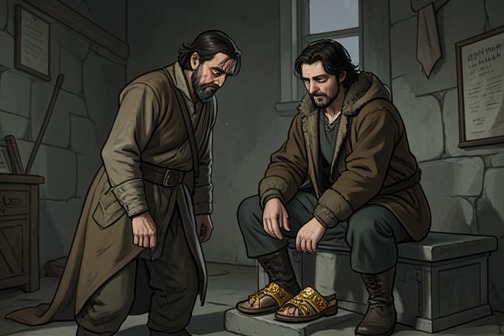
[The Sandals of Rama](entity:event-recall-event-the-sandals-of-rama-62f2081e11f9) turns a refused appeal into a practical settlement: [Ráma](entity:character-recall-character-r-ma-2db51e45ae4a) will keep his promise and remain in exile, while [Bharat](entity:character-recall-character-bharat-6395f3ef7f4e) accepts responsibility for the kingdom without claiming its sovereignty as his own. The gold-adorned sandals become the visible token through which Ráma’s authority is entrusted to his brother.
## The Appeal and the Conflict of Duties
Bharat’s request is direct: he urges Ráma to take the rule that is rightfully his. The appeal presses the competing claims of kingship and filial obedience against the course Ráma has already chosen. Ráma is presented as steadfast in truth; the surrounding canto names the praises of truth, placing his refusal to return within a larger concern with fidelity to obligation.
The pressure of that choice has already been made public through grief. When Ráma’s banishment begins, the town is struck by numbing sorrow as he departs. Later, Bharat, distressed by grief, is urged to rise and make the funeral offering for the monarch. The sandal exchange therefore answers not only Bharat’s plea but also the political uncertainty and mourning that have followed Ráma’s absence.
## The Sandals as Delegated Authority
Bharat asks Ráma to put the sandals on his feet, describing them as adorned with gold and as guardians of the realm and its people. Ráma complies: he places the sandals beneath his feet and then gives them into Bharat’s hands. The gesture makes the sandals a material sign of Ráma’s standing, passed from the absent ruler to the brother who will administer the kingdom.
Bharat states the arrangement in governmental terms: he will delegate the rule and all affairs of state to the shoes. The sandals are thus more than a keepsake or a private pledge between brothers. They represent the authority under which public business will proceed, while preserving the distinction between governing on Ráma’s behalf and taking Ráma’s place as king.
## Bharat’s Vow and the Exile
Bharat couples this transfer with a vow of his own. For fourteen seasons, he will remain beyond the realm, longing for Ráma to come again. His absence from the kingdom mirrors [Ráma’s exile](entity:state-recall-state-r-ma-a94ec8a82327), while the sandals provide the connection between the absent ruler and the affairs Bharat has undertaken to oversee.
The exchange resolves the immediate question of who will manage the state without undoing Ráma’s promise. Bharat accepts delegated responsibility rather than the throne, and Ráma supplies the emblem that makes this arrangement possible. Their agreement sustains royal administration while keeping Ráma’s return, not Bharat’s succession, as its intended conclusion.
## Narrative Significance
The episode gives political force to a small, portable object. The sandals have touched Ráma’s feet; passed to Bharat, they stand in for his presence in the realm. The movement from feet to brother’s hands makes the transfer legible without changing the underlying claim to rule.
The scene also brings the brothers’ positions into sharp contrast. Bharat seeks Ráma’s return and accepts authority only as a trust; Ráma refuses the return but does not leave the kingdom’s rule without a representative. The sandals hold those decisions together: they are the means by which Bharat can govern, and the reminder that his delegated rule remains bounded by Ráma’s exile and expected return.
Event 69
Bharata's Regency at Nandigrama
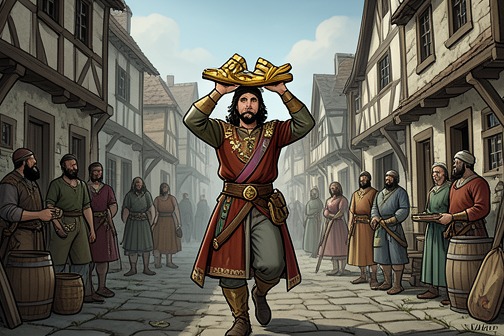
[Bharata](entity:character-recall-character-bharata-72e56a1f79da)’s Regency at [Nandigrama](entity:location-recall-location-nandigrama-2f8bc49956ee) makes an absent ruler’s authority visible through his sandals. Rather than occupy the throne as its independent owner, Bharata places the sandals on the royal seat and refers the powers of rule to them. His public gestures and ascetic life frame the regency as stewardship under [Rama](entity:character-recall-character-rama-fdac9c17dd0c), joining political authority to personal grief and restraint.
## From Farewell to Regency
Bharata’s move to Nandigrama follows his unsuccessful appeal for Rama to return and take the rule he regards as rightfully his. The narrative records Bharata turning from that appeal toward a different course: he tells his spiritual guides that he is going to Nandigrama, then travels there carrying Rama’s sandals on his head. That physical act gives the transfer of authority a strikingly humble form. The sandals are not carried as trophies or as tokens of Bharata’s own elevation; their place above his head marks the deference with which he bears the responsibility of governing in his brother’s absence.
At Nandigrama, Bharata enters the town and addresses those around him. The scene moves from private sorrow and departure to a public arrangement. His words and actions make the object he has carried central to the community’s understanding of who rules: the sandals are to receive the honor ordinarily associated with the king. The episode therefore presents the regency not as a change of sovereign, but as a way to preserve Rama’s position while he remains away.
## The Sandals on the Royal Seat
Bharata calls for the canopy that shades a king and instructs the gathered people to show the sandals due reverence. The canopy is a concrete emblem of royal dignity, and its requested use makes the sandals’ status public rather than merely personal. The people are asked not simply to remember Rama, but to enact that remembrance through the honors they give the sandals.
The decisive image follows: the sandals are installed upon the royal seat, and Bharata refers his powers to them. The poem does not describe specific administrative decisions or the practical machinery of government. Instead, it concentrates authority in a visible arrangement—the vacant seat, the sandals occupying it, and Bharata acting beneath their delegated sovereignty. This restraint matters. The narrative shows how Bharata understands his role without suggesting that he has replaced Rama or independently claimed the crown.
## A Regent in Ascetic Dress
Bharata’s conduct is marked by grief. Still oppressed by sorrow, he takes leave of his guides and goes to Nandigrama with his burden of mourning. The account later describes him living there in a hermit’s dress, with matted hair, together with his army. A note to the passage identifies him as acting as Rama’s regent and leading an ascetic life while mourning his absent brother. The regency thus combines public responsibility with visible renunciation; Bharata does not present himself in the trappings of a triumphant new king.
His words also distinguish delegated rule from possession. He declares that his joy would be fourfold greater if he ruled the state in the supreme position, a comparison that acknowledges the appeal of kingship while affirming his choice not to claim it. The statement gives the episode a personal tension: Bharata carries a heavy duty, but the narrative does not portray him as indifferent to the throne. His humility is meaningful precisely because the authority and honor of kingship are present before him, represented by the seat, canopy, and gathered people.
## Meaning and Limits of the Arrangement
The regency resolves the immediate political problem created by Rama’s continued absence without undoing Bharata’s conviction that Rama should rule. The sandals serve as a material sign of that conviction, while Bharata’s treatment of them translates it into public practice. His authority is real enough to require a formal place for the sandals and the participation of the people, but it is represented as borrowed and answerable to his brother.
The poem’s focus on gestures rather than policy keeps the episode’s emphasis on legitimacy, fidelity, and self-restraint. The sandals are raised onto the royal seat; Bharata remains in ascetic clothing. Royal honor is preserved, yet the regent refuses to make that honor his own. At Nandigrama, absence does not leave the throne symbolically empty: Rama’s sandals occupy it, while Bharata bears the work of rule in grief and deference.
Event 70
The Hermits' Appeal to Rama in Dandaka
[The Hermits' Appeal to Rama in Dandaka](entity:event-recall-event-the-hermits-appeal-to-r-c96f91ee5ba9) is the encounter in which forest ascetics ask [Rama](entity:character-recall-character-rama-fdac9c17dd0c) to protect them from their enemies. The petition is more than a request for aid: the hermits show him the dead among them, and Rama answers with a declared willingness to fight. Their appeal establishes protection of the vulnerable as a purpose of his life in the forest.
## Setting and Participants
The episode takes place at [Sharabhanga](entity:character-recall-character-sharabhanga-711b3aa5743d)'s hermitage in [Dandaka Forest](entity:location-recall-location-dandaka-forest-2a53e179ca8b). It follows the account of the holy ascetic's departure for his heavenly home, where [Brahmá](entity:character-recall-character-brahm-8b6ab0d9402f) welcomes him. The narrative then turns from that singular passage to the community of holy men who live around the hermitage: they gather and press toward Rama to speak.
The hermits address Rama as a virtuous chief and remind him that the lordship of the earth is his. Their appeal invokes his standing as a ruler even though he is staying in the forest. In this setting, authority is presented not simply as a claim to rule but as an obligation to hear those who seek help.
## The Appeal and Rama's Response
The hermits ask Rama to come near and look at the bodies of holy men lying beside the tangled paths. The corpses make the danger present and visible; the request is grounded in the harm already suffered, not in a distant or abstract fear. They describe the fiends as their enemies and ask Rama to preserve them from further attack.
Rama hears the complaint of the sages devoted to penance. His answer turns listening into action: he says that he longs to meet the fiends in battle and slay the hermits' foes. The episode thus presents a clear sequence—an endangered community speaks, its suffering is made visible, and Rama responds by committing himself to its defense. The account identifies the encounter as part of Rama's promise, while the surviving speech shows the resolve behind that promise.
## Consequences and Significance
The scene joins two roles that might otherwise seem separate. Rama is living among forest ascetics, yet the hermits appeal to him as a prince whose duty reaches beyond his immediate household. Their suffering gives that public responsibility a concrete object: the dead lie close at hand, and the remaining community asks for protection. Rama's readiness to fight makes the appeal a turning point in how his forest stay is framed—not only as banishment, but also as a setting for defending others.
The exchange also places the ascetics' way of life beside the violence threatening it. Their identity is marked by penance; Rama's proposed answer is battle. The episode does not describe the subsequent fighting in this scene, but it establishes its cause and the commitment from which it can follow. Protection here is not passive sympathy: Rama hears the petition and offers force against those who prey on the hermits.
Event 71
Sita's Warning to Rama About Violence
[Sítá](entity:character-recall-character-s-t-0be56374418b)’s Warning to [Ráma](entity:character-recall-character-r-ma-2db51e45ae4a) About Violence is a debate over the purpose and limits of force in forest life. As Ráma travels armed with bow and sword, Sítá urges him not to let the presence of weapons turn protection into needless aggression. The scene’s significance lies in the tension it makes explicit: restraint matters, but so does the obligation to defend those who seek help.
## Setting and Occasion
The exchange occurs during the forest journey, with Ráma and [Lakshmaṇ](entity:character-recall-character-lakshma-7aad0629b677) armed and Sítá beside them. The weapons make the question immediate rather than abstract: carrying the means to fight can be necessary, but it also raises the question of when their use is justified. Sítá’s intervention is presented as an act of loving concern, not as indifference to danger or a rejection of Ráma’s responsibilities.
The poem marks her words as prompted by true love, and Ráma hears them. That framing matters. Her warning is not set up as a quarrel between strangers or as a challenge to his authority; it is counsel offered within a close relationship, and the narrative gives it enough weight to pause over the reasons that might lead a warrior to violence.
## The Case for Restraint
Sítá’s argument distinguishes self-command from the urge to take other lives. The passage invokes mastery over the senses, then turns to an insatiable appetite for the lives of others and a thirst for blood where there is no hatred. Her concern, as the surviving lines present it, is the danger of violence detached from a specific enmity or necessity. The warning asks Ráma to examine not only what he can do with his weapons, but what purpose would make their use right.
This distinction makes the speech more than a general appeal to gentleness. It draws attention to motive: force directed against a present threat is not the same as force born of appetite or habit. Sítá’s caution therefore places an ethical condition on the use of martial power. The poem does not show her denying that danger exists; instead, her words resist treating the capacity to fight as a sufficient reason to do so.
## Counsel and Protective Duty
The episode then places Sítá’s appeal beside the hermits’ distress. The forest ascetics cry out and describe the danger posed by its fiends, addressing Ráma as a potential guardian. Their plea changes the practical stakes of the discussion: the question is no longer only whether violence without cause should be avoided, but what protection requires when vulnerable petitioners seek aid.
Ráma promises the hermits his help and identifies truthfulness as a value he holds dear. The sequence therefore preserves both sides of the problem. Sítá’s warning cautions against unjustified killing; the hermits’ appeal calls for protection; and Ráma’s response takes the form of a promise to aid them. The narrative does not reduce the conflict to a choice between violence and nonviolence. It presents the harder task of distinguishing wrongful aggression from force undertaken in response to a plea for protection.
## Narrative Significance
The episode links intimate counsel to public responsibility. Sítá speaks from love for Ráma, while the hermits appeal to him as their guardian; both relationships ask him to act with care. The contrast gives his armed presence a double meaning: it offers a means of defense, but it also demands restraint and judgment about when defense is warranted.
The scene’s movement—from Sítá’s warning, to the hermits’ cry, to Ráma’s promise—keeps the question open while sharpening its terms. Restraint cannot mean simply ignoring those at risk, and protection cannot excuse violence without cause. By placing the two appeals in close succession, the poem frames Ráma’s task as one of discerning duty: to control the impulse to harm and to answer those who call upon him for aid.
Event 72
Sita's Meeting with Anasuya
[Sítá](entity:character-recall-character-s-t-0be56374418b)’s meeting with [Anasuya](entity:character-recall-character-anasuya-08fe864b03f5) turns a visit to [Atri](entity:character-recall-character-atri-b51f08773de5)’s retreat into an encounter shaped by hospitality, attentive listening, and a gift. After [Ráma](entity:character-recall-character-r-ma-2db51e45ae4a), accompanied by Sítá and [Lakshmaṇ](entity:character-recall-character-lakshma-7aad0629b677), reaches the retreat and pays reverence to Atri, he receives a welcome there. Anasuya is then called to meet them. The scene moves from formal respect for a holy host to a more intimate exchange between two women, with Sítá’s story and Anasuya’s response at its center.
## Arrival at Atri’s Retreat
Ráma comes to Atri’s pure retreat with Sítá and Lakshmaṇ beside him. He pays reverence to Atri and wins the sage’s welcome; the account also notes that Lakshmaṇ and Sítá are cheered with due observance. These gestures establish the encounter as more than a chance meeting: the visitors are received within the order of the retreat, where reverence and hospitality shape their arrival.
Anasuya enters at the call of Atri, described as his venerable spouse. The sequence gives her a distinct place in the welcome. The greeting first acknowledges Atri as host, then brings Anasuya into the scene, where she becomes Sítá’s listener and giver. The movement from a shared reception to a conversation between them changes the scale of the episode, focusing attention on Sítá’s experience and the recognition another woman offers it.
## Sítá Tells Her Story
Anasuya asks Sítá to tell how Ráma won her hand among the assembled suitors. The request makes Sítá, rather than Ráma, the teller of the story of their marriage. The passage does not recount that earlier contest in detail here; instead, it frames it as a remembered event that Anasuya wishes to hear from Sítá herself. The question draws the encounter toward personal history without turning it into a public account of royal achievement.
Sítá’s reply speaks of faithful wives and the glory accorded to pure love. Her words move beyond her own marriage to place devotion within a wider company of women. Anasuya responds with rapture, and the narration emphasizes her emotional reception of Sítá’s speech. The exchange is therefore reciprocal in attention: Anasuya invites the story, Sítá gives it, and Anasuya answers not with judgment or interruption but with visible affection.
## Anasuya’s Gift
After Sítá’s reply, Anasuya presses kisses upon her head. The gesture gives physical expression to the warmth already conveyed through her response. Anasuya then offers Sítá a precious robe to wear, presenting the gift as something that will repay her sweet contentment. The stated reason links the offering to the pleasure Anasuya has found in Sítá’s company and account; the passage identifies the robe, but does not specify further properties or describe its later use.
The gift completes the scene’s pattern of exchange. Anasuya’s welcome and question make room for Sítá’s story; Sítá’s account brings Anasuya delight; Anasuya answers with affection and an offering. The robe is not presented as a political token or as compensation for a service, but as a personal expression of regard within the retreat’s hospitality. The encounter thus gives the act of listening a consequence: Sítá’s words are met with warmth and a concrete gift.
## Place in the Narrative
The episode places a brief pause of welcome and conversation within Ráma, Sítá, and Lakshmaṇ’s journey among forest retreats. Its movement is quiet but carefully shaped: arrival and reverence, Anasuya’s invitation, Sítá’s recollection, affectionate response, and gift. Rather than advancing through confrontation, it develops through the exchange of attention and honor.
Sítá’s account also links her present forest journey to the marriage that joined her to Ráma. Anasuya’s question makes that history part of their meeting, while her response recognizes the devotion Sítá describes. The scene’s significance lies in this intimate recognition: within Atri’s retreat, Sítá is received not only as one of Ráma’s companions, but as a speaker whose account moves her listener and elicits a gift.
Event 73
Rama's Defeat of Viradha
[Ráma](entity:character-recall-character-r-ma-2db51e45ae4a)’s Defeat of [Viradha](entity:character-recall-character-viradha-dad33eea7558) turns a dangerous forest encounter into an act of release. When weapons prove useless against Viradha’s charmed life, Ráma and [Lakshmaṇ](entity:character-recall-character-lakshma-7aad0629b677) change their method; the victory reveals that their enemy was Tumburu, a minstrel under [Kuvera](entity:character-recall-character-kuvera-f257d27e2149)’s curse, and ends with a direction toward the hermitage of [Sharabhanga](entity:character-recall-character-sharabhanga-711b3aa5743d). The episode’s decisive movement is from combat to recognition: overcoming Viradha does not simply remove a threat, but frees a cursed being and guides the exiles to their next destination.
## Setting and Encounter
The episode unfolds in the forest, among the tangled thickets through which Ráma travels with Lakshmaṇ and his wife. The surroundings are marked as wild and difficult, a place where danger is encountered during the exiles’ movement rather than sought out in a settled community. Viradha describes himself as wandering there day after day, giving the encounter the character of a continuing menace within the forest.
The confrontation is also framed in terms of righteousness and appearance. Viradha addresses the men as sinners who seem to have taken on the guise of holy people. His accusation makes the conflict more than a contest of strength: it challenges the apparent identity of the travellers and casts the forest meeting as a test of how they respond when their conduct is called into question. The surviving passage does not resolve that accusation through debate. Instead, the encounter becomes physical, and the brothers must find a way to overcome their opponent.
## The Fight and Its Turning Point
Lakshmaṇ strikes Viradha and breaks the left arm with which the enemy holds him. The blow changes the immediate balance of the struggle, but it does not settle the fight. Viradha’s life is charmed against weapons, so force of arms alone cannot finish what the brothers have begun. The problem is made explicit in the counsel that “No arms may take in battle strife.” The line marks a practical turning point: ordinary heroic violence has reached its limit, and the brothers must adapt rather than simply strike harder.
The proposed answer is to dig a pit in the grove. That detail gives the defeat a different shape from a conventional killing in battle. The brothers’ response is tactical and specific to Viradha’s protection; the text presents the pit as the means by which they can deal with an enemy whose charmed life resists weapons. Thus the episode’s resolution depends on recognizing the limits of the available force and changing the terms of the contest.
## Tumburu and the Curse
After the struggle, Viradha identifies himself: “My name was Tumburu,” he says, recalling that he was renowned among the minstrels. He also names Kuvera’s stern decree as the source of his curse. This disclosure alters the meaning of the fight. The forest adversary is not only a dangerous figure to be subdued; he is a celebrated singer whose present condition follows from a supernatural punishment. The revelation makes the encounter a recovery of identity as well as a defeat.
Ráma and Lakshmaṇ’s success therefore leads beyond the removal of an immediate danger. The event’s stated outcome includes helping Viradha ascend to heaven, a release that follows the revelation of his former identity and the curse that had confined him to his present state. The movement from combat to ascent distinguishes this episode from a simple monster-slaying: the brothers’ victory restores the possibility of a different destiny for the being they have overcome.
## Aftermath and Narrative Function
Before departing, Viradha points the travellers onward, telling them that Sharabhanga’s hermitage stands one league beyond their present spot. His direction gives the encounter a concrete consequence for the journey: the forest episode ends not in a return or a pause, but with a route forward. The hermitage becomes the next destination after the brothers have confronted the danger in their path.
The episode links several stages of the forest journey through a compact sequence: Viradha’s daily wandering, the brothers’ struggle with his charmed life, the discovery of Tumburu beneath the hostile appearance, and the guidance toward Sharabhanga. Its central reversal is that victory does not conclude in destruction. Once the means of overcoming Viradha are found, the encounter opens into release and renewed direction, carrying Ráma and Lakshmaṇ deeper into the forest narrative.
Event 74
Sarabhanga's Ascension
Sarabhanga’s Ascension joins a final act of ritual offering to a deliberate departure for [Brahma](entity:character-recall-character-brahma-39f8aa187fff)’s sphere. The sage has attained the right to that higher abode through long penance, yet postpones his departure until he has seen [Ráma](entity:character-recall-character-r-ma-2db51e45ae4a); after their meeting, he enters the consecrated fire and is transformed. The episode makes his arrival at the divine realm both the consequence of austerity and the completion of a personal wish.
## The Encounter and the Delayed Departure
Ráma asks Sarabhanga to explain [Indra](entity:character-recall-character-indra-9cdc4e2c85c7)’s visit. In answering, the sage describes a home that the lawless cannot attain, won through his prolonged penance. But attainment has not meant immediate departure: once Sarabhanga learned that Ráma was near, he could not go to Brahma’s world before his longing to see the hero had been fulfilled. His ascent is therefore held back, not by failure to reach its destination, but by the desire to meet Ráma first.
That delay gives the encounter a clear place in the event’s sequence. Sarabhanga’s otherworldly destination is already within reach, but he chooses to remain until the meeting has taken place. The episode does not say that Ráma grants the sage his spiritual reward; rather, it sets the sage’s earned destination beside his wish to see Ráma before leaving the world.
## The Offering and the [Fire](entity:character-recall-character-fire-b3a40eeb15fa)
After speaking, Sarabhanga lays the fire in order and makes the prescribed offerings with holy oil. He then places his own body in the fire. The act is presented as an ordered ritual, not as an accidental death: preparation and offering precede his entry, making the fire the means through which the departure is enacted.
The account dwells on the bodily change. The flame consumes skin, blood, flesh, and bones; the passage then turns from the destruction of the physical form to Sarabhanga’s radiant transformation. The sequence makes the cost of the transition visible without treating the sage’s death as its final outcome.
## Arrival in Brahma’s Sphere
Sarabhanga reaches Brahma’s sphere, where [Brahmá](entity:character-recall-character-brahm-8b6ab0d9402f) beholds him. This ending confirms that the fire has carried the sage to the destination associated with his penance. The transformation is not merely an image of release: the narrative gives it a definite endpoint, his arrival in the divine realm and the presence of Brahmá there.
## Significance of the Event
The episode’s movement is from waiting, to ritual action, to ascent. Sarabhanga’s long austerity establishes his claim to the higher abode; his decision to wait for Ráma adds a personal condition to the timing of his departure. The final fire joins these strands: it completes the sage’s embodied life while carrying him toward the destination he had already earned. In that contrast between a goal attained through years of penance and a last, chosen delay, the narrative presents the ascension as both fulfillment and farewell.
Event 75
Agastya's Slaying of Vatapi and Ilvala
[Agastya's Slaying of Vatapi and Ilvala](entity:event-recall-event-agastya-s-slaying-of-va-a3bd84875f21) turns a meal into a contest between demonic deception and a sage's power. The brothers Vátápi and Ilval have made the killing of Brahmins a repeated practice; [Agastya](entity:character-recall-character-agastya-57db2c7eeb00), attending a banquet after an appeal from the [Devas](entity:character-recall-character-devas-f5bcab1c71d9), breaks the pattern by devouring Vátápi so that Ilval's summons cannot bring him back. Ilval's rush at the sage ends in a flash of destructive fury.
## The brothers' murderous ruse
The episode begins by locating two fierce brothers of demon race, Vátápi and Ilval, in the place through which the surrounding narrative is passing. Their violence is not presented as a single eruption: the account says that they dwelt there and dealt slaughter among the Brahmins. The detail makes the meal that follows part of an established danger, rather than an innocent gathering that turns unexpectedly hostile.
Their method depends on concealment and hospitality. One brother takes the form of a Brahmin, disguising the threat in the very identity of those the brothers prey upon. The holy men, unaware of the danger, eat their fill. Then Ilval gives the signal for Vátápi to issue forth. The brothers have made eating itself the mechanism of attack: what appears to be a shared meal becomes a trap whose violence is set off by a spoken call.
## Agastya breaks the pattern
Agastya is pressed to attend the funeral banquet with the others, in response to the Devas' appeal. His presence brings the brothers' familiar ruse into contact with a power it cannot control. Where the other guests are unaware of the danger, the episode centers on Agastya as the figure able to face it without being overcome.
After Agastya has devoured Vátápi, Ilval calls for his brother to emerge. Agastya answers by asking how a demon could issue forth after being eaten by him. The question exposes the failure of Ilval's signal: it can no longer restore the brother whose return the scheme depends upon. The reversal is precise. Ilval's cry, previously the means of unleashing the attack, now confirms that the trick has failed; Vátápi is dead, not waiting to burst out of a guest.
## Ilval's attack and destruction
Ilval recognizes that his brother is dead and, consumed by vengeful rage, rushes at Agastya. The threat therefore changes shape. The first assault relied on disguise, food, and a summons; once that stratagem has been defeated, Ilval attacks the sage openly. Agastya meets this charge with a single furious glance, described as hot as fire. The episode presents the glance as the decisive answer to Ilval's rush, completing the destruction of both brothers.
The contrast between the two deaths gives the encounter its compact dramatic structure. Vátápi is defeated from within the brothers' own scheme: Agastya has eaten him, and Ilval's call cannot undo that fact. Ilval, by contrast, comes directly against the sage and is destroyed by Agastya's gaze. In each case the brothers' violence is turned back upon them, but by different means: first the meal ceases to be a trap, then the attack meets a force it cannot withstand.
## Narrative significance
The tale makes hospitality an unstable surface. A meal offered to holy men is also the brothers' instrument of murder, and the disguised form of a Brahmin lets danger pass under the appearance of welcome. Agastya's intervention restores the distinction the brothers have corrupted: the guests are no longer helpless participants in a concealed killing, and the perpetrators lose control of the occasion they have arranged.
The episode also moves from a collective threat to a sharply focused confrontation. The Brahmins' vulnerability establishes the stakes; Agastya's attendance answers the Devas' appeal; the call for Vátápi produces the reversal; and Ilval's final rush brings the conflict into the open. Rather than prolonging the encounter, the narrative concentrates its force in two decisive actions, Agastya devouring Vátápi and destroying Ilval with his fiery glance. The brothers' practiced violence ends when their own method can no longer command what happens next.
Event 76
Rama's Visit to Agastya
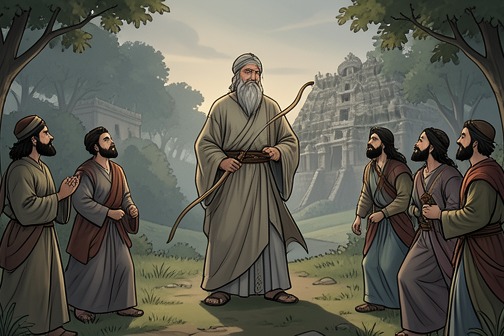
[Ráma](entity:character-recall-character-r-ma-2db51e45ae4a)'s Visit to [Agastya](entity:character-recall-character-agastya-57db2c7eeb00) is a meeting of welcome, gift, and guidance: the sage receives Ráma and [Lakshmaṇ](entity:character-recall-character-lakshma-7aad0629b677) with joy, offers Ráma a magnificent divine bow, and points the brothers toward [Panchavaṭí](entity:location-recall-location-panchava-db789c4c557a) as their next place of refuge. The scene joins hospitality to practical counsel, turning an encounter with a revered hermit into a decisive direction for the travelers’ forest life.
## Welcome at the Hermitage
Agastya’s welcome is presented as the culmination of long anticipation. He declares his joy that Ráma has at last come to him, explaining that his soul has yearned to see him. The meeting is therefore more than a formal reception: Agastya greets a guest whose arrival has mattered to him before the visit itself began.
The sage comes out surrounded by disciples. The description associates his presence with the force of his devotion, bright as flame, giving the reception a sacred and public character. Ráma and Lakshmaṇ are not simply admitted to a dwelling; they are received by a respected ascetic in the company of his followers. The scene’s emphasis on the assembled disciples also makes Agastya’s welcome an act witnessed within the hermitage community.
Agastya’s words address both brothers. He expresses delight in Ráma and praises Lakshmaṇ’s faithful zeal, recognizing the younger prince’s service as part of the visit rather than treating him as an incidental companion. The greeting thus acknowledges the shared journey and the loyalty that sustains it.
## The Divine Bow
Agastya’s hospitality takes material form in a gift. He offers Ráma a mighty bow, described as divine and adorned with red gold and diamonds. Its craftsmanship is emphasized: it was planned by a heavenly artisan. The gift combines martial capacity with extraordinary workmanship, marking it as an object of distinction rather than an ordinary provision for travel.
Ráma accepts the offered gifts, and Agastya continues speaking. This exchange establishes a bond through giving and receiving: the sage equips his guest, while Ráma accepts what is entrusted to him. The bow’s presence also gives practical weight to Agastya’s welcome. His reception does not end with praise or shelter; it supplies Ráma with a powerful weapon as the brothers continue through the forest.
## Counsel and the Road to Panchavaṭí
After a moment of reflection, Agastya identifies a destination four leagues away: Panchavaṭí. He describes it as fair and thronged with deer, and recommends its tranquil groves as a place where Ráma may find shelter. The direction is precise enough to guide the travelers onward, while the description gives the destination a character distinct from the hermitage they are leaving.
Agastya then makes the recommendation direct, telling Ráma to seek the shades of Panchavaṭí. The place is presented as both beautiful and suitable for refuge. Its deer-filled landscape and quiet groves make it a fitting setting for the next stage of the brothers’ forest residence, rather than merely a point on a route.
## Narrative Role
The visit moves through three connected acts: Agastya’s long-awaited welcome, his presentation of the divine bow, and his instruction about where to go next. Each changes the meaning of the encounter. The welcome establishes personal regard; the gift equips Ráma; the counsel converts hospitality into a practical onward path.
Panchavaṭí is the scene’s forward-looking conclusion. Agastya does not leave the visitors with a general blessing alone: he names a place, gives its distance, and describes why it offers shelter. The episode therefore joins the stillness of an ascetic reception to the movement of the larger journey. Ráma and Lakshmaṇ arrive as guests, receive recognition and a weapon, and depart with a clear destination.
Event 77
Jatayu's Alliance with Rama
[Jaṭáyu](entity:character-recall-character-ja-yu-feaa8c7732e2)'s Alliance with [Ráma](entity:character-recall-character-r-ma-2db51e45ae4a) is formed at [Panchavaṭí](entity:location-recall-location-panchava-db789c4c557a), where a meeting with the bird becomes a pledge of protection for [Sítá](entity:character-recall-character-s-t-0be56374418b). Jaṭáyu offers to guard Ráma’s household when Ráma and [Lakshmaṇ](entity:character-recall-character-lakshma-7aad0629b677) go out to pursue their way through the forest, and Ráma accepts him as a trusted friend to whom Sítá can be entrusted. The encounter turns recognition into responsibility: Jaṭáyu’s promise is not merely a declaration of goodwill but a commitment to stand watch over Ráma’s family.
## The Meeting at Panchavaṭí
The encounter takes place as Ráma, Sítá, and Lakshmaṇ make their way toward Panchavaṭí. Seeing Jaṭáyu’s great form, the brothers ask who he is. The bird answers gently, seeking to win their confidence rather than meet their uncertainty with force. That manner shapes the meeting: before offering assistance, he makes himself known and presents himself as a friend.
Jaṭáyu’s introduction joins personal identity to lineage. He names himself as the son of Śyení and places his family among the sons of Aruṇ. He recounts that [Vinata](entity:character-recall-character-vinata-c973ce56f735) gave birth to Aruṇ and [Garuḍa](entity:character-recall-character-garu-a-b39daf34be65), and identifies [Sampati](entity:character-recall-character-sampati-286582a41b86) as the first-born before himself. This genealogy gives the encounter a formal dimension: Jaṭáyu is not an anonymous creature found in the forest but a figure who can explain who he is and how he belongs to a wider kinship line.
## The Promise of Protection
Jaṭáyu offers to guard Ráma’s home and Sítá when Ráma and Lakṣmaṇ leave to range through the forest. His offer is conditional on their agreement, preserving the character of a freely accepted alliance rather than an imposed service. The protection is also specific: he proposes to watch over the household in the brothers’ absence, addressing the immediate practical needs of their life at Panchavaṭí.
The promise gives the meeting its decisive consequence. Ráma has brought Sítá into the forest with him, and Jaṭáyu’s pledge provides a trusted protector for the moments when the brothers are away. The pact therefore joins friendship to vigilance. Jaṭáyu does not merely welcome the visitors or tell them of his origins; he makes his presence useful by offering to guard what matters to them.
## Trust and Friendship
The narrative describes Ráma and Jaṭáyu as bound by friendship and says that Ráma loved him well. That bond is made concrete when Ráma hastens to his trusted friend to entrust his darling to him. Jaṭáyu’s offer and Ráma’s confidence answer one another: the bird volunteers protection, and Ráma responds by placing Sítá in his care.
This reciprocal trust gives the alliance its emotional weight. Jaṭáyu has first established who he is; Ráma’s act then treats that introduction as grounds for confidence. The scene moves from wary recognition to reliance, with Sítá’s safety at its center. Their friendship is thus shown not only as affection but as a willingness to assume responsibility for one another’s household and loved ones.
## Narrative Significance
The episode establishes Jaṭáyu as a protector before his promise is put to the test. Its sequence is compact but consequential: the brothers encounter an unfamiliar figure, question him, hear his lineage, and receive an offer of aid; Ráma then entrusts Sítá to the friend he trusts. The practical arrangement makes Jaṭáyu’s place in the household clear and gives his presence a purpose within the forest narrative.
The scene also sets a measure for friendship in the poem. Jaṭáyu’s words lead directly to an obligation, while Ráma’s confidence turns that obligation into a bond between households. The alliance rests on a stated promise and an act of trust, making the bird’s role as Sítá’s guardian a defining consequence of their meeting.
Event 78
The Establishment of Rama's Hermitage at Panchavati
In [The Establishment of Rama's Hermitage at Panchavati](entity:event-recall-event-the-establishment-of-ra-7b163359bdfe), [Ráma](entity:character-recall-character-r-ma-2db51e45ae4a) turns a forest glade into a household: he selects the place, asks [Lakshmaṇ](entity:character-recall-character-lakshma-7aad0629b677) to build, and settles there with Lakshmaṇ and [Sítá](entity:character-recall-character-s-t-0be56374418b). The episode moves from arrival to choice, labor, and repose. Its decisive change is modest but consequential: the forest is no longer only a landscape through which the exiles travel; one particular grove becomes their home.
## Arrival and the choice of a home
The episode opens with Ráma and Lakshmaṇ reaching [Panchavaṭí](entity:location-recall-location-panchava-db789c4c557a), a shaded place where forest life and serpents roam. The setting is not presented as empty ground awaiting human use. Its living inhabitants and natural cover are part of what the princes encounter, giving the proposed home a distinctly woodland character.
Ráma names the change he wants in a simple declaration to his brother: “Brother, our home is here: behold / The grove of which the hermit told:” The words make the choice personal and practical. He recognizes the grove as the place previously described by a hermit, then identifies it as a home for the three exiles. Rather than continuing onward, he fixes their dwelling in this landscape.
The choice also sits beside the party’s stated aim of freeing the pleasant woodland shades from fear and slaying the giant brood. That purpose gives the settlement a wider context: the forest is both a place to live and a setting where danger is part of the surrounding world. The passage does not claim that the new cottage removes those dangers. Instead, it shows Ráma establishing a domestic center amid the forest they have entered.
## The glade and the work of building
Ráma draws Lakshmaṇ’s attention to the ground itself: “See, see this smooth and lovely glade / Which flowery trees encircling shade:” The image is specific—an open, smooth space, ringed by flowering trees and sheltered by their shade. Ráma’s choice is therefore conveyed not merely as a command to settle, but as an act of looking closely at a place and recognizing its suitability for dwelling.
He entrusts the building to Lakshmaṇ, speaking to him with affection and pressing his hand. The gesture accompanies a practical request: Lakshmaṇ is to raise the shelter. Ráma’s direction and Lakshmaṇ’s response establish the pattern of the scene. Ráma identifies the home and the task; Lakshmaṇ accepts the work and carries it out. The poem presents the brothers’ closeness through both tenderness and cooperation, without making the construction a shared task in the account.
Lakshmaṇ’s labor produces an ample cottage, overlaid with leaves and made to shelter Ráma in the wood. The description records its essential features—size, purpose, and forest materials—rather than ornament or possessions. Its leaf covering belongs to its setting, while its ample space marks it as more than a temporary stopping place. The dwelling is made to house Ráma, and its completion gives the exiles’ decision a durable form.
## From construction to settlement
Once the work is duly finished, Lakshmaṇ goes to the [Godávarí](entity:location-recall-location-god-var-57142abcc8b1). There he bathes and plucks lilies. This brief sequence extends the settlement beyond the cottage: after building a shelter, Lakshmaṇ turns to the nearby stream and gathers flowers. The account offers no further inventory of what he collects, so the lilies remain the concrete detail that connects the new home to its surrounding waters and vegetation.
Ráma then stays in a pleasant spot where fruit is abundant. He is content there with Lakshmaṇ and his Maithil spouse, Sítá. The sequence arrives at a clear resting point: a chosen glade, a completed cottage, the neighboring river, and fruit-bearing surroundings. The narrative’s emphasis is not on a ceremony or a change in rank, but on the practical acts that make residence possible and the family’s presence that makes the shelter a home.
## The episode’s significance
The settlement gives the forest journey a fixed center. At first the grove is identified by its shade, flowers, animals, and serpents; through Ráma’s decision and Lakshmaṇ’s work, it also becomes a place of household life. This shift does not erase the wilderness. The cottage is leaf-covered, the river remains close, and the surrounding landscape continues to supply the passage’s defining images. Home is established within the forest rather than apart from it.
The episode also gives each brother a distinct part in that transformation. Ráma recognizes the place, names it as home, and directs the building; Lakshmaṇ presses his affection into service, raises the cottage, and goes to the river after the work is done. Sítá is present at the close as part of the household settled there. The result is a quiet but definite transition from arrival to habitation: the exiles stay in Panchavaṭí, together, in a dwelling fashioned for them from the materials and setting of the grove.
Event 79
Rama’s Battle Against Khara at Janasthana
[Rama’s Battle Against Khara at Janasthana](entity:event-recall-event-janasthana-12c4cb409655) is the episode in which [Surpanakha](entity:character-recall-character-surpanakha-dfff4f16e96c)’s grievance becomes a military confrontation, and [Rama](entity:character-recall-character-rama-fdac9c17dd0c)’s defense of the hermitage culminates in the destruction of [Khara](entity:character-recall-character-khara-de406d3d61b8)’s forces. The poem builds the battle through successive escalations: a summons to a small band, the advance of a much larger host, the fall of [Dushana](entity:character-recall-character-dushana-3ab26dd10f74), and Rama’s final stand against Khara. Its close measures the victory not only by the number of demons slain but by the sudden arrival of celestial and sage witnesses.
## Causes and Escalation
Surpanakha returns to Rama’s dwelling with her train, and Khara, pressed by his sister, orders twice seven giants from his crew into action. Her return makes the conflict more than a private grievance: Khara turns it into a command, sending armed followers against the place where Rama is staying. The episode’s first military response is therefore organized by kinship and authority, with Surpanakha urging action and Khara supplying it.
The confrontation then widens. Dushana leads the armies, while Khara gives him instructions about calling warriors from the host. Khara himself draws near the small hermitage, accompanied by a force that the poem compares to planets gathering to blot out the sun and moon. That image sets the scale of the approaching danger against the vulnerability of the dwelling: a concentrated army advances upon a solitary forest refuge. The progression from a band of fourteen to a host in sight makes the battle feel like a deliberate escalation rather than a single sudden clash.
## The Battle and the Fall of Dushana
The poem follows the attack through its commanders as well as its numbers. Dushana’s leadership places him at the center of the fighting, and his fall becomes the decisive report that changes Khara’s next move. Rama’s arrows are described as piercing the giants, leaving passages through them and flying onward with a fiery brilliance. The image gives the weaponry both physical force and visual prominence: the shafts do not merely strike, but travel through the enemy ranks with the speed and radiance of a continuing assault.
The scale of the losses is stated in more than one measure. One passage says five thousand demons were sent to [Yama](entity:character-recall-character-yama-ad82a71e0067)’s realm; when Khara learns the fate of the entire giant band and of Dushana, he summons the chiefs who remain. The account later gives the wider total: Rama has brought down fourteen thousand fiends in three short hours. These figures mark successive stages and enlargements of the engagement, rather than reducing the battle to an undifferentiated tally. Dushana’s death signals that Khara’s army has lost a commander; the larger count shows that the rout has reached the whole force.
## Rama and Khara
Once the host has been broken, the confrontation narrows to Khara and Rama. Khara’s challenge turns to the claims of heroic standing and ancestry, asking what warrior boasts of high birth when the war cry sounds and fighters meet their deaths. The exchange gives the final phase a different character from the earlier mass combat: Khara contests Rama’s stature in words as well as in arms, while the poem places the argument within the imminent test of battle.
Rama takes a shaft from his side, described as bearing a name and possessing a mortal stroke. The passage then frames the encounter as the climax of the campaign against the demons. The reported duration—three hours for the defeat of the fourteen thousand—makes the outcome strikingly compressed: the host that had approached the hermitage in overwhelming numbers is destroyed within a brief span. The evidence presented here identifies the defeat of the force and the battle’s scale, while giving particular emphasis to the earlier fall of Dushana and the culminating confrontation with Khara.
## Aftermath and Narrative Significance
The victory receives a public, supernatural acknowledgment. Celestial beings beat their drums and scatter flowers over Rama, transforming the battlefield’s aftermath into a scene of celebration. The poem then brings royal sages of high station to the place, led by [Agastya](entity:character-recall-character-agastya-57db2c7eeb00). Their arrival enlarges the significance of the combat beyond the immediate defeat of Khara’s army: the battle becomes an event witnessed and recognized by figures associated with the wider sacred and royal order.
The episode’s structure carries its own force. It moves from Surpanakha’s return and Khara’s order, through the approach of the host and Dushana’s death, to the stated destruction of fourteen thousand demons in three hours and the arrival of the sages. In this sequence, the hermitage is first exposed to an apparently overwhelming assault, then becomes the setting for a victory whose scale is made explicit. The celestial flowers and drums do not alter the military result; they confirm its place in the poem’s larger narrative of conflict and recognition. [Janasthana](entity:location-recall-location-janasthana-41d8cb8dc154)’s battle thus stands as a decisive escalation in the forest narrative, with Rama’s survival and Khara’s force’s destruction establishing the consequences of answering Surpanakha’s appeal with arms.
Event 80
Maricha’s golden-deer ruse and false cry

The golden-deer ruse is a deception planned by Rávan and carried out by [Márícha](entity:character-recall-character-m-r-cha-ad86b029a502): a marvel in the forest becomes bait, and the arrow that pierces it is followed by a false cry in [Ráma](entity:character-recall-character-r-ma-2db51e45ae4a)’s voice. The sequence turns [Sítá](entity:character-recall-character-s-t-0be56374418b)’s wonder into an opportunity to separate her from her protectors, making the deer’s apparent beauty part of a calculated attack.
## Causes and Design
Rávan explains the aid he wants for his intended task and directs Márícha to take the semblance of a golden deer marked with silver spots. Márícha is to approach the dwelling and cross the path of Ráma and his consort. Rávan’s plan depends on Sítá seeing the strange animal and asking Ráma and [Lakshmaṇ](entity:character-recall-character-lakshma-7aad0629b677) to pursue it. The deer is therefore not incidental to the plot: its purpose is to draw the household outward and divide the people who might otherwise frustrate Rávan’s design.
The plan also assigns Márícha a dangerous double role. He must first make the disguise convincing enough to attract Sítá, then use Ráma’s voice to send a second signal after Ráma has followed the animal. Rávan anticipates both reactions: Sítá’s interest will draw Ráma away, and the cry will prompt those left behind to respond. The ruse works by shaping what each person sees and hears, so that the appearance of an animal and the sound of a familiar voice conceal the same hostile purpose.
## Márícha’s Transformation
Márícha obeys his master. He casts off his giant form and comes near the cottage as a beautiful deer, using magical power to assume a fair and unusual borrowed shape. Silver spots mark the golden appearance; the horns shine with sapphires. These details give the disguise a conspicuous, almost precious quality, precisely the quality needed to arrest attention in the forest.
Sítá gazes at the unfamiliar marvel with delight. As she stoops to gather flowers, she continues looking toward it. Her attention gives the plan its first intended result: the deer is seen not as a threat but as something wondrous, worth watching and pursuing. The episode’s contrast rests on that gap between appearance and function. Márícha’s animal form invites admiration, while the giant beneath it remains an agent in Rávan’s attempt to seize Sítá.
## The Pursuit and the Arrow
The deer’s disguise leads Ráma into pursuit. As his desire to kill his quarry grows, he draws an arrow from his side. The weapon flashes in the sunlight and flies toward the false deer like [Indra](entity:character-recall-character-indra-9cdc4e2c85c7)’s lightning. Its force pierces Márícha’s flesh, and the dart stands quivering in his heart. The apparent hunt has thus become the point at which the trick exacts its cost from the accomplice who made it possible.
The shot also brings the disguise to its limit. Márícha has been struck in the heart, and the deer’s bright form leaves him. The narrative’s movement from a glittering animal to a wounded body exposes the violence that its beauty had hidden. Ráma’s arrow ends the visible illusion, but it does not end the scheme: Márícha still has one last act to perform before the deception is complete.
## The False Cry and Its Consequence
Knowing that the moment has come for Sítá to send her guard away, Márícha calls out to Sítá and Lakshmaṇ in a tone borrowed from Ráma. The sound is not Ráma’s appeal but an imitation, timed to make those at the dwelling believe he is in danger. Rávan’s design thus uses the familiarity of Ráma’s voice against the people who would trust it: after the deer has drawn Ráma away, the false cry is meant to draw protection away from Sítá.
The episode’s decisive turn is not simply the transformation or the shot, but the conversion of a familiar voice into a trap. Each stage depends on a mistaken reading: the beautiful animal conceals Márícha, the apparent hunt masks Rávan’s purpose, and the cry that sounds like Ráma is not his. The scene prepares the opportunity Rávan seeks by making separation appear to be a response to urgent need. Márícha’s obedience advances the plot even as the arrow strikes him, while the call in Ráma’s voice extends the ruse beyond the moment when the golden form itself can endure.
Event 81
Ravana’s abduction of Sita in disguise
[Rávaṇ](entity:character-recall-character-r-va-06a1d00141e6)’s abduction of [Sita](entity:character-recall-character-sita-1913dd4978f6) in disguise turns an encounter under false appearances into a violent separation: the ten-necked captor approaches as a mendicant, but soon takes Sita by force and bears her away in a golden, ass-drawn chariot. The scene’s decisive movement is from deception to open coercion, as Sita’s cries rise into the air while [Ráma](entity:character-recall-character-r-ma-2db51e45ae4a) is far away.
## Timing and Disguise
The episode begins with Rávaṇ judging the moment propitious for the crime he intends. He approaches Sita in the guise of a mendicant, appearing before the Maithil lady in red clothing, with his hair gathered in a tuft. The disguise supplies the scene’s initial contrast: the figure who presents himself as a religious wanderer is, in fact, the ten-necked captor preparing to abduct her.
The narration does not dwell on a prolonged exchange before the disguise gives way to force. Instead, the sequence moves quickly from Rávaṇ’s calculated approach to his physical seizure of Sita. That compression makes the change in the encounter stark: the mendicant’s appearance gives no protection once he acts as the leader of the giant crew and puts his arm around her.
## The Seizure
As Rávaṇ draws near, the account describes him as inflamed with desire. He places an arm around Sita, rebukes her while she moans and cries, and then puts his captive into his chariot with an arm around her waist. Her distress accompanies each stage of the abduction; the scene presents neither consent nor negotiation, but a captor’s threats and a captive’s resistance.
The vehicle makes the abduction conspicuous even as its approach began in disguise. Rávaṇ’s magic car blazes with gold and is drawn by asses. Its appearance marks the moment when the concealed identity and purpose of the visitor become an unmistakable act of force: Sita is no longer merely confronted by a suspicious stranger but carried away as his prisoner.
## Flight and Separation
Rávaṇ rises toward the sky with Sita, who struggles helplessly and cries aloud as he bears her through the air. The narration compares the flight to an eagle carrying a serpent’s consort, an image that casts the abduction as predation and emphasizes the imbalance between captor and captive. The aerial movement also makes the separation immediate: Rávaṇ carries Sita away while her dear lord, Ráma, is far off.
From the air, Sita sends a piteous lament toward Ráma. Her cries cannot stop the flight, but they give the abduction a second, vocal dimension: the captor controls her movement, while her call makes the separation audible. The scene thus closes not with rescue or reunion, but with Sita still being borne away and Ráma absent from her side.
## Narrative Significance
The episode is structured around a sharp reversal of appearance and power. Rávaṇ first arrives in the red garb and tufted hair of a mendicant; the golden chariot, the arm around Sita, and the ascent into the sky reveal the violence beneath that presentation. The disguise is therefore not incidental detail: it frames the abduction as a crime initiated through deception and completed by force.
The scene’s central change is from proximity to enforced separation. Sita’s crying, struggling, and appeal to Ráma keep her resistance present, while the chariot carries her beyond his reach. The account ends in that unresolved state of captivity and distance, making the flight itself—not a later response to it—the event’s defining image.
Event 82
Jatayu’s attempt to stop Ravana
[Jaṭáyus](entity:character-recall-character-ja-yus-b5402c84d6c0)’s attempt to stop [Rávaṇ](entity:character-recall-character-r-va-06a1d00141e6) is a direct intervention in [Sítá](entity:character-recall-character-s-t-0be56374418b)’s abduction: the vulture refuses to let the king carry her away without a fight. The encounter turns a flight into a combat, and Jaṭáyus’s persistence makes him a defender who acts even when the odds and injuries are against him.
## The Challenge and Combat
Jaṭáyus wakes and hears Sítá speak. Seeing her being carried off, he confronts Rávaṇ, who is encased in glittering mail and armed with arrows. Jaṭáyus makes clear that the king will not pass unchallenged or steal the woman without a blow, and calls on him to stay and meet him in battle. The challenge is not a negotiation: Jaṭáyus places himself between the abductor and his captive and makes combat the price of continuing the flight.
Rávaṇ answers with violence, and the narrator compares the two opponents meeting to storm clouds driven together by opposing winds. The combat becomes a sustained exchange: Rávaṇ rains arrows on the vulture, striking his breast and wings, while Jaṭáyus bears the shafts and continues fighting. Even as his body is pierced and bleeding, he glances toward the chariot, where Sítá weeps, then rushes at Rávaṇ again. The sight of her distress accompanies, rather than interrupts, his renewed assault.
## The Fight's Turning Point
Even after Rávaṇ’s arrows have pierced him and left his body bleeding, [Jaṭáyu](entity:character-recall-character-ja-yu-feaa8c7732e2) does not retreat. He looks toward the chariot, where Sítá is weeping, and charges the king once more; the narrative makes her distress the immediate focus of his renewed attack. Jaṭáyu’s talons then break Rávaṇ’s arrows and bow, interrupting the weaponry from which the assault had been delivered. But the reversal is not a victory: arrows continue to fly in hundreds and thousands, and Jaṭáyu is struck from every side. The combat thus shifts from a challenge meant to halt the abduction to a desperate struggle in which Jaṭáyu keeps opposing Rávaṇ despite mounting wounds and overwhelming fire.
## The Meaning of the Interception
The episode makes Jaṭáyu’s resistance significant not because it immediately frees Sítá, but because it breaks the apparent simplicity of Rávaṇ’s escape. The king’s armor, bow, and repeated volleys establish the force arrayed against the bird; Jaṭáyu’s renewed attack, even while wounded, makes refusal itself the decisive action. His glance toward the weeping Sítá ties the struggle to the person at its center, while his talons striking at Rávaṇ’s weapons turn that concern into direct opposition. The fight therefore presents protection as an act undertaken under unequal conditions: Jaṭáyu cannot command the outcome, but he denies the abductor an unchallenged passage.
## The Terms of Resistance
Jaṭáyus defines the encounter as a contest that must last as long as he does: “For I to thee, while yet I live, / The welcome of a foe will give.” The conditional phrase makes his own continued life the limit Rávaṇ must overcome, turning the interception into more than a brief interruption. Jaṭáyus cannot decide whether Sítá will escape, but he refuses to let her abduction proceed without opposition; the scene’s measure of resistance is the fight he insists upon, not a promised victory.
Event 83
Abduction of Sita
[Abduction of Sita](entity:event-recall-event-abduction-of-sita-b0257d8e9fca) turns a deceptive encounter in the forest into the separation that drives the story toward [Lanká](entity:location-recall-location-lank-4c2ae5988d40). [Rávaṇ](entity:character-recall-character-r-va-06a1d00141e6) approaches [Sítá](entity:character-recall-character-s-t-0be56374418b) under the appearance of a mendicant, then takes her away by force and carries her across the landscape and sea. During the flight she drops her scarf and ornaments near five watching monkeys, leaving a possible trace of her passage. The episode ends not with a reunion but with her arrival at Rávaṇ’s royal home, where he orders female demons to guard her.
## Deception and the encounter
The episode’s decisive turn begins when Rávaṇ judges the moment propitious for his intended crime. He comes disguised as a mendicant, with red clothing and tufted hair, and presents himself to Sítá in the guise of a holy man. The disguise matters because it shapes the first terms of their encounter: rather than arriving openly as a captor, he approaches as someone whose appearance invites trust. The poem makes the threat legible through the contrast between his apparent religious identity and the purpose the narration has already disclosed.
Rávaṇ speaks in praise of Sítá and asks why she is travelling through the forest without a companion. The setting is the [Daṇḍaka forest](entity:location-recall-location-da-aka-forest-0749c0f39fbb), described in the exchange as a place inhabited by giant bands and savage beasts. Sítá questions the stranger about his identity and his presence there. Her questions give the scene a brief structure of ordinary conversation, but the account has already established that the encounter is not what it seems. His saintly look and Brahman guise raise no doubt in her mind at first; the narrative thus makes deception, rather than a mistaken destination, the opening mechanism of the abduction.
The Canto XLIX heading, “The Rape Of Sítá,” marks the change from approach to seizure. Rávaṇ presses his courtship, moves closer, and puts his arm around her. The account describes the act as a transition from soft persuasion to taking her away, not as a mutual departure. He carries her to a car drawn by asses, rebukes her as she cries out, and rises into the air with her. The sequence makes the change in Sítá’s circumstances unmistakable: the conversation in the forest has become captivity, and [Ráma](entity:character-recall-character-r-ma-2db51e45ae4a) is far away.
## Flight and the trace left behind
The journey removes Sítá from the forest in a series of widening distances. Rávaṇ bears her above the ground and across woods, rocks, lakes, and streams. During the flight, she sees five monkeys standing on a hill above the forest. She draws off her scarf and lets it fall, along with earrings, a necklace, a chain, and a gem. The poem gives these objects a practical place in the action: they are left behind while she is being carried away, rather than remaining with her in the captor’s possession.
The monkeys look up in surprise and see Rávaṇ passing overhead with the weeping Sítá held fast. Their presence creates a witness to the flight, while the dropped garments and jewelry create material signs that may connect the missing woman to the route taken. The episode does not yet show what the monkeys understand or what use anyone will make of the objects. It establishes the facts that they saw the airborne captor and that Sítá’s ornaments reached the ground below them. A passage defined by isolation therefore contains the first visible possibility of evidence beyond the captive and her abductor.
From the hill, Rávaṇ flies over the flashing flood of [Pampá](entity:location-recall-location-pamp-cfee6d24001a) and continues toward Lanká. He then passes over the sounding sea, a further boundary between Sítá’s forest home and the place to which she is being taken. Voices warn him that his guilty deed will bring about his end. The warning places the abduction within a larger chain of consequences, but it does not interrupt the flight: Rávaṇ continues carrying Sítá and lands at Lanká.
## Confinement and consequences
At Lanká, Rávaṇ brings Sítá into his royal home and places her in a queenly bower. The language of a royal chamber contrasts with the condition in which she arrives: she is a captive, not a guest. Rávaṇ then commands the female demons filling the hall to watch and guard her. His order turns the abduction from a journey into an ongoing confinement, and the guarded chamber becomes the immediate setting of Sítá’s captivity.
The separation is also registered through Ráma’s response when he returns to the leafy shelter and cannot find his wife. The account says that his senses fail and that he weeps and wails in despair. This reaction gives the abduction its other immediate consequence: while Sítá has been removed to Lanká, Ráma encounters her absence at home. The scene links a concrete discovery—she is not there—to an overwhelming loss of composure, without yet resolving where she has gone.
## Narrative role
The episode combines deception, forced separation, flight, and the beginnings of a traceable pursuit. Its action proceeds from Rávaṇ’s concealed identity to Sítá’s removal, then from the isolated forest to the distant sea and the guarded chamber in Lanká. Each change narrows her freedom: the apparently religious visitor becomes the captor, the forest encounter becomes an airborne escape for him and an abduction for her, and arrival at the royal home brings imposed surveillance rather than safety.
The discarded ornaments and the monkeys’ astonished sight of the flight counter the apparent completeness of Rávaṇ’s escape. The abductor succeeds in carrying Sítá away, but the journey leaves objects on the ground and witnesses behind. The warning that the deed will bring his end also frames the success as temporary and morally consequential. The episode closes with captivity established and separation made explicit; its unresolved distance between Sítá in Lanká and Ráma in the forest supplies the immediate stakes for what follows.
Event 84
Jatayu’s battle with Ravana
[Jaṭáyu](entity:character-recall-character-ja-yu-feaa8c7732e2)’s battle with [Rávaṇ](entity:character-recall-character-r-va-06a1d00141e6) is the armed resistance that interrupts [Sítá](entity:character-recall-character-s-t-0be56374418b)’s abduction and gives the episode a defender willing to act when [Ráma](entity:character-recall-character-r-ma-2db51e45ae4a) and [Lakshmaṇ](entity:character-recall-character-lakshma-7aad0629b677) are absent. Awakened by Sítá’s appeal, Jaṭáyu challenges Rávaṇ not merely with force but with a claim about law and wrongdoing. His intervention briefly turns the abduction into a contest: he damages Rávaṇ’s weapons and vehicle, but cannot prevent the abductor from escaping with Sítá. The encounter ends with Jaṭáyu gravely wounded and Sítá beside him.
## Background and Stakes
The battle takes place during the sequence of events set in motion by [Márícha](entity:character-recall-character-m-r-cha-ad86b029a502)’s magic. Márícha has drawn the princely youths away, leaving Sítá vulnerable; Rávaṇ then carries her off. The narrative presents this separation as the condition that makes Jaṭáyu’s intervention necessary: Ráma and Lakshmaṇ are not there to protect her, and Jaṭáyu is the one who can answer her appeal.
Sítá’s cry also gives the encounter a second purpose beyond immediate resistance. As she is carried away, she asks that Ráma and Lakshmaṇ be told what has happened. Her appeal identifies the deed and its consequence, while making clear that the abduction is not a journey undertaken willingly. The battle therefore unfolds under the pressure of an urgent message as well as a rescue attempt: Jaṭáyu tries to stop Rávaṇ, and Sítá’s words preserve a path by which the event may later be reported.
At first, Jaṭáyu is asleep. He wakes when he hears Sítá speak, raises his eyes, and sees her with her abductor. The change from sleep to alertness is the scene’s hinge. Rather than remain a witness to the crime, Jaṭáyu becomes its opponent. The narrative describes him as a noble and imposing bird, but the decisive feature of his entrance is his choice to act despite the disparity between himself and Rávaṇ.
## Jaṭáyu’s Challenge
Before attacking, Jaṭáyu addresses Rávaṇ from the tree and counsels him to desist. His appeal is grounded in fidelity to established faith and laws; he argues that Rávaṇ, whom he addresses as a brother, should refrain from this wrong. The speech gives the intervention a moral dimension before combat begins. Jaṭáyu does not treat the abduction as a private dispute between rivals: he presents it as a breach of standards that bind even a powerful ruler.
Jaṭáyu also makes the challenge explicit. Rávaṇ will not, he says, leave without being opposed or carry Sítá away without a fight. The words turn his warning into a commitment, and the next canto names the ensuing encounter as the combat. Jaṭáyu offers resistance while he is still alive, making his own body the obstacle between Rávaṇ and an unopposed escape.
The scene then moves from counsel to action. Rávaṇ responds in fury, and the two engage in a sustained battle. The narrator compares the clash to opposed forces meeting in the sky, framing it as a contest between the giant and the bird rather than as a brief attempt to frighten the abductor. Jaṭáyu withstands the assault and continues attacking. The confrontation’s movement repeatedly reverses the apparent balance of power: Rávaṇ rains arrows, but Jaṭáyu persists and retaliates.
## The Contest and Its Reversals
Jaṭáyu’s resistance has concrete effects on Rávaṇ’s means of escape. He snaps the bow Rávaṇ has been using, interrupting the weapon’s use in the fight. He then turns his attack on Rávaṇ’s aerial chariot, described as a vehicle that moves by its own will, and breaks it. The attendants and guards holding the chariot’s emblems are also brought down. These actions make Jaṭáyu’s defense more than symbolic: for a time, he damages both the weapon and the vehicle that enable Rávaṇ to carry Sítá away.
Jaṭáyu next attacks the charioteer, striking at him with his beak and claws. By this stage the chariot is broken, its driver and team are down, and Rávaṇ still has one arm around Sítá. The battle’s immediate stakes remain visible throughout: every attack is made while Sítá is being held and carried away. Jaṭáyu’s blows interrupt Rávaṇ’s control of the vehicle, but they do not free her.
The bird also renews his moral appeal amid the fighting. He warns Rávaṇ about the dire consequences that follow wrongdoing, then swoops to attack. This repetition links the struggle’s physical and ethical dimensions. Jaṭáyu does not abandon his judgment of the deed once the combat starts; his resistance continues to express the same position he stated before the first assault. His actions give force to the warning, while the warning gives the struggle a stated moral cause.
For a moment Jaṭáyu’s attack drives the action sharply against Rávaṇ. Rávaṇ holds Sítá fast, but Jaṭáyu counters his attempt to strike by removing the giant’s left arms. The episode presents this as a sudden reversal in the fight, not as a final victory: Rávaṇ remains able to continue, and Jaṭáyu’s success does not release Sítá. The shifting advantage keeps the outcome uncertain until Rávaṇ takes up his sword.
## Defeat and Immediate Aftermath
Rávaṇ ultimately strikes Jaṭáyu with the sword, wounding him in the wings, side, feet, and throat. The account states the result without changing the essential measure of Jaṭáyu’s resistance: he falls, and his life is nearly gone. The loss is consequential but not a death within this scene. Later, when Ráma reaches the place where Jaṭáyu lies, the narrative describes him as slain; the battle episode itself ends with the bird still alive, though close to death.
Sítá sees her champion fall and hurries to his side. That gesture marks the emotional consequence of the defeat: the defender who answered her appeal can no longer continue the fight, and she attends to him even as Rávaṇ’s abduction remains in progress. Her concern gives the encounter a human bond at its close, without reversing its outcome. Jaṭáyu has failed to stop Rávaṇ from taking her, but his defense has not been passive or unnoticed.
The larger narrative recalls the battle as part of the chain leading from Sítá’s abduction to Ráma’s search. An earlier account places Jaṭáyu’s fall among the events Ráma encounters after the abduction, while a later summary pairs the abduction with Jaṭáyu’s death. The battle thus serves as both an attempted rescue and a crucial point in the story’s transmission: Sítá asks that the deed be reported, and Jaṭáyu’s eventual discovery by Ráma connects the struggle to the search that follows.
## Narrative Significance
The episode gives Jaṭáyu a distinct role in the rescue plot. He is neither one of the absent princes nor an uninvolved observer; he becomes a defender through his response to Sítá and his attachment to Ráma. The narrative specifically associates his fighting with his love for Ráma, making that loyalty the motive for a risky intervention. His action extends the protective bond around Sítá beyond the immediate household and demonstrates that Rávaṇ’s power does not make the abduction uncontested.
The battle also separates moral victory from practical success. Jaṭáyu acts on a defensible claim, warns Rávaṇ, and manages to break his bow and chariot. Yet he is overcome, and Sítá remains in Rávaṇ’s grasp. The mismatch between the justice of the resistance and its immediate outcome gives the episode its force: Jaṭáyu’s defeat does not make his opposition meaningless, but it does show the cost of resisting Rávaṇ without the strength to complete the rescue.
Finally, the encounter binds action to witness. Sítá appeals for the event to be made known, Jaṭáyu answers by confronting the abductor, and Ráma later finds Jaṭáyu after the fight. In that sequence the battle is more than an isolated clash. It is a failed attempt to prevent the abduction, an act of loyalty, and a link between Sítá’s disappearance and the information that enables the search to proceed.
Event 85
Sita rejects Ravana
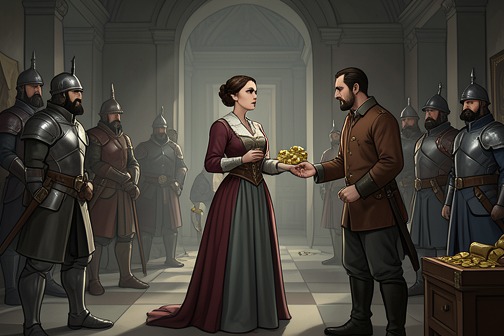
[Sita rejects Ravana](entity:event-recall-event-sita-rejects-ravana-602d986b6db6) when he attempts to turn her captivity into an offer of wealth, power, and protection. She refuses his courtship, answers his contempt for [Rama](entity:character-recall-character-rama-fdac9c17dd0c) with a prediction of [Ravana](entity:character-recall-character-ravana-f2652ae52080)’s defeat, and is taken under guard to the [Ashoka Grove](entity:location-recall-location-ashoka-grove-d19d45180627). The exchange makes the difference between possession and consent explicit: Ravana can command the guards and the place of confinement, but he cannot make [Sita](entity:character-recall-character-sita-1913dd4978f6) accept his offer.
## The Offer and Its Stakes
Ravana’s approach follows a display of his household and authority. He leads Sita through his home, then presents the scale of his power: three hundred million giants, with a thousand selected from their number waiting to serve him. He offers his pomp and dominion at her feet and says that he would give her his life as well. The offer is therefore more than a promise of comfort. It asks Sita to exchange fidelity to the absent Rama for the resources and protection of the ruler who holds her captive.
Ravana sharpens the appeal by belittling Rama. He presents Rama as a man whose days are numbered, whose light is fading, and who has been driven from home and royal power. His argument depends on making Sita’s loyalty seem misplaced: Ravana claims that she should judge the future by his strength and grandeur, not by her bond with an exiled husband. The boast and the offer work together, setting his material abundance against Rama’s apparent vulnerability.
## Sita’s Refusal
The narration makes clear that Ravana’s speech does not persuade Sita. She hears him in grief, but remains undeterred and casts aside fear of him. Her answer rejects the premise of his comparison: Rama is not simply a dispossessed man whom Ravana can supersede. Sita identifies him as a descendant of the Ikshvaku line and names the help of his brother [Lakshmaṇ](entity:character-recall-character-lakshma-7aad0629b677); together, she says, they will strike Ravana down.
She develops that warning through an image of helplessness. Ravana’s power, she predicts, will be as useless as serpents’ venom when the great bird swoops upon them; Rama’s arms and golden arrows will overcome it. The image reverses Ravana’s account of the contest. His apparent superiority is not proof of safety but the height from which his fall can be measured. Sita then projects the consequences beyond Ravana himself: [Lanka](entity:location-recall-location-lanka-4b3ac7e9a824) will be widowed through his guilt, and the giants’ blood will be spilled. Her refusal is thus also a judgment on the political and human cost of his act.
Sita further distinguishes Ravana from the sacred order he tries to violate. She compares herself to an altar prepared with vessels for a holy rite, which a low creature would not dare approach. The comparison presents her as someone whose status and commitments cannot be erased by captivity. Yet she does not pretend that her body is beyond Ravana’s reach: she acknowledges that it is exposed to torture, chains, wounds, or death, while making clear that such force will not win her consent. The contrast between bodily vulnerability and unyielding refusal gives the scene its central tension.
## Threat and Confinement
Ravana answers rejection with anger rather than reconsideration. His next speech begins by tying his threat to the passage of twelve months. The shift from an offer of wealth and life to a time-bound menace exposes the coercion already present in his courtship: when Sita will not accept what he offers, he turns to the prospect of force. The passage establishes the threat without making Sita’s response dependent on fear or bargaining.
He then summons the women he commands and orders them to take Sita away. They are described as hideous in appearance and as flesh-eaters, a detail that makes the threat to her safety concrete rather than abstract. Ravana directs them to carry Sita to the Ashoka Grove and guard her there until her stubborn pride is bent. The order gives the exchange an immediate consequence: Sita’s defiance is followed not by release but by more controlled confinement.
The garden’s beauty does not soften that purpose. Sita is led among sweet-smelling flowers and trees bearing rare fruit, but the place is assigned to her as a guarded enclosure. Its attractive surroundings contrast with the command to watch and tame her; abundance is no substitute for freedom. Ravana can decide where she is kept and who watches her, but the scene does not show him winning the submission he demands.
## Narrative Significance
The episode turns on a reversal of power within a captive’s limited circumstances. Ravana possesses wealth, an immense following, and the authority to order Sita’s removal; Sita has no comparable physical means of resistance. Yet his offer fails at the point where it requires her assent. Her speech instead makes Rama’s return and Ravana’s defeat the horizon against which his apparent security should be judged.
The scene also links private coercion to public consequence. Sita names Lanka and the deaths that Ravana’s guilt will bring upon its people, refusing to treat his proposal as a private contest between two individuals. The order to imprison her follows directly from that refusal, preserving the danger while confirming that his power can enforce custody but not affection. The event thus establishes both the immediate condition of [Sita’s captivity](entity:state-recall-state-sita-s-captivity-fa2f2efb3317) in the Ashoka Grove and the moral contrast between Ravana’s command and her steadfast rejection.
Event 86
Rama and Lakshmana search for Sita
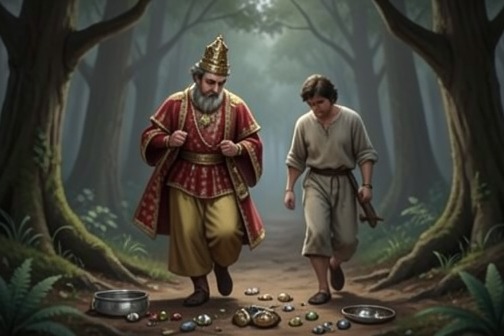
The search for [Sítá](entity:character-recall-character-s-t-0be56374418b) begins as a collision between dread and blame: [Ráma](entity:character-recall-character-r-ma-2db51e45ae4a) returns expecting to find his wife, but she is absent, and [Lakshmaṇ](entity:character-recall-character-lakshma-7aad0629b677) arrives alone. Their search unfolds through Ráma’s shifting fears, a journey back to [Janasthán](entity:location-recall-location-janasth-n-9473651b6256), and the discovery of scattered ornaments and signs of a fiend. The missing woman is not merely the object of the search; her absence changes Ráma’s conduct, drawing him from anguished uncertainty toward a fierce resolve to answer the loss.
## The Missing Wife and the Brothers’ Meeting
The episode follows the moment when Ráma’s arrow has struck the giant in the seeming-buck form. Lakshmaṇ comes to meet him with his face drained of light. The brothers approach one another carrying the same misery, but Ráma’s first response is reproach: he blames Lakshmaṇ for leaving Sítá without aid. The reunion therefore offers no comfort. It brings the danger into focus while turning Ráma’s fear against the brother who had been charged with protecting her.
Ráma sees Lakshmaṇ standing alone and understands that Sítá is not with him. His mind moves between two possibilities: she has been carried off, or she is dead. That uncertainty gives the scene its first sharp turn. Before there is evidence of what happened, the empty space beside the brothers becomes enough to make both separation and death feel immediate. Ráma’s distress is not yet a settled knowledge; it is a fear that finds no relief in Lakshmaṇ’s arrival.
## From Janasthán to the Empty Dwelling
With his thoughts fixed on Sítá, Ráma goes to Janasthán. His movement is urgent, but reaching the dwelling does not restore the closeness he longs for: he hurries there hoping to see her face and sinks beneath misery when she is absent. The domestic place that should confirm her presence instead makes the loss unmistakable. The search begins in the gap between what Ráma expects to find and what the dwelling can offer him.
The poem then stretches the search across the landscape. Ráma moves from grove to grove, at one point sinking down to rest before starting up and pressing onward again. His brief pauses do not end the pursuit; each becomes a moment within a restless circuit. The repeated pattern of stopping and moving gives physical form to grief: exhaustion interrupts him, but it cannot loosen his attention from the missing Sítá. He wanders like one distraught, still seeking the woman whose absence has become the single object of his thoughts.
## Grief Without an Answer
Ráma seeks an answer beyond the empty dwelling, hoping that the stream will hear his cry, while fear continues to hold back the tale for which he longs. The episode lets uncertainty persist rather than supplying an immediate explanation. His appeal is an act of desperate address: he turns outward toward the landscape because the person who could answer him is gone. The search is therefore both practical and emotional, a pursuit of information undertaken by someone whose grief is already overwhelming the possibility of patience.
The animals and landscape register that grief without resolving it. The deer, moved by pity for Ráma’s distress, obey his summons and rise. Their response briefly gives his appeal an answer, but it does not yet reveal Sítá’s fate. This moment of pity contrasts with the continuing human uncertainty: the natural world appears to respond to his sorrow, while the decisive account of what happened remains withheld. The poem’s sequence moves through anguish, appeal, and temporary response without allowing any of them to become knowledge.
## The Evidence on the Ground
As the brothers search, flowers from a fallen garland lie scattered along their way. Ráma sees the flowers and recognizes that the ground may preserve traces of Sítá’s passage. Farther on, he finds a fiend’s footprint and small traces beside it. The landscape changes from a place through which he wanders into evidence that can be read: the scattered objects and marks suggest that Sítá’s disappearance involved an encounter, not simply an unexplained absence.
Ráma then points Lakshmaṇ to Sítá’s gold earrings, which have fallen there, and to her torn garlands. These objects make the search concrete. The earrings and garlands are identifiable traces of Sítá, while their scattered and damaged condition gives the brothers reason to fear that she was taken by force. The episode does not make the ornaments themselves a complete account of her fate; rather, it places physical signs beside Ráma’s earlier fear that she has been carried away. The difference between an empty dwelling and a trail of belongings is consequential: absence had opened several terrifying possibilities, but the objects on the ground begin to direct those fears toward abduction.
## From Tenderness Toward Vengeance
The discoveries do not soothe Ráma. They intensify his grief and anger, and his language marks a change in the disposition he presents. He declares himself estranged from the gentle qualities that had characterized him and turns toward a life of killing. The passage makes this resolve a consequence of the search’s painful progress: first Sítá is missing, then the brothers encounter signs that point to violence, and finally Ráma imagines himself changed by what he has found.
That change does not erase the tenderness that drives him. His longing to see Sítá’s face and his repeated efforts to find her remain the emotional center of the episode; the hardening follows from, rather than replaces, that attachment. The search thus binds intimate grief to the coming pursuit. Its decisive outcome is not a reunion or a full explanation, but a changed resolve: Ráma and Lakshmaṇ have evidence that Sítá is gone, and Ráma’s sorrow has begun to take the form of vengeance.
Event 87
Death and funeral of Jatayu
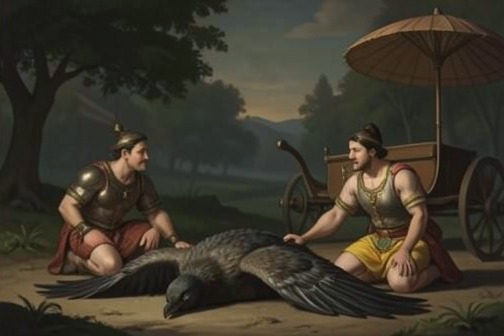
[Jatayu](entity:character-recall-character-jatayu-4a0081bd15db)’s death and funeral turn the search for [Sítá](entity:character-recall-character-s-t-0be56374418b) into a confirmed pursuit of [Rávaṇ](entity:character-recall-character-r-va-06a1d00141e6): the dying bird identifies her abductor, tells how he tried to intervene, and points [Ráma](entity:character-recall-character-r-ma-2db51e45ae4a) toward the south. His testimony is also an act of loyalty that Ráma answers with care, performing the rites that allow the fallen bird’s spirit to rise.
## Discovery and the rescue attempt
Ráma and [Lakshmaṇ](entity:character-recall-character-lakshma-7aad0629b677) come upon Jatayu lying on the ground, his condition showing that a violent struggle has taken place. The bird is described as immense, like a shattered mountain crest, but he is now weakened and close to death. His state makes the scene a discovery as well as a farewell: the searchers have found someone who encountered Sítá’s abductor, but must receive his account before he dies.
Jatayu tells Ráma that the woman he has been seeking is Rávaṇ’s prey. He had seen her being carried away and hurried to her aid. In the struggle, he crushed Rávaṇ’s chariot and royal parasol, and beat down the driver with his wings. These concrete details establish that Jatayu did more than witness the abduction: he actively tried to stop it, and his effort disrupted Rávaṇ’s conveyance before the attacker escaped with Sítá.
The account also gives the battle a clear limit. Jatayu says that age and exertion overcame his strength; Rávaṇ then defeated him and carried Sítá away. The bird asks Ráma not to turn his anger against him, insisting that he has already been slain by the giant. His appeal frames the encounter around the difference between responsibility and failure: Jatayu could not save Sítá, but the story presents him as having spent his strength trying to do so.
## Testimony and death
Ráma hears Jatayu’s report and places his bow on the ground. The gesture follows the revelation of Sítá’s fate and the bird’s account of fighting in her defense; for this moment, the weapon gives way to attention to the dying witness. Jatayu is visibly in distress, but the narrative makes his spoken testimony, rather than a prolonged description of his suffering, the center of the scene.
Later, as Jatayu lies dying, Ráma grieves for him and asks where his wife, dearer to him than life, has gone. Jatayu again identifies Rávaṇ as the king of the giant race who stole Sítá from Ráma’s dwelling. He adds that Rávaṇ used magic, and confirms that after Jatayu’s strength was spent, Rávaṇ seized Sítá and flew toward the southern region. The second account reinforces the essential facts of the abduction and its direction, even as Jatayu’s breath is failing.
In his last words, Jatayu identifies Rávaṇ as the son of [Viśravas](entity:character-recall-character-vi-ravas-fbce43951a2c) and brother of [Kubera](entity:character-recall-character-kubera-fe5e28c9cf92). This genealogical detail gives the abductor a place within a known family relationship, while the immediate practical information remains the southward flight. Ráma asks Jatayu to speak again, joining his palms in reverence, but the bird’s spirit has already departed. His death closes the testimony before Ráma can question him further.
## Funeral rites and obligation
Ráma turns from the pursuit to Jatayu’s funeral. He tells Lakshmaṇ to gather fuel and declares that he will light the solemn fire with his own hands. The choice to perform the rite himself gives the farewell a personal and public dimension: Ráma treats the bird not as a mere informant encountered on the road, but as one whose service merits the formal honors due to the revered.
The funeral is described through its prescribed acts. Ráma makes balls from venison and places them on fair grass; he then recites solemn words and texts so that the departed soul may rise and find free passage to the skies. The account emphasizes ritual care after the loss: the body is not simply left behind, and grief is given an ordered form through offerings and recitation. When the offerings have been made, Ráma and Lakshmaṇ bathe in the water.
The narrative also recalls that Jatayu was honored by all and beloved by all, presenting his standing among those around him as part of the reason his death calls for a formal funeral. Ráma’s own actions make that regard tangible. He gathers what is needed, performs the fire rite, offers food for the dead, and completes the observances with Lakshmaṇ. The passage thus records both a communal reputation and the specific obligations Ráma takes upon himself.
## Consequences and narrative significance
Jatayu’s report supplies Ráma with two decisive pieces of information: Rávaṇ is responsible for Sítá’s abduction, and he has taken her toward the south. The bird’s account also clarifies how the abduction was resisted. Jatayu damaged the chariot and parasol and drove off the driver, but could not overcome Rávaṇ once his strength failed. The episode therefore turns a search marked by absence into a pursuit with an identified enemy and direction, without suggesting that the lost time or failed rescue can be undone.
The order of events gives the scene its particular weight. Ráma first receives the news, then hears the final confirmation, and only after Jatayu dies does he undertake the funeral. Information and mourning are inseparable: the messenger who makes the next stage of the search possible is also the one who must be honored and left behind. Ráma’s reverence, including his joined palms and his decision to perform the rites himself, answers the loyalty Jatayu demonstrated by risking himself for Sítá.
The funeral also brings the episode to a deliberate close. The southward flight opens the way forward, while the offerings, sacred words, and final bathing mark the duty owed to the dead. Jatayu cannot accompany Ráma and Lakshmaṇ farther, but his intervention remains consequential: he resisted Rávaṇ, preserved knowledge of Sítá’s fate, and received the funeral rites Ráma judged appropriate to his service.
Event 88
Liberation of Kabandha
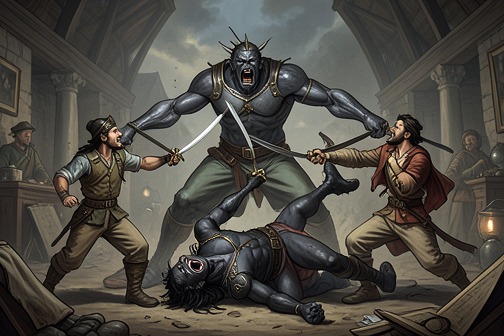
The liberation of [Kabandha](entity:character-recall-character-kabandha-ad987f302922) begins as a sudden forest encounter that turns a warning of coming conflict into a test of [Ráma](entity:character-recall-character-r-ma-2db51e45ae4a) and [Lakshmaṇ](entity:character-recall-character-lakshma-7aad0629b677)’s readiness. By cutting off the monster’s grasping arms, the brothers break the condition that holds him in his monstrous form and open the way to his release.
## The Encounter
As the princes continue their search through the desolate forest, a mighty sound startles them. It seems to announce that strife and victory are near. Ráma raises his sword, and the brothers investigate its source; before them stands a huge fiend, his body a vast, misshapen trunk. The threat becomes immediate when he stretches out his enormous arms and casts them around the two princes.
The monster hears the brothers speaking, opens his horrid mouth, and draws them toward him. They respond with practiced timing: Ráma and Lakshmaṇ unsheathe their swords and strike, each severing the arm that holds him. The dismembered fiend falls to the earth with a terrible cry. The encounter’s reversal is physical and decisive: the arms that made Kabandha dangerous are removed, leaving him able to speak with his captors rather than seize them.
## The Curse and Release
Once the brothers have cut away his arms, Kabandha asks them to identify themselves and their lineage. Their answer allows the encounter to turn from combat to disclosure: he explains that the misshapen body is not his original form, but the consequence of rebellious pride. He recalls having once possessed a shape beyond ordinary thought, and says that a curse condemned him to the monstrous form in which the princes found him. His story makes the severed arms more than a tactical victory: their loss fulfills the condition under which his curse can end.
Kabandha recounts that he had pleaded for the curse to cease and received a specific prophecy: Ráma must cleave his arms away and place his body on a pyre. Only then would he be released from his doom. The brothers’ violence thus proves to be the means of deliverance foretold for him, not simply the defeat of an enemy. The sequence joins bodily destruction to promised transformation, while making the prophecy’s terms exact: the severing must be followed by the funeral fire.
When the pyre is lit, Kabandha rises from it like a flame undimmed by smoke, now in spotless garments. He shines across the surrounding regions and ascends in a car, then halts in the sky to speak to Ráma. His emergence completes the change from trapped monster to radiant speaker; the conversation that follows begins only after the physical condition of the curse has been fulfilled.
## The Counsel and Its Consequences
Kabandha’s first words after his release turn the encounter toward Ráma’s search for [Sítá](entity:character-recall-character-s-t-0be56374418b). He recognizes that Ráma is plunged in grief over his abducted wife and insists that there is no useful course except to listen and act: Ráma must seek [Sugríva](entity:character-recall-character-sugr-va-f4b2f7927084) and make him a friend. Without the aid of this powerful chief, Kabandha warns, Ráma’s hopes and plans will be vain. The advice answers the loss with a practical next step, shifting the scene from the end of Kabandha’s curse to the beginning of an alliance.
Kabandha identifies the cause of Sugríva’s exile: his brother [Báli](entity:character-recall-character-b-li-40ae88ddddbf) has driven him out by force. Sugríva dwells on [Rishyamúk](entity:location-recall-location-39ec2cffb756), and Kabandha urges Ráma to go there and establish a solemn alliance with him before the witnessing fire. His counsel treats friendship as a pledged bond, not merely a convenient meeting; the fire is to attest the agreement between the two parties.
The promised help is specific. Sugríva, Kabandha says, will search with his [Vánars](entity:creature-recall-creature-v-nars-66c23f0e487a) for Sítá and send leading chiefs east, west, south, and north to find the distant place where she is held. The scene therefore closes with a route out of grief and isolation: the released figure who once needed Ráma’s violence for his own deliverance now directs Ráma toward the network of allies and searchers needed for Sítá’s rescue.
## Narrative Function
Kabandha’s episode links two kinds of release: his own freedom from a curse and Ráma’s movement toward help in the search for Sítá. The sequence first presents a threat that can be answered by force, then reveals that the violence fulfills the precise condition of another being’s deliverance. Only after emerging from the pyre can Kabandha speak as a guide. The reversal makes recognition follow action: the brothers meet a monster in the forest, but their victory brings forth a witness whose knowledge redirects their quest from solitary pursuit toward alliance and organized search.
Event 89
Shabari’s meeting with Rama
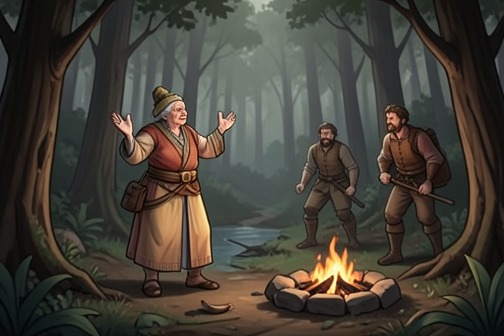
[Shabari](entity:character-recall-character-shabari-707c74464e77)’s meeting with [Ráma](entity:character-recall-character-r-ma-2db51e45ae4a) turns a forest encounter into the culmination of a life of religious discipline: after welcoming the exiled brothers and showing them the sacred woodland around her dwelling, she receives Ráma’s permission to leave her body in the fire and rises to heaven. The scene joins humble hospitality, remembered service, and spiritual release, making her ascent the decisive close of the encounter.
## Arrival and welcome
Ráma and his brother reach Shabari’s home after continuing through the forest under a friendly guide’s counsel to seek the company of [Sugríva](entity:character-recall-character-sugr-va-f4b2f7927084). The setting is a holy, secluded ground enclosed by noble trees. The poem lingers on the brothers’ approach through this wooded sanctuary before Shabari comes out to meet them, hands raised in reverence. Her greeting establishes the meeting as an act of devotion, but she also attends to the visitors’ immediate needs: she gives them water to cool their lips and wash their feet.
That practical welcome gives the encounter its human scale. Shabari is presented as an aged, pious votaress, yet the scene does not separate her spiritual standing from the ordinary gestures by which she receives guests. Her service is both courteous hospitality and the conduct of a devotee welcoming the person she has long awaited. Ráma addresses her as a saint who has never broken the law of duty and asks whether cares disturb her peace, placing the emphasis on the disciplined life she has maintained rather than on any worldly rank.
## The hermitage and its remembered teachers
Shabari answers that meeting Ráma has brought her the reward of her penance. She says that the purpose and fruit of her birth have been fulfilled on this day: the encounter is not merely a welcome visit but the event through which she understands her long religious practice to have reached completion. Her words give the scene a clear inward turn. The brothers have arrived at a forest dwelling; Shabari experiences their arrival as the fulfillment of a life’s work.
Ráma asks to see the woodland’s glories, and Shabari rises to lead the two brothers through the forest around her sacred dwelling. The landscape thus becomes something she interprets as well as shows. She identifies [Matanga](entity:character-recall-character-matanga-0a44805b6a35)’s wood and its celebrated grove, then refers to the lawns and dells the visitors have seen and to the account she has given them. Her guided passage through this place ties the present meeting to the holy community that shaped her life. The scene does not elaborate the full history of that community, but Shabari recalls the holy ones whom she obeyed in the woodland with reverence and care.
Her request to depart follows this act of showing and remembering. She asks Ráma to permit her to go to those she served in the holy shade. In narrative terms, the tour makes her destination intelligible: the landscape is not simply a stop on the brothers’ journey, but the setting of Shabari’s religious service and the place from which she now seeks release. Her attention moves from welcoming the living visitors to rejoining the revered figures whose presence has defined her life there.
## Consent, fire, and ascent
Ráma grants Shabari permission to go where she wishes, acknowledging that she has honored him. The exchange makes his consent explicit before the scene turns to her death. Shabari has her hair bound in the manner of a hermit and wears a bark garment and black deerskin. These details preserve her ascetic identity at the moment of departure: she does not leave the scene in royal or worldly dress, but in the clothing associated with the life she has practiced.
She then gives up her body to the flames. The poem presents what follows not as disappearance but as transformation: like a glowing fire, she rises toward heaven dressed in celestial garments, and her ascent sends a brightness through the sky like lightning. She reaches the holy sphere attained through the depth of contemplation, where pure spirits dwell. The passage therefore supplies its own account of the outcome. Shabari’s penance is complete; her death is followed by arrival in a heavenly realm associated with purified saints.
## Narrative significance
The encounter moves through distinct forms of service. Shabari first receives Ráma and his brother with reverence and water; then she guides them through the sacred woodland and recounts its associations; finally, she asks for and receives permission to depart. Each action shifts the scene closer to its conclusion without diminishing the importance of the welcome itself. Hospitality is the form her devotion takes in the brothers’ presence, while the remembered service of the holy ones gives her departure its direction.
The scene also alters the brothers’ role in the forest episode. They arrive as travelers seeking a guide toward Sugríva, but at Shabari’s dwelling they become witnesses to the completion of her spiritual course. Ráma does not command her to remain or make her departure his own undertaking; he grants her request after recognizing the honor she has shown him. The final movement—from the hermitage, through the flame, to the sphere of pure spirits—closes Shabari’s earthly story while briefly making her attainment visible to the travelers. Her ascent is thus both the ending of a devoted life and the defining event of their meeting.
Event 90
Sugriva seals the cave and is crowned king
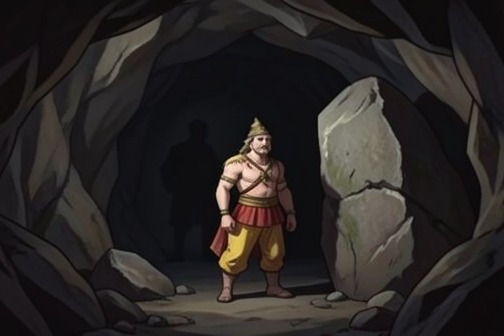
[Sugríva](entity:character-recall-character-sugr-va-f4b2f7927084) seals the cavern after a year of waiting for [Báli](entity:character-recall-character-b-li-40ae88ddddbf) to return from its darkness. When blood and the sounds of violence emerge but Báli’s triumphant cry does not, Sugríva treats the silence as evidence of his brother’s death: he closes the entrance with a huge block of shattered rock, makes offerings for Báli’s shade, and goes to [Kishkindhá](entity:location-recall-location-kishkindh-075c7eae31c0). The episode joins an uncertain report of death to a consequential transfer of rule, presenting Sugríva’s decision through the fear and limited knowledge of his vigil.
## The order at the cavern
Before entering the dark recess, Báli turns to Sugríva and tells him to remain at the cavern’s mouth, keeping watch and listening while Báli explores inside. He makes Sugríva swear by his feet to stay there. The instruction gives Sugríva a defined duty: he is not to follow his brother into the darkness, but to guard the entrance and wait for what comes out.
The account does not identify what Báli encounters within the cavern or describe the combat itself. Its focus is the watch outside. Sugríva remains at his post while his brother is beyond sight, with no report from within to clarify whether he is winning, injured, or alive.
## A year of waiting and the sign of blood
The vigil lasts a year. Sugríva watches at the entrance and looks in vain for Báli’s return. The duration makes the silence consequential: this is not a brief interruption in their journey, but an extended absence in which Sugríva has no direct knowledge of what has happened inside.
His uncertainty sharpens when a flood rolls out of the cavern. Sugríva describes it as a stream of froth and blood, and hears a frightening sound from the depths. Yet the expected sign that might settle the matter—the shout of Báli victorious in battle—never comes. The account places these clues side by side without showing the battle’s outcome. Blood and sound suggest violence; the missing cry leaves Sugríva to infer that Báli will not emerge.
## Sealing the entrance and returning to Kishkindhá
Sugríva responds by blocking the cavern with a great mass of shattered rock, compared in the account to a hill. The act makes the entrance inaccessible and turns his fearful interpretation into a decisive physical intervention. The passage does not say that he sees Báli die; the block follows the evidence available to the watcher outside, not a witnessed death.
He then gives offerings for Báli’s shade and goes to Kishkindhá, distressed. These actions mark a shift from waiting for a living brother to treating him as dead. The offerings give that assumption a funerary consequence, while the return to the kingdom carries Sugríva away from the place where the uncertainty began.
## Concealment and succession
For a long time, Sugríva tries to hide Báli’s fate from Báli’s lords. The account records the concealment but does not explain its motive or specify what Sugríva tells them. It does establish that the news eventually becomes known, bringing the private episode at the cavern into the affairs of Kishkindhá.
The event’s title identifies Sugríva’s subsequent crowning, making the presumed death consequential for the kingdom as well as for the brothers. The episode therefore hinges on an unresolved gap between sign and certainty: Sugríva receives no confirmation from Báli, yet acts as though the blood and silence are decisive. His year of obedience at the entrance ends not with a reunion, but with a sealed cave, funeral offerings, and a changed succession.
Event 91
Bali returns and exiles Sugriva
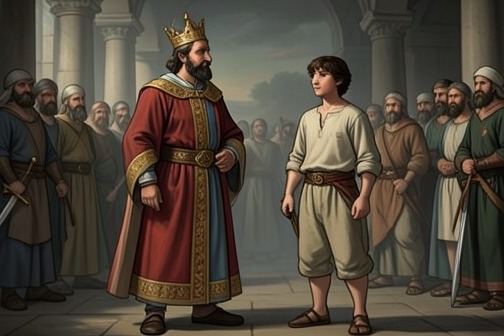
[Bali returns and exiles Sugriva](entity:event-recall-event-bali-sugriva-0c609a39e320) is the reversal in which [Sugriva](entity:character-recall-character-sugriva-bd875ea369d2)’s provisional rule gives way to his brother’s violent restoration of power. Recounted by Sugriva as an explanation of his present condition, the episode moves from [Bali](entity:character-recall-character-bali-4ed36663458c)’s return after a demon has been slain to the killing of the lords who made Sugriva king, and finally to Sugriva’s banishment and separation from his wife. What had been a temporary arrangement becomes a rupture of authority, kinship, and security.
## The Return and the Reversal
Sugriva remembers the moment as beginning with Bali’s return, joyous after the demon’s death. Bali found Sugriva ruling in his stead. The account does not present the brothers meeting as a negotiated transfer: Bali’s eyes grow red with rage, and he kills the lords who had made Sugriva king. His return therefore immediately overturns the political order that had formed during his absence.
Sugriva’s rule had been undertaken in a situation in which the city was without a king; the people made him its lord for its defence. Yet when Bali came back, Sugriva says he checked his own claim out of respect for the rights of birth. His deference is important to the sequence: even while ruling, he did not treat the kingship as an entitlement that superseded his elder brother’s claim. Bali’s response, as Sugriva recounts it, is not a reciprocal recognition of that restraint. It is anger, the killing of those who had elevated Sugriva, and the destruction of the arrangement that had protected the city.
## From Petition to Banishment
Sugriva says that he approached Bali humbly and sued for consideration. The plea does not restore his standing. Bali reviles him in fury, turning the exchange between brothers into an assertion of power rather than a hearing of Sugriva’s account. The surviving recollection emphasizes this contrast: Sugriva’s meek respect and humble speech meet Bali’s rage and contempt.
The punishment strips Sugriva of both place and protection. Bali leaves him a single robe and sends him into banishment. Sugriva also says that his wife is torn from his side. These are distinct losses: he is expelled from the kingdom, reduced to what he can carry, and separated from his wife. The account does not describe the circumstances of that separation further, but its placement alongside the banishment makes clear how completely Bali’s return changes Sugriva’s life.
## Sugriva’s Account and Its Aftermath
Sugriva recounts the episode in the first person, presenting his former rule, his deference to birthright, his plea, and his expulsion as the history behind his current fear. He describes himself afterward as roaming through lands of woods and seas, fearful and ill at ease. The return that might have ended an absence instead leaves him displaced and insecure.
Because the episode reaches the reader through Sugriva’s recollection, its emphasis falls on the sequence as he experienced and explains it: a brother returns, a substitute ruler is removed, a plea fails, and exile follows. The account gives Bali’s anger and actions, but does not supply his reasoning beyond his fury at finding Sugriva on the throne. That imbalance keeps attention on the consequences Sugriva identifies: political dispossession, humiliation, and separation from his wife. The event is thus not merely a change of ruler. It is the rupture that leaves Sugriva without a kingdom or a settled home, and makes his present condition intelligible.
Event 92
Bali kills Dundubhi

[Bali kills Dundubhi](entity:event-recall-event-bali-dundubhi-eda020baae90) in a contest that turns the demon’s challenge into a public measure of the monkey king’s strength. [Dundubhi](entity:character-recall-character-dundubhi-402a3265901e) is described as a bull-shaped monster of mountain-like size, driven by pride in his gifts and confidence in his unmatched might. His defeat comes in stages: he seeks battle, confronts [Bali](entity:character-recall-character-bali-4ed36663458c), fights with whatever force and objects are at hand, and is finally overcome. Bali’s last act—lifting the corpse and throwing it a league away—makes victory visible on a scale as immense as the combatants themselves.
## Dundubhi’s challenge
Dundubhi is introduced through the striking contrast between his animal shape and his extraordinary size. He resembles a bull, yet rises to the height of a mountain. The account makes his stature part of the threat: he is not an ordinary opponent but a creature whose body alone suggests the scale of the contest to come.
His confidence is just as conspicuous. Pride in his gifts and belief in his unparalleled strength drive him to seek war. He goes first to [Ocean](entity:character-recall-character-ocean-faa070d4a0c3), described as lord of streams and brooks, thirsty for combat. This opening establishes Dundubhi as the initiator: his appetite for a fight precedes the encounter with Bali. The account moves from his challenge to Ocean to Bali’s confrontation with him, without detailing every step between those moments.
## Bali enters the fight
Bali hears the roar and crashing from within his bowers and responds indignantly. The disturbance is not described as a quiet or formal challenge: Dundubhi’s arrival is registered through the noise he makes and the destruction around him, including trees torn up near the portal. Bali comes out to meet a threat that has already announced itself by shaking the surroundings.
The encounter quickly becomes physical. Bali seizes Dundubhi by the horns and holds him fast, then drags him round and round. The grip turns the monster’s defining feature—his great bull-like body—into a point of control. Instead of being overwhelmed by Dundubhi’s size, Bali handles that immense frame directly, making the fight a test of strength expressed through contact, restraint, and movement.
## The contest and Dundubhi’s defeat
Dundubhi resists with his fists, feet, and knees. The struggle also draws the landscape into the fight: he uses fragments of rock and trees as weapons. His resistance is varied and forceful, but it does not reverse the contest. The account marks a clear turning point when his strength fails against Bali, identified as the offspring of Śakra. Dundubhi’s earlier confidence in his own power is answered by a stronger opponent whose advantage becomes decisive in the physical struggle.
The defeat is not left at the moment Dundubhi’s strength gives out. Bali raises the lifeless body with tremendous effort and hurls it a league away. The action gives the ending its own measure: killing the monster establishes Bali’s victory, while throwing the corpse demonstrates that victory through the distance the immense body travels. The surviving image is one of scale and force, from the mountain-sized challenger to the body cast away after the fight.
## Narrative significance
The episode presents Bali’s might through a sequence of concrete tests rather than through a bare claim of strength. Dundubhi’s mountain-like stature, Bali’s grip on his horns, the struggle with fists and improvised weapons, and the final throw each enlarge the demonstration. Strength is shown first as the ability to meet a formidable opponent, then to withstand his resistance, and finally to move his enormous dead body.
The contrast also gives the encounter a compact dramatic shape. Dundubhi’s pride propels him toward combat; his varied resistance prolongs the test; and the failure of his strength reverses his expectation of victory. Bali’s final throw closes the contest with an outward, measurable display. The episode therefore establishes not only that Dundubhi is defeated, but why the encounter can serve as evidence of Bali’s exceptional physical power.
Event 93
Matanga’s curse bars Bali from his hermitage
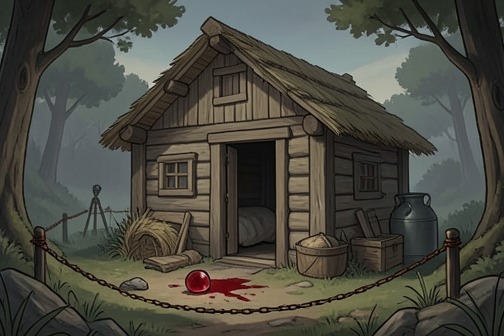
[Matanga](entity:character-recall-character-matanga-0a44805b6a35)’s curse turns the sage’s hermitage into a boundary [Bali](entity:character-recall-character-bali-4ed36663458c) cannot cross. After blood from a demon’s shattered corpse reaches the retreat, Matanga curses Bali and bars him from approaching within a league; the curse and fear of its consequence keep Bali away from [Rishyamuka Mountain](entity:location-recall-location-rishyamuka-mountain-fcb74e1f2585).
## Cause and Setting
The curse follows Bali’s act of hurling a demon’s corpse through the air. Blood from the shattered jaw falls near Matanga’s hermit cell, carrying the violence of the distant act into the sacred space. Matanga sees the drops defiling his hermitage and hastens out to discover who is responsible. His anger is directed not merely at the corpse’s passage but at the blood that has reached and polluted the retreat.
## Terms and Immediate Effect
Matanga’s warning makes the boundary precise: Bali must not come within one league of the sage’s retreat. The threat is not simply exclusion; if Bali ventures that near, his death is at hand. The curse thus gives a measurable limit to the danger, turning distance from the hermitage into protection for Matanga’s grove and a mortal risk for Bali.
Its force persists beyond the moment of anger. The curse weighs on Bali and troubles his conscience, while fear keeps him far from the heights of Rishyamuka Mountain. Matanga’s hermitage consequently becomes more than the setting of Bali’s punishment: its protected boundary shapes where Bali can go and makes the mountain a place beyond his reach.
## Consequence for the Conflict
The curse also alters the balance between the brothers: because Bali cannot approach Rishyamuka Mountain without risking death, the mountain can shelter [Sugriva](entity:character-recall-character-sugriva-bd875ea369d2) beyond his reach. Matanga’s defense of his retreat therefore has consequences beyond the hermitage, creating a geographical limit on Bali’s power and a refuge from which the conflict between the brothers can continue.
## Narrative Function
The episode makes the aftermath of violence consequential: Bali’s act reaches beyond its immediate target when blood from the corpse falls beside Matanga’s retreat, and the sage answers that intrusion with a lasting prohibition. The curse converts a moment of anger into a continuing condition of the brothers’ conflict. Its force lies in this change of scale: a single act leaves a boundary that continues to shape the story after Matanga has returned to his hermitage.
Event 94
Rama’s arrow pierces seven palm trees
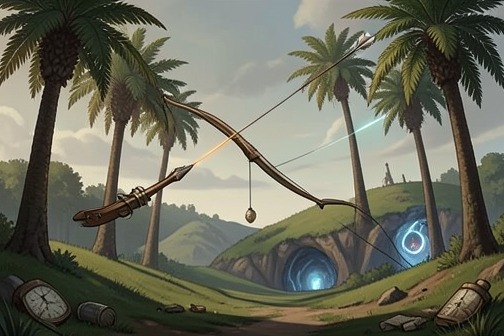
[Ráma](entity:character-recall-character-r-ma-2db51e45ae4a)’s arrow piercing the seven palm trees is a demonstration of strength made for a witness: Ráma takes up his bow so that his friend [Sugríva](entity:character-recall-character-sugr-va-f4b2f7927084) can know the measure of his power. The arrow does not stop at the trees. It passes through a hill and six subterranean realms, reaches the lowest depth, then travels back through earth and air to rest in Ráma’s quiver. Sugríva is amazed. The feat converts a claim of heroic ability into a visible, startling display, and the arrow’s return completes the proof as decisively as its passage through the obstacles.
## The demonstration
The episode appears in the canto titled “The Palm Trees.” Its purpose is stated directly: Ráma grasps his bow so that his friend may know his unrivalled strength. The bow is described as mighty and a source of dismay to foes; Ráma lays an arrow on its string, fixes his gaze on a tree, and releases it. The scene therefore begins not with an exchange of blows but with a deliberate test. Ráma’s martial capacity is presented to Sugríva as something that can be seen and judged, rather than accepted on reputation alone.
The action is also carefully directed toward a particular observer. The narration identifies Sugríva as Ráma’s friend, and the demonstration is meant for him. The arrow’s performance answers that purpose without requiring a battle to take place: it shows what Ráma’s weapon can do before the two face a deadly fight. The passage does not describe Sugríva voicing a request or explain what doubts he may have had; it makes the immediate aim plain through the narrator’s account of why Ráma takes up the bow.
## The arrow’s course
The feat expands in successive stages. First, the arrow cleaves seven palm trees standing in a line. It then continues through the hill rising behind them, carrying the trajectory beyond the visible row of trees and into the depths beneath the earth. It passes through six subterranean realms and reaches the lowest depth. The numbered sequence gives the feat its accumulating scale: each obstacle extends the arrow’s course, while the descent into the realms below makes the demonstration more than a single powerful strike.
The arrow’s return is essential to the episode’s design. After reaching the lowest depth, it speeds back through earth and air and rests in the quiver from which it came. Its movement forms a complete circuit—outward through trees, hill, and underworld, then back to its owner. The account thus does not leave the weapon lost beyond sight or end with penetration alone. The return makes the extraordinary journey part of Ráma’s controlled act, and closes the demonstration by bringing its result back to the bowman.
## Sugríva’s response and the scene’s force
The narration marks Sugríva’s astonishment before he addresses Ráma. His response focuses on the implication of what he has witnessed: he asks what champion could hope to meet Ráma in deadly combat when his arrow can travel with such force. The passage moves from the sight of the arrow’s course to a judgment about Ráma as a fighter. Sugríva’s reaction supplies the human consequence of the demonstration: the feat has not merely altered the landscape it passes through, but has made Ráma’s strength undeniable to its intended witness.
That shift gives the episode its narrative force. A bow, a single arrow, and a row of palms become the means by which Ráma’s martial reputation is tested in action. The arrow’s extraordinary reach establishes the scale of his power; its return establishes his command over the demonstration; Sugríva’s amazement registers the result. Though the scene is not itself a battle, it points toward combat through Sugríva’s reference to a deadly fight and the bow’s association with foes. It turns the prospect of such a fight into a question of capacity already answered before combat begins.
Event 95
Rama misses Sugriva’s first duel because he cannot tell the brothers apart
[Ráma](entity:character-recall-character-r-ma-2db51e45ae4a)’s failure to act in [Sugríva](entity:character-recall-character-sugr-va-f4b2f7927084)’s first duel with [Báli](entity:character-recall-character-b-li-40ae88ddddbf) turns a planned intervention into a defeat. Though Ráma stands ready with his bow, the brothers’ likeness makes it impossible for him to identify his friend in the fight. His withheld arrow leaves Sugríva to face Báli alone, and the duel ends with Sugríva beaten and fleeing to Rishyamúka.
## Background and Challenge
The confrontation is framed as an effort to answer Báli’s violation of his brother’s right. Ráma and Sugríva come to the gate of [Kishkindhá](entity:location-recall-location-kishkindh-075c7eae31c0) and take cover among the trees. From there, Sugríva calls Báli out to fight. The concealment places Ráma close enough to watch and ready to intervene, while Sugríva openly initiates the challenge.
Báli emerges in fury at the shout. The sequence moves directly from the call to the brothers’ encounter: Sugríva has drawn Báli into combat, and Ráma is present as the ally expected to turn the contest’s outcome. But the scene’s decisive obstacle is not a lack of readiness. It is the difficulty of telling the combatants apart once the fight begins.
## The Mistaken Restraint
The poem emphasizes that the brothers resemble one another both in form and in might. Ráma watches with his bow in hand, but cannot tell where his friend is and where his foe. Although his bow is ready, he sends no life-destroying shaft. The hesitation is not presented as a change of allegiance or a refusal to help: Ráma cannot safely choose a target when the two figures are indistinguishable to him in the midst of combat.
That visual confusion converts readiness into helplessness. Ráma’s position beside the fight and his weapon’s readiness make the absence of a shot consequential; the scene does not show him intervening by another means. His restraint gives Báli the advantage of meeting Sugríva without the assistance on which Sugríva had hoped. The difference between friend and foe is clear in the alliance’s purpose, but not in the brothers’ appearance as they fight.
## Defeat and Flight
With Ráma’s arrow withheld, Báli strikes with greater force and Sugríva’s strength gives way. Sugríva, who had hoped for Ráma’s aid, receives none in this encounter. He escapes to Rishyamúka, weary, faint, wounded, bruised, and covered in blood. The flight is the duel’s outcome: Báli has not been stopped, and Sugríva has to retreat rather than prevail at Kishkindhá’s gate.
The return to Rishyamúka also makes the failed intervention more than a missed shot. The expected aid has not reached Sugríva, and the immediate result is his physical defeat and withdrawal. The scene establishes a sharp reversal between the confidence of the challenge and the damaged figure who escapes afterward. Ráma is present throughout, but his presence alone cannot secure the result Sugríva expected.
## Narrative Significance
The episode makes recognition, rather than courage or weaponry, the hinge of the action. Sugríva calls Báli out, Báli answers, and Ráma stands ready; yet resemblance prevents the ally from acting at the moment his support matters. The failure is therefore specific and practical: Ráma does not mistake the purpose of the fight, but cannot distinguish the two brothers in its movement.
By ending with Sugríva’s retreat, the episode marks the first duel as a failed attempt to resolve the conflict through their joint action. Its outcome contrasts the prepared bow with the arrow never released, and the expectation of aid with the wounded flight that follows. The reversal gives the encounter its narrative force while leaving its cause plainly visible: Báli and Sugríva look and fight alike, and Ráma will not risk striking the wrong brother.
Event 96
Rama shoots Bali during the second duel
[Ráma](entity:character-recall-character-r-ma-2db51e45ae4a)’s intervention in the second duel between [Báli](entity:character-recall-character-b-li-40ae88ddddbf) and [Sugríva](entity:character-recall-character-sugr-va-f4b2f7927084) converts a renewed contest into a decisive, lethal reversal. A flowering creeper supplies the crucial mark by which Ráma can identify Sugríva; once he sees his ally weakening, he draws his bow and shoots Báli through the chest. The sequence turns on recognition, watching, and timing: Ráma waits until the danger to Sugríva becomes unmistakable, then changes the course of the fight with a single arrow.
## A badge for the second encounter
The need for a visible distinction shapes the event before the combat begins. In the first duel, Ráma had failed to distinguish the two brothers and withheld his arrow. For the renewed encounter, he tells Sugríva to bind a badge around himself, so that Ráma will know which fighter to watch. The instruction makes identification an explicit condition of intervention: Ráma cannot safely act on allegiance alone when the brothers are locked together in battle.
The badge is not a crafted emblem but a flower plucked from a creeper growing on the mountain slope. [Lakshmaṇ](entity:character-recall-character-lakshma-7aad0629b677) gathers the bloom and ties it around Sugríva. This small, practical gesture answers the problem left by the first fight. The flower gives Ráma a visible point of recognition before the fighters meet again, turning the mountain’s vegetation into a means of distinguishing friend from foe. The scene’s preparation therefore belongs to its action, not merely to its setting: without a mark, Ráma risks repeating his earlier failure to intervene.
## The duel and Ráma’s decision
When the brothers meet again, the narration presents them as closely matched in their clash, like thunderclouds meeting amid battle cries and threats. Ráma watches Sugríva rather than acting at once. He sees his ally begin to lose strength and notices Sugríva’s searching glance, cast toward every quarter. The detail makes Sugríva’s distress visible and gives Ráma a clear moment to respond; the second encounter does not simply repeat the first, because the badge has made recognition possible and the balance of the fight now calls for intervention.
The poem marks Ráma’s decision through a sequence of increasingly direct actions. He cannot endure the sight of his friend’s defeat; he fixes his attention on his arrow, burns to kill the victorious opponent, and lays the shaft on the bow. The passage moves from watching to resolve and from resolve to physical action. Ráma’s concern for Sugríva is thus not left as a general allegiance: it takes the form of a deliberate choice to enter a fight in which Sugríva is being overcome.
## The arrow and the reversal
The arrow springs from the bowstring with the force of a serpent’s fang. The narration compares its flight to red lightning and stresses that it reaches its aim. These images compress the interval between Ráma’s decision and its consequence: the shaft is released, crosses the space between archer and combat, and strikes Báli in the breast. The arrow quivers there as Báli reels and falls. The exchange of force is immediate and irreversible; a duel that had been turning against Sugríva is ended by Ráma’s shot.
The blow also completes the scene’s pattern of recognition. The flower badge was introduced to prevent uncertainty about which brother was fighting; Ráma then watches Sugríva’s weakening, selects his moment, and directs his arrow at the opposing champion. The consequence is not an abstract victory but Báli’s mortal fall, anticipated by the warning that he will lie stricken and gasp as he dies. The narrative therefore links preparation, perception, and consequence in a tightly ordered chain: the mark enables recognition, recognition enables intervention, and intervention ends the duel.
## Narrative significance
The second fight reverses the failure of the first. Previously, Ráma could not act because he could not tell the brothers apart; now the flower makes that distinction visible, and he shoots when Sugríva’s defeat appears imminent. The change is practical, but it also gives the scene its dramatic structure. The reader is made to wait with Ráma through the combat, watching for the moment when the danger to Sugríva and the identity of the fighters are both clear enough for decisive action.
The episode’s emotional movement follows the same narrowing sequence. The clash begins as a contest between the brothers; attention shifts to Sugríva’s failing strength, then to Ráma’s refusal to accept his friend’s defeat, and finally to the arrow in flight. The imagery intensifies at the instant of the shot, from battle cries to lightning-like speed and the fatal wound. Ráma’s intervention is consequently both an act of aid and the decisive mechanism of Báli’s death. The scene closes not with a prolonged exchange but with the wounded warrior reeling and falling, leaving the consequences of that act to the events that follow.
Event 97
Bali’s funeral rites and cremation
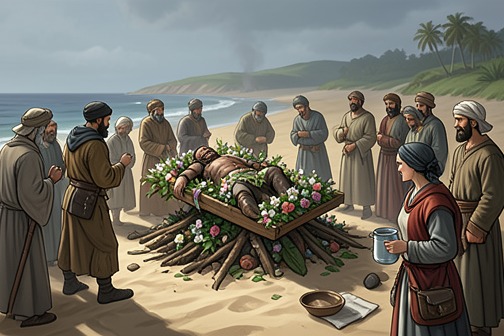
[Bali’s funeral rites and cremation](entity:event-recall-event-bali-8788aa05fd37) transform the aftermath of his death into a communal ceremony. The [Vánars](entity:creature-recall-creature-v-nars-66c23f0e487a) carry him on a splendid, flower-covered litter; [Sugríva](entity:character-recall-character-sugr-va-f4b2f7927084) orders the obsequies; and the mourners gather at a funeral pile on a low, sandy island. [Tárá](entity:character-recall-character-t-r-551b368fbdfe)’s grief and the final water offering, made with [Angad](entity:character-recall-character-angad-ece5a55cd18f) placed first, show that the dead hero is mourned not only by his family but by the community that performs the rites around him.
## From death to public ceremony
After [Bali](entity:character-recall-character-bali-4ed36663458c)’s death, the narrative turns from combat to the work of mourning. [Tára](entity:character-recall-character-t-ra-0a0055608a37) hears [Ráma](entity:character-recall-character-r-ma-2db51e45ae4a) speak, hurries into the town, and returns bearing the litter. Its brilliant blooms catch Ráma’s attention, and he tells [Lakshmaṇ](entity:character-recall-character-lakshma-7aad0629b677) that Bali should be placed upon the bier. The sequence gives the funeral a deliberate transition: the dead warrior is taken from the immediate scene of conflict and prepared for a formal farewell.
The litter’s flowers and its description as glorious distinguish the funeral procession from the violence that preceded it. Bali is carried with visible honour, while Ráma’s instruction establishes his role as a witness to, and participant in, the handling of the dead. The passage does not dwell on the cause of Bali’s death here; instead, it attends to the obligations that begin once his body is brought out for the rites.
## Sugríva orders the obsequies
Sugríva directs that the funeral ceremonies be performed according to law. His command gives the proceedings an ordered character: the funeral is not left to grief alone but is carried out as a prescribed duty. He calls for the Vánars to lead the way, placing the community within the ceremony rather than leaving it as a private observance by Bali’s household.
Bali’s body is laid beneath layered garments, wreaths, ornaments, and gold. These coverings make the bier a carefully adorned resting place and maintain the poem’s emphasis on Bali’s status as a hero. The passage offers no inventory of the objects’ origins or further explanation of their meaning; their presence, together with Sugríva’s command, is enough to mark the funeral as a dignified public undertaking.
## The pyre and the rites
The Vánars raise the funeral pile on a low, sandy island. The place is described in simple physical terms, but the choice of a separate island gives the ceremony a distinct setting: the crowd labours there to prepare the pile, and the funeral procession moves away from ordinary urban space toward the site of cremation. The account emphasizes collective effort, describing crowds of Vánars at work.
At the pyre, the flame is lit and the mourners pass slowly around the dead. This measured movement contrasts with the earlier action of battle and makes the rite’s sequence legible: the body is borne, adorned, placed upon the pile, and circled after the fire is kindled. The poem identifies the observance as complete, saying that the funeral train performs the rites in full. It does not supply additional ritual details, so the emphasis remains on the prescribed actions and on the gathered participants who carry them out.
## Tárá, Angad, and the final offering
The ceremony also gives space to grief within the public rites. Tárá is overcome by sorrow and lies on the ground; the Vánar women raise her. Her distress makes the cost of Bali’s death visible in the midst of formal observance, while the women’s action shows that care for the bereaved accompanies the funeral itself.
After the cremation rites, the mourners go to a flowing stream to make the water offering. Angad is placed first, with Tárá and Sugríva among the chieftains who pour the water. The closing gesture gathers Bali’s close relations and the Vánar leaders into one act directed toward the dead. The funeral thus ends not simply with the lighting of the pyre, but with a further communal observance in which Angad’s position is expressly marked and Bali’s loss is acknowledged by those who remain.
Event 98
Sugriva’s restoration and Angada’s appointment as co-ruler

[Sugríva](entity:character-recall-character-sugr-va-f4b2f7927084)’s restoration and [Angad](entity:character-recall-character-angad-ece5a55cd18f)’s appointment as co-ruler turn a change of fortune into a public transfer of authority. [Ráma](entity:character-recall-character-r-ma-2db51e45ae4a) directs Sugríva back to the town once governed by [Báli](entity:character-recall-character-b-li-40ae88ddddbf), and the Vánar leaders confirm the new order through a coronation conducted according to sacred precedent. Yet the ceremony also establishes a boundary: Ráma has helped restore his ally, but remains bound by his father’s command and cannot return before the full period of exile has passed.
## Background and Ráma’s Decision
The ceremony follows Sugríva’s recovery of the home and position that had been under Báli’s royal authority. It is not presented merely as a private reconciliation or a return to familiar surroundings. Ráma tells Sugríva to go back and be consecrated sovereign, making the restoration an act of public kingship. The assembled Vánar councillors and peers give the event a collective setting: Sugríva’s return is to be recognized by the community whose leadership he resumes.
Ráma’s own situation remains unresolved. In addressing the gathering, he explains that he cannot break the mandate spoken by his father before fourteen years have elapsed. His refusal to return is therefore not a withdrawal of support for Sugríva, but a limit imposed by his continuing obligation. The contrast shapes the scene: Sugríva can go home and receive a crown, while Ráma, despite the victory and the restoration of his ally, must continue to honor his exile.
## The Coronation Rite
Sugríva returns to the town that had been governed by Báli and submits to a deliberately ordered ceremony. A throne has been prepared with a splendid carpet and fresh garlands. Seated upon it, Sugríva turns his gaze toward the east, giving the moment a prescribed ritual orientation rather than treating the throne as an ordinary seat of power.
The Vánar leaders then pour sacred water over Sugríva in accordance with the instructions of sacred tradition and the authority of earlier sages. The rite makes his accession visible and communal: the leaders themselves perform the consecration, and the gathered [Vánars](entity:creature-recall-creature-v-nars-66c23f0e487a) answer with sustained cries of triumph. The sequence moves from preparation, to the ruler’s placement and orientation, to the pouring of water, and finally to public acclamation. Sugríva’s authority is thus represented both through ritual and through the response of those assembled to witness it.
## Angad and the New Royal Order
When the rite is complete, Sugríva follows Ráma’s direction and draws Angad to his breast. The episode identifies Angad’s appointment alongside Sugríva’s restoration, presenting the young prince’s elevation as part of the settlement rather than as a separate contest for power. Sugríva’s public accession and Angad’s place beside him establish a new arrangement for the restored court.
That transition carries particular weight because the town had been under Báli’s rule. The ceremony does not simply replace one name on the throne: it publicly acknowledges Sugríva’s return and assigns Angad a role in the authority that follows. The text’s movement from the leaders’ consecration of Sugríva to Sugríva’s embrace of Angad connects the legitimacy of the restored ruler with the future position of the prince. The concluding gesture gives the political change a familial form without displacing the ceremony’s public character.
## Significance of the Event
The coronation binds together personal restoration, ritual legitimacy, and collective recognition. Ráma names the course of action, but the Vánar leaders carry out the consecration, and the assembled community answers with acclaim. Sugríva’s return is therefore shown as more than a favor granted by an ally: it becomes an acknowledged kingship enacted before the people who gather around the throne.
At the same time, the scene does not allow Ráma’s role as restorer to erase his own constraint. He can authorize Sugríva’s return and support the new order, yet he will not shorten his father’s fourteen-year mandate. The two outcomes stand side by side: Sugríva’s kingship is renewed through a completed rite, while Ráma’s return remains postponed. The moment consequently joins political closure in Sugríva’s realm to continuing obligation in [Ráma’s exile](entity:state-recall-state-r-ma-a94ec8a82327).
Event 99
Lakshmana confronts Sugriva over delaying the search for Sita
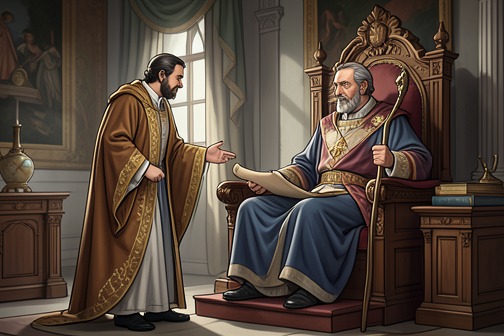
[Lakshmaṇ](entity:character-recall-character-lakshma-7aad0629b677) confronts [Sugríva](entity:character-recall-character-sugr-va-f4b2f7927084) over delaying the search for [Sítá](entity:character-recall-character-s-t-0be56374418b) when a promise of aid has outlasted the rainy season and action can no longer be deferred. [Ráma](entity:character-recall-character-r-ma-2db51e45ae4a) sends his brother to rebuke the newly secure king: the encounter turns an alliance into a test of fidelity, then lets Sugríva answer the charge by recalling what Ráma saved for him and what he still owes in return.
## The Promise and Its Delay
Sugríva had promised that, when the rains ended, he would lend Ráma the strength of his arm. The season has now passed, and Ráma sees the interval not as harmless waiting but as a failure of faith and wasted time. His need remains urgent: [Rávaṇ](entity:character-recall-character-r-va-06a1d00141e6) is to be slain and Sítá recovered, but the pledged assistance has not yet been delivered.
The contrast at the heart of the episode is between a promise made under pressure and the obligation that remains when circumstances become easier. Sugríva’s fortunes have improved; Ráma tells Lakshmaṇ to seek him sunk in bliss and sloth, forgetful of his royal oath. The accusation is serious because the alliance was founded on reciprocal aid. Sugríva’s delay therefore places not only his reliability but the practical value of that compact in question.
## Lakshmaṇ’s Mission
Ráma does not go himself. He gives Lakshmaṇ the charge of confronting Sugríva and naming the lapse as a failure of faith. Lakshmaṇ obeys, with his thoughts devoted to Ráma, and carries the rebuke into [Kishkindha](entity:location-recall-location-kishkindha-34f806a0d9f0). Ráma’s instruction gives the mission a clear purpose: to make Sugríva recognize that the opportunity for warlike enterprise has arrived and that continued inaction cannot be treated as a small oversight.
Lakshmaṇ’s warning frames his arrival as a summons to wake from a slothful trance. The image marks the gap between the urgency outside the court and Sugríva’s apparent ease within it. The scene is a political confrontation rather than a battle: Ráma uses his brother’s words to press the alliance back into motion, while leaving Sugríva an opportunity to answer rather than declaring the bond ended.
## Sugríva and [Tárá](entity:character-recall-character-t-r-551b368fbdfe) Answer the Charge
Sugríva starts from his rest with doubt and terror in his breast. The scene presents the rebuke’s immediate effect as alarm, not indifference. Tárá then responds to Lakshmaṇ, arguing that Sugríva has not strayed from truth or taken forbidden paths, and that his heart will not forget the lasting debt owed to Ráma, who saved him. Her defense recasts the delay against the history of the alliance: the present failure to act need not mean that gratitude has disappeared.
When Sugríva speaks, he acknowledges how much was at stake before Ráma came to his rescue. His glory, wealth, and royal power, he says, would have passed into other hands. The reminder gives his debt concrete political weight: Ráma’s aid preserved the position and sovereignty Sugríva now enjoys. His response thus answers Lakshmaṇ’s charge not by denying that assistance is due, but by affirming the bond that makes the obligation binding.
Sugríva also connects that obligation directly to Ráma’s objective. He declares that Rávaṇ will be slain and Sítá will again be with Ráma, and pledges not to leave the hero’s side. His assurance turns the confrontation away from rupture and back toward cooperation. Tárá’s appeal to Sugríva’s gratitude and Sugríva’s own renewed commitment both insist that the alliance still has force, even after its promised timetable has slipped.
## Consequences and Significance
The episode places royal comfort beside royal responsibility. Sugríva is surrounded by signs of settled prosperity: gay garlands are twined around his neck, and [Rumá](entity:character-recall-character-rum-ecc0c11f6d8d) reclines beside him. Those details sharpen Lakshmaṇ’s charge that pleasure has displaced the promised work. But the poem does not leave the scene at accusation. Sugríva’s alarm, Tárá’s defense, and his pledge to stand with Ráma restore the moral basis of their partnership without erasing the delay that prompted the rebuke.
The confrontation also distinguishes a lapse from a final betrayal. Ráma’s mission asks Sugríva to fulfill a specific promise; Tárá recalls the debt behind it, and Sugríva names the expected outcome—Rávaṇ’s death and Sítá’s recovery. The scene therefore renews the alliance through speech before its military purpose can be fulfilled. It makes gratitude more than a feeling: in Sugríva’s own account, it must become action on behalf of the ally who saved his throne.
Event 100
Sugriva assembles the monkey army to search for Sita
[Sugríva](entity:character-recall-character-sugr-va-f4b2f7927084)’s assembly of the monkey army transforms the search for [Sítá](entity:character-recall-character-s-t-0be56374418b) from a promise between allies into a coordinated military undertaking. He calls in forces from across the country, gathers their chiefs at [Kishkindhá](entity:location-recall-location-kishkindh-075c7eae31c0), and begins sending search parties into distant regions, with the eastern expedition marked by an order for ten thousand [Vánars](entity:creature-recall-creature-v-nars-66c23f0e487a).
## The summons and its purpose
Sugríva’s mobilization follows a timely appeal that rouses him to act. He turns to [Nila](entity:character-recall-character-nila-ad117a8e9da1), a trusted and capable commander, and orders him to go out to the distant forces stationed in their separate posts. Nila is to summon the troops and bring them together; Sugríva meanwhile undertakes the preparations required for their arrival. The division of responsibilities gives the gathering both a clear chain of command and a practical beginning: one leader carries the summons, while the king coordinates what must be ready at home.
The call is deliberately wide in reach. Sugríva directs that the Vánar host be assembled from coast to coast, invoking force, persuasion, and valuable gifts as means of securing compliance. The order speaks to the scale of the task: the search cannot be entrusted to a few scouts or confined to the country nearest the court. It requires the separate bodies of the host, stationed over a broad territory, to respond together.
## The army gathers at Kishkindhá
The summons brings the forces rapidly homeward. The chiefs and their troops converge on the walls of Kishkindhá and crowd into Sugríva’s palace hall, arriving richly laden. The movement from distant posts to the royal center makes the king’s command visible in physical form: what had been scattered forces becomes an assembled host, present before its ruler and ready to receive its next instructions.
Sugríva reviews the multitude and finds the chiefs gathered with their warrior companies. This inspection is more than a display of numbers. It establishes that the call has been answered across the host and that the assembled leaders can now be assigned work. The gathering therefore forms the hinge between summoning and searching: the army’s size matters because it can be divided, directed, and sent out on separate routes.
## [Ráma](entity:character-recall-character-r-ma-2db51e45ae4a)’s appeal and the eastern dispatch
At the assembly, Ráma presses Sugríva to his breast and urges him to seek his lost Sítá. The gesture places personal trust alongside royal command. Ráma’s appeal identifies the purpose of the mobilization, while Sugríva’s position enables that purpose to be acted upon through the assembled Vánar forces. The alliance is no longer only an exchange of assurances; it now has troops, commanders, and a task.
Sugríva begins assigning the host by region. For the eastern search, he orders a prince leading warlike troops to take ten thousand Vánars, described as well trained in knowledge of time and place. The number gives the order a concrete scale, and the emphasis on knowing when and where to act marks the expedition as planned reconnaissance rather than a disorderly march. The evidence preserves this eastern assignment as one specific deployment within the larger gathering, not as the whole search.
## The event’s place in the story
The assembly converts Sugríva’s authority into action on behalf of Ráma. Its sequence is sharply practical: a timely prompting, a command to Nila, a summons extending across the host, the arrival and review of the troops, and the assignment of an eastern force. Each step answers a different need—recall, preparation, concentration, assessment, and deployment—so the scene presents mobilization as organized work rather than a single grand gesture.
Its scale also changes the terms of the search. Sítá’s disappearance is no longer faced by Ráma and his immediate companions alone; the resources of Sugríva’s realm are now committed to finding her. The gathered multitude supplies the means for a search across distant regions, while the first regional order shows how that immense undertaking can be broken into commands. The army’s arrival at Kishkindhá is thus both a response to Ráma’s loss and the beginning of a wider expedition.
Event 101
Sugriva’s search expedition
[Sugríva](entity:character-recall-character-sugr-va-f4b2f7927084)’s search expedition turns the effort to find [Sítá](entity:character-recall-character-s-t-0be56374418b) into an organized mission: the [Vánars](entity:creature-recall-creature-v-nars-66c23f0e487a) are addressed in regional contingents, given directions, and sent out, with special counsel reserved for [Hanumán](entity:character-recall-character-hanum-n-b41d60813de6). The surviving account establishes the expedition’s command structure and departure, but not the search parties’ eventual findings.
## Mobilization and Command
The dispatch is presented through a sequence of addresses rather than a single undifferentiated order. In the canto devoted to the western army, Sugríva turns respectfully to [Susheṇ](entity:character-recall-character-sushe-a6dd745d6daf) and addresses him; the passage identifies two hundred thousand of the best as part of this force. The detail gives the mobilization a concrete scale while associating it with a named regional contingent.
The following canto turns to the northern army. Its heading and the transition from the departing western legions establish that the search is divided by region, while Sugríva’s address signals that the king continues to direct the operation as the contingents are organized. The excerpt does not provide the full set of assignments, so the expedition’s broader deployment cannot be reconstructed from these passages alone.
## Directions and Special Counsel
A later instruction tells the Vánars to turn back and not venture farther toward the sunless, boundless shore. The warning places a limit on the search: the mission calls for exploration, but not for pressing onward into a perilous or inaccessible expanse. The account does not specify here which contingent receives the instruction or what prompted it.
The canto titled The Ring singles out Hanumán for special counsel. This marks him as a particular recipient of Sugríva’s guidance within the larger operation, although the available lines do not spell out the counsel’s content. The contrast between directions addressed to the Vánars collectively and advice reserved for Hanumán gives the expedition both a broad, organized reach and a distinct individual focus.
## Departure and Narrative Function
The sequence culminates in the Vánars setting out, their movement likened to locusts spread across the land. The image conveys the scale of the departure and turns the preceding addresses into action: commands have been given, and the search is now under way.
The episode establishes the expedition’s launch rather than its resolution. Its regional headings, named commanders, stated force of two hundred thousand, boundary warning, and separate counsel to Hanumán show how the search is framed as a coordinated undertaking. The supplied account ends with the Vánars in motion, without reporting what they discover.
Event 102
The southern search party’s adventure in the enchanted cave
[The southern search party’s adventure in the enchanted cave](entity:event-recall-event-9ab8b6810c3e) is a turning point in the search for [Sítá](entity:character-recall-character-s-t-0be56374418b): the hunters’ forward movement gives way to thirst, hunger, and uncertainty in a vast hidden place. There they meet Svayamprabhá, whose welcome and questions bring their immediate plight into contact with their larger purpose, the service of [Ráma](entity:character-recall-character-r-ma-2db51e45ae4a).
## Approach and setting
The cave episode follows a sequence of continued travel. [Hanumán](entity:character-recall-character-hanum-n-b41d60813de6) presses onward with [Tára](entity:character-recall-character-t-ra-0a0055608a37), [Angad](entity:character-recall-character-angad-ece5a55cd18f), and the rest of the party; the narrative thus presents the cave not as a destination sought for itself but as an interruption in a search already under way. Their movement forward matters: when they enter the gloomy vault, the open-ended journey becomes a predicament that demands help and explanation.
The surrounding passage also evokes a contrasting landscape of fragrance and abundance, with bees gathering around flowers, and names the hermit Kaṇdu as famed for truth and the power of penance. These details place the episode within a world where secluded natural places can carry spiritual associations as well as physical danger. The cave, by contrast, is described as vast and treasure-filled, yet its darkness and the visitors’ hunger make its riches no immediate answer to their need.
## Inside the cave
The party’s condition is stated plainly: they have entered the gloomy vault assailed by thirst and hunger. This is the episode’s concrete ordeal. The cave’s stored treasures suggest abundance, but the searchers arrive as vulnerable travelers who need sustenance and a way forward. The contrast makes the cave’s enchantment more than a matter of spectacle; it marks a place where familiar direction and ordinary self-sufficiency have failed.
After resting beneath spreading trees, the searchers rise and continue their efforts. The narrative gives this pause its own weight: weary bodies need relief before the party can attempt to move on. Hanumán’s renewed effort, with Angad and Tára beside him, keeps the company’s collective purpose in view even as fatigue and confinement threaten to halt it.
## Svayamprabhá and the searchers’ purpose
The encounter with Svayamprabhá begins with questions. She asks who the visitors are and who rules the cavern, requiring the strangers to account for themselves before she can understand their presence. Their answer begins with their immediate circumstances—hunger and thirst—and identifies them as travelers inside the gloomy vault. The meeting therefore changes the scene from solitary disorientation to a conversation in which assistance becomes possible.
Svayamprabhá tells them to explain clearly why they have come, but first invites them to eat fruit and quench their thirst. The order is significant: hospitality answers the bodily emergency before the party can give a full account. When Hanumán names Ráma and describes him as a prince whose authority reaches all peoples, the cave’s enclosed episode is connected back to the search’s governing cause. The party is not simply lost travelers; its journey is undertaken in Ráma’s service.
## Exit and narrative function
The next canto is titled “The Exit,” giving the cave sequence a clear movement from entrapment toward departure. The supplied passage establishes the transition through the searchers’ encounter with Svayamprabhá, their need for food and water, and their explanation of their mission; it does not detail every step by which they leave. What it does show is the change in their immediate prospects: they have found a host who offers relief and listens to their purpose, rather than remaining alone in the dark.
As an episode within the southern search, the cave adventure interrupts forward progress without displacing the quest itself. Its sequence—from pressing onward, to exhaustion and enclosure, to questioning and hospitality, and finally to an exit—makes the search’s physical costs visible. The brief naming of Ráma also restores the larger frame at the moment when the party’s attention might otherwise be narrowed to its own distress. The cave is an ordeal on the way, not the end of the undertaking.
Event 103
Angada Leads the Search Party in a Fasting-to-Death Crisis
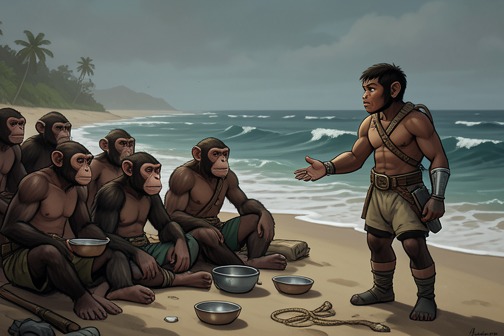
[Angad](entity:character-recall-character-angad-ece5a55cd18f) Leads the Search Party in a Fasting-to-Death Crisis is the moment when the southern [Vánars](entity:creature-recall-creature-v-nars-66c23f0e487a)’ failed search becomes an open revolt against the terms of their return. With the month fixed by [Sugríva](entity:character-recall-character-sugr-va-f4b2f7927084) gone and the party at the ocean’s edge, Angad declares that he would rather fast to death than face the consequences of coming back. The crisis sets the authority of the king against the young prince’s fear, despair, and distrust.
## The Search Deadline and the [Ocean](entity:character-recall-character-ocean-faa070d4a0c3)
The episode follows the party’s departure from a cave: [Svayamprabha](entity:character-recall-character-svayamprabha-de389b0fa6b7) has given them her blessing and withdrawn, and the Vánars look out upon the boundless ocean. The setting marks the limits of their search, while the expired deadline gives their predicament a political urgency. Angad reminds the chieftains that their monarch had fixed a day for their return; the month has been spent in toil and pain, and that appointed time has passed.
The deadline is not simply a measure of elapsed time. It makes the party’s inability to report success consequential: returning late exposes them to the displeasure they expect from Sugríva, while staying leaves them without a clear way forward. The ocean, vast and still before them, frames the decision as a threshold between an uncertain return and Angad’s proposed refusal to return at all.
## Angad’s Refusal
Angad first addresses the chieftains gently, but his restraint gives way as he declares his intention to lie by the ocean and fast until he dies. His proposal converts a failed mission into a deliberate act of self-destruction. Rather than lead the party back to face the king, he offers death as the alternative to submission to Sugríva’s authority.
The declaration also challenges the justice of the king’s rule. In answering an appeal from the chieftains, Angad asks what truth or justice they can find in Sugríva’s conduct. His resistance is therefore more than fear of punishment: he disputes the legitimacy of the authority demanding their return. The episode presents this challenge through a crisis within the search party, not through a battle; the immediate stakes are whether its members will follow their leader into death or turn back.
## Kinship, Counsel, and the Unresolved Crisis
The chieftains appeal to Angad through his mother’s love, urging him not to reject the bond with his mother, who has only him. Their plea makes the consequences of his decision personal: his death would leave her bereft. But the appeal does not resolve the conflict in the surviving episode. Angad bids the chiefs farewell, then throws himself down on sacred darbha grass, physically enacting the fast he has threatened.
The scene ends with the crisis still in progress. Angad has not returned to Sugríva, and the evidence does not establish that he dies or that the party accepts his proposal. Instead, his posture on the darbha marks a dangerous pause: the search has reached the ocean, the deadline has expired, and the leader has chosen refusal over a return he regards as intolerable.
Event 104
Sampati Reveals that Sita Is Held Captive in Lanka
[Sampati](entity:character-recall-character-sampati-286582a41b86)’s revelation that [Sita](entity:character-recall-character-sita-1913dd4978f6) is held captive in [Ravana](entity:character-recall-character-ravana-f2652ae52080)’s [Lanka](entity:location-recall-location-lanka-4b3ac7e9a824) breaks a deadlock of despair among the [Vánars](entity:creature-recall-creature-v-nars-66c23f0e487a): their search has brought them to the brink of giving up, and his news gives their effort a destination. The episode joins a public disclosure to a personal renewal, ending not only with knowledge of Sita’s whereabouts but with young pinions growing from Sampati’s side.
## Despair Before the Revelation
The Vánars are sitting sorrowfully when Sampati, identified as the mighty king of vultures, comes among them. The scene follows their cry that they should die with [Angad](entity:character-recall-character-angad-ece5a55cd18f). Their decision is starkly final: since flight seems useless, they resolve to fast until death. Sampati’s arrival therefore interrupts a gathering already oriented toward surrender; the information he brings matters because it answers the practical uncertainty that has left them without hope.
The episode’s title, “Tidings Of [Sítá](entity:character-recall-character-s-t-0be56374418b),” marks the shift from their immediate crisis to the news they need. Sampati tells them that Sita is captive in Ravana’s Lanka. Rather than letting the search party’s despair stand as the last word, the disclosure gives their mission a specific object. The change is from a decision to die because further effort appears futile to the possibility of acting on knowledge of where Sita is held.
## The News and Its Political Context
Sampati’s account identifies Ravana as the brother of [Kubera](entity:character-recall-character-kubera-fe5e28c9cf92), the Lord of Gold. This detail places the captor within a wider familial and political frame: Ravana is not introduced only as the person holding Sita, but is also connected to Kubera. The passage then evokes the [Southern Ocean](entity:location-recall-location-southern-ocean-c3710e414f22), setting the news against the formidable geography that separates the searchers from their goal. The revelation offers direction, but the surrounding image of the ocean makes clear that knowing the destination does not itself complete the journey.
The episode thus turns information into a new challenge. The Vánars’ immediate crisis has been the apparent pointlessness of continuing; Sampati’s testimony removes that uncertainty without erasing the distance or difficulty ahead. Its narrative force lies in this distinction: hope returns not because the task is finished, but because the searchers can now understand what they must attempt.
## Sampati’s Story and Renewal
Sampati’s disclosure is framed alongside his own remembered suffering. In the canto devoted to his story, he recalls complaining to a saint, with tears falling as he spoke. The account gives his speech a personal history: the speaker who brings the Vánars news is himself marked by anguish and by a past he recounts to them. The poem places this act of telling beside the group’s grief, linking the searchers’ crisis with Sampati’s remembered distress without making their experiences identical.
When Sampati finishes, young pinions grow from his side, and boundless rapture fills his breast. This change supplies the episode with a second outcome beyond the revelation about Sita. The Vánars receive knowledge that can renew their purpose; Sampati experiences a visible bodily transformation at the close of his account. The movement from tears in the remembered story to joy at the end gives the scene a structure of reversal: a speech shaped by anguish concludes in renewed wings.
## Consequence and Narrative Role
The episode closes the immediate impasse created by the Vánars’ resolve to fast and die. Sampati’s news does not narrate Sita’s rescue or the searchers’ eventual arrival; it establishes the fact that makes continued action meaningful. The distinction keeps the revelation consequential without confusing it with its later fulfilment.
Sampati’s appearance therefore works on two connected levels. In the search, he is the source of decisive intelligence: Sita is captive in Ravana’s Lanka. In his own story, he is a figure whose narrated grief is followed by the return of his pinions. The episode brings those turns together, replacing the Vánars’ proposed ending with a renewed objective and ending Sampati’s testimony in an image of recovered capacity.
Event 105
Hanuman Flies Across the Ocean
[Hanúmán](entity:character-recall-character-han-m-n-8456b29d444d)’s flight across the ocean is the opening action of Book V’s first canto, a crossing shaped by deliberate preparation, a vow to complete his mission, and a final arrival within sight of [Lanká](entity:location-recall-location-lank-4c2ae5988d40). The passage moves from prayer on a wooded mountain to a leap that shakes the mountain, then through the air to a peak overlooking the city. It establishes both the distance Hanúmán must overcome and the resolve with which he undertakes the search for [Sítá](entity:character-recall-character-s-t-0be56374418b).
## Setting and Mission
The canto introduces the flight as a response to the search for Sítá. It identifies Hanúmán as [Rávaṇ](entity:character-recall-character-r-va-06a1d00141e6)’s foe and presents him as resolved to pursue the mission. The narrative thus makes the crossing more than a display of physical strength: it is the means by which he carries the search into the territory where Sítá may be found.
The scene begins on a mountain’s wooded height. Hanúmán wanders there, then stands on a flower-covered patch of ground. This pause gives the journey a defined starting place and sets a quiet, deliberate moment before the violence of the leap. The canto’s movement from the mountain to the air is also a change in scale: a solitary figure on a height becomes a traveler spanning the distance to Lanká.
## Prayer and Vow
Before taking flight, Hanúmán pays his vows to Svayambhu and the Sun. The prayer places a religious observance immediately before the physical feat; preparation is presented as both spiritual and practical, rather than as strength alone. The sequence gives the leap a solemn threshold: first the vows, then the mustering of might.
Hanúmán states the alternatives that govern his undertaking. He will search for Sítá, and, if she is not found in heaven, he will bring Rávaṇ back bound. The vow makes the mission’s stakes explicit while showing that the search is not framed as an open-ended journey. Its possible outcomes are finding Sítá or returning with her captor. The declaration also anticipates a confrontation without claiming that it takes place during the crossing itself.
## The Leap and Passage
After making his vow, Hanúmán gathers his strength and springs downward from the mountain height. The force of the launch is registered in the mountain’s response: it is shattered beneath the power of his limbs. The landscape therefore records the exertion that begins the journey, turning the launch into a visible measure of his strength rather than a merely reported departure.
The flight continues through the fields of air. The poem records praise for Hanúmán’s combination of valor, thought, and skill, and then describes him springing onward again as his labor nears its end. This pause for praise broadens the account beyond bodily force: the passage recognizes judgment and ability alongside courage. Yet the movement does not stop at acclaim; he resumes the journey, and the praise falls within an ongoing effort rather than replacing it.
## Arrival in Sight of Lanká
Hanúmán lands on Lamba’s peak, whose surface is streaked with tinted metals, and looks toward the splendid town of Lanká. The landing gives the crossing a concrete endpoint in the poem: he has reached a high place from which the city can be seen. The account’s attention shifts from the force of departure to the destination now before him.
The episode concludes at this threshold of sight, not with the discovery of Sítá. Its decisive result is that Hanúmán has crossed the intervening distance and arrived where the search can proceed. The canto’s structure makes that transition legible: vows and resolve precede the leap; physical power carries him through the air; the view of Lanká closes the crossing and opens the next stage of the mission.
Event 106
Hanuman Passes Surasa’s Test
[Hanuman Passes Surasa’s Test](entity:event-recall-event-1b33bd7aac74) is an encounter during [Hanuman](entity:character-recall-character-hanuman-83c726a7b662)’s extraordinary flight to find [Sita](entity:character-recall-character-sita-1913dd4978f6). [Surasa](entity:character-recall-character-surasa-b000dd7c63c2), mother of the [Nāgas](entity:organization-recall-organization-n-gas-58dddec4df48) and recipient of a boon from [Brahma](entity:character-recall-character-brahma-39f8aa187fff), confronts him in a terrifying form and makes passage depend on his entering her mouth. The episode turns a journey into a test of resolve: Hanuman faces a supernatural challenge without allowing threat or display to divert him from his purpose.
## Setting and Background
The scene comes as Hanuman flies onward on his mission to trace Sita. The narration presents his passage as unparalleled, observed by gods, sages, and heavenly bards. In that heightened setting, the encounter is more than a private obstruction: Surasa’s challenge interrupts a flight watched by celestial witnesses.
Surasa’s intervention follows the words of others, which she obeys after receiving their honours. The account also gives her a source of power: she says that her boon came through Brahma’s favour. Her place in the episode is therefore double. She is the threatening figure Hanuman must answer, but she is also a divinely favoured being whose demand cannot simply be treated as an ordinary attack.
## The Challenge
Surasa appears in a shape intended to inspire terror. Hanuman, however, remains undaunted by either her appearance or her threat. When she orders him to enter her mouth before continuing, he answers with a defiant command that she open her jaws wider. The exchange makes the test a contest of wills: Surasa sets the condition for passage, while Hanuman answers by meeting her challenge directly rather than abandoning his course.
The passage stresses his composure in the face of the threat, but does not explain every physical detail of how he meets the challenge. What it does make clear is the sequence that resolves the confrontation: Hanuman acknowledges Surasa’s boon, states that he is going to seek the Maithil queen, and proceeds toward that task. His mission remains the measure by which the encounter is settled.
## Resolution and Significance
After Hanuman recognizes the grace behind Surasa’s power, she resumes her former shape. She then addresses him as the Vánar lord and sends him forward to his task. The encounter thus ends not with a reported injury or a change of destination, but with Hanuman continuing his search and Surasa no longer barring his way.
The episode places a test of courage and purpose within the larger search for Sita. Hanuman’s resistance is not presented as disregard for Surasa: he recognizes her boon before moving on. The resolution holds both parts of the encounter together—his refusal to be turned aside and his acknowledgment of the power she possesses. Surasa’s final direction returns the narrative to its forward movement, carrying Hanuman onward toward the queen he seeks.
Event 107
Hanuman kills the shadow-catching Simhika
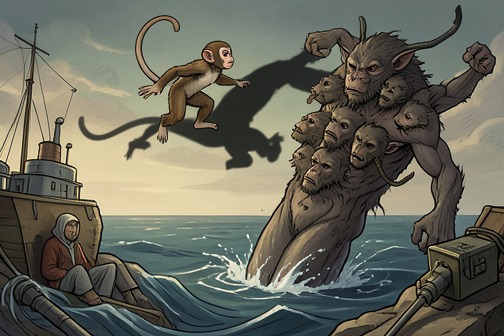
[Hanuman kills the shadow-catching Simhika](entity:event-recall-event-8398717a3444) during his flight over the sea toward [Lanka](entity:location-recall-location-lanka-4b3ac7e9a824), when the demon seizes his shadow and arrests his movement through the air. The encounter converts an unseen restraint into a visible threat: [Hanuman](entity:character-recall-character-hanuman-83c726a7b662) recognizes the danger, adapts his size to meet it, and kills the monster through a calculated maneuver rather than a contest of bulk.
## The Attack in Midair
[Simhika](entity:character-recall-character-simhika-f2725a886262) spots Hanuman as he travels above the sea. She is described as delighting in evil and changing her form to accomplish her purpose. Her method is unusual and decisive: instead of first confronting him directly, she catches his shadow. The capture of the shadow has immediate physical force, staying and holding Hanuman as surely as an obstacle in his path. The scene makes the danger legible through its effect on his flight: he feels a power checking him before he sees the creature responsible.
Hanuman looks below and above, scanning both sea and sky for the source of the restraint. The search moves from an invisible interference to a sighting: Simhika’s monstrous form rises out of the deep. Recognition follows discovery. Hanuman understands that the threat matches the warning [Sugriva](entity:character-recall-character-sugriva-bd875ea369d2) gave him, so the encounter confirms that the danger on his route is not merely a possibility or a mistaken sensation. The warning supplies a frame for interpreting what has happened; the monster’s appearance supplies proof.
## A Change of Scale
Simhika rushes at her expected prey with a roar, turning the capture of the shadow into an immediate attempt to seize and kill Hanuman. Her confidence rests on the apparent advantage of size and on the hold she has already established. Hanuman answers by compressing his borrowed bulk: the great form that carries him through the air gives way to a small one, chosen for this specific confrontation. His change of scale is not retreat from the danger but a way of changing its terms.
As Simhika lunges, Hanuman makes a swift bound and gets inside her. He then comes out again with equal speed. The narration foregrounds the quickness and control of that passage rather than describing a prolonged struggle. His ability to expand for the journey and contract for the attack gives the scene its tactical turn: the visible size that had made him a target is no longer a fixed condition. Simhika’s attempt to use her overwhelming form against him instead creates the opening for his maneuver.
## Simhika’s Death and the Passage Resumed
Hanuman kills Simhika through this feat of skill and then returns to his accustomed stature. The sequence is compact but complete: she detects him, catches his shadow, holds him back, reveals herself, attacks, and is slain. The return to his usual size marks the end of the immediate encounter; he has altered his form to meet the threat and can now resume the journey in his normal shape. The spirits witness the demon’s death, placing the victory within the larger, supernatural scene of his flight.
The episode does more than remove an enemy from Hanuman’s path. It demonstrates that the journey demands attention to different kinds of danger: this obstacle is neither a battlefield formation nor a simple physical barrier, but a predator whose power first works through his shadow. Hanuman’s response depends on reading the restraint, recognizing the monster, and adapting his body to the moment. The encounter therefore presents progress as a sequence of tests in which force alone is not the answer; observation and controlled transformation make the passage possible.
## Narrative Function
The action is organized around a clear reversal. Simhika initially controls the movement of the traveler by catching his shadow, and her attack seems to confirm that she has turned him into prey. Hanuman’s inspection of the sea and sky changes uncertainty into recognition; his deliberate shrinking then reverses the apparent balance of power. The danger is resolved not by denying that the monster can stop him, but by identifying how she has done so and answering with a form suited to escape and attack.
The episode also distinguishes warning from experience. Sugriva’s account has prepared Hanuman to recognize the threat, but recognition does not itself defeat her: he must still act when the shadow is held and the monster rises from the deep. The scene thus makes foreknowledge useful without making the encounter automatic. Simhika’s death closes this particular obstruction, while Hanuman’s restored stature leaves the larger flight intact. Her defeat is a local victory on the route, achieved through alertness and adaptability rather than through a drawn-out battle.
Event 108
Hanuman Defeats Lanka’s Guardian Goddess
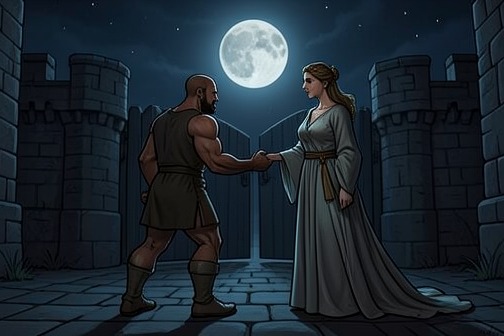
[Hanuman](entity:character-recall-character-hanuman-83c726a7b662)’s defeat of [Lankini](entity:character-recall-character-lankini-36436b0f8781), the guardian goddess of [Lanka](entity:location-recall-location-lanka-4b3ac7e9a824) ruled by [Ravana](entity:character-recall-character-ravana-f2652ae52080), turns a test at the city gate into a prophecy: his entry marks the beginning of the city’s threatened ruin, brought about for [Sita](entity:character-recall-character-sita-1913dd4978f6)’s sake. The encounter combines a brief physical contest with a decisive change in what the city’s guardian can do. She first bars his way; after he overcomes her, she acknowledges that the divine decree has come to pass.
## Approach and Challenge
The meeting takes place at night. Under the moonlight, Hanuman enters the city walls and surveys the sight from the rampart before encountering Lankini at the gate. The elevated view gives way to a direct confrontation: the guardian declares that he may not enter, regardless of Ravana and his warriors’ might. Her claim makes the threshold more than a point of entry. It is the place where the city’s protection confronts the intruder’s purpose.
Hanuman answers her challenge without being intimidated. He asks who she is and why she has met him at the gate. In explaining his presence, he says that he came to see the city’s beauties and would then return home. That stated intention precedes the violence and contrasts with the larger purpose the encounter soon names: the ruin to come is for Sita’s sake. The scene thus moves from a seemingly limited act of looking to the grave consequence attached to Hanuman’s arrival.
## The Contest and Reversal
Lankini responds with an angry roar and strikes Hanuman. The exchange reverses her initial posture of command: she is overcome, and the gate’s defender becomes a defeated suppliant. The account emphasizes Hanuman’s pity for her when she is weak and troubled by terror. Her request that he spare her and forgive the wrong shifts the scene away from continued combat and makes his treatment of a fallen opponent part of its outcome.
Her defeat does not simply remove an obstacle. It changes what she can reveal. Having first asserted that Hanuman could not pass, she now addresses him as the Vánar chief who has overcome her and accepts that the encounter fulfills heaven’s decree. Her submission connects the physical result to a larger, predetermined consequence; the guardian’s resistance has become the occasion for her recognition.
## Prophecy and Significance
Lankini’s final statement foretells that ruin will fall for Sita’s sake. The prophecy gives the gate encounter significance beyond Hanuman’s successful entry: the city’s own guardian recognizes his victory as a sign that its security is failing. The scene does not narrate the city’s later destruction here, but it places that outcome in prospect and links it to Sita, the reason named for the coming ruin.
The episode’s structure sharpens that reversal. Hanuman arrives as an outsider facing a defender who invokes the city’s power; after the contest, she is the one who yields, while he continues on his mission. Her appeal for mercy and her acknowledgment of the decree make the encounter both a threshold crossing and a forewarning. What begins as a challenge over whether Hanuman may enter ends with the guardian herself confirming the danger his arrival signifies.
Event 109
Hanuman discovers Sita among the Ashoka trees
[Hanuman](entity:character-recall-character-hanuman-83c726a7b662) discovers [Sítá](entity:character-recall-character-s-t-0be56374418b) among the Ashoka trees at the moment his search in [Lanka](entity:location-recall-location-lanka-4b3ac7e9a824) seems close to ending in failure. After finding her nowhere among the sleeping women, he nearly gives up; the sight of one grove still unsearched draws him onward. There, in a palace precinct, he sees Sítá under guard and recognizes her as the woman Rávan carried away. The discovery changes the search from uncertainty into knowledge, though the scene presents recognition rather than a completed rescue.
## A Search Near Its Breaking Point
The episode opens in a mood of reversal. Hanuman has come rapidly from Rávan’s halls, but his speed has not brought him to Sítá. He has looked where women lie asleep and found her nowhere. The contrast between haste and absence sharpens the danger of the moment: he has reached a place associated with Rávan, yet the person he seeks remains unseen.
The canto’s title, “Despair And Hope,” names the movement of the scene. Hanuman considers dying rather than returning without success, while also insisting that his death must not bring destruction upon his people and king. That thought places the search within a larger duty: failure is not merely personal disappointment but a consequence he fears for those he serves. Yet he does not let despair settle the matter. He notices that one grove remains unsearched, with many bright Aśoka trees, and chooses to enter it. The turn comes through a practical observation, not a sudden assurance that Sítá must be there.
## The Last Grove
The remaining grove offers a specific alternative to the searches that have failed. Hanuman’s attention shifts from the sleeping women to this still-unsearched place, and the narrative follows him into a setting distinct from the halls he has just left. The grove lies among the palace buildings: its surroundings include a palace whose whiteness is compared to [Kailása](entity:location-recall-location-0500ad1cf47a), with glittering towers rising above it. The landscape therefore joins a place of apparent splendour to the urgent, private search taking place within it.
The grove is not simply a picturesque refuge. It is the place where Hanuman finds Sítá watched by hostile attendants. The discovery depends on continuing the search despite his stated despair; had he stopped at the conclusion that she was absent, the last place left to examine would have remained unexplored. The episode’s small but decisive action—entering the grove—reverses the movement toward defeat.
## Sítá Under Guard
Hanuman sees Sítá pallid and dressed with neglect, watched closely by fiends and giantesses. Her face has grown thin through continual weeping; her sobs, sighs, and mournful appearance mark the grief that her captors have not suppressed. The scene identifies her through both circumstance and bearing: she is physically diminished and isolated, but the signs of sorrow distinguish her from the surrounding figures.
Recognition is explicit. Hanuman understands that this is the woman Rávan bore away. His certainty rests on seeing Sítá herself, not on a report or a trace left behind. The detail matters because the search has moved through absence and inference; now the sought person is present before him. At the same time, the conditions of her discovery make clear that finding her is not the same as freeing her. She remains under watch in Rávan’s domain, and the passage establishes her captivity as well as her location.
## From Despair to Knowledge
The scene’s central change is in what Hanuman can know. Before entering the grove, he has no sight of Sítá and faces the prospect of returning without her. Afterward, he has found her and identified the captive Rávan took. The movement from despair toward hope is therefore grounded in a concrete event, not in an abstract change of mood: one final search yields the first direct confirmation of her presence.
The episode also holds two contrasting images together. The palace precinct gleams with towers and splendour, while Sítá appears pallid, neglected, and grief-worn under guard. That contrast makes the setting’s beauty inseparable from the captivity taking place within it. The discovery resolves the immediate uncertainty of the search but leaves its danger intact: Hanuman has reached Sítá, while her guarded state shows that a further step will be needed before discovery can become deliverance.
Event 110
Ravana Courts and Threatens Sita in the Ashoka Grove
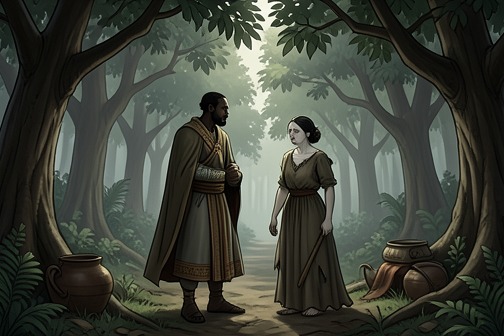
[Ravana](entity:character-recall-character-ravana-f2652ae52080)’s approach to [Sita](entity:character-recall-character-sita-1913dd4978f6) in the [Ashoka Grove](entity:location-recall-location-ashoka-grove-d19d45180627) turns a forced encounter into a contest between coercion and fidelity. He offers affection and queenship, but her thoughts remain with [Rama](entity:character-recall-character-rama-fdac9c17dd0c); when persuasion fails, Ravana’s anger replaces his soft address with menace. The episode makes the shift from wooing to threat its decisive action, while keeping Sita’s refusal at the center of the exchange.
## Setting and Sita’s Condition
The episode is framed as a sequence of cantos devoted first to Ravana, then to his wooing, Sita’s scorn, and his threat. That progression gives the scene its shape: an attempted courtship does not remain a private offer but becomes an open confrontation. The grove is the setting of Ravana’s address, while Sita is described as forlorn among fiends, sad, helpless, wan, and worn. The poem presents her vulnerability plainly, without allowing it to become consent or surrender.
An earlier glimpse places a Vánar watching Rama’s spouse from shelter in the boughs. Sita’s jewels have been stripped from her neck and limbs, and the poem sets that loss of adornment against her continuing love for Rama. The contrast makes her attachment the defining possession she retains: outward finery is gone, but her devotion is not. The watcher’s presence also gives the scene a witness beyond the two speakers, though the cited episode does not describe his intervention here.
## Ravana’s Offer and Sita’s Refusal
Ravana begins with an amorous look and soft address, pressing his suit rather than opening with a threat. He invites Sita to become “The queen of all those dames and me,” promising a royal place within his household. The offer is expansive in status but coercive in circumstance: Sita is already isolated among fiends, and Ravana’s desire is presented as an effort to overcome her refusal, not as a mutual courtship.
Sita’s response is anchored in remembrance of Rama. She thinks of her lord and sighs before replying in gentle tones. The poem thus places her inward loyalty before her spoken answer: her attention has not shifted to Ravana, even while he addresses her with softness and the prospect of queenship. The canto title, “Sita’s Scorn,” identifies the essential result of his appeal. His words do not win her; the tenderness of his manner cannot alter the allegiance on which her refusal rests.
## From Persuasion to Threat
The next movement is marked by a change in Ravana himself. His anger swells, and the canto turns from the wooing to his threat. The sequence matters: the menace follows the failure of persuasion, exposing the force beneath the earlier soft address. The scene does not present the threat as a separate dispute; it grows directly out of Ravana’s insistence that Sita accept him and her continued resistance.
The exchange also places the danger beyond Sita alone. The threat invokes the giants around their king, raising the prospect of destruction in the conflict surrounding Ravana’s rule. Ravana’s anger is rendered through the image of a furious snake, and his speech is described as hissing. That image sharpens the reversal from amorous approach to intimidation: the same encounter that began with a promise of queenship now carries the language and posture of menace. The evidence establishes the threat, but does not supply its eventual consequence within this scene.
## Narrative Significance and Limits
The episode’s structure gives Sita’s refusal and Ravana’s reaction distinct stages rather than collapsing them into a single exchange. First comes the watcher’s glimpse of her stripped of jewels but steadfast in love; then Ravana’s appeal, her remembrance of Rama, and finally the king’s angry threat. The sequence makes the failure of persuasion visible before force is named, so that Ravana’s change of tone becomes the scene’s central turn.
The contrast is not simply between two suitors. Sita’s condition is one of helplessness, yet the poem preserves her judgment and choice: she remains oriented toward Rama while Ravana tries to make his authority and offer prevail. At the same time, the episode does not resolve the danger it raises. Its ending, as represented by these passages, is the threat itself and the continued opposition between Ravana’s demand and Sita’s loyalty.
Event 111
Trijata Foretells Lanka’s Destruction
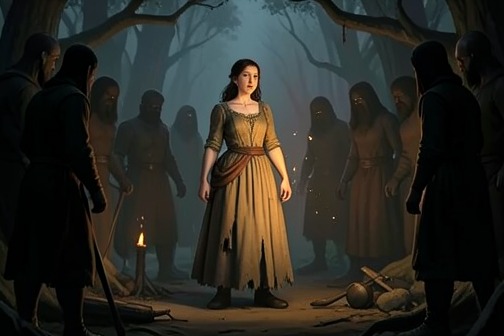
[Trijata Foretells Lanka’s Destruction](entity:event-recall-event-e2d6364684ca) is a dream report that interrupts the demons’ threats against [Sítá](entity:character-recall-character-s-t-0be56374418b) with a vision of [Rávaṇ](entity:character-recall-character-r-va-06a1d00141e6)’s defeat and [Lankā](entity:location-recall-location-lank-b4442384d69a)’s collapse. [Trijata](entity:character-recall-character-trijata-913e8d5ebf58) presents what she saw as a warning, not a means of escape from the future: the demons may flee, she says, or die at [Ráma](entity:character-recall-character-r-ma-2db51e45ae4a)’s hand. The episode shifts the scene from intimidation to foreboding, making the threatened destruction of the city visible before it occurs.
## The Dream as an Intervention
Trijata recounts that the dream came the previous night and that its fear and awe still affect her. Her warning begins in the middle of danger to Sítá: she offers herself to the demons as a victim if they will spare the wife of [Daśaratha](entity:character-recall-character-da-aratha-ffdd8279512e)’s heir. The plea gives the vision an immediate purpose. It is not detached spectacle; Trijata invokes it to oppose the threats around Sítá and urge the demons to reconsider their course.
The report also changes the terms of the confrontation. The demons’ threats have not frightened Sítá, and they respond to the counsel by burning with fury. Trijata answers that anger with a prediction of consequences. Her dream places the threatened captive and the powerful city within a future shaped by Ráma’s vengeance, turning the demons’ present confidence into a warning of vulnerability.
## Images of Defeat and Ruin
The vision first presents Rávaṇ in a strikingly altered state: shaved and shorn, covered from head to foot with oil, drinking and raving, and dressed in red. These details mark a departure from the image of a secure ruler. The dream does not describe a battle in progress; instead, it gives the king a disturbing appearance and surrounds it with signs of impending reversal. Trijata’s account thus makes the prediction through a sequence of images before she states its practical consequence.
[Kumbhakarṇa](entity:character-recall-character-kumbhakar-a-1980dd1976c4), too, appears in an ominous tableau, shaved and shorn and carried southward on a camel. The dream then widens from individuals to the city itself. Lankā reels and falls, its gate, tower, and citadel brought down; the ancient, renowned city is no longer secure behind its defenses. Finally, ocean waves roll over Lankā and its streets of gold. The progression from Rávaṇ and Kumbhakarṇa to the fortifications and then the streets makes the threatened loss comprehensive: it reaches the rulers, the city’s defenses, and the place where its people live.
## Warning and Choice
Trijata draws a direct warning from what she has seen. She tells the demons to flee, or else die at Ráma’s hand, whose vengeance will not spare life. The alternatives are stark, but the warning does not claim that flight will reverse the dream or restore Lankā. It identifies a choice still available to the listeners while presenting Ráma’s vengeance as the danger they must reckon with.
Her appeal is especially sharp because it follows her willingness to take the threatened violence upon herself in order to spare Sítá. Trijata speaks both as a protector in the immediate scene and as the interpreter of a vision that reaches beyond it. Her concern for Sítá gives the warning urgency; the images of Rávaṇ and the fallen city give it scale. The demons’ fury, however, stands against her counsel, leaving the prediction unanswered by any change of heart in the moment.
## Narrative Significance
The episode makes the coming destruction present as a vision before it is enacted as history. Rather than narrating the fall of Lankā directly, it lets Trijata describe the king’s altered appearance, the collapse of the city, and the sea covering its golden streets. The dream compresses personal danger and civic catastrophe into a single forecast, moving from figures to buildings to the surrounding ocean.
Its force lies in the contrast between the demons’ immediate fury and the future Trijata announces. The city’s gates, towers, and citadel may suggest strength in the present, but in the vision those defenses fall, and even the streets are submerged. Trijata’s appeal therefore reframes power as temporary: the demons can choose whether to heed her warning, but they cannot make the dream’s image of Ráma’s vengeance disappear by refusing her counsel. The episode serves as both a plea to spare Sítá and a forewarning that the conflict will reach beyond her captivity to Lankā itself.
Event 112
Hanuman and Sita Recognize One Another and Exchange Tokens
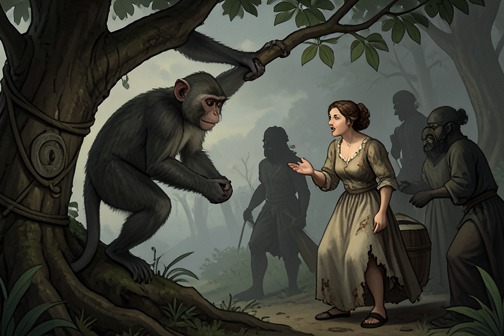
[Hanumán](entity:character-recall-character-hanum-n-b41d60813de6) and [Sítá](entity:character-recall-character-s-t-0be56374418b)’s meeting turns a hidden watcher into a trusted intermediary. From concealment he hears Sítá speak with the fiends guarding her; he then descends from the tree and stands before her humbly. By telling her that he crossed the sea and offering [Ráma](entity:character-recall-character-r-ma-2db51e45ae4a)’s ring as a sure token, he gives material proof of his connection to her absent husband. Sítá answers with a gem and a message, making the encounter a two-way exchange across the separation that has trapped her in [Lanka](entity:location-recall-location-lanka-4b3ac7e9a824).
## Concealment and Approach
The scene begins not with a conversation but with observation. Hanumán watches from concealment and hears the exchange between Sítá and her captors. The placement gives him knowledge of her immediate circumstances before he addresses her, while keeping his presence unknown to her at first. His decision to come forward changes the scene: the concealed listener becomes a visible visitor, and the meeting can move from surveillance to communication.
The next recorded encounter places him descending from the tree and standing humbly before Sítá. The gesture matters to the meeting’s terms. He does not approach as a captor or issue a demand; the narration marks his posture as deferential. That posture, however, is not by itself proof of who he is or whom he serves. The conversation must establish his identity and purpose, a problem answered through his account of the journey and the object he brings.
## Sítá’s Deadline and Hanumán’s Account
Sítá speaks in a mournful mood and states that two months of suffering remain before the captive will be killed. Her words make the danger specific: she faces a stated limit, not an indefinite wait. The deadline gives Hanumán’s visit its immediate stakes. News must travel back to Ráma while Sítá is still alive, and the encounter becomes a narrow opening for action within the threat of her captivity.
Hanumán replies that he reached the coast, crossed the sea, and found his way to her. The account links his arrival to a difficult passage and explains how a messenger from Ráma has reached the captive in Lanka. It also changes the balance of the scene. Sítá is no longer receiving only the speech of her guards; someone has come from beyond their enclosure with access to Ráma and a route back to him.
## The Ring as Evidence
Hanumán presents Ráma’s ring as a precious object and a sure token from Sítá’s lord. Its importance in the exchange is practical as well as emotional: it identifies the sender through something he can place in her hands. The ring gives material form to a connection otherwise conveyed by words across distance. Hanumán’s claimed journey and the token reinforce one another—the account explains how he came, while the ring anchors his message to Ráma.
The object also alters the meeting’s movement. Hanumán has arrived bearing a sign from the absent husband; Sítá can now answer him not merely as a stranger but as a messenger who carries Ráma’s token. The narrative isolates the ring in the title of Canto XXXVI, following the colloquy and Hanumán’s renewed speech. Its prominence marks the token as the scene’s hinge: private recognition becomes an exchange capable of carrying meaning in both directions.
## Sítá’s Reply and the Return Message
The exchange does not end with Ráma’s ring. The later canto, titled Sítá’s Gem, presents Hanumán replying after he has been satisfied by her wise answer. Together, the ring and the gem form reciprocal tokens: Hanumán brings an object associated with Ráma, and Sítá supplies a corresponding sign for the return journey. The evidence establishes the gem as part of this answering exchange without detailing its appearance or the precise circumstances in which it is handed over.
Sítá also gives Hanumán a message to bear to Ráma, asking that he end her long despair. The request converts the meeting into communication with a clear destination. Hanumán is not only the visitor who has found her; he is entrusted with words and a token that can carry her response out of captivity. The scene therefore closes its immediate circuit—from Ráma’s ring, through Hanumán’s arrival and Sítá’s reply, toward the absent Ráma—while leaving the threatened two-month limit in force. Recognition brings proof and a means of contact, not yet release.
Event 113
Hanuman destroys the Ashoka grove and battles Lanka’s forces before capture
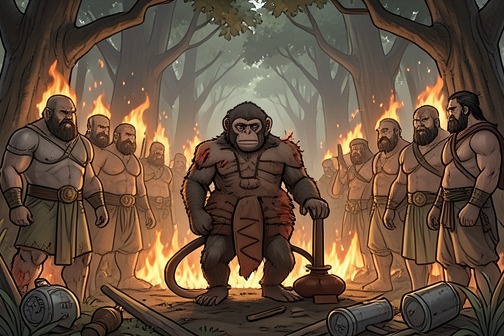
[Hanuman](entity:character-recall-character-hanuman-83c726a7b662)’s destruction of the [Ashoka Grove](entity:location-recall-location-ashoka-grove-d19d45180627) marks a decisive change in his mission in [Lanka](entity:location-recall-location-lanka-4b3ac7e9a824): after carrying messages between [Sita](entity:character-recall-character-sita-1913dd4978f6) and [Rama](entity:character-recall-character-rama-fdac9c17dd0c), he becomes the center of a violent confrontation with Lanka’s forces. The devastation draws the giants into battle, brings several champions against him, and ends not in his defeat in combat but in his capture by a divine weapon and physical bonds.
## From message to confrontation
The episode follows Hanuman’s meeting with Sita. The book says that it omits two Cantos of dialogue in which Sita again asks him to urge Rama to hurry to her rescue, and Hanuman repeats his assurance that Rama will come and destroy [Ravana](entity:character-recall-character-ravana-f2652ae52080). The text describes this exchange as reiteration rather than a source of new information. Hanuman is then dismissed with the honours due to him and withdraws from Sita’s presence. The movement from that respectful departure to the ruin of the grove gives the sequence its sharp turn: the envoy’s work of reassurance gives way to an assault that brings Lanka’s defenders into action.
## The grove’s destruction and the response
The next Canto is titled “The Ruin Of The Grove.” Its surrounding verses evoke the damage through the cries of startled birds and the crash of tall trees, likening the devastation to the passage of a furious blast or raging fire. The grove is not merely a setting for the encounter with Sita; its destruction is the visible sign that Hanuman’s presence has become an open challenge to the city’s power. The narrative then names the next stage “The Giants Roused,” connecting the wreckage to the mobilization of Lanka’s defenders. The transition is brisk and consequential: ruined trees and disturbed birds give way to armed response.
## Champions and the death of [Aksha](entity:character-recall-character-aksha-bdb96ac442f0)
Among the defenders sent against Hanuman is Jambumáli, introduced as a figure of pride and renown in the Rákṣasas’ host. His death receives a Canto of its own, making the encounter part of an escalating series rather than an isolated skirmish. The supplied passage identifies him as a champion but does not preserve the details of the fight, so the emphasis rests on the narrative progression: Lanka sends notable warriors, and Hanuman’s resistance makes their intervention costly.
The confrontation becomes especially severe when Ravana turns his attention to his youthful son Aksha. The account gives Aksha a separate Canto, “The Death Of Aksha,” and states that he falls with his life-blood drained away. His death raises the stakes of Hanuman’s destruction beyond damage to the grove or defeat of the Rákṣasas’ fighters: Ravana’s own family suffers a loss. The action also provides the immediate setting for Ravana’s next decision, as he gives [Indrajit](entity:character-recall-character-indrajit-88da9c19b071) the mandate to deal with Hanuman.
## Capture by [Brahma](entity:character-recall-character-brahma-39f8aa187fff)’s weapon
Hanuman is brought down by a weapon whose power he recognizes. He knows that Brahma has enchanted it and that its force has disarmed him; the giants see him helpless on the ground and crowd around him. They then cast bonds of hemp and bark upon him. The scene distinguishes the divine force that immobilizes Hanuman from the material restraints the Rákṣasas add once he is down. His capture closes this phase of the confrontation, but the account presents it as a change in circumstance, not evidence that his strength has been overcome in an ordinary contest.
The episode’s sequence—departure from Sita, devastation, the rousing of the giants, the deaths of champions, and capture—turns Hanuman’s mission into a public crisis for Lanka. The grove’s destruction summons the city’s military power; the deaths of Jambumáli and Aksha demonstrate the cost of confronting him; and Brahma’s weapon finally alters the balance by making him vulnerable to restraint.
Event 114
Hanuman Is Brought Before Ravana
[Hanuman Is Brought Before Ravana](entity:event-recall-event-1d6187e3ff09) is the moment a captured intruder becomes a speaking envoy: dragged before [Ravana](entity:character-recall-character-ravana-f2652ae52080) in triumph, [Hanuman](entity:character-recall-character-hanuman-83c726a7b662) is questioned by [Prahasta](entity:character-recall-character-prahasta-a083d07d44fb) and identifies his mission as the liberation of [Sita](entity:character-recall-character-sita-1913dd4978f6). The scene turns a spectacle of force into a test of truth and allegiance, with Hanuman using his answer to make the purpose of his arrival unmistakable.
## From Capture to Audience
Hanuman reaches Ravana not as a voluntary visitor but under coercion. His captors strain a cord and drag him to their lord amid shouts of triumph. The procession makes his capture visible as a victory for Ravana’s side; the captive is delivered as proof that the intruder has been subdued. The narrative then pivots from physical control to speech: Ravana fixes his angry gaze on Hanuman, and Prahasta addresses the Vánar chief at his lord’s behest.
That order matters. Ravana is present as the ruler before whom Hanuman has been brought, while Prahasta takes up the questioning. The scene does not describe a negotiation between equals: Hanuman has been hauled in bound, and the questioning takes place under the threat of the king’s authority. Yet the captive is given the opportunity to answer. The episode’s dramatic movement is therefore from the captors’ triumphant display to a verbal exchange in which Hanuman can define himself and his purpose.
## Prahasta’s Questions
Prahasta’s questioning sets a sharp limit on what Hanuman may say: falsehood spoken to the king will bring swift death. The warning frames the exchange as more than an attempt to establish the prisoner’s name. Hanuman must explain himself in a setting where a false answer carries an explicit, lethal consequence. At the same time, the warning gives his reply a clear measure: he openly distinguishes himself from the messenger he is not, rather than accepting a misleading identity.
The passage identifies the formal sequence through its canto headings: Prahasta’s Questions lead into Hanuman’s Reply. That transition concentrates the scene on testimony. Hanuman’s first clarification is that he is not [Indra](entity:character-recall-character-indra-9cdc4e2c85c7)’s messenger. He then gives the identity that matters to the conflict: he has come as a messenger from [Rama](entity:character-recall-character-rama-fdac9c17dd0c). The answer replaces suspicion or misidentification with a direct account of his allegiance, turning the interrogation into a declaration delivered in Ravana’s presence.
## Hanuman Declares His Mission
Hanuman does not present his journey as a private visit. He says that his king, [Sugriva](entity:character-recall-character-sugriva-bd875ea369d2), sends greetings and bids him deliver a message; he identifies himself as the son of the Wind God, [Váyu](entity:character-recall-character-v-yu-b18a1f1350d5), and names the purpose of his arrival as setting the Maithil lady free. Together, these details establish his identity, political connection, and objective. He is Sugriva’s representative, acting in relation to Rama, and his mission concerns Sita’s release.
The ordering of the declaration is significant to the scene’s structure. Hanuman first answers the question of whose messenger he is, then places himself within Sugriva’s authority, and finally states what he has come to accomplish. His captivity has brought him before the opposing ruler, but it has not erased the message he carries. The encounter thus converts the captors’ display into a public statement of the alliance and purpose behind Hanuman’s arrival. The text supplies no resolution to that confrontation here; its emphasis is on the moment when Hanuman makes his mission known.
## The Scene’s Narrative Function
The episode joins two kinds of power without confusing them. Ravana’s side controls Hanuman’s body and brings him to its ruler; Hanuman controls the account he gives of himself. The contrast is grounded in the scene’s concrete actions: the cord and triumphant escort on one side, the warning against falsehood and the captive’s measured identification on the other. His speech does not undo his capture, but it changes what the audience knows about it: this is an emissary sent by Sugriva and Rama to free Sita, not a messenger of Indra.
The encounter also gives Hanuman’s arrival a diplomatic as well as personal dimension. His reference to Sugriva’s greeting and message identifies an organized mission, while his stated objective brings the question of Sita’s freedom directly before Ravana. The scene’s significance lies in that disclosure under pressure. The captive is physically presented as a defeated intruder, yet his answer restores the larger purpose to view: he has come on behalf of an alliance, and he openly names the woman whose release is its immediate aim.
Event 115
Burning of Lanka
The [Burning of Lanka](entity:event-recall-event-burning-of-lanka-2813d2838660) turns a punishment meant to humiliate [Hanuman](entity:character-recall-character-hanuman-83c726a7b662) into an assault on [Ravana](entity:character-recall-character-ravana-f2652ae52080)’s city. As flames are set around his tail and he is led through [Lanka](entity:location-recall-location-lanka-4b3ac7e9a824), [Sita](entity:character-recall-character-sita-1913dd4978f6) hears what is happening and pleads for his safety. The fire relents; Hanuman then uses his burning tail to attack the city’s buildings, while [Vibhishana](entity:character-recall-character-vibhishana-48b5fde5e908)’s house alone escapes the common ruin.
## Causes and Public Punishment
Ravana is moved by a plea and approves the counsel of his chief. The punishment that follows puts Hanuman on display: he is led through Lanka with flames glowing around his tail. The spectacle makes the tail a public instrument of disgrace, but also gives Hanuman a means to strike back. The episode’s reversal begins with this imposed punishment, not with a new weapon brought into the city.
The procession carries the news to Sita, and the report deepens her grief. She goes swiftly to the kindled fire and asks that Hanuman be spared. Her appeal places his danger at the center of the scene even as the punishment unfolds publicly around him. The fire leaps up and shines in answer; its pity restrains its rage. Hanuman’s escape from the full force of the flames makes the threatened instrument of punishment usable against Lanka.
## The Burning of Lanka
Once his tail is ablaze, Hanuman reflects on what further act might vex Ravana. He then scales the palaces and spreads the fire. The movement from one building to another gives the destruction its momentum: each mansion he climbs is assailed at the roof, and the fire passes across the city’s structures rather than remaining confined to the procession that began the episode.
The account describes a ruin shared across Lanka, but marks one explicit exception: Vibhishana’s house alone is spared. That detail gives the devastation a boundary within the scene. The city suffers broadly, yet the narrative distinguishes Vibhishana’s dwelling from the other buildings Hanuman attacks; it does not describe the destruction as indiscriminate in every instance.
## Reversal and Consequence
The episode reverses the intended meaning of Ravana’s punishment. Hanuman’s burning tail is first displayed as a sign of his subjection, then becomes the instrument with which he assails the palaces. The movement from public spectacle to citywide attack shifts power within the scene: the captive made to endure humiliation becomes the agent of Lanka’s destruction.
Sita’s intervention supplies a second turn. She cannot prevent the punishment from being staged, but her plea is followed by the fire’s restraint, allowing Hanuman to act without the flames consuming him. The narrative links her appeal to the changed behavior of the fire, then links that reprieve to the burning of Lanka. The one spared house, Vibhishana’s, further qualifies the destruction and distinguishes it from an account in which every building meets the same fate.
## Place in the Narrative
The Burning of Lanka is an escalation in Hanuman’s confrontation with Ravana: the king’s approved punishment produces an attack on the city itself. Its force lies in the reversal between intended penalty and actual consequence, and in the contrast between the widespread ruin and Vibhishana’s spared house. The scene also makes Sita’s plea consequential within the action: the fire answers her appeal before Hanuman turns its flames against Lanka.
Event 116
Hanuman's return with news of Sita
In Canto LXV, “The Tidings,” [Hanumán](entity:character-recall-character-hanum-n-b41d60813de6)’s return turns a distant search into concrete news for [Ráma](entity:character-recall-character-r-ma-2db51e45ae4a): [Sítá](entity:character-recall-character-s-t-0be56374418b) is alive, remains faithful to him, and has sent a token with an urgent message. The report is delivered before [Sugríva](entity:character-recall-character-sugr-va-f4b2f7927084) and Ráma on [Praśravaṇa Hill](entity:location-recall-location-pra-rava-a-hill-80aff15798e1). Its force rests on two kinds of evidence—a witness’s account and a precious object carried across the sea—and on the narrow month Sítá says she can bear her distress.
## The return and the gathering
The report follows an episode of disorder among the [Vānaras](entity:organization-recall-organization-v-naras-8a2b29931499). Dadhimukh escapes the monkeys’ anger and hurries to Sugríva with news of their misconduct. Rather than treating the disturbance simply as disobedience, Sugríva reads their exuberance as a sign that Hanumán and his band have succeeded. He directs that they be sent onward without delay. The gathering on the hill is therefore both a return from the search and the moment when Sugríva’s inference can be confirmed.
Led by [Angad](entity:character-recall-character-angad-ece5a55cd18f), the Vānar chieftains bow before their king. Hanumán speaks for the returning party, but the account gives his report a striking first gesture: before telling the adventure, he places Sítá’s gem in Ráma’s hand. The sequence makes the object the report’s opening proof. Ráma receives something that belonged to Sítá before he receives Hanumán’s words about her.
## The gem and the private sign
The gem is described as the sea-born stone Sítá has long known, and Hanumán identifies it as the precious object she bids Ráma take. It is not merely a sign that the search party reached her. In Hanumán’s account, it carries her message across the separation: she weeps beyond the sea, but her heart remains with Ráma. The physical token gives that assertion a material presence in the gathering, while the distance it has crossed measures the separation it cannot itself end.
Sítá also supplies a more intimate means of recognition. Hanumán reports a bright mark pressed upon her brow when no one was present except her and Ráma. Its force depends on their shared knowledge: it is not simply a public emblem that anyone could identify, but a private sign linking the captive’s account to the couple’s past. The paired evidence—the familiar gem and the remembered mark—makes the report personal as well as credible.
## Sítá’s message and its limit
Hanumán recounts that he consoled Sítá with encouraging words before telling Ráma the adventure. His report does not present comfort as a resolution: Sítá is still grieving, still far away, and still imprisoned. What it confirms is the persistence of her attachment in those circumstances. The contrast between her physical distance and the statement that her heart remains with Ráma gives the news its emotional center.
The message also carries a precise limit. Sítá says that she can sustain her life under grief for one more month. This is her stated endurance, not a general measure of the journey or an abstract expression of sorrow. By conveying it to Ráma, Hanumán turns the report into urgent knowledge: the search has located Sítá, but the separation remains dangerous and time-bound.
## Narrative function
The scene changes the status of the search. Before Hanumán speaks, Sugríva has only inferred success from the returning party’s exuberance; after the gem is placed in Ráma’s hand and the private sign and message are delivered, Sítá’s presence and condition are reported directly. The movement from inference to testimony gives the reunion on the hill a clear dramatic structure, with the object arriving first and the spoken account unfolding its meaning.
The event is a report rather than a rescue. Hanumán brings evidence, Sítá’s message, and a measure of the danger she faces; the account does not make the distance between her and Ráma disappear. Its decisive achievement is to replace uncertainty with specific knowledge, while the one-month limit makes clear that knowledge alone cannot secure her freedom.
Event 117
Madhuvana honey feast
The [Madhuvana honey feast](entity:event-recall-event-madhuvana-honey-feast-beb715357acb) is the returning search party’s exuberant celebration, and a comic reversal in which the party’s success first appears as disorder. [Angad](entity:character-recall-character-angad-ece5a55cd18f) gives permission for the [Vánars](entity:creature-recall-creature-v-nars-66c23f0e487a) to raid the honey stores and eat the grove’s fruit. Dadhimukh, the keeper who sees the damage and tries to resist the revelers, is beaten and driven off. When he reports the misconduct to [Sugríva](entity:character-recall-character-sugr-va-f4b2f7927084), the king reads the uproar as evidence that [Hanumán](entity:character-recall-character-hanum-n-b41d60813de6)’s party has found [Sítá](entity:character-recall-character-s-t-0be56374418b). The feast thus turns a complaint about disorder into an announcement of hope.
## Return and Permission
The episode appears as Canto LVIII, “The Feast Of Honey,” after the narrative has reached the returning Vánars’ flight. The grove is presented as a store of honey and fruit, not as an incidental backdrop: its abundance gives the party something tangible to celebrate and something the keeper is responsible for protecting. The returning group approaches Angad together and asks that they be allowed to eat from the honey stores. Angad consents, making their feast an authorized act at its outset rather than an immediate act of defiance.
That permission matters to the scene’s shape. The gathering begins with a request made collectively to their leader; only after consent do the Vánars go to the trees, where innumerable bees crowd the stores. They empty the honey and eat the fruit from the branches, then continue their revels. The progression from petition to permission to excess gives the episode its comic momentum: a legitimate celebration grows beyond the limits the grove’s keeper can accept.
## The Grove’s Destruction
The feast is not described as restrained refreshment. The Vánars rifle the treasured stores and strip fruit from the branches, while the narrative emphasizes the length and intensity of their celebration. Dadhimukh sees the multitude intoxicated and the shade rifled. His anger gives the revelry its opposing point of view: what feels like release to the returning party is damage and misconduct to the person charged with keeping the grove.
The confrontation turns that difference into physical action. The Vánars use claws, teeth, and hands against the keeper and beat him beneath their trampling feet. The scene’s disorder is therefore concrete, not merely a label applied to the feast: the stores are plundered, the fruit is taken, and Dadhimukh is assaulted. Yet the episode does not present this violence as a battle between armies or as a change in political control. It is an unruly outburst within a celebration, and its narrative consequence comes through what Dadhimukh does next.
## Complaint and Inference
Dadhimukh escapes from the infuriated monkeys and hastens to Sugríva to report their conduct. His complaint might seem to call for discipline, but Sugríva interprets the very excess being reported. He infers that Hanumán and his band have been successful in their search, and that their high spirits and mischief are the natural expression of joy. The keeper’s account therefore carries two meanings at once: it testifies to the damage in the grove and, for Sugríva, supplies indirect evidence of good news.
Sugríva gives Dadhimukh little sympathy and tells him to return and send the Vánars onward as quickly as possible. The response redirects the scene from reprimand to continuation. The search party’s conduct is not allowed to delay its return journey; the celebration has served as a sign of success, and the monkeys are to move on. In the following canto, “The Tidings,” they hasten toward [Praśravaṇ](entity:location-recall-location-b3b5ef20f48f)’s hill, carrying the consequences of their discovery back into the larger campaign.
## Narrative Function
The feast makes the search’s success legible before the episode turns to the tidings themselves. Sugríva’s inference links the Vánars’ conspicuous joy to the result of their mission, while the next canto’s heading and movement onward prepare for the report. The scene does not need a formal announcement at the grove: the emptied stores, the keeper’s escape, and the king’s interpretation of the uproar together bridge the returning party’s excitement and the news that is about to be delivered.
Its comedy rests on a sharp contrast of scale and perspective. For Dadhimukh, the immediate facts are a damaged grove and an unruly crowd; for Sugríva, those same facts point beyond the grove to the successful search. The feast briefly turns the searchers’ discipline toward appetite and celebration, but it does not break their connection to the mission. Sugríva’s order sends them onward, so the episode ends not with a penalty or a prolonged quarrel, but with the return journey resumed and hope strengthened.
Event 118
Vibhishana's defection and refuge
[Vibhishana](entity:character-recall-character-vibhishana-48b5fde5e908)’s defection and refuge turns a rupture within [Rávaṇ](entity:character-recall-character-r-va-06a1d00141e6)’s household into a test of [Ráma](entity:character-recall-character-r-ma-2db51e45ae4a)’s principles. [Vibhishaṇ](entity:character-recall-character-vibhisha-e07caf5116fd) leaves his brother’s side after their counsel fails, approaches Ráma as a fugitive, and is received under a solemn promise of protection. His change of allegiance immediately becomes a military and political commitment: he offers to guide the army against the city, and Ráma has him consecrated as its king before the campaign is won.
## Causes and Background
The break follows an argument in which Vibhishaṇ rises in anger after hearing advice he considers base. His own appeal to Rávaṇ is framed as a warning about the consequences of the king’s course: Rávaṇ should save himself, his royal city, its people, and his own renown. The appeal places the dispute in terms broader than the brothers’ relationship; the fate of the kingdom and its inhabitants is also at stake.
When the bitter exchange ends, Vibhishaṇ leaves for Ráma and [Lakshmaṇ](entity:character-recall-character-lakshma-7aad0629b677), accompanied by four captains. The scene presents his departure as a deliberate severing of political and familial allegiance, not an accidental separation. It also makes the choice costly: the man seeking refuge is Rávaṇ’s brother, and the king he leaves remains ruler of the city that Ráma’s army is preparing to attack.
## Flight and Appeal for Refuge
Vibhishaṇ approaches the opposing leaders and identifies himself as Rávaṇ’s brother. He reports that Rávaṇ carried away the woman from [Janasthán](entity:location-recall-location-janasth-n-9473651b6256), giving Ráma’s side direct confirmation of the abduction that has made the conflict personal and political. His disclosure joins insider knowledge to an explicit act of defection: he does not merely report on Rávaṇ but presents himself as having fled from him.
The arrival leaves Ráma with a decision about how to treat a newcomer from the enemy’s household. The account marks a shift in Ráma’s response: his doubt is stilled, and friendly thoughts take its place. The movement from hesitation to acceptance is central to the episode. Vibhishaṇ is not first shown proving himself through battle; the immediate question is whether a person who comes seeking safety will be received.
## Ráma’s Promise and Vibhishaṇ’s Consecration
Ráma grounds his decision in a solemn vow to give aid to those who seek him in distress and cry out for help. The promise makes protection more than a tactical concession to a useful defector: Ráma treats the appeal itself as carrying an obligation. In this episode, the standard is put to a sharp test because the petitioner is closely connected to the enemy and the war is still approaching.
Vibhishaṇ answers acceptance with a pledge of service. He bows his head and offers to guide the conquering army as it storms the enemy city, until Rávaṇ and his kin have paid for their wrongdoing. His promise makes the refuge reciprocal in practical terms: Ráma offers protection, while Vibhishaṇ offers guidance and allegiance. The pledge also points toward a political outcome in which Rávaṇ’s family will lose its rule.
Ráma then calls to Lakshmaṇ to bring sea-water for the new king. The consecrating drops are shed over Vibhishaṇ’s head amid acclamation. This brief ritual gives public form to the change already made: the former fugitive is recognized as king while Rávaṇ still holds the city and before the promised victory has occurred. The scene therefore joins refuge to succession, making Ráma’s acceptance an act with consequences beyond the immediate safety of one man.
## Significance in the Narrative
The episode brings two obligations into the same encounter. Vibhishaṇ’s warning to Rávaṇ concerns the threatened ruler, city, people, and reputation; Ráma’s vow concerns the duty owed to someone who seeks protection. The narrative resolves the latter question decisively: Vibhishaṇ’s kinship with the enemy does not prevent Ráma from receiving him. At the same time, Vibhishaṇ’s offer to guide the assault ensures that mercy and military purpose are not separated in the unfolding plot.
The consecration sharpens the reversal. Vibhishaṇ arrives as the brother who has fled the reigning king; he leaves the encounter recognized as the king who may replace him. His promised guidance links the internal fracture in Rávaṇ’s family to the coming attack, while Ráma’s vow supplies the stated ground for admitting him. Refuge thus changes the balance of allegiance and establishes Vibhishaṇ’s future kingship before the conflict itself is settled.
Event 119
Construction of Rama's Bridge
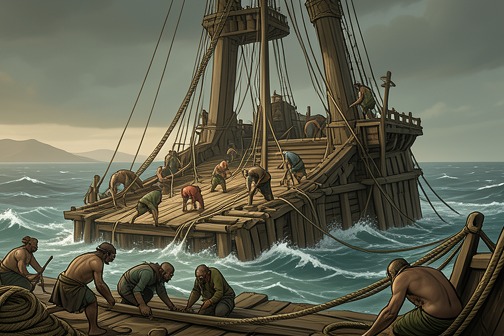
[Construction of Rama's Bridge](entity:event-recall-event-construction-of-rama-s-bb89a7de5d56) turns a seemingly impassable sea into a route for [Ráma](entity:character-recall-character-r-ma-2db51e45ae4a)'s army to reach [Lanka](entity:location-recall-location-lanka-4b3ac7e9a824). The episode joins negotiation to collective labor: [Ocean](entity:character-recall-character-ocean-faa070d4a0c3) cannot set aside the ancient laws that keep the waters unfordable, but he identifies [Nala](entity:character-recall-character-nala-b1bf0c261172) as capable of building a bridge, and the [Vánars](entity:creature-recall-creature-v-nars-66c23f0e487a) complete the immense work in five days. Their crossing converts the campaign's natural boundary into a passage for the army.
## Causes and the Sea's Answer
The construction follows Ráma's confrontation with the sea. After he addresses Ocean with angry menace, voices from the air call on him to spare it. Ráma remains at the shore, and Ocean's majestic form rises from the seething flood. The encounter does not end with the sea simply yielding to force. Ocean explains that, under ancient law, he must remain unfordable; he will not pile up his waters even for love, hope, or fear. The limit is presented as a rule of nature, not a refusal that can be overcome by pleading alone.
Ocean nevertheless offers a solution. He tells Ráma that Nala is divinely taught and skilled, and can build a bridge across the sea. The answer therefore preserves the sea's defining condition while changing what the army can do about it. The obstacle is not removed; a way across it is made. In the scene's sequence, the supernatural figure supplies counsel, but the crossing depends on a named builder and the labor of the host.
## Nala and the Vánar Labor
After Ocean speaks, Nala addresses Ráma. Rather than volunteer a display of his ability, he asks why he should praise his own skill unbidden and urges Ráma to command the Vánar host to lay the bridge's foundations that day. The exchange gives the construction a practical chain of authority: Ocean identifies Nala, Nala asks for the order and the workers, and Ráma's command sets the work in motion.
The account emphasizes the scale and noise of the undertaking. The Vánars send ponderous rocks into the sea; as mountains fall, Ocean heaves and swells with a roar. The labor is organized in crews, and the first day's effort carries the structure fourteen leagues before sunset. The poem singles out that initial day's progress rather than detailing every day's increment, then marks the completion of the whole work at sunset on the fifth day. It describes the finished bridge as a hundred leagues long, a measure that makes the crossing monumental without making the narrative a technical account of its construction.
## Completion and Crossing
Once finished, the bridge proves firm beneath the army's immense numbers: the Vánars hurry over the broad way, and it does not sway under their countless tread. That detail answers the scale of the feat with a test of use. The bridge is not merely visible across the water; it holds as the army passes, fulfilling its immediate purpose as a route to Lanka.
The crossing is not represented as uniform movement. Some Vánars skim the surface of the waves, while others travel through the air; amid their ceaseless roar, the sound of Ocean's fearful voice is drowned. The account thus places the built causeway within a world where the army also moves by extraordinary means. Yet the bridge remains central: it is the shared, stable passage over which the host advances, and the noise of its crossing marks the sea's voice giving way to the movement of the expedition.
## Narrative Significance
The bridge's construction changes the campaign's geography through a negotiated answer to a limit. Ocean does not cease to be unfordable, and Ráma does not simply command the waters into submission. Instead, counsel identifies a capability already present in Nala, and Ráma's order turns that knowledge into coordinated labor. The episode gives both divine intervention and organized effort a distinct part in the achievement.
Its measured progress also gives the extraordinary feat a deliberate temporal shape. The structure is vast, the rocks and the sea are in tumult, and yet the work advances day by day until the fifth day's completion. The army's successful passage then supplies the consequence that matters: a sea that had held the expedition at its edge becomes a traversable boundary, and the way to Lanka opens.
Event 120
Ravana's false report of Rama's death
[Ravana's false report of Rama's death](entity:event-recall-event-ravana-s-false-report-o-424d26975420) is a deception aimed at [Sita](entity:character-recall-character-sita-1913dd4978f6) during the war in [Lanka](entity:location-recall-location-lanka-4b3ac7e9a824). [Ravana](entity:character-recall-character-ravana-f2652ae52080) enlists the magician Vidyujjihva to create the appearance of [Rama's death](entity:event-recall-event-rama-s-death-72faab9ef860) and presents the supposed battlefield outcome as fact. The lie briefly turns the threat of military defeat into an assault on Sita's hope; [Sarama](entity:character-recall-character-sarama-6a391f04ff90)'s intervention reveals that [Rama](entity:character-recall-character-rama-fdac9c17dd0c) lives and has brought his army across the sea.
## Causes and Preparation
Ravana summons Vidyujjihva, whose magical skill makes him, in the poem's phrasing, a master of the means of ill. The episode presents the false report not as a mistaken account of battle but as a deliberately manufactured spectacle: Ravana calls upon an illusionist, then rewards him with a valuable ornament for his work. The payment marks the deception as a commissioned act, planned and carried out in Ravana's service.
The event belongs to the larger military crisis of the siege, but its immediate target is Sita, held in the [Ashoka Grove](entity:location-recall-location-ashoka-grove-d19d45180627). Ravana goes there after the magical display has been prepared. The poem describes Sita as pale, wasted, and weeping on the ground, establishing her vulnerability before the report is delivered. The contrast is stark: while an army's fate is ostensibly being announced, the scene concentrates on a captive woman who cannot verify the news for herself.
## The Fabricated Report
Ravana presents the supposed defeat as the work of his victorious host. He claims that his giants have overthrown the [Vánars](entity:creature-recall-creature-v-nars-66c23f0e487a) and killed Sita's husband, and points to what appears to be a bloodied, dust-stained sign of that death. The Canto's title, “The Magic Head,” identifies the central image as an illusion rather than a real battlefield trophy. The false object gives physical form to the false report, making the lie appear witnessed and settled rather than merely asserted.
The deception's force comes from joining two kinds of evidence: Ravana's confident account of victory and the magician's apparent proof. Sita is asked to receive the report in the very place where Ravana has power over her and where Rama's distant army cannot immediately answer it. The scene thus makes the apparent death of Rama a means of pressure on Sita, even as the poem's later disclosure shows that neither the reported victory nor the displayed evidence is true.
## Sarama Exposes the Lie
The reassurance comes through Sarama, who regards the grieving Sita with pity. She has learned the secret reason Ravana left the Ashoka Grove and tells Sita not to mourn Rama as one slain in battle. Her knowledge directly overturns the tyrant's staged account: Rama is not dead, and his bow remains a weapon no other hand can string.
Sarama supplies concrete news that contradicts Ravana's claim of victory. Rama and his Vánar forces have built a bridge across the sea and led their legions over it. The army's crossing places the rescue and the war within reach, where Ravana's story had presented the opposing force as already destroyed. Sarama also tells Sita that [Lakshmi](entity:character-recall-character-lakshmi-4d9520b17871) regards her favorably, setting the prospect of divine favor against Ravana's attempt to make despair seem inevitable.
## Consequences and Narrative Significance
The lie produces a moment of apparent certainty—Rama has supposedly been killed—only for Sarama's information to disclose that the certainty was fabricated. The reversal depends on the difference between an image made by magic and knowledge grounded in events: Ravana offers a visible but false sign, while Sarama counters it with the concrete fact of the bridge and the army's passage. The deception therefore delays the truth but cannot replace it.
The episode also sharpens the conflict between Ravana's control of Sita's immediate surroundings and Rama's advancing forces beyond them. Ravana can summon a magician, stage a report, and bring the illusion into the grove; he cannot make the reported outcome true. Sarama's intervention breaks that temporary isolation by giving Sita reliable news. The false report's decisive consequence is thus not Rama's death but the exposure of Ravana's deceit and the renewed expectation that the army crossing into Lanka will bring the conflict to its reckoning.
Event 121
Angada's embassy to Ravana
[Angad](entity:character-recall-character-angad-ece5a55cd18f)’s embassy to [Ravana](entity:character-recall-character-ravana-f2652ae52080) is both a diplomatic ultimatum and a display of force. Sent by [Ráma](entity:character-recall-character-r-ma-2db51e45ae4a) while [Lanka](entity:location-recall-location-lanka-4b3ac7e9a824) is already shaken by war, Angad demands [Sita](entity:character-recall-character-sita-1913dd4978f6)’s return and offers Ravana a last chance to avert defeat. Ravana answers the appeal with an order to kill the envoy; Angad turns the attempted arrest into a demonstration of his strength and leaves after completing his mission.
## Background and Stakes
The embassy takes place amid open conflict. Lanka’s groves, streams, towers, walls, and ramparts shake, and the giants are appalled. Against this backdrop, Ráma calls Angad and sends him to address the enemy king. The sequence makes the mission a pause within the assault, but not a retreat from it: the city is under pressure, and the demand concerns the captive whose abduction has brought the sides to war.
Angad identifies himself as Ráma’s envoy and as the son of [Báli](entity:character-recall-character-b-li-40ae88ddddbf). His statement establishes both the authority under which he speaks and his own lineage. He does not present himself as a private challenger: the warning is Ráma’s, delivered by a representative who is also prepared to stand behind it personally.
## The Ultimatum
Angad’s message gives Ravana a choice, but not an open-ended negotiation. He calls on the king to bring Sita back at once, while there is still time, and warns that Ráma’s fiery arrow will not spare him if he refuses. The threat is explicit, yet it is paired with a route away from destruction: Ravana can restore the woman with due honour, repent, and ask pardon for his wrongdoing.
That combination gives the embassy its force. Angad names the injury, specifies the act required to repair it, and sets the consequence of refusal. His appeal treats Ravana’s submission not as an impossible humiliation but as an available decision—one that could still prevent the punishment Ráma is prepared to impose. The offer of pardon makes the threat more than a boast: the king is warned, but also given a final opportunity to change course.
Angad further declares that [Vibhishaṇ](entity:character-recall-character-vibhisha-e07caf5116fd) will be anointed king once Ravana has been slain. The message thus projects a political consequence beyond the immediate battle: Ravana’s defeat would bring a change of ruler in Lanka. The appeal to restore Sita and the forecast of Vibhishaṇ’s accession together make the stakes personal and dynastic.
## Ravana’s Response and Angad’s Escape
Ravana does not answer the terms of the appeal. He cries out for the Vánar to be seized and killed, replacing negotiation with an attempt to silence the messenger. The abrupt command marks the point at which the diplomatic encounter becomes physical: the king rejects the proposed settlement without addressing its conditions.
Four members of Ravana’s band obey. Angad initially offers no resistance, but this apparent compliance becomes a controlled reversal. He suddenly circles his arms around the captors and holds them fast. Rather than allowing himself to be carried away, he springs onto the palace roof and releases his grasp there. The sequence turns the act of seizure against those carrying it out: the guards become the ones held, while the envoy chooses when to break free.
Angad then springs skyward with a loud cry. The poem presents his departure as exultant and says that his errand is done. The escape completes the embassy on two levels: Ravana has received the warning, and the king’s order has failed to detain the person who delivered it. Angad’s restraint before the reversal is part of the display; he demonstrates strength without allowing the attempted arrest to dictate the encounter’s outcome.
## Significance
The episode sets speech and force beside one another without treating them as opposites. Angad first uses the authority of an envoy to state a precise condition for peace, then answers Ravana’s violence with physical power. His conduct does not erase the diplomatic offer; it underscores that the opportunity to accept it belonged to Ravana, whose response is to order the envoy’s death.
The embassy also sharpens the contrast between the two rulers’ choices. Ráma’s message combines a threat of punishment with an offer of pardon if Sita is restored; Ravana responds with an order to kill the messenger. By leaving alive and unrestrained, Angad carries the unresolved warning back into the larger conflict: Ravana has been told both what could avert the threatened consequence and what will follow if he refuses.
Event 122
Siege of Lanka
The [Siege of Lanka](entity:event-recall-event-siege-of-lanka-7981c63de929) begins with [Ráma](entity:character-recall-character-r-ma-2db51e45ae4a) directing [Lakshmaṇ](entity:character-recall-character-lakshma-7aad0629b677) to marshal the forces and oppose the enemy who has taken his wife. The [Vánar Army](entity:organization-recall-organization-v-nar-army-aa4a90162424) advances toward [Lankā](entity:location-recall-location-lank-b4442384d69a), where the defenders emerge from every gate at [Rávaṇ](entity:character-recall-character-r-va-06a1d00141e6)’s command. The passage culminates in a fierce clash, establishing the siege as a confrontation between an advancing army and a city’s armed defenders, while leaving the battle’s outcome beyond this episode’s evidence.
## Causes and Command
The immediate cause is personal and political: Ráma’s wife has been taken, and the enemy is before him. The passage frames the response as a military undertaking rather than a solitary challenge. Ráma entrusts Lakshmaṇ with marshalling the legions, then declares their readiness to oppose the foe. Authority is divided in the moment: Ráma sets the purpose, while Lakshmaṇ receives the practical task of organizing the army.
The order gives the approach a deliberate structure. Before the forces move, they are to be marshalled; the advance follows that command. The text does not specify a troop count, formation, or detailed plan, so the emphasis falls instead on leadership and collective readiness. Ráma’s appeal to oppose the enemy turns grief at the loss of his wife into an immediate military objective.
## Advance on the City
The captains burn for battle, their attention fixed on Lankā. The Vánar Army then marches with the royal brothers toward the city walls. This movement is the passage’s key transition: the conflict leaves the stage of preparation and becomes an approach to a defended urban stronghold.
The city is already under pressure when the scene identifies the defenders as surrounded by their Vánar foes. That image establishes the siege’s opposing positions without describing the construction of works or the full deployment of either army. The focus stays on the movement toward the walls and the pressure created by the encircling force.
## The Sally and First Clash
The section titled “The Sally” shifts attention from the besieging army to the defenders’ response. A report that the Vánar forces close around the city provokes Rávaṇ to call for an attack. His command is answered by the Rákṣasa forces, who pour out from every gate. The city’s gates become the point where defense turns into direct engagement: its warriors emerge to meet the force outside rather than remaining behind its walls.
The sortie is accompanied by the sounds of shells, drums, and other martial instruments. The narrative then compresses the armies’ meeting into the image of opposing ranks closing in a deadly fight. It records the intensity and sound of the opening clash, but these lines do not identify a victor, name casualties, or resolve the siege.
## Narrative Shape and Significance
The episode advances through a clear sequence: Ráma gives the order, Lakshmaṇ marshals the legions, the Vánar Army approaches Lankā, and Rávaṇ sends defenders through the gates. Each turn changes the scale of the action, from command among leaders to the movement of armies and finally to combat. The contrast between the besiegers’ advance and the defenders’ sortie makes the city’s perimeter the scene’s decisive threshold.
The account presents the confrontation as collective warfare while keeping its attention on a handful of commands and transitions. Ráma’s stated purpose and Rávaṇ’s answering charge frame the first encounter, but the excerpt offers no settlement, victory, or aftermath. Its ending holds the action at the point of collision: the siege has become battle, and its result remains to be told.
Event 123
Indrajit's serpent-noose attack
[Indrajit's serpent-noose attack](entity:event-recall-event-indrajit-s-serpent-noos-2929eaf7a9b9) is a sudden reversal in the battle for [Lanka](entity:location-recall-location-lanka-4b3ac7e9a824): after [Angad](entity:character-recall-character-angad-ece5a55cd18f)'s success drives [Indrajit](entity:character-recall-character-indrajit-88da9c19b071) from his chariot, Indrajit strikes at [Ráma](entity:character-recall-character-r-ma-2db51e45ae4a) and [Lakshmaṇ](entity:character-recall-character-lakshma-7aad0629b677) from concealment and binds them with a magical serpent weapon. The princes' release comes not through their own counterattack but through [Garuḍa](entity:character-recall-character-garu-a-b39daf34be65), whose appearance makes the serpents flee and whose touch restores their strength. The episode changes the immediate balance of the battle, but its ending is recovery rather than final victory.
## Causes and Background
The attack follows a setback for Indrajit. Angad, identified as [Báli](entity:character-recall-character-b-li-40ae88ddddbf)'s son, has won a victory over the enemy; Indrajit is then compelled to leave his shattered chariot. The account presents this defeat as a blow to his pride as well as a tactical reverse: he cannot tolerate being overcome by a warrior of the [Vánaras](entity:creature-recall-creature-v-naras-af40f01820e3), especially while relying on the favor granted by [Brahmá](entity:character-recall-character-brahm-8b6ab0d9402f). Angad's victory thus sets the attack in motion, while Indrajit's anger explains its abrupt escalation.
The change of method is central to the episode. Indrajit does not meet the princes openly after losing his chariot. He conceals himself in a magical mist and draws his bow from within it, turning obscurity into a weapon. The attack begins with conventional arrows, but they fail to kill Ráma and Lakshmaṇ. Indrajit then uses the serpent noose, a magical bond described as impossible for ordinary means to loosen. The sequence moves from a failed direct assault to a form of capture that bypasses the princes' ability to answer him in battle.
## The Attack and Capture
The princes are the first targets of Indrajit's concealed assault. The arrows strike with the force of a storm, but the decisive turn comes only after their failure to kill. Indrajit binds Ráma and Lakshmaṇ with the serpent noose, making the episode a reversal of the earlier contest: the princes who had resisted his arrows are now held fast by a supernatural weapon. The noose's power lies not simply in force but in its stated resistance to release, which makes the capture appear, for a time, final.
The narrative sets Indrajit's hidden position against the visible consequences for the princes and their allies. The mist conceals the attacker, while the serpent bonds make his power unmistakable. This contrast gives the capture its force: Indrajit has been driven from his chariot, yet his resort to magic enables him to impose a new crisis. The episode does not describe a conventional victory won through a fair exchange of blows; it shows a tactical recovery achieved through concealment and an exceptional weapon.
## Garuḍa's Intervention
The Vánaras watch as Garuḍa appears in a fiery light. His arrival directly answers the nature of Indrajit's weapon: the serpents flee at the sight of Garuḍa, and the beings transformed into shafts that bind the princes disappear into the ground. The noose's release is therefore not presented as a gradual weakening or as the result of the princes breaking free by strength. Its hold ends when the serpents themselves retreat.
Garuḍa then bends over Ráma and Lakshmaṇ and touches their faces with his wing. The touch eases their pain, and the account links their recovery to a return of their mental powers as well as their physical strength. Released from the numbing bonds, they recover memory and clear awareness; their spirit, zeal, and strength are renewed, and they stand firmly again. The episode therefore distinguishes release from restoration: the serpents' flight ends the restraint, while Garuḍa's healing touch completes the princes' return to action.
## Consequences and Significance
[Sugríva](entity:character-recall-character-sugr-va-f4b2f7927084)'s response frames the capture as a crisis that should not be mistaken for the final loss of Lanka. He counsels against despair and maintains that the island will remain his, even as the tyrant and his son continue to threaten the opposing side. This assurance does not erase the danger of the princes' binding; rather, it places that danger within a larger struggle whose outcome is still unsettled. The episode's immediate consequence is a temporary interruption, not a conclusion to the battle.
The attack also marks a contrast between Indrajit's confidence and the limits of his success. He first suffers defeat at Angad's hands and loses his chariot, then uses concealment and magic to bind Ráma and Lakshmaṇ. Yet the weapon that seems impossible to loose is undone by Garuḍa's arrival. The reversal makes the noose powerful but not absolute: its effect depends on serpents that flee before Garuḍa. In the episode's structure, defeat becomes capture, capture becomes release, and release restores the princes to readiness. The recovery raises the stakes of the war without resolving it, leaving Indrajit's attack as a dramatic interruption in the larger contest over Lanka.
Event 124
Battle of Lanka
The [Battle of Lanka](entity:event-recall-event-battle-of-lanka-50abf8cda902) is the campaign between [Ráma](entity:character-recall-character-r-ma-2db51e45ae4a)’s allies and [Rávaṇ](entity:character-recall-character-r-va-06a1d00141e6)’s forces, fought over [Sítá](entity:character-recall-character-s-t-0be56374418b)’s captivity and ending in the canto named for Rávaṇ’s death. The account presents the conflict as both a contest of arms and a test of command: spies gather information, leaders marshal immense forces, and successive assaults wear down the defenders before the final encounter. Its scale is epic, but its movement is marked by specific reversals, from the [Vánars](entity:creature-recall-creature-v-nars-66c23f0e487a)’ flight before [Kumbhakarṇa](entity:character-recall-character-kumbhakar-a-1980dd1976c4) to their repeated charges against the giants.
## Causes and stakes
The war’s immediate political stake is Sítá. The account’s commentary says Rávaṇ repeats his refusal to surrender her, insisting that neither the Gods, [Gandharvas](entity:character-recall-character-gandharvas-ba2b1040fb1d), nor fiends combined can compel him. The refusal makes the conflict more than a contest for territory: it blocks the remedy sought by Ráma’s side and leaves force as the means by which the captivity can be ended. Rávaṇ’s confidence in his protection against supernatural enemies also sharpens the irony of a war in which his human opponent presses the attack.
The battle narrative places the opposing armies within a wider political and divine order. Its commentary describes the Lokapálas as guardians of the directions, listing [Indra](entity:character-recall-character-indra-9cdc4e2c85c7), [Agni](entity:character-recall-character-agni-c62fbffdea27), [Yáma](entity:character-recall-character-y-ma-96ea81596800), [Súrya](entity:character-recall-character-s-rya-1a5160e73a29), Varuṇa, [Váyu](entity:character-recall-character-v-yu-b18a1f1350d5), [Kuvera](entity:character-recall-character-kuvera-f257d27e2149), and [Soma](entity:character-recall-character-soma-eb1677ab6e1e). The gods and their spheres supply a cosmic frame for the earthly conflict, while the campaign’s outcome turns on the actions of its commanders and combatants. The account does not reduce the war to a single duel: it unfolds through musters, sorties, routs, and successive encounters.
## Intelligence and the scale of the armies
Information is one of the campaign’s instruments. The narrative describes secret spies as reporting what people were doing or were likely to do. Later, Rávaṇ orders [Shardula](entity:character-recall-character-shardula-9e6d600b6f84) to identify the Vánar chieftains seen in Ráma’s army; the commentary notes that [Shuka](entity:character-recall-character-shuka-3252994d9215) and Sáraṇ had already named them. The repeated reports show that the opposing leaders are trying to turn observation into usable knowledge, even as the same information is revisited in the poem.
The musters are rendered on extravagant scales. A commentator gives the numbers for Rávaṇ’s present army as 150 million chariots, 300 million elephants, and 1.2 billion horses and asses, with foot soldiers unnumbered. Elsewhere, a note calls a set of figures comparatively moderate: 10,000 elephants, 10,000 chariots, 20,000 horses, and 10 million giants. These distinct enumerations convey the poem’s shifting measures of military magnitude rather than a single stable census. Against such vastness, the battle’s attention to named commanders and individual combats gives the immense host a succession of visible actions.
## Assaults, reversals, and combat
The war advances through repeated sorties. One canto heading identifies [Dhúmráksha](entity:character-recall-character-dh-mr-ksha-d4cd61fecd6a)’s assault, whose approach is heard by Rávaṇ amid the thunder of drums and conches. Elsewhere, the Vánars charge to drive back the giants as their cries and roars echo across earth and sky. The clash is not narrated as a smooth advance: the defenders and attackers meet in surges, and the account repeatedly returns to the physical fact of a crowded battlefield.
Kumbhakarṇa’s emergence brings a sharp reversal. The commentary reports ominous signs accompanying his sortie and describes the Vánars’ terror and flight at the canto’s close, briefly repeated at the opening of the next. The episode gives the giant’s appearance a force that changes the immediate balance of the scene: the army that had charged now retreats. The recurrent flight and renewed engagement make the battle’s progress uneven rather than inevitable.
Single combats provide another measure of the campaign. The translator notes that several were omitted because their details varied little and each ended in victory for a Vánar or an ally. This editorial observation identifies a repeated pattern in the poem’s larger war narrative: individual contests accumulate as evidence of the attackers’ persistence, even when the form of each duel is familiar. The commentary also identifies [Devántak](entity:character-recall-character-dev-ntak-aafd93036406), [Narántak](entity:character-recall-character-nar-ntak-efc620932771), [Atikáya](entity:character-recall-character-atik-ya-e52c152de283), and [Triśirás](entity:character-recall-character-tri-ir-s-f54225a490c4) as sons of Rávaṇ, connecting the named combatants to the ruling household and giving the battlefield’s roster a dynastic dimension.
## The final confrontation and the poem’s treatment
The account emphasizes duration as well as spectacle: the conflict continues through the hours of night and day without pause. At the approach of the final encounter, the canto heading announces Rávaṇ’s death. [Mátali](entity:character-recall-character-m-tali-29d508e758fc) then calls on Ráma to let other arms decide the day, directing attention to the weapons that will determine the outcome. The excerpted scene thus places a decision about arms at the threshold of the battle’s decisive conclusion, without treating the final turn as merely another anonymous clash.
The printed account also makes its shaping of the battle visible. Its notes acknowledge omitted single combats and warn that the canto concerning Kumbhakarṇa contains repetition; they report that verses in the long canto describing the fighting are regarded by many as interpolated. The commentary further records differences between the version followed and the Bengal recension, including a different account of [Vibhishaṇ](entity:character-recall-character-vibhisha-e07caf5116fd)’s departure from Rávaṇ and appeal to Ráma. These remarks distinguish the battle’s narrated action from the editorial and textual choices through which it reaches the reader. The result is a war portrayed as immense and recurrent, but also as a layered poem whose omissions, repetitions, and variant traditions affect how its course is presented.
Event 125
Garuda Rescues Rama and Lakshmana from the Serpent Bonds
[Garuda Rescues Rama and Lakshmana from the Serpent Bonds](entity:event-recall-event-9ee7baf4544c) marks a sudden reversal: the magical restraints that had left the two princes helpless are released, and their spirit, zeal, and strength return. The rescue also reveals that [Garuda](entity:character-recall-character-garuda-11f50d0aa84b)'s aid springs from an old bond of affection for [Rama](entity:character-recall-character-rama-fdac9c17dd0c).
## The Serpent Bonds
[Indrajit](entity:character-recall-character-indrajit-88da9c19b071), [Ravana](entity:character-recall-character-ravana-f2652ae52080)'s son, had bound the princes with arrows fixed in their limbs. The account discloses the arrows' hidden nature: they were mighty snakes transformed by Indrajit's magic. The weapon thus turns restraint into something living and supernatural, holding the princes in numbing bonds rather than merely wounding them.
## Garuda's Intervention
The bonds are released through Garuda's aid. Rama responds with gratitude, crediting Garuda's grace in their hour of need. Garuda, in turn, presents himself as one who has loved Rama from of old. The exchange makes the rescue more than a change in the princes' physical condition: it reveals a prior affection that gives the intervention a personal dimension.
## Release and Aftermath
Once free of the bonds, Rama and [Lakshmana](entity:character-recall-character-lakshmana-1b97114243c1) regain their spirit, zeal, and strength. The passage emphasizes this recovery as the immediate consequence of Garuda's intervention, reversing the helplessness imposed by Indrajit's spell. The episode therefore connects deliverance with renewed capacity to act, while its brief exchange of thanks and avowal establishes Garuda as an old and devoted ally of Rama.
Event 126
Rama’s army builds a sea bridge to Lanka
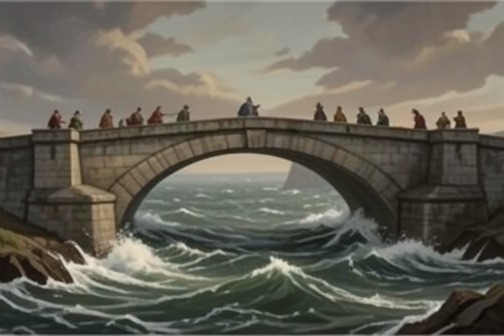
[Rama’s army builds a sea bridge to Lanka](entity:event-recall-event-4e22180b43c4) is presented as the passage that carried [Ráma](entity:character-recall-character-r-ma-2db51e45ae4a) across the sea to [Lanká](entity:location-recall-location-lank-4c2ae5988d40). The text emphasizes the crossing and the bridge’s enduring fame, while leaving the construction itself undescribed.
## The Crossing to Lanká
In an address to his spouse, Ráma recalls that he met and slew his deadly foe, then built a bridge across the deep and crossed to Lanká’s shore. The bridge is thus bound to a completed sea crossing and to the victory Ráma recounts; the passage offers no account of the work’s stages or the people who carried it out.
## Ráma’s Account of the Deed
Ráma’s recollection makes the bridge part of a sequence of exertion and achievement. He says that sleep had not yet returned to him, and places the building and crossing immediately after his encounter with his foe. The account gives the feat a personal voice without supplying practical details about its design or construction.
## A Bridge Remembered
Elsewhere, the bridge is described as stretching from shore to shore and as wondrous, with fame that will endure. This emphasis shifts attention from the mechanics of building to the scale and lasting renown of the crossing. The surviving account therefore preserves the bridge chiefly as a celebrated link between shores and as the means of Ráma’s passage to Lanká.
Event 127
The Death of Indrajit
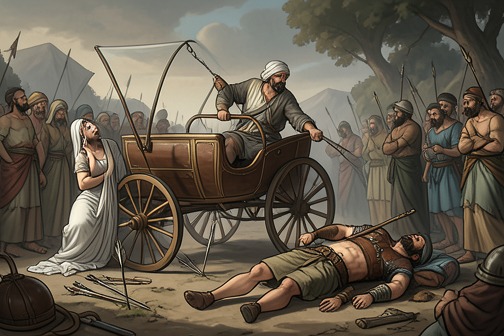
[The Death of Indrajit](entity:event-recall-event-f5f23f9c7a18) is presented as the fall of [Rávaṇ](entity:character-recall-character-r-va-06a1d00141e6)’s son after a sequence of attacks that combines battlefield force with magical deception. The account moves from [Indrajit](entity:character-recall-character-indrajit-88da9c19b071)’s unseen assault on the [Vánars](entity:creature-recall-creature-v-nars-66c23f0e487a) to the destruction of an illusory [Sítá](entity:character-recall-character-s-t-0be56374418b), then ends with his death at [Lakshmaṇ](entity:character-recall-character-lakshma-7aad0629b677)’s hand and the news reaching his father.
## Background and Battle
The episode follows the deaths of [Kumbha](entity:character-recall-character-kumbha-47f8ffc6933e) and [Nikumbha](entity:character-recall-character-nikumbha-f012a046e07b). The account next names [Makaráksha](entity:character-recall-character-makar-ksha-f82ce9315dab), [Khara](entity:character-recall-character-khara-de406d3d61b8)’s son, as a new challenger: he sallies forth against [Ráma](entity:character-recall-character-r-ma-2db51e45ae4a) and dies by Ráma’s fiery dart. The text says that Makaráksha’s battle occupies two cantos, which the compiler passes over, making the surrounding campaign a compressed sequence of successive Rávaṇ-aligned fighters falling in battle.
Indrajit then returns to the fighting using magic to become invisible. From that concealed position he kills countless Vánars with arrows described as unerring. He withdraws to the city, but his next appearance shifts the attack from unseen slaughter to a spectacle staged before the opposing force.
## The Illusion and Indrajit’s Death
Indrajit comes back in his chariot with a magical image of Sítá beside him, depicted as weeping and wailing. In view of the enraged [Hanúmán](entity:character-recall-character-han-m-n-8456b29d444d) and the Vánar host, he seizes the image by the hair and cuts it down with his scimitar. The scene gives the apparent destruction of Sítá a public witness: Hanúmán and the gathered warriors see the act, although the figure is an illusion rather than Sítá herself.
The fighting continues. Indrajit’s chariot is eventually broken to pieces and his charioteer is killed; after further combat, Indrajit himself falls to Lakshmaṇ. The account records the outcome plainly, without detailing the final exchange or the weapon that kills him. His death thus follows the dismantling of the vehicle that carried him into battle and the loss of the charioteer beside him.
## News and Aftermath
The next canto is titled Rávaṇ’s Lament. Its opening image is a mournful company seeking the king to tell him that his son has been slain by Lakshmaṇ before their eyes. The report makes the consequence immediate: the battlefield death becomes a father’s bereavement, and Indrajit’s fall supplies the occasion for the lament that follows.
The episode’s sequence sets two kinds of threat against one another. Indrajit first attacks from a position his enemies cannot see, then makes a false image of Sítá visible to them; the visible spectacle is deception, while the final fact is his own death. The compiler’s brief account does not supply the full battle narrative, but it preserves the reversal from Indrajit’s magical assault to the report of his defeat and the grief it brings to Rávaṇ.
Event 128
Hanuman brings the healing mountain to save the monkey army
[Hanuman](entity:character-recall-character-hanuman-83c726a7b662)’s search for healing herbs becomes an act of rescue when he returns carrying the mountain itself. The episode turns a command to save the suffering [Vánars](entity:creature-recall-creature-v-nars-66c23f0e487a) into a demonstration of strength and resourcefulness: when the needed plants evade him, he brings their whole mountain back to the army.
## The Command to Save the Vánars
A wounded chieftain has lived anew, cheered by the face he longed to see. The call then turns outward to the Vánars: Hanuman is urged to go forth and save them in their distress, with the appeal resting on a strength said to be beyond anyone else’s.
## The Mountain and Its Hidden Herbs
The search leads to a mountain described in relation to [Mount Kailasa](entity:location-recall-location-c20e37b8e0ab) and [Mount Rishabh](entity:location-recall-location-e80ec8d3153a). When Hanuman reaches for the plants he seeks, they hide from his sight. Unable to seize the healing herbs directly, he addresses the hill in anger, threatening vengeance if it will show no pity.
## Return with the Mountain
Hanuman retraces his swift course over hill, plain, and water, carrying his burden through the air. He lays it among the Vánars, and the passage invokes the delightful scent of the wondrous herbs. The episode’s decisive action is not a successful gathering of individual plants, but the delivery of the mountain that bears them.
Event 129
Lakshmana’s recovery after Ravana’s magic spear strikes him
[Lakshmana](entity:character-recall-character-lakshmana-1b97114243c1)’s recovery is the turn from a deadly spear attack to an urgent search for healing: after [Rávaṇ](entity:character-recall-character-r-va-06a1d00141e6) strikes him with a weapon forged by [Maya](entity:character-recall-character-maya-ccfe93b60cb8), [Ráma](entity:character-recall-character-r-ma-2db51e45ae4a) sends [Hanumán](entity:character-recall-character-hanum-n-b41d60813de6) to [Mahodaya Mountain](entity:location-recall-location-mahodaya-mountain-68fe74bab494), where powerful herbs grow.
## The Spear Attack
As arrows fall thickly against Rávaṇ’s armor, he shifts his aim to Lakshmana and cries out against him. He then hurls a mortal spear, forged by Maya with magic. The attack redirects the battle’s immediate danger onto Lakshmana and leaves Ráma confronting the possible loss of his brother.
## Ráma’s Response
The following canto, titled “Lakshman Healed,” opens with Ráma gazing tenderly at Lakshmana’s face. The intimate gesture follows the violence of the assault: the battle is no longer only a clash between armies, but a crisis centered on the life of someone Ráma loves.
## The Search for Healing
Ráma addresses Hanumán and sends him to the high peak of Mahodaya Mountain, where herbs of sovereign virtue grow. The episode thus moves from the spear’s destructive force to the prospect of restoration, making the search for medicinal herbs the immediate means by which Lakshmana’s recovery is pursued.
Event 130
The Death of Ravana
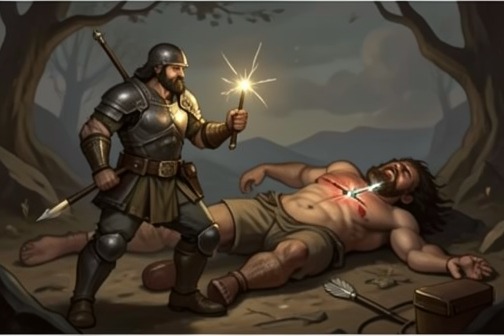
[The Death of Ravana](entity:event-recall-event-780a5fd67bd4) is the decisive moment of the battle in [Lanka](entity:location-recall-location-lanka-4b3ac7e9a824): after a conflict that has continued through night and day, [Rama kills Ravana](entity:action-recall-action-4bfc52f35af2) with a divinely kindled dart. The blow ends the struggle between them in an image of overwhelming force, as [Ravana](entity:character-recall-character-ravana-f2652ae52080) falls like Vritra struck down by the Thunderer.
## The Battle Reaches Its Decisive Moment
The fight has not paused with the passing hours; night and day alike have been consumed by the conflict. As the battle continues, [Mátali](entity:character-recall-character-m-tali-29d508e758fc) calls on [Rama](entity:character-recall-character-rama-fdac9c17dd0c) to let another weapon decide the outcome and urges him to launch the dart kindled by the Almighty Sire. His intervention directs the scene toward a final, unmistakable act rather than another exchange of blows.
## The Dart and Its Release
Rama obeys Mátali’s counsel. He sets the arrow on the string, then turns its point toward Ravana, lord of Lanka. The weapon is described as carrying a weight supplied by [Mount Meru](entity:location-recall-location-mount-meru-9179cab3b3d8) and Mount Mandar, giving the fatal dart a cosmic scale within the scene. Its release transforms Mátali’s counsel into action: Rama aims, and the dart strikes its intended target.
## Ravana’s Fall
The dart pierces Ravana’s great chest and cleaves his heart. He falls dead upon the plain, compared to Vritra slain by the Thunderer. The comparison gives Ravana’s defeat the force of a legendary overthrow, while the direct image of the pierced heart makes the result final: the opponent who has sustained the battle is dead. The passage presents this moment as the battle’s decisive end, without detailing the subsequent response of Ravana’s forces.
Event 131
Vibhishana Is Crowned King of Lanka
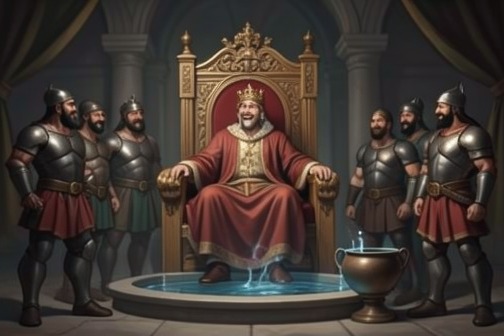
[Vibhishana Is Crowned King of Lanka](entity:event-recall-event-48196746c065) is the ceremony in which [Ráma](entity:character-recall-character-r-ma-2db51e45ae4a) makes [Vibhishana](entity:character-recall-character-vibhishana-48b5fde5e908) king of the giants. The scene gives visible, ritual form to the friendship and truthfulness for which Ráma commends him: [Vánars](entity:creature-recall-creature-v-nars-66c23f0e487a) bring sea water, and [Lakshmaṇ](entity:character-recall-character-lakshma-7aad0629b677) consecrates the new ruler on a throne as Ráma watches with joy.
## The Decision and Its Meaning
Ráma calls for king-making drops to be poured on Vibhishana’s head, addressing the task to Lakshmaṇ and linking the consecration to Vibhishana’s demonstrated truth and friendship. The exchange presents the appointment not merely as a change of ruler but as recognition of the qualities Ráma names as its grounds.
## The Consecration
Ráma then directs the Vánars to bring sea water for the giants’ king. They swiftly bring a brimming urn, and Vibhishana takes his seat on a superbly wrought throne. The water is poured over his brow, completing the ceremony through a clear sequence of command, preparation, enthronement, and consecration.
## Ráma’s Response
Ráma watches the rite and is filled with joy. The narrative gives the ceremony an intimate as well as political emphasis: the new kingship is enacted before him, and his response registers the affection and approval attached to Vibhishana’s recognition. The passage thus closes the appointment on both a public ritual gesture and Ráma’s personal gladness.
Event 132
Sita's fire ordeal
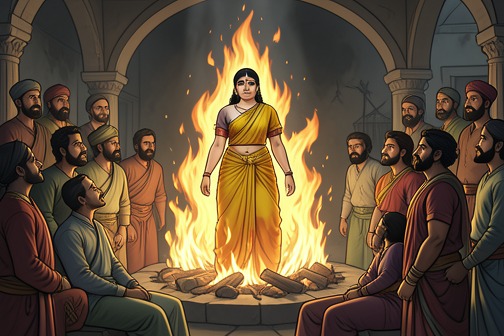
[Sita's fire ordeal](entity:event-recall-event-b2c6c241107d) is the decisive test of her fidelity after [Ráma](entity:character-recall-character-r-ma-2db51e45ae4a) lays a charge against her. Rather than ending in her destruction, the ordeal reverses the accusation: [Sita](entity:character-recall-character-sita-1913dd4978f6) enters the flames without fear and emerges restored, with a divine witness declaring her free of blemish and faithful to her husband.
## Causes and Stakes
The episode centers on a charge Ráma has laid against Sita. She calls on [Lakshmaṇ](entity:character-recall-character-lakshma-7aad0629b677) to prepare a pyre, presenting the ordeal as her answer to that charge. The conflict is therefore not a contest of physical strength but a test with her honor and standing as Ráma’s queen at stake.
## The Ordeal
Sita turns to Lakshmaṇ while sobs and sighs break her speech, and asks him to prepare the pyre. She then passes into the fierce flames, described as fearless to the last. The people respond with a piercing cry. The scene makes the danger visible to those gathered around her, while her composure gives the act its force: she faces the fire rather than leave the accusation unanswered.
## Restoration and Significance
The ordeal does not end with Sita’s entry into the flames. In the canto titled “[Sítá](entity:character-recall-character-s-t-0be56374418b) Restored,” the Self-existent Sire speaks, and the universal witness declares that Sita returns to Ráma free from every blot and blemish, faithful in word, deed, look, and mind. The verdict changes the meaning of the scene: what begins as an accusation becomes an affirmation of her integrity, and the fire becomes the setting for her public restoration.
Event 133
Indra Revives the Fallen Monkey Army
[Indra](entity:character-recall-character-indra-9cdc4e2c85c7)’s restoration of the fallen monkey army turns a battlefield’s loss into a scene of collective return. [Ráma](entity:character-recall-character-r-ma-2db51e45ae4a) asks for the dead to be restored, and Indra grants the rare boon; the warriors rise from [Yáma](entity:character-recall-character-y-ma-96ea81596800)’s domain and assemble around their king.
## The Request
The episode occurs in the aftermath of the fighting, when Indra, ruler of the sky and slayer of Páka, speaks to Ráma. Ráma uses the moment not to ask for a reward for himself but to plead for the fallen Vánar warriors. His request makes the army’s losses the central concern of the exchange.
## Indra’s Boon
Indra calls the requested favor a high boon, one that no one but Ráma should win. He nevertheless honors the word he has given and grants the restoration. The exchange presents Ráma’s appeal as extraordinary, while Indra’s response makes the spoken promise consequential: divine favor is expressed through a deed that reverses the battlefield’s deadliest outcome.
## The Army Returns
The fallen warriors are restored from Yáma’s dark domain. They rise like sleepers waking and fill the plain, once again arrayed around their royal chief. The image changes the scene from a tally of casualties to a renewed gathering of the army. Victory is thus marked not only by the defeat of Ráma’s enemy but also by the return of the allies who fought beside him.
Event 134
Rama Returns to Ayodhya and Reunites with Bharata
[Rama Returns to Ayodhya and Reunites with Bharata](entity:event-recall-event-d4ee29012b97) closes the arc of exile with a reunion that is at once familial and political. As [Ráma](entity:character-recall-character-r-ma-2db51e45ae4a) sees [Ayodhyá](entity:location-recall-location-ayodhy-08bd0b6815c4) from afar, news promises that [Bharat](entity:character-recall-character-bharat-6395f3ef7f4e) will meet his brother that very day, victorious over his foe and released from his long ordeal and vow. Bharat receives the tidings with overwhelming joy; when the brothers meet, he places the sandals he has borne at Ráma’s feet and welcomes him as king. The return makes private affection visible as the restoration of rightful rule.
## The Return Comes into View
The homecoming begins with Ayodhyá seen from a distance. Ráma looks down and recognizes the city, turning the approach to home into a moment of recognition before the reunion itself. The message that follows promises Bharat’s presence and the end of Ráma’s toil and prolonged vow. Victory and homecoming are joined: Ráma does not return simply because the separation has run its course, but as a victor whose return can resolve the waiting that has defined the brothers’ lives apart.
The news reaches Bharat as more than a report of arrival. He hears that his brother has defeated his foe and will be reunited with him that day; the account describes him as overwhelmed by rapture. The message thus changes expectation into immediate anticipation. The long absence is about to end, and the reunion is announced before it is enacted.
## The Sandals and the Restoration of Rule
At the meeting, Bharat places the shoes he has brought on Ráma’s feet. The gesture returns to Ráma a visible sign of the authority that the sandals had represented during his absence. Bharat’s welcome, addressed to him as king, makes the political meaning of the reunion explicit: the brother who had carried the emblem of rule now yields it back to its rightful bearer.
The act also gives the scene a precise emotional shape. Bharat does not greet Ráma only with words; he performs the restoration through an object associated with their separation and with his own stewardship. The sandals have crossed the distance between the brothers, bearing the burden of delegated sovereignty; placed again at Ráma’s feet, they mark the close of that arrangement. The reunion therefore gathers personal loyalty, obedience to Ráma’s claim, and the return of kingship into one concrete action.
## A Fulfilled Vow and a Public Homecoming
The event answers the tension between Bharat’s urgent wish for Ráma to rule and Ráma’s insistence on keeping his promise. Earlier, Bharat had appealed to him to take the rule that was justly his, while the account presents Ráma as steadfast in truth. The return resolves that conflict without erasing its cost: Ráma comes back only after the vow and its attendant hardship have reached their end. The meeting is both an intimate reconciliation and the completion of a public obligation.
The poem’s commentary identifies the [Bharat-Milap Festival](entity:event-recall-event-d9df660d9c28), or meeting of the brothers, as the closing scene of the dramatic representation of Ráma’s victory and triumphant return. It says that the scene was performed annually in October in many cities of Northern India. The Rám-Lalá play took place in the open air over fifteen successive days, with one day’s break. In Benares, three performances were held at nearly the same time: one near the Maharajah’s palace at Ramnaggur, another near the Missionary settlement at Sigra and elsewhere in the city, and a third at Chowká Ghát, organized by leading residents.
## The Reunion in Performance
The commentary dwells on the public scale of the brothers’ meeting. On the principal day, elephants bearing elaborate silver and gold howdahs joined the procession; richly dressed riders wore jewels in their turbans. Thousands of spectators filled streets and squares, balconies and rooftops, while flowers fell upon the advancing car amid music, shouts, and celebration. In this retelling, the family reunion becomes a civic spectacle: the return of the king is not complete in private, but is made visible to a gathered community.
That performance tradition extends the scene beyond the poem’s chronology. The sandals placed at Ráma’s feet give the reunion its intimate, legible gesture; the procession and assembled crowd enlarge that gesture into a recurring public image of victory, return, and restored rule.
Event 135
Rama's coronation
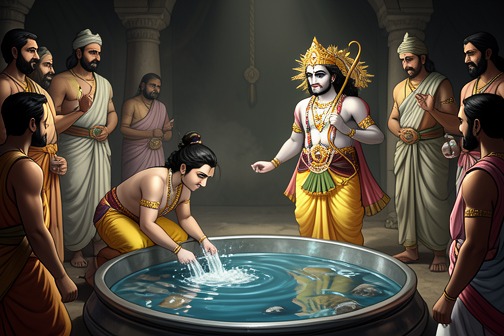
[Rama's coronation](entity:event-recall-event-3aef1da66350) marks the transition from his return to [Ayodhyá](entity:location-recall-location-ayodhy-08bd0b6815c4) to a reign the poem portrays as exceptionally long and peaceful. The consecration is rendered through concrete signs of royal authority and sacred participation: [Vaśishṭha](entity:character-recall-character-va-ish-ha-033580f29400) leads an assembly of sages, water is gathered from five hundred rivers, and an ancient gold ornament is placed on [Rama](entity:character-recall-character-rama-fdac9c17dd0c). The account’s emphasis on ritual and its reported aftermath makes the event both an investiture and the beginning of an idealized era.
## The Consecration
The coronation scene opens with [Bharat](entity:character-recall-character-bharat-6395f3ef7f4e) addressing his brother reverently. The narrative then places Rama amid many Brahman sages, with Vaśishṭha foremost among them, identified as chief by age. The gathering gives the rite a public and religious setting rather than presenting kingship as a private possession.
Water from five hundred rivers is supplied for the ceremony. Its great quantity and many sources make the consecration an act in which the wider realm is symbolically gathered around its new king. The ritual thus gives visible form to Rama’s accession through a shared sacred act.
The ceremony also includes rare juices distilled from herbs and applied to Rama’s brow. Alongside the river water, this detail presents the consecration as a carefully enacted rite, combining gathered offerings with the formal recognition of the king.
## The Marks of Kingship
Rama’s brows are bound with gold that the poem says [Manu](entity:character-recall-character-manu-91d5f38f8c61) himself had worn in ancient times. The ornament is bright with gems, and its association with Manu gives the new king’s investiture a connection to an earlier royal past. The passage places Rama’s authority within a line of remembered sovereignty rather than treating the coronation as an isolated change of rule.
Water, herbs, sages, and the inherited gold each contribute a distinct part to the ceremony: ritual materials prepare and mark Rama, while Vaśishṭha and the assembled sages frame the act as a consecration. Together, these details make kingship legible through both sacred procedure and visible insignia.
## The Reign That Follows
The narrative describes ten thousand years of Rama’s rule in Ayodhyá as a time of peace and rest. It reports that no widow mourned a husband murdered during this reign, linking the promised security of kingship to the protection of ordinary households. This is the poem’s account of Rama’s ideal rule, not merely a record of the ceremony itself.
The movement from the concentrated ritual to the vast span of the reign gives the coronation its decisive consequence: Rama’s accession becomes the starting point for a portrayal of public order sustained over generations. The ancient gold of Manu and the poem’s account of Ayodhyá’s long peace together present royal legitimacy as both inherited and measured by the wellbeing of the people.
Event 136
Dasharatha’s Sacrifice to Obtain Sons

[Dasharatha’s Sacrifice to Obtain Sons](entity:event-recall-event-807ba4e9c1f6) is both a royal rite seeking an heir and the point where that earthly need meets a crisis among the gods. The Ashvamedha and a further generative rite bring the gods’ attention to [Dasharatha](entity:character-recall-character-dasharatha-b9552a8b18f7)’s plea; the gods promise four sons, while their appeal to [Vishnu](entity:character-recall-character-vishnu-4fe080f11b04) establishes the larger purpose behind the births.
## Background and purpose
Dasharatha undertakes the sacrifice because he has no children and longs for heirs. The account presents the Ashvamedha as a major, extended royal observance: its course spans a year, and its rites involve the lifeblood of the sacrificial horse. The passing of that year gives the ceremony a defined progression, from its beginning in spring to its completion.
The Ashvamedha is not the only rite connected with the king’s wish. [Rishyasringa](entity:character-recall-character-rishyasringa-ba925de3f764), the sage who officiates for Dasharatha, proposes a further sacred rite specifically to secure progeny. The narrative therefore distinguishes the completed horse sacrifice from the additional act directed toward the desired result, even as it gathers them into one episode of royal and religious petition.
## The rites and the petition
The gods and other celestial beings assemble to receive portions of Dasharatha’s great sacrifice. Rishyasringa addresses them on the king’s behalf: Dasharatha has already performed the Ashvamedha in faith and now undertakes another rite because he wants children. The sage asks the assembled gods to grant him four sons worthy of fame throughout the worlds. They agree that the king’s desire will be fulfilled, then depart under [Indra](entity:character-recall-character-indra-9cdc4e2c85c7)’s lead.
The exchange gives the ritual a clear human purpose and a clear divine response. Dasharatha’s longing becomes a formal petition made through the officiating sage; the gods’ assent promises not simply an heir but four sons. The episode thus makes the hoped-for continuation of the royal line an outcome of both ritual action and divine favor.
## The gods’ crisis and Vishnu’s incarnation
The account then widens from the altar to the gods’ larger predicament. They approach [Brahma](entity:character-recall-character-brahma-39f8aa187fff) about [Ravana](entity:character-recall-character-ravana-f2652ae52080), who has become a danger to gods, sages, and other beings after receiving a boon protecting him from death at their hands. The protection has a fatal omission: Ravana did not ask to be spared from human beings. Brahma identifies that omission as the means by which Ravana can be killed.
The gods ask Vishnu to take human form and become Dasharatha’s son, divided into four portions and born through the king’s four wives. Their appeal joins the king’s desire for children to the need to defeat Ravana: the requested birth is at once the answer to a royal succession crisis and the means by which the gods’ enemy can be overcome. The boon’s human loophole explains why divine intervention must take human form rather than simply destroy Ravana from the heavens.
## Promise and narrative significance
Rishyasringa’s petition receives an explicit promise of four sons, while the gods’ request of Vishnu gives that promise a further, world-restoring purpose. The ritual’s success is therefore presented on two linked scales. For Dasharatha, it secures the heirs he desires; for the divine assembly, it opens the way to Ravana’s defeat through a human birth.
By placing the sacrifice beside the gods’ deliberation, the narrative makes ritual more than a private royal observance. It becomes the meeting point between the king’s household and the affairs of the worlds. The Ashvamedha, the additional rite, the sage’s intercession, and the divine decision converge on the birth of four sons, while the incarnation plan explains why that birth matters beyond the succession of a kingdom.
Event 137
The Gods Ask Vishnu to Incarnate and Slay Ravana
[The Gods Ask Vishnu to Incarnate and Slay Ravana](entity:event-recall-event-5f882765002e) is the divine council that turns [Ravana](entity:character-recall-character-ravana-f2652ae52080)’s immunity into the condition of his defeat. Because Ravana had secured protection from powerful supernatural beings but had neglected to include humans, the gods ask [Vishnu](entity:character-recall-character-vishnu-4fe080f11b04) to enter mortal life as [Dasharatha](entity:character-recall-character-dasharatha-b9552a8b18f7)’s four sons and kill him. The event joins cosmic crisis to royal succession: the remedy for a tyrant beyond the gods’ strength must be born into a human dynasty.
## Ravana’s Boon and the Gods’ Appeal
The gods assemble before [Brahma](entity:character-recall-character-brahma-39f8aa187fff), creator of the world, to describe the damage caused by Ravana. The boon Brahma had granted at Ravana’s request prevents the gods, [Danavas](entity:creature-recall-creature-danavas-5ec0d6ca1e20), Genii, and other named supernatural classes from killing him. Since the gods revere Brahma’s word, they have endured Ravana’s crimes rather than simply ignoring the protection his boon provides. His immunity has become a constraint on the very beings he persecutes.
The appeal describes Ravana’s violence as extending across the three worlds. Gods, [Rishis](entity:character-recall-character-rishis-2e1ff8964841), Genii, [Gandharvas](entity:character-recall-character-gandharvas-ba2b1040fb1d), Titans, and mortals suffer under his rule. The account conveys the reach of his power through the effects attributed to his presence: the sun does not shine, the wind will not blow, fire will not burn, and even the ocean stands motionless when he appears. Ravana has also driven [Kubera](entity:character-recall-character-kubera-fe5e28c9cf92) from his seat by force. The catalogue makes the crisis more than a dispute between rival rulers: Ravana’s tyranny has disrupted the natural order as well as the lives of its inhabitants.
## The Loophole in Ravana’s Protection
Brahma considers the gods’ request and identifies the omission that determines the solution. Ravana had asked to be safe from Gandharvas, Genii, gods, Danavas, and giants, but, in contempt for human beings, had not asked protection from them. That oversight leaves a single fatal opening: a human can kill him. The gods’ fear is therefore not answered by revoking the boon. Instead, the council must act within the terms Ravana himself established.
This reasoning gives the episode its precise reversal. Ravana’s confidence had led him to discount human power; the same dismissal makes humanity the means of his death. His immunity is formidable but conditional, and the condition converts apparent invulnerability into a prophecy of vulnerability. The gods’ appeal moves from a report of helplessness to a plan grounded in the limit of Ravana’s own demand.
## Vishnu’s Incarnation as the Remedy
Vishnu arrives as the gods’ protector and asks what they require of him. They answer that he should assume human nature and become the sons of Dasharatha, who has performed an Ashvamedha and longs for children. Their proposal is specific: Vishnu is to divide himself into four and be born through Dasharatha’s three wives, described in the account through chastity, beauty, and renown. The crisis among the gods is thus linked to the king’s childlessness and to the ritual undertaken in hope of an heir.
Vishnu questions why the task must fall to him in bodily form, and the gods restate the crucial distinction: no other heavenly being can kill Ravana, but a human can. They point to Ravana’s long and severe austerities, through which Brahma was moved to grant the protection that now makes ordinary divine intervention impossible. Vishnu accepts the requested course, promising to take mortal form, defeat Ravana and his allies, and rule the earth among human beings. The council’s answer is not simply a warrior sent down from heaven; it is a divine power entering the human order that Ravana had dismissed.
## Fulfilment and Narrative Significance
The episode supplies the cause behind [Rama](entity:character-recall-character-rama-fdac9c17dd0c)’s human birth and the purpose of the divine incarnation. In a later hymn after Ravana’s death, the gods identify Rama with Vishnu and say that he assumed human form to kill Ravana; [Sita](entity:character-recall-character-sita-1913dd4978f6) is identified there with [Lakshmi](entity:character-recall-character-lakshmi-4d9520b17871). That recognition confirms the council’s plan in retrospect: the apparent human king has completed the task for which Vishnu entered mortal life.
The account also places this divine decision beside the promise of a royal family. A sage tells Dasharatha that four sons will uphold his line, while the council explains why Vishnu must be among them. The promised sons are therefore both heirs and the means by which a cosmic threat can be overcome. The event’s central irony remains the one Brahma uncovers: Ravana’s contempt for human beings, expressed in the terms of his boon, makes a human birth the necessary instrument of his defeat.
Event 138
Vishnu Defeats Three Rakshasa Kings
[Vishnu](entity:character-recall-character-vishnu-4fe080f11b04)’s defeat of the three Rakshasa kings is an embedded account of an earlier war between the gods and the brothers [Mályavat](entity:location-recall-location-51a543361e56), Sumáli, and Máli. Told by [Agastya](entity:character-recall-character-agastya-57db2c7eeb00) to [Ráma](entity:character-recall-character-r-ma-2db51e45ae4a) after Ráma has returned to [Ayodhyá](entity:location-recall-location-ayodhy-08bd0b6815c4) and taken the throne, it explains why the [Rakshasas](entity:creature-recall-creature-358c637738a5) were driven from [Lanka](entity:location-recall-location-lanka-4b3ac7e9a824) and connects Vishnu’s ancient promise to destroy them with Agastya’s identification of Ráma as Vishnu in human form.
## The history of Lanka and the Rakshasa kings
Agastya’s account begins with the Rakshasas’ origins. When [Brahma](entity:character-recall-character-brahma-39f8aa187fff) created the waters, he formed beings to guard them; some came to be known as Rakshasas, whose first kings were Heti and Praheti. Through the generations, Heti’s descendant Sukeśa became the father of Mályavat, Sumáli, and Máli. After intense austerities, the brothers received invincibility and long life from Brahma. Their new power did not bring peace: they used it to harass the gods and the [Rishis](entity:character-recall-character-rishis-2e1ff8964841).
The brothers’ stronghold was Lanka, a city built by [Viśvakarmá](entity:character-recall-character-vi-vakarm-1aea8b792d3f) on [Mount Trikūṭa](entity:location-recall-location-mount-trik-a-460402d710ab) beside the [Southern Ocean](entity:location-recall-location-southern-ocean-c3710e414f22) at [Indra](entity:character-recall-character-indra-9cdc4e2c85c7)’s command. This history gives Ráma a reason to question the familiar account of Lanka: he had understood the Rakshasas as descendants of [Pulastya](entity:character-recall-character-pulastya-a738f3cdd5b7), and now learns that the city had also been their home before a divine defeat drove them away. The story therefore places the war against the three kings before the later history of Lanka under [Kubera](entity:character-recall-character-kubera-fe5e28c9cf92) and, eventually, Rávaṇa.
## The gods seek Vishnu’s aid
Unable to end the threat themselves, the gods and Rishis appeal first to Mahádeva. Because Sukeśa, the brothers’ father, was under his protection, Mahádeva says he cannot kill the Rakshasas. Instead, he directs the petitioners to Vishnu. Vishnu promises that he will destroy their enemies, giving the ensuing battle a stated purpose: it is the fulfillment of a commitment made in response to the gods’ appeal.
When the three kings hear of that promise, they consult one another and go to heaven to attack the gods. Vishnu prepares to meet them. The conflict is thus more than a contest between powerful rulers and their opponents: the brothers challenge the divine order after learning that Vishnu has pledged to stop them, and their assault brings that pledge into action.
## Defeat and return to Lanka
Vishnu defeats the Rakshasa army with great slaughter. Máli is killed, and the surviving brothers are driven back to Lanka. As they flee, Vishnu attacks their retreating force. Mályavat protests that striking at the fugitives’ rear is not warrior-like and expresses a wish to renew the combat. His objection introduces a dispute about conduct in battle even as the outcome is already clear: the brothers have been defeated and their advance halted.
Vishnu answers that he must keep his promise to the gods and will destroy the Rakshasas even if they escape to [Patala](entity:location-recall-location-patala-d2951cb0d439). The reply makes fidelity to the pledge, rather than Mályavat’s proposed standard of combat, the governing reason for continuing the pursuit. The survivors return to Lanka, while the death of Máli marks the cost of their defeat and the end of their attack on heaven.
## The story’s place in Ráma’s history
Agastya emphasizes that these three Rakshasa kings were more powerful than Rávaṇa, yet could be destroyed only by Náráyaṇa, whom he identifies as Ráma himself: the eternal, indestructible god. This statement turns an account of Lanka’s distant past into an explanation of Ráma’s present role. Vishnu’s earlier promise to the gods and Ráma’s later confrontation with the Rakshasas belong to a continuous divine purpose in Agastya’s telling.
The episode also clarifies how Lanka changed hands. After the defeat, Sumáli and his family lived for a long time in Patala, while Kubera dwelt in Lanka. Agastya’s genealogy and account of the battle therefore supply the background to the later return of Sumáli’s line and the rise of Rávaṇa. Framed as an answer to Ráma’s questions, the tale connects the city’s changing rulers, the gods’ appeal, and Vishnu’s intervention in a single history.
Event 139
Ravana’s austerities win boons from Brahma
[Ravana’s austerities win boons from Brahma](entity:event-recall-event-8fe22057fe06) in an encounter that transforms extreme self-sacrifice into supernatural power. [Ravana](entity:character-recall-character-ravana-f2652ae52080) does not obtain the immortality he seeks, but the protection he receives, together with restored heads and the ability to change shape, makes the boon a decisive source of his later strength.
## Background and Austerities
Ravana goes with his brothers to the hermitage at [Gokarṇa](entity:location-recall-location-ec74daefdb94) to perform austerities. After a thousand years of penance, he casts one of his heads into the sacrificial fire. At equal intervals he repeats the offering nine times, turning his own body into the measure of his devotion and resolve.
As he is about to offer his tenth head, [Brahma](entity:character-recall-character-brahma-39f8aa187fff) appears and offers him a boon. The arrival comes at the limit of Ravana’s repeated sacrifice: the ritual has brought him to the edge of destroying himself, and the divine offer interrupts that final act.
## The Boon and Its Limits
Ravana asks for immortality, but Brahma refuses that request. Ravana then asks to be indestructible by all creatures more powerful than men. Brahma grants this conditional protection, rather than absolute deathlessness; human beings remain outside the class from which Ravana has secured immunity.
The boon also restores all the heads Ravana has sacrificed and gives him the power to assume any shape he pleases. Its terms therefore answer the bodily cost of his austerities while adding a further power of transformation. Ravana leaves the encounter not immortal, but protected by a formidable, specifically bounded grant.
## The Brothers’ Different Boons
Ravana’s austerities take place alongside those of his brothers, but their requests and outcomes differ. [Vibhishana](entity:character-recall-character-vibhishana-48b5fde5e908) asks that he remain devoted to righteousness even amid the greatest calamities, and Brahma grants that request and adds immortality. [Kumbhakarna](entity:character-recall-character-kumbhakarna-993814df073f), whose destructive appetite has alarmed the gods, is led through [Sarasvati](entity:character-recall-character-sarasvati-d1e3c2eed9b1)’s intervention to ask for long sleep instead of a more dangerous boon.
These contrasting outcomes make the encounter more than a contest in ascetic endurance. Ravana’s request secures power and protection; Vibhishana’s centers on moral constancy; and Kumbhakarna’s boon confines his dangerous strength through prolonged sleep. The same divine offer thus exposes sharply different possibilities in the brothers’ destinies.
## Consequences and Significance
The terms of Ravana’s boon establish both his exceptional power and its limit. His protection extends to creatures more powerful than men, but does not make him invulnerable to human beings. His restored heads and shape-changing capacity reinforce the scale of the gift without removing that boundary.
The episode’s central reversal is that the request Ravana cannot have—immortality—is replaced by a conditional protection that still leaves a path to his defeat. His austerities bring him extraordinary advantages, but the boon’s wording preserves the vulnerability that absolute immortality would have erased.
Event 140
Kumbhakarna Seeks a Boon and Is Granted Long Sleep
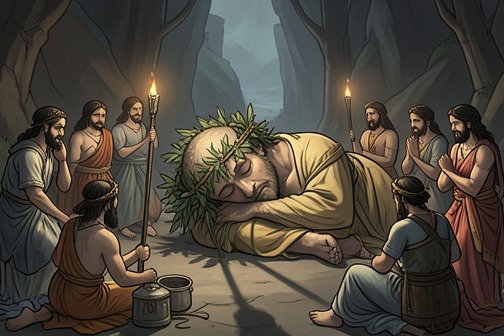
[Kumbhakarṇa](entity:character-recall-character-kumbhakar-a-1980dd1976c4) Seeks a Boon and Is Granted Long Sleep is the episode in which a divine boon becomes a means of containment: the gods intervene before Kumbhakarṇa can ask for a gift that might magnify the danger he poses, and he receives instead a long sleep. The episode turns on the gap between the boon he believes he is requesting and the one he understands himself to have received.
## Causes and Background
Kumbhakarṇa had become a threat through his violence and appetite. The account says he had eaten seven [Apsarases](entity:character-recall-character-apsarases-2faecadb0f67) and ten of [Indra](entity:character-recall-character-indra-9cdc4e2c85c7)’s followers, as well as [Rishis](entity:character-recall-character-rishis-2e1ff8964841) and ordinary people. When [Brahmá](entity:character-recall-character-brahm-8b6ab0d9402f) is about to offer him a boon, the gods intervene, asking that stupefaction be inflicted on him under the appearance of a blessing. Their concern is not abstract: his past consumption of divine attendants, ascetics, and people gives the request its urgent cause.
## The Request and the Deception
Brahmá thinks of [Sarasvati](entity:character-recall-character-sarasvati-d1e3c2eed9b1), who arrives and, at his command, enters Kumbhakarṇa’s mouth so that she can speak for him. Under her influence, Kumbhakarṇa asks for the boon of sleeping for many years. Brahmá grants it. The exchange has the outward form of a request freely made and a boon formally bestowed, but the gods have shaped its outcome by intervening in the speech through which Kumbhakarṇa makes his choice.
## Recognition and Significance
After Sarasvati leaves him, Kumbhakarṇa recovers his own consciousness and realizes that he has been deluded. That recognition marks the cost of the episode: the boon is not simply a power he sought, but a constraint produced by divine intervention and concealed within the language of favor. The episode also distinguishes his fate from that of his brother [Vibhishana](entity:character-recall-character-vibhishana-48b5fde5e908), whose boon is explicitly directed toward righteousness even amid calamity and is accompanied by immortality. Kumbhakarṇa, by contrast, receives long sleep and understands the deception only after the request has been granted.
Event 141
Ravana Takes Lanka from Kubera
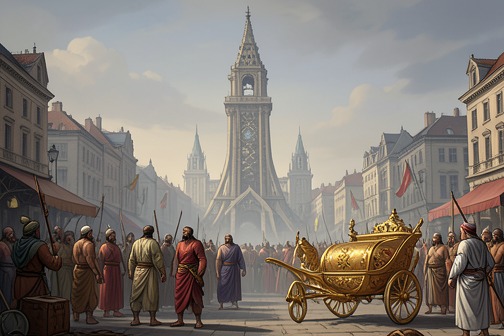
[Ravana Takes Lanka from Kubera](entity:event-recall-event-006ce6de085e) is the transfer of [Lanka](entity:location-recall-location-lanka-4b3ac7e9a824) from [Kuvera](entity:character-recall-character-kuvera-f257d27e2149) to [Ravana](entity:character-recall-character-ravana-f2652ae52080), recounted by [Agastya](entity:character-recall-character-agastya-57db2c7eeb00) after [Rama](entity:character-recall-character-rama-fdac9c17dd0c) has returned to [Ayodhya](entity:location-recall-location-ayodhya-ef190b6473a9) and taken the throne. The episode places Ravana’s possession of the city within a longer history of Rakshasa rule, exile, and return. Although the account groups the conquest of Kuvera and acquisition of his self-moving chariot among the events of Ravana’s rise, its specific description of the city’s transfer says that Kuvera gives Lanka up on his father’s advice; it does not narrate a battle for the city.
## Lanka Before Ravana
Agastya’s account gives Lanka more than one political past. Viśvakarma had built the city for the [Rakshasas](entity:creature-recall-creature-358c637738a5) on Mount Trikuta, by the southern ocean. The Rakshasas later abandoned it through fear of [Vishnu](entity:character-recall-character-vishnu-4fe080f11b04), leaving it unoccupied. On the advice of his father [Viśravas](entity:character-recall-character-vi-ravas-fbce43951a2c), Kuvera subsequently took possession of the empty city. Lanka was therefore already an established royal seat before Ravana claimed it, and its earlier association with the Rakshasas foreshadows its return to their rule.
The family history that leads to the transfer begins with [Sumali](entity:character-recall-character-sumali-3ccd1d5e48b2), who had lived in [Patala](entity:location-recall-location-patala-d2951cb0d439) with his family while Kuvera dwelt in Lanka. When Sumali saw Kuvera travelling in his chariot to visit Viśravas, he considered how his own family might recover its fortunes. He urged his daughter [Kaikasi](entity:character-recall-character-kaikasi-8c0af34c8a35) to seek Viśravas as a husband. She became the mother of Ravana, [Kumbhakarna](entity:character-recall-character-kumbhakarna-993814df073f), [Shurpanakha](entity:character-recall-character-shurpanakha-d90734bb95c3), and [Vibhishana](entity:character-recall-character-vibhishana-48b5fde5e908). The city’s change of ruler thus follows a deliberate dynastic strategy: Sumali’s plan connects his descendants to Viśravas, the father of the ruler already established in Lanka.
## Ravana’s Rise
Kaikasi pressed Ravana to equal his half-brother Kuvera in splendour, and Ravana promised to do so. He went with his brothers to the hermitage at Gokarna to practise austerities. After a thousand years of penance, Ravana cast one of his heads into the fire as an offering; he repeated the act nine times at intervals and was about to sacrifice the tenth when [Brahma](entity:character-recall-character-brahma-39f8aa187fff) appeared. Ravana asked for immortality, which Brahma refused, and then requested protection from creatures more powerful than human beings. Brahma granted that boon, restored the sacrificed heads, and gave Ravana the power to assume different forms.
The boons help explain the scale of Ravana’s ascent, but the account distinguishes the brothers’ requests. Vibhishana asked to remain devoted to righteousness even in the greatest calamity and received immortality as well as the promised appearance of Brahma’s weapon without prior instruction. Kumbhakarna, meanwhile, was led by [Sarasvati](entity:character-recall-character-sarasvati-d1e3c2eed9b1) to ask for prolonged sleep, a request shaped by the gods’ intervention. These outcomes establish the circumstances in which Ravana’s claim to Lanka takes place, without making the transfer itself a narrated contest of arms.
## The Transfer and Its Consequences
After the brothers’ austerities and the granting of their boons, Kuvera gives up Lanka to Ravana on Viśravas’s advice. That concise statement makes paternal counsel decisive at the moment when the city changes hands: Viśravas had earlier advised Kuvera to take the vacant city, and now his advice precedes its surrender to Ravana. The episode does not specify the terms of the advice or describe Kuvera’s departure, so the transfer is clearer than its immediate political circumstances.
The account also identifies the conquest of Kuvera and the acquisition of his magical, self-moving chariot as subjects of later sections. It thereby presents the takeover as part of Ravana’s wider expansion, while preserving a distinction between that broader conquest and the brief explanation given for Lanka itself. With Ravana established in the city, the old Rakshasa capital is restored to a Rakshasa ruler, and Sumali’s effort to revive his family’s standing reaches its political result.
## Narrative Frame and Significance
The episode is an embedded account: Agastya relates Lanka’s earlier history in response to Rama’s questions about the Rakshasas after the return to Ayodhya. Rama is surprised to learn that Lanka had once belonged to the Rakshasas and asks about their ancestry and the reason they were driven away. Agastya’s answer makes the transfer part of a chain of remembered origins rather than an isolated change of ownership.
The city’s history turns on successive acts of displacement and inheritance: the Rakshasas abandon Lanka, Kuvera occupies it, and Ravana receives it after the rise prepared by Sumali’s family plan and his own austerities. Its return to Rakshasa rule is therefore both a dynastic recovery and a step in Ravana’s emergence as a power. The restrained account of the handover leaves the mechanics of the seizure unspecified, but its sequence makes clear why Lanka matters: it is the inherited stronghold from which Ravana’s later kingdom is identified.
Event 142
Vedavati Curses Ravana and Is Reborn as Sita
[Vedavati](entity:character-recall-character-vedavati-fa154b0bc2c4)’s curse and rebirth turn [Ravana](entity:character-recall-character-ravana-f2652ae52080)’s attempt to possess an ascetic into the beginning of his eventual destruction. Refusing to curse him directly, she chooses instead to surrender her life and return as the daughter of a righteous king: in the next age, she is [Sita](entity:character-recall-character-sita-1913dd4978f6), Ravana’s future captive and the decisive cause of his death.
## Identity and Vow
The episode introduces Vedavati in a forest on the [Himalaya](entity:character-recall-character-himalaya-573d6ee7fa39), where Ravana encounters her living in ascetic garb. She is the daughter of the sage Kuśadhwaja, born during his constant study of the Veda. Though gods and other celestial beings had wished to marry her, her father had chosen [Vishnu](entity:character-recall-character-vishnu-4fe080f11b04) as the husband he desired for her. Vedavati has made that wish her own: she regards Vishnu, also called Narayana, as her husband and practices severe austerities to attain him.
Her identity thus rests on a commitment already made, not on Ravana’s attention. Her ascetic discipline is directed toward Vishnu, and her father’s wish confirms rather than overrides that choice. Ravana’s approach confronts this settled devotion with a demand she has no reason to accept.
## Ravana’s Assault and Vedavati’s Curse
Ravana tells Vedavati that austerity is ill-suited to someone so young and beautiful, asks her to become his bride, and boasts that he is superior to Vishnu. She rebukes his contempt for the deity. Ravana then touches the hair on her head with his fingertip. In response, she cuts off her hair and declares that she cannot continue to live after this insult.
Vedavati does not answer the assault with a direct curse. She says that such a curse would waste the merit of her austerities, and instead vows to be born again for Ravana’s destruction. She asks to return as the virtuous daughter, not born from a womb, of a righteous man. Having made this declaration, she enters the blazing fire before Ravana. A shower of celestial flowers falls as she dies, marking the act as more than an escape from his violation: it is the chosen means by which she carries her vow into another life.
## Rebirth and Fulfillment
The account identifies Vedavati, who lived in the [Krita Age](entity:time-recall-time-krita-age-52bef069d3fa), with Sita, born in the [Treta Yuga](entity:time-recall-time-treta-yuga-f545ffd9d6bf) as the daughter of King [Janaka](entity:character-recall-character-janaka-3887e8243491) and later the bride of [Rama](entity:character-recall-character-rama-fdac9c17dd0c). The transformation fulfills the terms of Vedavati’s vow: she returns as a virtuous, womb-born daughter of a king, and her life becomes bound to Ravana’s downfall. The episode presents her earlier resolve as the hidden cause behind the later conflict, even though Rama performs the act of killing Ravana.
The commentary makes that distinction explicit: Sita is the principal cause of Ravana’s death, while the function of destroying him belongs to Rama. It also interprets Rama as Vishnu and Sita as [Lakshmi](entity:character-recall-character-lakshmi-4d9520b17871). The result is a layered account of agency: Vedavati’s austerity and decision establish the fatal purpose, Sita embodies its return, and Rama carries out the destruction. Ravana’s brief violation of Vedavati’s person therefore becomes the point at which his future defeat is set in motion.
Event 143
Ravana Disrupts Marutta’s Sacrifice
[Ravana Disrupts Marutta’s Sacrifice](entity:event-recall-event-410d8220c23e) is an episode in the account of [Ravana](entity:character-recall-character-ravana-f2652ae52080)’s exploits. When Ravana interrupts a sacrifice performed by King Marutta, the assembled gods respond by changing their shapes to escape. Each then grants a boon to the animal whose form it assumed, turning the gods’ flight into an explanation for several animal traits and customs.
## Setting and Participants
The account identifies Marutta as the king performing the sacrifice and describes the gods assembled there when Ravana disrupts it. Faced with the interruption, the gods do not remain in their divine forms: [Indra](entity:character-recall-character-indra-9cdc4e2c85c7) becomes a peacock, [Yáma](entity:character-recall-character-y-ma-96ea81596800) a crow, [Kuvera](entity:character-recall-character-kuvera-f257d27e2149) a lizard, and [Varuṇ](entity:character-recall-character-varu-de3c2e357e7b) a swan. The passage gives no further detail about the sacrifice’s completion or the immediate outcome of Ravana’s intervention.
## The Gods’ Transformations and Boons
After taking animal forms, the gods each bestow a boon on the animal they have chosen. Indra’s peacock retains a visible reminder of the god: its tail recalls Indra’s thousand eyes. Varuṇ’s association with the ocean is reflected in the swan’s whiteness, likened in the account to ocean foam, while Kuvera’s lizard is granted a golden colour.
Yáma’s boon to the crow concerns death and funeral offerings. A crow is not to die except through violent death, and the dead are to receive their funeral oblations when crows have eaten them. The episode thus connects the crow not only to Yáma but also to the treatment of offerings for the dead.
## Narrative Significance
The scene presents Ravana’s assault on a royal sacrifice as the occasion for a chain of transformations and divine gifts. Its details give mythic explanations for animal appearance and for the crow’s role in relation to funeral oblations. Rather than describing the sacrifice’s eventual fate, the account dwells on what the gods’ escape leaves behind: lasting signs and customs attached to the forms they assumed.
Event 144
Ravana Is Captured by Kartavirya
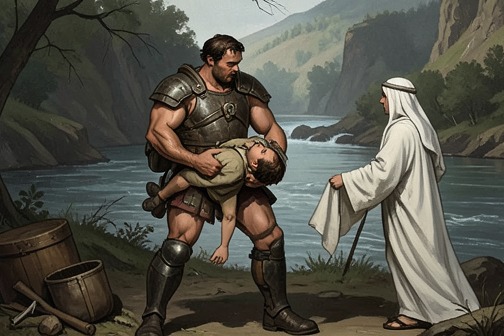
[Ravana](entity:character-recall-character-ravana-f2652ae52080)’s campaign of conquest is checked when he attacks [Karttavirya Arjuna](entity:character-recall-character-karttavirya-arjuna-98fc8cf4039c), the powerful king of Mahishmati, on the banks of the [Narmada River](entity:location-recall-location-narmada-river-ead9a4d23c1a). Karttavirya defeats and imprisons him, making the episode a reversal in Ravana’s series of military exploits; Ravana is released only after [Pulastya](entity:character-recall-character-pulastya-a738f3cdd5b7) intercedes.
## The Encounter
The account places the clash at the Narmada River and identifies Karttavirya as a mighty ruler of Mahishmati. Ravana attacks him, but the encounter ends not in another conquest for Ravana but in his defeat and capture.
## Captivity and Release
Karttavirya takes Ravana prisoner and holds him in confinement. Pulastya’s intercession brings that captivity to an end: Ravana is released from his bonds. The passage gives no further details of the imprisonment or the terms of his release.
## Place in Ravana’s Campaigns
The episode interrupts a sequence in which Ravana subdues other powerful opponents and territories. After his release, he visits [Kishkindha](entity:location-recall-location-kishkindha-34f806a0d9f0) and enters an alliance with [Bali](entity:character-recall-character-bali-4ed36663458c), then undertakes further campaigns. His capture is therefore a temporary setback in the account, rather than the end of his power or military activity.
Event 145
Ravana Battles in the Realm of the Dead and the Underworld
[Ravana Battles in the Realm of the Dead and the Underworld](entity:event-recall-event-aa3d6195ab4b) recounts a stage of [Ravana](entity:character-recall-character-ravana-f2652ae52080)’s expanding campaign in which conquest reaches beyond the human kingdoms. Its decisive pattern is a victory qualified by divine restraint: Ravana survives [Yama](entity:character-recall-character-yama-ad82a71e0067) not simply through superior force, but because [Brahma](entity:character-recall-character-brahma-39f8aa187fff)’s promise bars Yama from striking him with his deadly weapon.
## Campaign and Captivity
Before entering the underworld, Ravana attacks Kartavirya Arjuna, the powerful king of Mahishmati, on the banks of the [Narmada River](entity:location-recall-location-narmada-river-ead9a4d23c1a). Arjuna defeats him, captures him, and holds him prisoner. [Pulastya](entity:character-recall-character-pulastya-a738f3cdd5b7) intervenes on Ravana’s behalf, and Ravana is released. The episode establishes that his campaign is not an uninterrupted sequence of victories: even a formidable conqueror can be overcome, and his release depends on another’s intervention.
Afterward, Ravana visits [Kishkindha](entity:location-recall-location-kishkindha-34f806a0d9f0) and forms an alliance with [Bali](entity:character-recall-character-bali-4ed36663458c), king of the [Vánars](entity:creature-recall-creature-v-nars-66c23f0e487a). The account presents this pact as an agreement to share their possessions and privileges, extending Ravana’s reach through alliance as well as force. From there, the narrative turns to his invasion of the realm of the dead and his confrontation with Yama.
## Confrontation with Yama
Ravana fights Yama, the sovereign of the dead, and defeats him. The account makes clear that this outcome is shaped by a prior divine commitment: at Brahma’s request, Yama refrains from using the deadly weapon against Ravana, to whom Brahma had once given a protective promise. Ravana’s victory therefore does not prove that he overpowers every divine defense. It depends on an obligation that limits Yama’s response, making the contest a collision between martial ambition and the consequences of a boon.
The narrative also sketches the dead’s realm through images of a blood-filled river, lamentation, pleas for water, and punishment for the guilty, set against comparatively modest pleasures for the just. These details establish the campaign’s setting as a place of judgment and suffering, rather than merely another territory to be conquered; the account’s emphasis remains on the scale of Ravana’s incursion and Yama’s constrained resistance.
## Invasion of [Patala](entity:location-recall-location-patala-d2951cb0d439)
Ravana next descends into Patala, described as an underwater domain inhabited by [Nāgas](entity:organization-recall-organization-n-gas-58dddec4df48) and [Daityas](entity:creature-recall-creature-daityas-6de4a3918757) and defended by [Varuna](entity:character-recall-character-varuna-8e42e452a193). He conquers [Bhogavati](entity:location-recall-location-bhogavati-b5c7336bb16b), the city ruled by [Vasuki](entity:character-recall-character-vasuki-d3b0afcfa971), and brings its Nāga inhabitants under his power. He then presses on to Varuna’s seat. Varuna himself is away, but his sons come out to fight Ravana; Ravana defeats them and leaves victorious.
The sequence distinguishes between the absent ruler and the defenders who meet the invasion in his place. Ravana’s success there extends his dominion over a city and its serpent people, while the account ties the limits of his earlier victory over Yama to divine promise rather than treating every encounter as a simple contest of strength. Together, the episodes depict conquest spreading across realms, with alliances, interventions, and obligations shaping its course.
Event 146
Meghanada captures Indra and earns the name Indrajit
[Meghanáda](entity:character-recall-character-meghan-da-0e264072ed22) captures [Indra](entity:character-recall-character-indra-9cdc4e2c85c7) and earns the name [Indrajít](entity:character-recall-character-indraj-t-9eaa6775f6fc) in an account of [Rávaṇ](entity:character-recall-character-r-va-06a1d00141e6)’s campaigns. His victory turns the king of the gods into a prisoner, but the capture ends not with Indra’s death: [Brahmá](entity:character-recall-character-brahm-8b6ab0d9402f) intervenes, and Indra’s release is exchanged for a boon that will make Meghanáda invincible in battle after a sacrifice to [Fire](entity:character-recall-character-fire-b3a40eeb15fa).
## The Campaign and the Capture
The episode occurs during the account of Rávaṇ’s expansive conquests. In its description of a battle with Indra, Meghanáda—Rávaṇ’s son—emerges victorious. He binds Indra by magical means and carries him away to [Lanká](entity:location-recall-location-lank-4c2ae5988d40), reversing the expected balance between the gods’ king and the invading prince.
The capture is the decisive action of the episode: Indra is not merely defeated in the field but taken as a prisoner. The narrative then shifts from military force to divine negotiation, making the captive’s release the hinge on which Meghanáda’s future advantage turns.
## Brahmá’s Intervention and the Boon
Brahmá intercedes, and Meghanáda releases Indra. The release is tied to a specific return: Meghanáda obtains the boon that sacrificing to Fire will make him invincible in a coming battle. The episode thus gives the capture a consequence beyond the immediate humiliation and recovery of Indra. The encounter establishes a condition under which ritual action will confer extraordinary battlefield protection.
## Name and Narrative Consequence
The account identifies the victorious son first as Meghanáda and then calls him Indrajít after his capture of Indra and the negotiated release. His new name preserves the feat at the center of the episode, while the boon links that feat to a future source of power. The event therefore joins conquest, divine intervention, and ritual privilege: Meghanáda’s victory brings him recognition, but Brahmá’s settlement also specifies how his promised invincibility may be secured.
Event 147
Sita Is Abducted by Ravana
[Sítá](entity:character-recall-character-s-t-0be56374418b) Is Abducted by [Ravana](entity:character-recall-character-ravana-f2652ae52080) is presented not as an extended action scene but through [Sampati](entity:character-recall-character-sampati-286582a41b86)’s later testimony: he recalls seeing [Rávaṇ](entity:character-recall-character-r-va-06a1d00141e6) carry a woman through the air, then identifies Sítá as held in [Lanká](entity:location-recall-location-lank-4c2ae5988d40). The episode’s decisive narrative function is to transform an old witness’s incomplete sighting into actionable knowledge for those searching for her. It establishes the abduction and the direction of the search, while leaving its immediate causes and circumstances unstated.
## Causes and Background
The available account does not explain what led Rávaṇ to seize Sítá, nor does it recount the moment of her removal from her former home. It does not describe a confrontation, the preparations for the abduction, or the route taken through the air. Those absences matter: the event reaches the reader through what Sampati remembers and can tell, rather than through a fully narrated sequence of actions.
The report does establish that Sítá was carried away against her will and kept apart from those searching for her. In Sampati’s later description, Rávaṇ is associated with a city in which Sítá is securely confined. The account therefore joins two aspects of the episode—her forcible removal and her subsequent captivity—without filling in the intervening events.
## Sampati’s Recollection
When the searchers face the distance and difficulty of their task, Sampati explains that he is too old and weakened to undertake it himself. He nevertheless offers a crucial piece of knowledge: he saw Rávaṇ carrying a woman through the air. His statement is a witness’s recollection, not an account of every stage of the abduction, and the narrative preserves that distinction. Sampati can attest to what he saw; the passage does not give him knowledge of Rávaṇ’s intentions or of what happened before and after the sighting.
The description identifies the woman as gentle, but Sampati’s decisive contribution is the observed act of carrying her away. The image is brief and directional: Rávaṇ is in motion, and the woman is being taken from one place toward another. Rather than staging the episode in real time, the poem makes the remembered sight the hinge between the searchers’ uncertainty and their new knowledge.
## Lanká and Sítá’s Captivity
Sampati identifies Rávaṇ as the brother of the Lord of Gold and locates his city at Lanká, surrounded by the southern ocean. The city is described as nobly planned and built by [Viśvakarmá](entity:character-recall-character-vi-vakarm-1aea8b792d3f). These details situate the abduction within a specific geography and associate Rávaṇ with a powerful, established stronghold; they do not, by themselves, explain why he took Sítá.
The account then moves from the remembered flight to Sítá’s condition in the city. She is said to lie within a securely barred bower, watched by monstrous guards, still wearing her silken clothing and grieving. This description makes clear that the abduction has become confinement: Sítá is not simply beyond reach but held under guard in Rávaṇ’s domain. The passage gives no further account of her daily life there, so the important facts are her location, her guarded status, and her sorrow.
Sampati also gives the searchers a measure of the remaining journey: their course lies a hundred leagues beyond the margin of the sea. That distance belongs to the searchers’ route toward the captive, not to a stated measurement of Rávaṇ’s flight or the abduction itself. Its practical consequence is clear, however. The testimony supplies both a destination and a formidable obstacle, turning the ocean crossing into the next condition of the rescue effort.
## Narrative Function and Limits
The episode is disclosed retrospectively, through Sampati’s recollection to the search party. This framing makes testimony itself consequential: the sight he once witnessed acquires its full importance only when the searchers need to know where Sítá has been taken. Sampati’s inability to travel does not make him useless; his memory provides information that strength alone cannot supply.
The account also balances revelation with restraint. It confirms Rávaṇ as the captor, identifies Sítá as the woman he carried away, and names Lanká as her place of confinement. It does not narrate the abduction’s precise circumstances, describe a struggle, or disclose Rávaṇ’s motive. The result is a compact but significant turn in the larger account: captivity becomes locatable, and the search for Sítá can proceed toward a named city across a measured expanse of sea.
Event 148
Rama's years of forest exile
[Rama's years of forest exile](entity:event-recall-event-cb6a30bd9a24) are presented as a prolonged journey through the hermitages of Brahmanical sages and as a test of fidelity to a promise, endured at the cost of separation and grief. The book’s afterword also treats the episode as historically obscure: it finds little recoverable evidence of the original tradition or of ordinary life beyond the ascetic world attributed to the sages, while arguing that the episode remains important for understanding how the poem’s author wished to portray [Rama](entity:character-recall-character-rama-fdac9c17dd0c).
## The Exile as a Journey
Wheeler’s account describes Rama as spending more than thirteen years of his exile wandering among Brahmanical settlements scattered between the [Ganges](entity:location-recall-location-ganges-13554a03c098) and the [Godavari](entity:location-recall-location-godavari-f8f46fb459b9). The route stretches from [Chitrakúṭa](entity:location-recall-location-chitrak-a-63502c96da20) in Bundelkund to Nasik, near the Godavari’s source and about seventy-five miles northwest of Bombay. The exile is thus not merely an interval away from the kingdom: in this account, it is an extended passage through a landscape marked by hermitages, each associated with a named sage.
That setting is also the source of the episode’s interpretive difficulty. Wheeler calls the jungle narrative obscure because it offers little trace, in his view, of an original tradition or of actual manners beyond an idealized life of self-mortification and self-denial. Yet he argues that the journey deserves serious attention for what it reveals about the poem’s meaning and its Brahmanical author’s intended characterization of Rama. The ascetic settlements matter not only as destinations but as the social and religious frame through which the exile is represented.
## Promise, Grief, and Separation
The episode’s emotional cost appears in the contrast between Rama’s resolve and his father’s anguish. At the moment identified as Rama’s promise, the text describes the father’s grief at his son’s fate. The exile’s duration also gives separation a concrete measure: a lament recalls ten years, then three, and then one more. Taken together, these details present the exile as a sustained ordeal rather than a single departure.
The poem also places the demand to return beside the value of keeping one’s word. In the passage headed The Praises of Truth, [Jabali](entity:character-recall-character-jabali-67dfe31384a2) urges Rama to heed [Bharat](entity:character-recall-character-bharat-6395f3ef7f4e)’s earnest appeal and accept the rule that is rightfully his; the passage nevertheless identifies Rama as the foremost of truthful hearts. The episode’s moral pressure therefore comes from competing claims: a plea to resume the rightful rule on one side, and the integrity associated with Rama’s promise on the other.
## The Sages and the Problem of Chronology
The hermitages connect Rama’s journey to sages whose place in time is uncertain. Wheeler notes that [Vishvamitra](entity:character-recall-character-vishvamitra-df735521f72c), [Atri](entity:character-recall-character-atri-b51f08773de5), and [Agastya](entity:character-recall-character-agastya-57db2c7eeb00) are named as contemporaries of Rama but are also frequently mentioned in the Rig-Veda, which he regards as separated from the Ramayana by many centuries. [Válmíki](entity:character-recall-character-v-lm-ki-6e665def9561) presents a further difficulty: he is identified as the sage dwelling at Chitrakúṭa and as the composer of the Ramayana, making his relationship to Rama’s supposed age especially problematic.
Wheeler extends the chronological difficulty through Atri’s genealogy. In a list preserved in the Mahabharata, Atri appears as the progenitor of the Moon and ancestor of the Lunar line; his grandson Budha is said to have married Ila, daughter of [Ikshváku](entity:character-recall-character-ikshv-ku-075374a4475b), whom Wheeler describes as a remote ancestor of the Solar line of [Ayodhyá](entity:location-recall-location-ayodhy-08bd0b6815c4). The account therefore places Atri in a genealogy that reaches across the distance between the two dynastic traditions, rather than securely situating him in Rama’s lifetime.
## Historical Reading and Narrative Significance
Wheeler acknowledges that these conclusions depend on authorities he considers untrustworthy, but argues that the relative chronology of the sages cannot be fixed with certainty. He reports that traditional explanations reconcile the contradictions by allowing sages to live for thousands of years and reappear in widely separated ages. He rejects that reconciliation on the grounds of modern scholarship and concludes that, if Válmíki composed the Ramayana in the Sanskrit form in which it has been preserved, he could not have belonged to the same age as the Rig-Vedic sages.
This critical account does not erase the exile’s literary force; it distinguishes that force from a secure historical reconstruction. The journey gives the poem a chain of encounters with authoritative ascetic figures, while its prolonged separation and the conflict between return and promise give it emotional and moral weight. For Wheeler, the uncertain chronology is part of the evidence that the narrative reflects layers of tradition rather than a reliably recoverable record of one historical period.
Event 149
Rama and Sugriva Form an Alliance and Kill Bali
[Rama and Sugriva Form an Alliance and Kill Bali](entity:event-recall-event-2671dca88ff0) joins a political alliance to a disputed succession and a killing the source’s historical commentary considers unfair. The episode is also used to explore two readings of the monkey army: a devotional account in which the warriors are divine in origin, and a proposed historical explanation rooted in southern India’s monkeys and its indigenous communities.
## Alliance and the Succession Dispute
The account links [Ráma](entity:character-recall-character-r-ma-2db51e45ae4a)’s alliance with [Sugríva](entity:character-recall-character-sugr-va-f4b2f7927084) to a quarrel between an elder and younger brother over possession of a kingdom. In the historical interpretation quoted from Wheeler’s History of India, [Báli](entity:character-recall-character-b-li-40ae88ddddbf) is the elder and has the superior right to rule; Sugríva is therefore the younger brother whom Ráma supports despite Báli’s stronger claim. The alliance is not presented as a neutral settlement of the brothers’ dispute: it chooses a side, and the commentary explicitly calls that side the wrong one.
The consequences reach beyond the transfer of political authority. Ráma is said to have tacitly sanctioned the transfer of [Tárá](entity:character-recall-character-t-r-551b368fbdfe) from Báli to Sugríva. The commentary treats this as another point at which the story’s customs diverge from what it calls modern rules, while suggesting that the arrangement accords with the rougher practices it attributes to an earlier age. The episode thus makes succession, alliance, and the status of a woman part of the same contested political outcome.
## Báli’s Death and the Question of Fairness
The commentary singles out the manner of Báli’s death as a moral problem: Ráma brings it about through an act contrary to the laws of fair fighting. That judgment complicates the alliance’s apparent purpose. Ráma’s intervention helps the younger brother against an elder whose claim is acknowledged as stronger, and its success depends on conduct that the account itself marks as unfair. The victory therefore does not simply settle who should rule; it leaves the legitimacy of the means open to scrutiny.
This criticism sits beside the wider account’s devotional frame rather than replacing it. The source describes the belief that Ráma is [Vishnu](entity:character-recall-character-vishnu-4fe080f11b04) incarnate, that he permits [Sítá](entity:character-recall-character-s-t-0be56374418b) to be captured in order to deliver the gods and Brahmins from Rákshasa oppression, and that he gathers a monkey army to attack Rávana’s stronghold at [Lanká](entity:location-recall-location-lank-4c2ae5988d40). In that reading, the alliance and the campaign belong to a divine purpose. The historical commentary, by contrast, draws attention to the local political dispute and asks whether the episode preserves the memory of a conflict among human communities.
## The Monkey Army: Devotional and Historical Readings
The source presents the monkey host as divine in origin within the literal religious understanding it describes: the warriors are regarded as progeny of the gods. It also considers why such a belief might have taken hold. Its proposed explanation points to the monkeys of southern India, described as intelligent, strongly attached to particular places, capable of organized movement over mountains and across rivers, and prone to assert what they take to be their rights. Those observable habits, in this account, could have helped inspire the story of an army composed of monkeys.
The historical hypothesis is related to, but distinct from, the reading of the brothers’ quarrel. Wheeler’s commentary suggests that the dispute between elder and younger over a kingdom may refer to a real event among indigenous tribes, while the monkey army may reflect impressions made by actual monkeys. The text presents these as interpretations, not as established proof of the episode’s historical basis. Together they show how a single narrative can be read as divine epic and as a story shaped by political conflict and encounters with the natural world.
## Custom and the Limits of the Historical Reading
The discussion of Tárá’s transfer extends the comparison between the episode’s customs and later social rules. The commentary says that the union of Tárá and Sugríva conflicts with a deeply rooted prejudice against the remarriage of widows and divorced women among Hindus at large, while noting that remarriage was practiced by the Marawars, identified there as indigenous people of the southern Carnatic. The contrast supports the commentary’s suggestion that the story may preserve customs different from those of its later audience; it does not, by itself, settle the event’s historical status.
The episode’s significance lies partly in this unresolved tension. The account gives Ráma’s campaign a cosmic purpose, yet its discussion of the alliance asks whether he backs the rightful party and whether Báli’s death conforms to fair combat. Its treatment of the monkey host and Tárá’s changed political position likewise moves between epic belief and historical conjecture. Rather than making the alliance an uncomplicated triumph, the source makes it a point where divine mission, disputed right, and judgments about custom meet.
Event 150
Hanuman Is Cursed to Forget His Own Strength
[Hanuman](entity:character-recall-character-hanuman-83c726a7b662)’s curse-induced unawareness of his strength is presented as an explanation for a striking gap between his extraordinary power and his earlier conduct: although he might have overcome [Bali](entity:character-recall-character-bali-4ed36663458c) and won the throne for [Sugriva](entity:character-recall-character-sugriva-bd875ea369d2), he did not do so because he was not conscious of his own might. [Agastya](entity:character-recall-character-agastya-57db2c7eeb00) relates the episode to [Rama](entity:character-recall-character-rama-fdac9c17dd0c) as a legend about Hanuman’s prowess.
## The Question Behind the Legend
The account begins from a question about the past. Rama wonders why Hanuman, whose strength and courage are described as stupendous, had not simply defeated Bali and secured the throne for Sugriva. The puzzle is not a lack of power, but the apparent failure to use it when it could have changed the succession.
## The Curse and Its Effect
Agastya attributes that difference to a curse laid on Hanuman by a rishi. Under its effect, Hanuman was unaware of his own might. The explanation distinguishes possessing great strength from being able to act with knowledge of it; the account gives the curse’s consequence, but does not specify its wording or further conditions.
## Narrative Purpose
Told by Agastya to Rama, the legend supplies a reason for Hanuman’s earlier inaction and reconciles it with the extraordinary prowess described elsewhere in the story. The curse functions as a limit on the availability of his power, not as evidence that he lacked the strength to challenge Bali. In linking that limit to Sugriva’s unrealized claim, the episode makes Hanuman’s later reputation and his earlier failure part of the same history.
Event 151
Hanuman Burns Lanka with His Flaming Tail
[Hanuman Burns Lanka with His Flaming Tail](entity:event-recall-event-4cdc271a885f) is a reversal in which [Ravana](entity:character-recall-character-ravana-f2652ae52080)’s attempt to shame a captive becomes the instrument of [Lanka](entity:location-recall-location-lanka-4b3ac7e9a824)’s destruction. The account emphasizes [Hanuman](entity:character-recall-character-hanuman-83c726a7b662)’s deliberate restraint while bound, the special value monkeys place on the tail, and the fire’s transformation into a force that consumes the city. A later mythological interpretation reads that burning as an image of the sun’s power overcoming darkness.
## Capture and the Intended Humiliation
[Indrajit](entity:character-recall-character-indrajit-88da9c19b071) binds Hanuman with cords, but the restraint does not amount to helplessness: Hanuman could easily free himself and chooses not to. Ravana then orders his tail burned, intending the punishment to disgrace him. The order depends on the tail’s importance to monkeys, making the attempted insult specific to the captive’s identity rather than a generic punishment.
## Reversal and Destruction
The punishment reverses its intended meaning. Hanuman’s tail, set alight under Ravana’s command, becomes the means by which fire is carried through the city of the monsters. The account gives the episode its force through this change of agency: Ravana controls the decision to burn the tail, but the resulting flame destroys the city rather than merely humiliating its captive.
## Solar Allegory
De Gubernatis compares the episode with the story of Samson, noting that Hanuman could escape his bonds but does not, and that Ravana targets the tail as a source of shame. He proposes that the burning tail personifies the rays of the morning or spring sun, which set the eastern heavens aflame and destroy the abode of nocturnal or winter monsters. This reading makes the fire more than a weapon in the episode: it also gives the city’s destruction a cosmic pattern, with light overcoming darkness.
Event 152
Rama and Ravana's War in Lanka
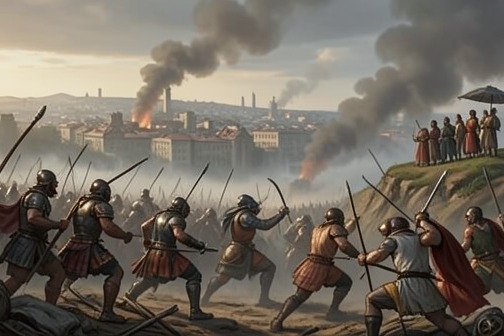
[Rama and Ravana's War in Lanka](entity:event-recall-event-3e699a957e0d) is the decisive conflict celebrated by the Rāmáyan: [Rama](entity:character-recall-character-rama-fdac9c17dd0c)’s expedition is directed against the [Rākṣasas](entity:organization-recall-organization-r-k-asas-b45e1d3ef2f9), and the main epic reaches its conclusion with his return to [Ayodhya](entity:location-recall-location-ayodhya-ef190b6473a9) and coronation. The supplied passages frame the war in two different ways. The narrative’s account links it to the histories of [Lanka](entity:location-recall-location-lanka-4b3ac7e9a824) and the Rākṣasa lineages; a later commentary argues that the epic preserves a historical conflict beneath mythic exaggeration. That interpretation is a commentator’s thesis, not an independently established account of the war’s historical reality.
## Place in the Epic
The commentary describes the Rāmáyan as epically complete when Rama and his rescued queen return to Ayodhya and he is consecrated and crowned in the capital of his forefathers. It treats the conclusion of the sixth book, with its account of Rama’s happy reign and its blessing for readers and hearers, as evidence that the poem was already regarded as finished before the final book was added.
The Uttarakāṇḍa is accordingly characterized there as an appendix or supplement. Its events precede or follow those narrated in the main poem, rather than supplying the necessary ending to an unfinished war story. The commentary notes a division of scholarly and traditional opinion: it regards the last book as later than [Válmíki](entity:character-recall-character-v-lm-ki-6e665def9561)’s work, whereas Indian scholars, out of reverence for tradition, attribute it to Válmíki and count it as part of the Rámáyan. This distinction matters for the war’s place in the whole: the victory and homecoming form the epic’s own closure, while the appended material extends the history around that completed arc.
## Lanka and the Rākṣasa Background
After Rama has returned to Ayodhya and taken possession of the throne, the [Rishis](entity:character-recall-character-rishis-2e1ff8964841) assemble to greet him. In response to Rama’s questions about his former enemies, [Agastya](entity:character-recall-character-agastya-57db2c7eeb00) recounts the ancestry and earlier history associated with Lanka. His account supplies a deep prehistory for the conflict rather than a description of its battles.
Agastya relates that [Pulastya](entity:character-recall-character-pulastya-a738f3cdd5b7), a son of [Brahmá](entity:character-recall-character-brahm-8b6ab0d9402f), fathered [Viśravas](entity:character-recall-character-vi-ravas-fbce43951a2c), whose son Vaiśravaṇ-[Kuvera](entity:character-recall-character-kuvera-f257d27e2149) became a guardian of the world and the god of riches after obtaining a boon from Brahmá. On his father’s advice, Kuvera took possession of Lanka, a city built by [Viśvakarmá](entity:character-recall-character-vi-vakarm-1aea8b792d3f) for the Rākṣasas and abandoned by them through fear of [Vishnu](entity:character-recall-character-vishnu-4fe080f11b04). Rama is surprised to learn that Lanka had belonged to the Rākṣasas before Kuvera’s occupation; the account therefore complicates his previous understanding of their ancestry and of the island’s past.
Agastya also traces another Rākṣasa lineage to beings formed when Brahmá created the waters, some of whom were assigned to guard them. Heti and Praheti are named as the first Rākṣasa kings. The account then follows their descendants, including Sukeśa and his sons [Mályavat](entity:location-recall-location-51a543361e56), Sumáli, and Máli. After the brothers undertake intense austerities, Brahmá grants them invincibility and long life; they then harass the gods. Viśvakarmá provides them with Lanka on Mount Trikúṭa, beside the southern ocean. The story thus presents the island and its rulers as the outcome of repeated changes in possession, divine favors, and conflict, giving Rama’s later campaign a history that precedes his own arrival.
## The War as Historical Interpretation
A separate passage presents Signor Gorresio’s interpretation of the epic’s subject. He argues that a hostile people lived in Lanka and the southern islands, and that Rama’s expedition, as celebrated in the poem, was directed against them. Gorresio proposes that the Sanskrit name Rākṣasa was applied to this people as a hostile designation and that epic tradition transformed its human opponents into giants and other monstrous, shape-changing beings. These are claims within a nineteenth-century historical reading, not neutral facts established by the narrative passages.
Gorresio points to features he considers traces of a human population beneath the mythic portrayal, including descriptions of dark coloring, distinctive hair and lips, and the wearing of gold ornaments. He also interprets the Rākṣasas’ opposition to Aryan rites and sacrifices as evidence of a religious and cultural conflict. In his account, the epic’s supernatural imagery magnifies an underlying struggle; he therefore regards the war’s substance as historical while acknowledging that myth has altered its natural appearance. The commentary’s language reflects the racial theories of its period, including its identification of the people as Hamitic. That terminology belongs to Gorresio’s argument and should not be mistaken for a conclusion demonstrated by the epic itself.
## Meaning and Limits of the Evidence
The war joins two kinds of explanation: Agastya’s mythic genealogy makes Lanka’s rulers part of an ancient sequence of creation, descent, austerity, and divine favor, while Gorresio’s preface attempts to read the campaign as a memory of human conflict. The first explains the Rākṣasas’ place in the epic’s sacred and dynastic history; the second seeks a historical substrate beneath the poem’s supernatural transformations. Neither supplied passage gives a detailed account of the war’s military course, so its commanders’ tactics and the sequence of its engagements cannot be reconstructed from this evidence alone.
The commentary also places Rama’s victory within a wider tradition of remembered struggles between Aryans and Rākṣasas. It refers to Puranic legends in which Kárttavírya, a descendant of the Yádava royal line and a contemporary of Paraśuráma, attacked Lanka and captured [Ravana](entity:character-recall-character-ravana-f2652ae52080). Gorresio uses this parallel to argue that the idea of conflict was deeply rooted in tradition. As presented, it is an additional legendary precedent, not an episode of Rama’s own campaign.
In the epic’s structure, the war is both the central confrontation and the threshold to restoration: its decisive significance lies in Rama’s eventual return and coronation, which close the main narrative. The appended book and the later historical reading reopen the story in different ways—one by extending the characters’ histories beyond that ending, the other by asking what kind of past the myth may preserve.
Event 153
Sita's Ordeal by Fire
[Sita's Ordeal by Fire](entity:event-recall-event-474b3982168b) is presented both as a test of [Sítá](entity:character-recall-character-s-t-0be56374418b)’s faith and as the turning point that exposes a deeper conflict over how [Ráma](entity:character-recall-character-r-ma-2db51e45ae4a) is understood. Ráma explains that [Rávaṇ](entity:character-recall-character-r-va-06a1d00141e6)’s successful deception has stirred suspicion among his people; the gods, in turn, question why Ráma has allowed Sítá to undergo the ordeal without recognizing his own divine identity. [Brahmá](entity:character-recall-character-brahm-8b6ab0d9402f)’s revelation resolves that tension by identifying Sítá with [Lakshmi](entity:character-recall-character-lakshmi-4d9520b17871) and Ráma with [Vishṇu](entity:character-recall-character-vish-u-50c288dea3c5), whose human incarnation has fulfilled the gods’ purpose of defeating Rávaṇ.
## The ordeal and the people’s doubt
Ráma’s account gives the ordeal a public consequence. He describes Sítá as having been tested by fire, then connects the need for her vindication to the suspicion that Rávaṇ’s deception has raised in the hearts of his people. His appeal is not simply that her faith be recognized privately: he asks that doubt about her be removed and that Sítá and her sons be restored to him. The scene thus ties the ordeal to the standing of the royal household before its community.
The passage does not dwell on the physical circumstances of the test. Instead, it presents the ordeal through what it has come to mean: Sítá’s faith has been tested, yet suspicion remains among the people. That distinction gives the event its unresolved pressure. The test is named as proof, but Ráma’s words show that proof alone has not ended public doubt. His request for restoration makes clear that the ordeal’s consequences reach into family life as well as the kingdom’s judgment of its queen.
## The gods challenge Ráma
The divine address shifts attention from Sítá’s ordeal to Ráma’s response to it. Brahmá asks how one who is creator and lord of the world can allow Sítá to fall into the fire, and how he can fail to know himself as the foremost of the gods. The challenge treats Ráma’s apparent uncertainty not as a minor misunderstanding but as a question demanding an account of his identity.
Ráma answers by describing himself as a man named Ráma, the son of [Daśaratha](entity:character-recall-character-da-aratha-ffdd8279512e). From that human understanding, he asks Brahmá to tell him who he is and where he has come from. The contrast is central to the scene: Ráma’s reply places him within a recognizable human lineage, while the divine address insists that his identity exceeds it. The exchange makes the ordeal a threshold between the human story of Sítá’s vindication and a cosmic explanation of the purpose behind Ráma’s life.
## Brahmá’s revelation
Brahmá identifies Ráma as Náráyaṇa and names him through a succession of divine and cosmic forms. The account describes him as creator and destroyer, truth and intelligence, and as the encompassing reality in which the world and its material forms exist. Its accumulating identifications answer Ráma’s question by making his human identity one aspect of a much larger divine nature.
The revelation also establishes Sítá’s place within that cosmic account. Brahmá identifies her as Lakshmi and Ráma as Vishṇu, and explains that Ráma assumed human form in order to kill Rávaṇ. The defeat of Rávaṇ is therefore described as the completion of a task imposed by the gods, not merely the outcome of a personal conflict. The ordeal and its divine interpretation meet at this point: Sítá’s faith is affirmed, while the scene reveals the larger purpose served by Ráma’s human life.
## Consequences and significance
The passage holds together two different kinds of recognition. Ráma speaks from the position of a human son of Daśaratha, concerned that his people continue to doubt Sítá; Brahmá answers from the perspective of divine knowledge, declaring Ráma’s cosmic identity and Sítá’s connection with Lakshmi. Neither strand cancels the other. The public consequences of the ordeal remain part of the account even as the revelation places the principal figures within a divine order.
Brahmá’s address also points beyond the immediate exchange. With Rávaṇ slain and the gods’ task complete, Brahmá tells Ráma that, after a period of rule in [Ayodhyá](entity:location-recall-location-ayodhy-08bd0b6815c4), he may go to paradise. The episode thereby joins the personal demand for Sítá’s restoration to the wider completion of the divine mission. The accompanying prayer and divine account are also presented as having a devotional afterlife: those who recite them are promised that they will not suffer defeat. In this framing, the ordeal becomes not only a crisis of trust within the story but a moment through which the epic asserts Ráma’s divinity and invites its audience to remember it.
Event 154
Ravana's Funeral Rites
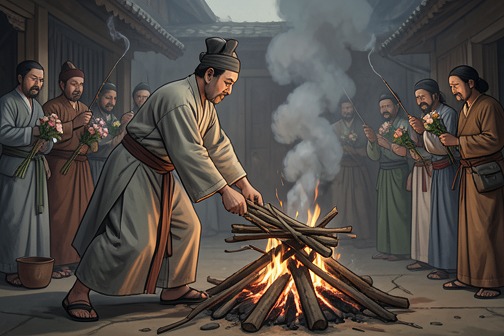
[Ravana](entity:character-recall-character-ravana-f2652ae52080)’s funeral is a carefully ordered funerary rite in which [Vibhishana](entity:character-recall-character-vibhishana-48b5fde5e908) helps honor the dead king and applies fire to his pyre. The account makes the transition from defeat to burial visible through materials, offerings, and gestures of mourning, while an accompanying commentary draws attention to the poem’s presentation of Brahmanical ritual among the [Rakshasas](entity:creature-recall-creature-358c637738a5).
## Sources and Ritual Context
The surviving description is presented in an editorial note rather than as a fully detailed account in the poem itself. The commentator says the funeral ceremonies are not described fully enough to explain them with certainty, then supplies Mr. Muir’s translation of the Calcutta edition. That distinction matters: the translated passage offers a specific sequence of rites, while the note cautions that the larger account leaves aspects of their performance unclear.
The same commentary describes a three-fire arrangement in Indian funerals: the Dakshina fire to the south, the Garhapatya to the west, and the Ahavaniya to the east. It uses this ritual context to observe that the poem assigns the funeral ceremonies of Aryan Brahmans to the Rakshasas, whom it describes as different in origin and religion. The note compares this literary transfer of ritual custom to Homer’s introduction of Greek religious rites into Troy.
## Preparation of the Pyre
In Muir’s translated account, the mourners construct a pyre from sandalwood and padmaka wood, with usira grass, and cover it with a quilt of deer’s hair. The funeral ground is arranged to the southeast, and the fire is placed in its prescribed position. These details present the funeral as a formal observance, shaped by the arrangement of its materials and ritual space rather than by fire alone.
The translated passage also records offerings and objects placed in relation to the body. A ladle filled with curds and ghee is cast upon Ravana’s shoulder; a car is placed at his feet and a mortar between his thighs. Wooden vessels, firewood, and a pestle are set in their proper places before the attendants depart. The translation itself marks one detail as uncertain, so the car’s placement is reported without resolving the source’s ambiguity.
## Offerings and Vibhishana’s Role
The rites continue with the sacrifice of a victim for Ravana, described as being performed according to the Shastras and the injunctions of great [Rishis](entity:character-recall-character-rishis-2e1ff8964841). The king’s coverlet, saturated with ghee, is then cast into the fire. The sequence gives the funeral both a public and a sacrificial character: the mourners honor the dead through prescribed offerings and the destruction of objects associated with him.
Vibhishana is explicitly included among those who adorn Ravana with perfumes, garlands, and varied garments, and sprinkle him with fried grain. After bathing, he scatters sesame seeds mixed with darbha grass and moistened with water, then applies fire to the pyre. His actions make him a central participant in the final rites, joining the preparation of Ravana’s body to the decisive act that begins the cremation.
## Significance of the Account
The funeral description gives ritual form to Ravana’s death: the body is adorned, offerings are made, and the pyre is lit through Vibhishana’s action. The rites do not erase the conflict that preceded the funeral, but they place the defeated king within a recognizable ceremonial order. The editorial comparison between Brahmanical practice and the Rakshasas’ funeral customs further emphasizes how the poem represents ritual across a boundary of origin and religion.
Event 155
Rama Sends Sita into Exile
[Ráma](entity:character-recall-character-r-ma-2db51e45ae4a)’s banishment of [Sítá](entity:character-recall-character-s-t-0be56374418b) turns a private knowledge of her innocence against the pressure of public opinion. What begins as a promised visit to hermitages on the [Ganges](entity:location-recall-location-ganges-13554a03c098) becomes an abandonment: Ráma sends his pregnant wife away, and the separation ultimately leads to her life at [Válmíki](entity:character-recall-character-v-lm-ki-6e665def9561)’s hermitage and her refusal of a second public test of her purity.
## Causes and Background
After the winter, Ráma and Sítá sit together beneath the Aśoka trees. Expecting a child, she tells him that she longs to visit the holy hermitages beside the Ganges, even if only for a day. Ráma agrees that she may go. The exchange is tender and apparently ordinary, but the journey she has requested will become the means by which he removes her from [Ayodhyá](entity:location-recall-location-ayodhy-08bd0b6815c4).
Public gossip supplies the cause of the reversal. People condemn Ráma for taking Sítá back after she had been held captive in [Rávaṇ](entity:character-recall-character-r-va-06a1d00141e6)’s palace. The account distinguishes their suspicion from Ráma’s own judgment: he knows her to be pure in thought, word, and deed, and knows her love for him. Yet he cannot endure the mockery and shame, and resolves to abandon her. His decision therefore does not arise from a discovery of wrongdoing; it is a choice made under the weight of public reproach despite his private certainty.
## The Decision and Separation
Ráma instructs [Lakshmaṇ](entity:character-recall-character-lakshma-7aad0629b677) to take Sítá to the hermitage she had asked to visit and leave her there. He also makes clear that he will see her no more. The plan turns her trust in the promised visit into a separation she does not anticipate: she travels toward the retreat believing she is going to fulfill her wish, and learns the truth only after she arrives.
Lakshmaṇ bears the immediate burden of telling her what has been decided. The episode contrasts his sorrowful obedience with Ráma’s resolve, while Sítá’s arrival at the hermitage marks the abrupt change from a shared domestic life to exile. The decisive loss is not simply her departure from the city; it is the collapse of the future she had imagined when Ráma granted her request.
## Sítá’s Response and Refuge
When Lakshmaṇ tells her, Sítá falls fainting. On recovering, she weeps and mourns the injustice of her fate. She nevertheless resolves to live for Ráma and for the child she is carrying. Her response holds grief and continued attachment together: although she has been cast off, she does not answer with rejection of him.
She sends Lakshmaṇ back with a composed message. She says that the cause of her abandonment is what people say, not any wrongdoing of hers, and expresses her understanding that a wife should follow what her husband considers right. The account presents this as the position she communicates, while making the circumstances of her suffering unmistakable: her fidelity persists even when Ráma’s confidence in her has not protected her from his decision.
Válmíki receives Sítá with honour, and the women of the hermitage are charged with caring for her. In that retreat she gives birth to [Kuśa](entity:character-recall-character-ku-a-080b9ea19afc) and [Lava](entity:character-recall-character-lava-58c876878914). Válmíki brings the boys up and teaches them to recite the poem recounting Ráma’s deeds. The hermitage thus becomes both her refuge after exile and the place where Ráma’s own story is preserved by sons whose parentage he has yet to recognize.
## Later Consequences
Years later, Válmíki attends Ráma’s [Aśvamedha](entity:concept-recall-concept-a-vamedha-1cfd0736948c) with the two boys. They recite the poem before their father, who asks about their history and recognizes them as his sons. Sítá is then invited to return and affirm her innocence before the assembled people. Her exile has therefore not ended with refuge: the demand for public vindication returns, now in the presence of the children born after her abandonment.
Sítá cannot submit to another ordeal. Instead, she calls upon Earth to grant her a place of refuge, affirming that her thoughts have remained true to Ráma. The earth opens, a divine throne rises, and Earth receives her as she descends. This ending gives the exile a lasting consequence: although Ráma later discovers the truth of his sons’ identity and invites Sítá back, the public demand for proof ends not in her return to him but in her departure from the human assembly.
Event 156
The Birth of Kusha and Lava
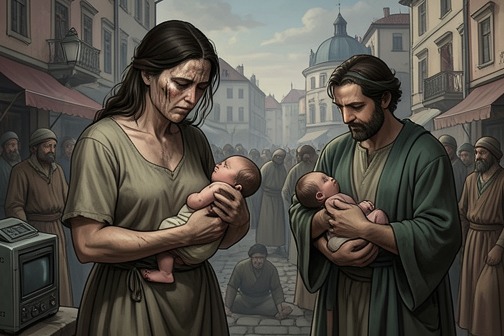
The birth of [Kusha](entity:character-recall-character-kusha-d5fb7b60cc28) and [Lava](entity:character-recall-character-lava-58c876878914) turns [Sítá](entity:character-recall-character-s-t-0be56374418b)’s banishment into the beginning of a new family and narrative inheritance. Born after their mother has been abandoned, the twins are sheltered by [Válmíki](entity:character-recall-character-v-lm-ki-6e665def9561), raised in his hermitage, and taught to sing the poem of [Ráma](entity:character-recall-character-r-ma-2db51e45ae4a)’s deeds. Their birth leads, years later, to a public recognition that reconnects the children with their father and brings Sítá’s fate before an assembly.
## Circumstances of the Birth
Sítá arrives at the hermitage after Ráma, though convinced of her innocence, decides to abandon her because of what the people say about her captivity in [Rávaṇ](entity:character-recall-character-r-va-06a1d00141e6)’s palace. The account presents her as unsuspecting of the decision until [Lakshmaṇ](entity:character-recall-character-lakshma-7aad0629b677) tells her what has happened. She grieves at the injustice, yet resolves to live for Ráma and her unborn child. Válmíki receives her with honour and entrusts the holy women of the hermitage with her care.
The poem then records the birth in a starkly brief line: that very night, the banished Sítá bears two children. The transition is consequential: the public judgment that has separated her from Ráma does not end her family, and the hermitage becomes the place where the next generation can grow beyond the reach of courtly scandal.
## Upbringing in Válmíki’s Hermitage
Válmíki takes a personal role in the twins’ upbringing. He performs the holy rites for them with the delight of a friend, and they receive the names Kusha and Lava. The account says that, even in childhood, they learn the lore of the Vedas. Their education joins sacred learning to artistic training: Válmíki teaches them to sing his own poem, the account of Ráma’s deeds.
This combination makes the hermitage more than a refuge for Sítá and her children. It is also a place of instruction and preservation, where the twins acquire the learning and performance skills that will carry their family’s history back into the royal world from which their mother has been cast out.
## The Poem as Inheritance
Kusha and Lava do not merely learn Ráma’s story as an account of another person’s life: it is also the story of their own parentage, though the poem describes their royal identity as not yet known to their father. Their singing brings that history into public space. Válmíki directs them to recite the heroic poem where sages and good people gather; later, they sing it in a royal hall, where Ráma happens to hear them.
The poem presents their performance as carefully shaped music. Its seven notes and triple measure are joined to melody, tone, and time; its emotional range includes tenderness, surprise, and contentment alongside other powerful feelings. Ráma’s deeds, sung by his own sons, offer Sítá comfort: the account says that their song allows her to forget her bitterest pain. The song thus serves at once as the twins’ education, their mother’s consolation, and the means by which the separated household’s history reaches Ráma.
## Recognition and Consequences
Years after the birth, Válmíki attends Ráma’s [Aśvamedha](entity:concept-recall-concept-a-vamedha-1cfd0736948c) with his two young pupils. The twins recite the poem before the delighted father, who asks about their history and recognizes them as his sons. The recognition changes their position from anonymous pupils of the hermitage to acknowledged members of Ráma’s family. It also makes Sítá’s presence an urgent question: she is invited to return and affirm her innocence before the assembled people.
That invitation leads not to a restored household but to a final public ordeal. Unable to submit to another test, Sítá calls upon the Earth goddess to receive her; the earth opens, and the goddess takes her away. The twins’ birth therefore brings Ráma’s children into recognition without repairing the harm done to their mother. Their lives preserve a bond between the royal family and the hermitage, while the song they learned from Válmíki makes that bond audible to the very court that had separated them.
Event 157
Kusha and Lava Recite the Ramayana at Rama's Horse Sacrifice
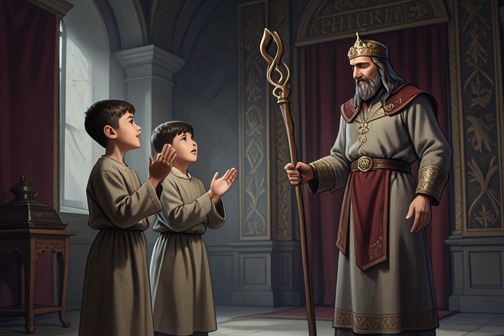
At [Ráma](entity:character-recall-character-r-ma-2db51e45ae4a)’s [Aśvamedha](entity:concept-recall-concept-a-vamedha-1cfd0736948c), the young singers [Kusha](entity:character-recall-character-kusha-d5fb7b60cc28) and [Lava](entity:character-recall-character-lava-58c876878914) recite the Ramayana before the king whose life it recounts. Their performance turns a royal ritual into an encounter with an unwritten family truth: Ráma recognizes his own likeness in the boys, and [Válmíki](entity:character-recall-character-v-lm-ki-6e665def9561) identifies them as his sons by [Sítá](entity:character-recall-character-s-t-0be56374418b). The recognition does not resolve the family’s separation. Instead, it brings Sítá before a public assembly for another affirmation of her innocence, a demand she refuses, ending the possibility of her return to Ráma.
## Setting and Circumstances
After Sítá has been abandoned in response to public suspicion, Válmíki receives her at his hermitage. The hermitage becomes the boys’ home: Sítá gives birth there to twins, Kusha and Lava, and Válmíki raises and teaches them. Among their lessons is the recitation of the Ramayana, the poem that tells of Ráma’s deeds. Their education thus joins personal history to public song long before the king knows who they are.
Years pass before Ráma determines to celebrate the Aśvamedha, or horse sacrifice. Válmíki attends the ceremony with the two pupils. The boys have already been singing the Ramayana as they travel through the land; at the sacrifice they sing before Ráma. This is not simply a private family meeting arranged in advance. The king encounters them as performers, and the story they recite reaches him through the public occasion of the rite.
The ritual setting gives the performance an unusual weight. The Aśvamedha is a royal sacrifice, but the scene’s decisive act is the telling of Ráma’s own story by children he does not yet recognize as his. The ceremony gathers king, sage, pupils, and nobles around a poem whose account of the past makes the hidden consequences of Ráma’s rule present before him.
## The Recitation and Recognition
Kusha and Lava sing the poem before the assembled listeners. Ráma is delighted by their song and observes their youthful forms. The nobles around him stand still and weep; those who praise the boys’ appearance notice that each bears Ráma’s likeness. The recognition first takes shape through performance and resemblance: the king hears his life rendered in verse, then sees his own features in the singers.
Ráma asks who taught them and who composed the remarkable poem. When Válmíki appears, the king bows his head in reverence. The sage answers the question of identity directly, telling Ráma that the boys are his children and urging him to recall Sítá, whom he declares pure and true. The scene therefore moves from an aesthetic response to an explicit disclosure. What begins as wonder at the song and its singers becomes knowledge of the relationship connecting them.
The recitation also presents the Ramayana as more than a record of events already completed. Its account of Ráma’s deeds is carried by the sons who were born during his separation from Sítá, and it brings those consequences into the king’s hearing. Válmíki’s pupils are at once singers of the poem and living evidence of the history it tells.
## Public Judgment and the Limits of Reunion
Ráma does not dispute Válmíki’s identification or Sítá’s purity. He explains that the arts of the demon had raised suspicions in the hearts of his people, and asks that their doubts be ended so that Sítá and her sons may be restored to him. His response distinguishes his own knowledge from the public judgment that has shaped his decision: he knows her innocence, yet still makes her return depend upon a public affirmation.
Sítá is summoned to affirm her innocence before the great assembly. This second ordeal follows the recognition of her sons, but it does not become a reunion. Rather than submit again, Sítá invokes the Earth as witness to her fidelity to Ráma. The Earth opens; a splendid throne borne by dragons rises, and the Earth goddess receives Sítá and carries her down. A shower of flowers falls as she disappears from the assembly. The event’s recognition is therefore inseparable from its loss: the sons are acknowledged, but their mother does not return to Ráma.
## Performance and Narrative Significance
The episode gives public recitation a role in both transmitting the poem and changing the characters’ understanding of one another. Earlier, Válmíki instructs his pupils to sing where sages gather and where kings assemble. At the Aśvamedha, that teaching comes to bear on Ráma himself: a poem carried from place to place reaches the ruler in a ceremonial setting, and its young performers disclose a truth that private knowledge alone had not made public.
The episode also places royal authority beside the consequences of public opinion. Ráma’s sacrifice gathers the court, but the song redirects attention from the ceremony to the family fractured by his response to popular suspicion. Válmíki’s identification offers a path toward acknowledging Sítá and the boys; Ráma’s request that the assembly be convinced nevertheless subjects Sítá to another test. Her refusal and descent make the ending decisive rather than restorative. The sons’ recognition resolves their uncertain place in Ráma’s family, while Sítá’s departure leaves the king’s desire to restore his wife unfulfilled.
Event 158
Sita Returns to the Earth
[Sítá](entity:character-recall-character-s-t-0be56374418b) Returns to the Earth is the final separation between Sítá and [Ráma](entity:character-recall-character-r-ma-2db51e45ae4a) in this account: after years apart and a reunion made possible by their sons, Sítá refuses a second public ordeal and is taken into the earth by its goddess. Her departure vindicates her innocence while making clear that recognition and reunion cannot restore the life she has lost.
## From the Hermitage to the Assembly
After Ráma abandons her because of what the people say, Sítá is received at [Válmíki](entity:character-recall-character-v-lm-ki-6e665def9561)’s hermitage. There she gives birth to [Kuśa](entity:character-recall-character-ku-a-080b9ea19afc) and [Lava](entity:character-recall-character-lava-58c876878914), who are raised and taught by Válmíki to recite the Ramayana. Their performance brings the story of Ráma’s deeds before Ráma himself: hearing the poem, he inquires into the young singers’ history and recognizes them as his sons.
The recognition leads to Sítá being invited to return and affirm her innocence before a great assembly. The invitation offers a public resolution, but it also requires her to undergo another test after the earlier suffering of separation. The scene’s stakes are therefore both personal and public: whether Sítá will be accepted as innocent, and whether that acceptance can restore her place beside Ráma.
## The Oath and the Earth’s Answer
Before the spectators, Sítá clasps her hands, bows her face, and speaks through tears. She calls on Mádhaví, the goddess of Earth, to grant her refuge if she has never, even in thought, considered anyone other than Ráma. The oath rests on her own knowledge of her fidelity; she does not ask the assembly to judge her conduct again.
At her appeal, the earth opens. A beautiful divine throne rises, carried on the heads of resplendent dragons, and the Earth goddess appears seated upon it. She welcomes Sítá, raises her onto the throne, and descends with her. Flowers fall from heaven as the queen disappears below. The marvel makes the earth itself the witness and recipient of Sítá’s appeal, turning a demand for human recognition into a supernatural acceptance.
## Consequence and Narrative Significance
Sítá’s departure resolves the question of her innocence without giving Ráma the reunion he has sought. The accompanying account emphasizes that she is too full of feeling to submit to this second ordeal and presents her conscious purity as resisting the demand. Her vindication is thus inseparable from refusal: the assembly receives no further proof, while the goddess’s welcome supplies an answer beyond its authority.
The episode closes on loss rather than restoration. The account compares this ending with the Mahábhárata, where victorious brothers relinquish their hard-won throne, and with tragic departures in the Iliad and the story of Ulysses. It further suggests that such sorrowful endings were later additions to heroic traditions. Within Sítá’s story, however, the final movement is sharply personal: after the recognition of her sons and the prospect of return, she leaves the human world, and Ráma loses her again.
Event 159
Lakshmana Gives His Life to Keep Rama's Promise
[Lakshmana](entity:character-recall-character-lakshmana-1b97114243c1)’s death is the consequence of a promise made under an impossible condition: [Rama](entity:character-recall-character-rama-fdac9c17dd0c) must keep the private audience demanded by Time, yet a visitor’s interruption threatens death to whoever witnesses it. When [Durvasa](entity:character-recall-character-durvasa-eee8653987e1) arrives and insists on seeing Rama at once, Lakshmana chooses to break the boundary and bear the consequence himself, sparing Rama and his family from the sage’s threatened curse. His death is therefore an act of protection and fidelity, not a battlefield defeat.
## The condition of the private audience
Time comes to Rama’s palace in the form of an ascetic, as a messenger from [Brahma](entity:character-recall-character-brahma-39f8aa187fff). He tells Rama that their conversation must be private and that anyone who witnesses it must lose his life. Rama admits Time and instructs Lakshmana to stand guard outside, making the danger of entry explicit before the crisis begins.
Time’s message also places the demand in a larger divine history. He recounts that Brahma asked Rama, who had become [Vishnu](entity:character-recall-character-vishnu-4fe080f11b04) to preserve the worlds, to take birth and destroy [Ravana](entity:character-recall-character-ravana-f2652ae52080). Rama had resolved to live on earth for ten thousand and one hundred years; Time now says that this period is nearing its end. Rama answers that he will return to the place from which he came, having fulfilled the gods’ purpose.
## Lakshmana chooses to interrupt
While Rama and Time are speaking, Durvasa arrives and demands immediate admission. He threatens to curse Rama and the whole family if he is refused. Lakshmana must choose between allowing that danger to fall on his kin and violating the condition whose penalty he already knows. He enters the palace and reports the sage’s demand to Rama, accepting that his own life will be forfeit.
Rama comes out, and Durvasa receives the food he wants and departs. The immediate threat is averted, but the private audience has been interrupted: the condition imposed by Time now requires Lakshmana’s death. The episode turns on the cost of a protective act. Lakshmana saves his family from Durvasa’s curse, but does so by making himself the one who must pay for breaking the promise.
## Abandonment and ascent
Rama is deeply distressed by the consequence. Lakshmana, however, urges him not to grieve and not to break his promise on his account. The counsellors agree with this counsel. Rama abandons Lakshmana, fulfilling the condition through a formal severance rather than by killing him in combat.
Lakshmana goes to the [Sarayu](entity:location-recall-location-sarayu-7e84ea23f33a), stilling his senses. [Indra](entity:character-recall-character-indra-9cdc4e2c85c7) carries him bodily to heaven, where the gods rejoice at the arrival of the fourth part of Vishnu. The ending presents his departure as both the mortal consequence of Rama’s promise and a return to divine existence; the act that appears to be a loss is also his ascent.
## Consequences for Rama’s departure
After Lakshmana’s ascent, Rama resolves to install [Bharata](entity:character-recall-character-bharata-72e56a1f79da) as his successor and retire to the forest, following his brother. Bharata refuses the succession and decides to accompany Rama instead. Rama’s subjects, too, grieve and say they will follow him. Lakshmana’s death thus becomes the immediate hinge between the end of the brothers’ rule and Rama’s own great departure from the capital.
Event 160
Rama's great departure into the Sarayu
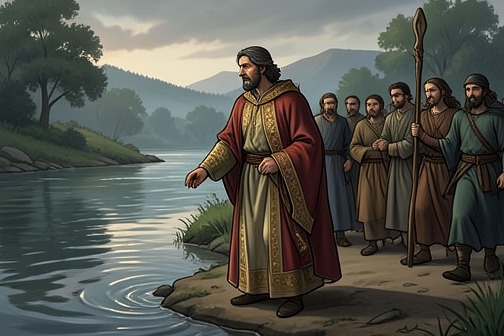
[Rama's great departure into the Sarayu](entity:event-recall-event-7be4299c6751) is the final passage of his earthly career in the account of the Uttarakanda. It begins with a conflict between a binding promise and the life of [Lakshmana](entity:character-recall-character-lakshmana-1b97114243c1), then expands into a collective procession from the capital to the river. [Rama](entity:character-recall-character-rama-fdac9c17dd0c) enters the water and is received as [Vishnu](entity:character-recall-character-vishnu-4fe080f11b04); the people who have followed him are granted a celestial dwelling, so his departure becomes both a divine return and the end of a shared earthly journey.
## The Promise and Its Cost
Time comes to Rama's palace in the form of an ascetic, bearing a message from [Brahma](entity:character-recall-character-brahma-39f8aa187fff). The message identifies Rama with Vishnu and explains that his earthly incarnation had been undertaken to destroy [Ravana](entity:character-recall-character-ravana-f2652ae52080) and deliver mankind. The appointed span of that life—ten thousand and ten hundred years—is nearly complete. Rama may prolong his stay or return to heaven, and he chooses to return, describing this as fulfilling the gods' purpose.
The meeting must remain private: anyone who witnesses it is to die. Rama tells Lakshmana to guard the entrance, but the sage [Durvasa](entity:character-recall-character-durvasa-eee8653987e1) arrives and demands immediate access, threatening a curse against Rama and his family if refused. Lakshmana chooses to interrupt the private audience rather than expose his kinsman and the household to that threat, although he knows the interruption will cost him his own life.
Once Durvasa has received the food he sought and departed, Rama confronts the consequence of the promise. His counsellors agree that it must be kept. Lakshmana urges Rama not to grieve or break his word on his account, and Rama abandons him. Lakshmana goes to the [Sarayu River](entity:location-recall-location-sarayu-river-7deb17947725), stills his senses, and is carried bodily to heaven by [Indra](entity:character-recall-character-indra-9cdc4e2c85c7). The gods welcome him as the fourth part of Vishnu. The great departure thus begins not with a public ceremony but with a private loss that Rama cannot undo without violating his pledge.
## From Succession to Procession
After Lakshmana's departure, Rama resolves to install [Bharata](entity:character-recall-character-bharata-72e56a1f79da) as his successor and retire to the forest. Bharata refuses the succession and chooses to accompany his brother instead. Messengers summon [Śatrughna](entity:character-recall-character-atrughna-60f42e73f771), who also decides to go with Rama. The people, grieving at the prospect of losing their king, declare that they too will follow him wherever he goes.
Rama sets out from the capital in a formal procession. He is described as silent, joyless, and indifferent to what lies around him. The company gives the departure its public and ceremonial scale: Bharata and his family follow, as does Śatrughna; Brahmins carry the sacred fire; and the people of the country travel with them, along with animals. The procession also gathers sacred presences around Rama: Śrí walks at his right, Earth at his left, and Energy before him, while his weapons appear in human form and the Vedas are represented as Brahmins. The Gáyatrí, Omkara, and Vashaṭkára accompany the rishis, women, attendants, and servants.
## The [Sarayu](entity:location-recall-location-sarayu-7e84ea23f33a) Crossing and Divine Return
The procession reaches the banks of the Sarayu River, where Brahma appears with the gods and innumerable celestial cars. The sky shines with divine radiance; fragrant breezes blow and flowers fall. Against this celestial display, Rama enters the river. Brahma welcomes him as Vishnu and names his arrival a return to his own divine being, not merely the end of a human life.
Rama's final concern is for the people who have followed him out of devotion. He asks Brahma to find them a place to dwell, and Brahma grants them a celestial residence. The conclusion therefore extends beyond Rama's own return: his followers are not left behind as an abandoned crowd, but are included in the passage from the earthly world to a divine home.
## Significance of the Departure
The episode joins the consequences of a promise to the fulfilment of a divine mission. Rama's choice to return comes after the appointed period of his incarnation has nearly elapsed, yet the immediate crisis is ethical and personal: keeping the private-audience condition requires Lakshmana's abandonment. The narrative makes Rama's departure inseparable from that painful cost, rather than presenting apotheosis as an untroubled escape from mortal obligations.
Its scale then changes from the solitary fate of Lakshmana to a whole community's act of following. Royal succession is offered and refused; the brothers and subjects converge on the same route; and sacred symbols, household attendants, and animals join the procession. At the Sarayu, the king's departure becomes a collective transition, while Brahma's grant of a celestial dwelling answers the loyalty that brought the people after him.
Event 161
Rama’s coronation after returning to Ayodhya

[Rama’s coronation after returning to Ayodhya](entity:event-recall-event-501177c005d6) is the decisive public completion of the epic’s main story: [Rama](entity:character-recall-character-rama-fdac9c17dd0c) returns with his rescued queen and is consecrated in the capital of his forefathers. The coronation closes the movement from separation and conflict to restoration, while the poem’s account of the reign that follows gives the return its larger promise of just and lasting rule.
## Return and Consecration
The poem describes its principal narrative as epically complete with Rama’s triumphant return to [Ayodhya](entity:location-recall-location-ayodhya-ef190b6473a9) and the consecration and coronation of the king in his ancestral capital. The coronation is not presented as an isolated ceremony: it follows the victory that recovers his queen and restores him to the city. Its significance lies in joining personal return to political restoration, bringing the epic’s central action to a formal close.
The narrative’s conclusion also looks beyond the act of consecration. The final canto of Book VI speaks of Rama’s glorious and happy reign and promises blessings to those who read or hear the poem. In this framing, the coronation inaugurates an idealized period of rule and supplies the victorious return with a future, rather than ending only with the defeat of an enemy.
## The Ending and the Appendix
The text distinguishes this ending from the Uttarakanda, or Last Book, which it characterizes as an appendix or supplement recounting events before and after those in the original poem. Its account argues that the main epic was already complete at Rama’s return and coronation; even the final canto of Book VI, though described as evidently the work of a later hand than [Válmíki](entity:character-recall-character-v-lm-ki-6e665def9561), treats the happy reign and the poem’s blessings as a sufficient conclusion.
The attribution remains a matter of tradition as well as textual judgment. Indian scholars, motivated by reverence for tradition, unanimously attribute the Last Book to Válmíki and regard it as part of the Ramayana. The coronation therefore occupies a distinctive position: it is the close of the epic’s central arc even as the received larger work continues beyond it.
## Public Remembrance and Performance
The return also became the subject of annual public performance. In many cities of Northern India, the [Bharat](entity:character-recall-character-bharat-6395f3ef7f4e)-Milap, or meeting with [Bharata](entity:character-recall-character-bharata-72e56a1f79da), forms the closing scene of a dramatic celebration of Rama’s victory and return, held in October. The Rám-Lalá is performed outdoors over fifteen successive days, with one day’s break. This reenactment centers on the brothers’ meeting, not on the coronation itself, but it carries the same return narrative into communal memory.
At Benares, three performances take place at nearly the same time: one near the Maharajah’s palace at Ramnaggur, another near the Missionary settlement at Sigra and elsewhere in the city, and a third at Chowká Ghát near the College, organized by leading residents. The meeting scene draws crowds into streets, squares, balconies, and rooftops; elephants with silver and gold howdahs, jeweled turbans, falling flowers, music, and public cries of joy turn the story’s reunion into a civic spectacle.
## Recitation and the Epic’s Afterlife
The poem’s life beyond its written conclusion is also tied to recitation. Válmíki directs its singers to perform the heroic song in tranquil places frequented by sages and in the seats of kings and crowded halls. Those contrasting settings—quiet retreats and public courts—show how the epic’s account of return could circulate among different audiences.
The coronation gives that circulation a natural point of closure: the rightful king is restored, and the epic can be heard as a completed account of victory and renewed rule. Yet the performance tradition extends the ending beyond the page. In the annual Bharat-Milap, the public gathers not simply to recall a finished story but to witness its return scene enacted again.
Event 162
Shiva destroys Daksha's sacrifice
[Shiva destroys Daksha's sacrifice](entity:event-recall-event-a6f7f0334309) in a mythic episode where an elaborate public feast turns into a violent reckoning. [Daksha](entity:character-recall-character-daksha-37bd37820a11)'s exclusion of [Shiva](entity:character-recall-character-shiva-a32afbfe6397) and [Umá](entity:character-recall-character-um-7acf9e29f2b3) gives the conflict its shape: ritual hospitality gathers the gods, but the absent couple's rupture with the host breaks the ceremony apart. Umá's death in the fire is followed by Shiva's terrible manifestation, the flight of the assembled gods, and the destruction of the rites.
## The Feast and Its Exclusion
Daksha holds a mighty feast at the gates of [Gangá](entity:location-recall-location-gang-9009c842330c). Its abundance is deliberately public and ordered: milk, curds, and butter are prepared, gifts are provided for the Brahmins, and food is set out for the poor. Daksha calls the gods, and they gather together. The poem stresses the exception to that universal assembly: Umá and her lord Shiva are missing. Their absence is not a small omission from an otherwise complete guest list; it is the division around which the episode turns.
The scene briefly brings Umá and Shiva into conversation about the sacrifice. The surviving lines establish her as Daksha's daughter and show her speaking to her lord, while a remark attributed to Daksha is heard by her. The account does not supply enough of the exchange to reconstruct every argument or the precise terms of the slight. It does make the sequence plain: an insult within a family gathering becomes a public and sacred rupture. The feast's lavish provisions cannot compensate for the exclusion at its center.
## Umá and the Sacred [Fire](entity:character-recall-character-fire-b3a40eeb15fa)
On hearing Daksha's words, Umá is overcome by sudden passion. Her eyes flash with fury; speechless in anger, she hurls herself into the holy fire. The gesture changes the scene from a dispute over invitation and honor into an irreversible act within the sacrificial space itself. The fire prepared for ritual becomes the place where Daksha's daughter dies, and the ceremony can no longer proceed as the ordered offering Daksha intended.
The poem then renders wrath as a visible, supernatural force. A lurid flame appears, described as Umá's wrath incarnate, and fiendlike forms spring up by the thousands at its side. This transition joins personal grief to collective destruction: the account moves from one woman's response to a power that overwhelms the gathering. It does not describe an ordinary confrontation between opposing armies. Instead, the sacrificial setting itself becomes the stage on which divine anger takes form and turns against the feast.
## The Sacrifice Is Broken
The gods, distracted by the eruption, turn and flee. Hymns and chanting fall silent; priests are mocked and spurned; food is defiled and scattered. Each detail reverses the feast's opening order. The chanting that had accompanied the gathering stops, the officiants lose their authority, and food meant for communal and ritual use is spoiled. The destruction is therefore both physical and ceremonial: the preparations remain present, but their purpose and discipline have been overturned.
In the confusion, the pursuing Rudras strike away a head. The following lines place Daksha prostrate and dismayed before Shiva, so the head-striking belongs to the violent climax of the sacrifice's ruin. The episode does not linger over the mechanics of that blow. Instead, it turns quickly from the broken rite to Daksha's submission and appeal. The power that has shattered the feast is also the power before which its host must acknowledge defeat.
## Appeasement and the Episode's Meaning
The ending does not leave the scene at the height of destruction. The broken altars shine with Shiva's form, and his blessing soothes the storm. His anger ceases, though the poem adds that it will arise again; the close thus presents divine wrath as checked rather than erased. The surviving passage also begins an image of a deer's head, but does not provide enough detail here to explain its full significance. What it does preserve is the change in the ceremony's outcome: devastation gives way to a blessing, without restoring the feast to its original condition.
An accompanying note offers an explicitly interpretive reading of the episode. It calls the subject a favorite of Hindu sculpture, particularly on temples of Shiva and at the caves of Elephanta and Ellora, and proposes that the myth allegorizes a contest between Shiva's followers and worshippers of the Elements, associated in the note with the older ritual of the Vedas. That reading belongs to the book's commentary, not to a motive stated by the characters in the poem. Set beside the narrative, it draws attention to the conflict's ritual stakes: the feast convenes the gods and sustains priestly ceremony, yet the omission of Shiva and Umá exposes the limits of that formal order. The rite's collapse makes the episode at once a family rupture, an assault on sacrificial authority, and a story of Shiva's power to end the turmoil he unleashes.
Event 163
King Shibi Gives His Flesh to Save a Dove
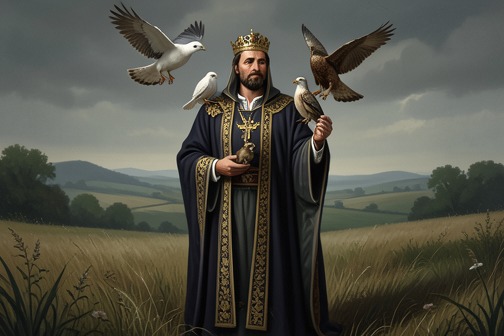
[King Shibi Gives His Flesh to Save a Dove](entity:event-recall-event-c9f17ab89b1e) is a tale of refuge and self-sacrifice: when a hawk pursues a dove into the king’s protection, [Shibi](entity:character-recall-character-shibi-5f0de454bce7) ultimately offers his own flesh rather than abandon the bird. The story makes the protection of the weak a test of kingship, and its ending joins that earthly act to heavenly reward.
## The Pursued Dove and the King’s Promise
The book introduces the episode as a free version of an ancient story that appears more than once in the Mahabharata. Its king, identified as Śaivya, has previously made a promise to a hawk. The action then turns on the arrival of a dove, pursued by the hawk and described as weary, its wing worn from flight. It comes to the king’s hand for safety: the endangered bird’s appeal places the ruler’s promise and his duty of protection in the same scene.
## The Bargain and the Test of Protection
The king first offers other prey: a cow or deer, or a ram or lamb, that could satisfy the hawk without sacrificing the dove. The hawk answers that its hunger follows Heaven’s decree: falcons feed on doves. It then sets the terms of a sharper test, asking the king to put his own flesh in the balance against the bird if compassion has truly stirred him. The conflict is no longer simply between predator and prey; it has become a measure of whether royal protection can hold when it costs the protector himself.
The king cuts flesh from his side and places it on the scales. The effort does not settle the contest: the balance still stands against the dove, and he adds more, in heaps of flesh, sinew, blood, and skin. The scene presses the promise toward its bodily limit. Protection is not secured by a declaration or by substituting another victim; the king persists in paying with his own body, until the account has consumed nearly all that can be given.
## Divine Recognition and the Tale’s Charge
The spectacle brings the gods near, led by [Indra](entity:character-recall-character-indra-9cdc4e2c85c7). Their arrival marks the change from a king’s private ordeal to a deed recognized in the heavens; music sounds, and the wounded ruler is borne through the air to his celestial home. The tale says that the lord of Kashi wins heaven and deathless fame through this noble act.
That reward closes the story but also carries its demand outward. The king’s example is offered as a rule for anyone entrusted with power: when the weak seek protection, they are to receive it. The dove’s appeal thus becomes more than an occasion for royal generosity. It defines protection as a promise tested against self-interest, and the king’s willingness to suffer gives that promise its force.
## The Ordeal as Public Spectacle
The test is not presented as a quiet exchange between king and hawk: as Shibi’s flesh is piled onto the scale, the women’s cries reach the sky, and the earth trembles at the sight. These reactions enlarge the cost of his promise beyond the wound itself. The king’s body becomes the visible measure of the dove’s claim to protection, while the disturbance around him makes the ordeal a public and world-shaking demonstration of what that protection demands.
## Competing Claims, Not a Simple Contest of Good and Evil
The hawk’s appeal complicates the rescue: it presents feeding on doves as Heaven’s decree, so the conflict is not framed solely as a cruel predator against an innocent victim. The king’s offer of other animals acknowledges the hawk’s hunger but cannot resolve the competing claims, and the hawk insists that the protection of the dove be paid for from the protector’s own body. By making the king bear that cost himself, the tale turns royal justice into a choice between claims rather than a simple victory over an enemy. Its moral force lies in the scale of the king’s response: he preserves the vulnerable creature without denying the hawk’s stated need, and accepts the suffering that reconciliation requires.
Event 164
Bharat-Milap Festival
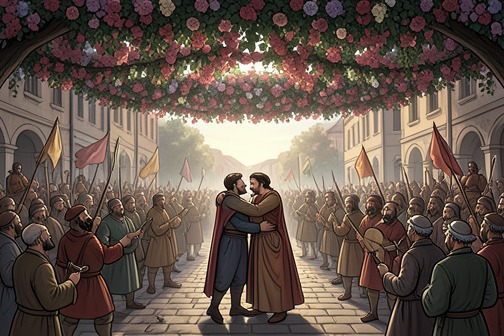
The [Bharat-Milap Festival](entity:event-recall-event-d9df660d9c28) is the annual public reenactment of the meeting between [Bharat](entity:character-recall-character-bharat-6395f3ef7f4e) and [Ráma](entity:character-recall-character-r-ma-2db51e45ae4a), staged as the closing scene of a dramatic celebration of Ráma’s victory and triumphant return. Its force lies in making the brothers’ reunion both the resolution of an epic story and a shared civic and devotional spectacle: the scene unfolds amid processions, music, flowers, and crowds filling the city.
## Place in the Performance
The meeting is identified as the concluding scene of the Rám-Lalá, the Play of Ráma. The drama is performed in the open air over fifteen successive days, with one day’s break, and the brothers’ reunion gives its extended account of victory and return a concentrated public climax. The festival’s timing is described as annual, in October, and its observance extends across many cities of northern India.
The epic also presents recitation as a public art. Its instructions call for the heroic song to be recited among sages and in places frequented by good people; elsewhere, singers perform it in a crowded royal hall, where Ráma happens to hear it. The poem describes its music through seven notes and triple measure, and names tenderness, surprise, and content among the emotions it can evoke. The festival’s staged reunion belongs to a related but distinct mode of transmission: rather than hearing the story alone, spectators gather to watch its climactic relationship enacted in public.
## Benares Performances
Benares is described as hosting three nearly simultaneous performances. The Maharajah of Benares provides one near his palace at Ramnaggur; the Maharajah of Vizianagram sponsors another near the missionary settlement at Sigra and at other locations in the city. A third is presented by the city’s leading gentry at Chowká Ghát, near the College. These multiple productions make the reunion a shared occasion without reducing it to a single court-sponsored ceremony: rulers and prominent citizens each support a public version of the drama.
## The Reunion as Public Spectacle
On the day when the brothers meet, the performance spills across the streets and squares. [Elephants](entity:creature-recall-creature-elephants-491be0a79b72) bearing silver and gold howdahs lead the procession, while magnificently dressed riders display jewels in their turbans. Thousands of spectators gather not only in the streets and squares but also on balconies and rooftops, turning the city itself into an audience space.
Flowers rain down on the advancing car as music and shouting accompany the procession. The account presents these details together—the decorated elephants, the elevated crowds, the shower of flowers, and the sound of collective celebration—as the means by which the brothers’ meeting becomes a memorable public event. The reunion is not simply represented before spectators; it draws their attention and participation into the movement of the spectacle.
## Significance
By reserving the brothers’ meeting for the drama’s closing scene, the festival makes reunion the public counterpart to the preceding story of victory and return. The celebration brings an epic resolution into the present through annual performance, while its several Benares productions show how the same scene can be supported by different civic patrons and encountered by a broad urban audience. Its distinctive image is one of collective welcome: a reunion carried through the city beneath flowers, amid music, and before spectators gathered throughout the streets and above them.
Event 165
Rama's birth
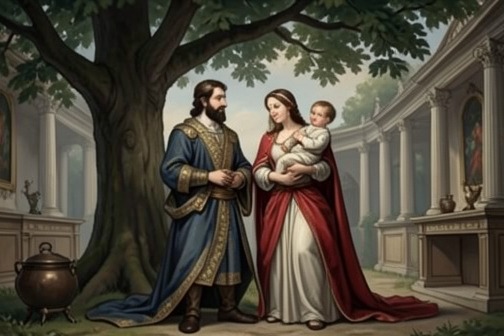
[Ráma](entity:character-recall-character-r-ma-2db51e45ae4a)’s birth fulfills a promise of four sons to the monarch and establishes the dynastic future around which the poem’s story turns. Its spring setting and the poem’s later astrological commentary give the event both a royal and a cosmic frame: the narrative presents a promised succession, while its annotations debate how the birth should be dated and understood.
## The [Spring](entity:time-recall-time-spring-5076a6d014bd) Sacrifice and the Promise of Sons
The poem marks the beginning of the sacrifice in spring, introducing the season as the setting for the royal hope of an heir. A later promise assures the monarch that he will have four sons to uphold his line. Together, these details place Ráma’s birth within a dynastic context, although they do not by themselves specify the circumstances of the birth or establish a direct causal link between the sacrifice and the promise.
## Birth Order and the Celestial Date
The commentary identifies [Chaitra](entity:time-recall-time-chaitra-30e052b692b1), the first of the two spring months, as the month intended for Ráma’s birthday and suggests that the poet had the vernal equinox in mind. It associates the birth with [Punarvasu](entity:time-recall-time-punarvasu-d806f3831c4d), the seventh lunar mansion, whose presiding figure the note identifies as [Aditi](entity:character-recall-character-aditi-74ada5fb0fb9), mother of the gods. The same annotation lists the Sun in Aries, Mars in Capricorn, Saturn in Libra, Jupiter in [Cancer](entity:time-recall-time-cancer-0cea32d0e74c), and Venus in Pisces. Rather than treating these positions as a settled historical calculation, the commentary leaves their consistency and dating to examination by astronomers.
The notes also clarify the order of the princes’ births. Although [Bharat](entity:character-recall-character-bharat-6395f3ef7f4e)’s birth is narrated before that of the twins, Schlegel’s annotation identifies him as the youngest of the four and places him eleven months after Ráma. The distinction makes the order of narration different from the inferred chronology of the brothers’ births.
## Chronology and Allegorical Meaning
The commentary sets the nativity at the boundary between the [Treta Yuga](entity:time-recall-time-treta-yuga-f545ffd9d6bf) and the [Dvapara Yuga](entity:time-recall-time-dvapara-yuga-589ed88070e5), but cautions that this placement may be allegorical rather than a literal chronological claim. It offers a different possibility: the poet may have been describing a configuration of the heavenly bodies associated with the age immediately before his own. Ráma’s birth thus carries two kinds of significance in the accompanying interpretation: it belongs to a royal succession narrative, and it invites debate over how celestial description relates to historical time.
Event 166
Dasharatha's Ashvamedha
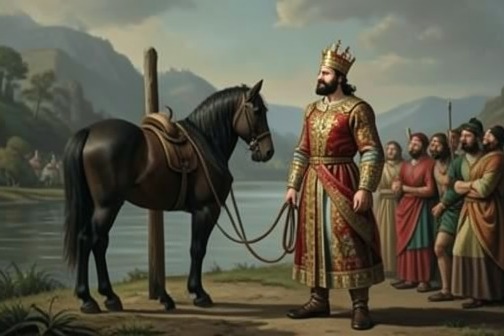
[Dasharatha's Ashvamedha](entity:event-recall-event-dasharatha-s-ashvamedha-df7e49f9851b) is a royal sacrifice whose completion joins exacting ritual observance to a public display of kingship. Its central object, a horse released to wander for a year and then brought back for sacrifice, makes the rite a test and proclamation of sovereignty as well as an offering to the gods. The account culminates on the northern bank of the [Sarjú River](entity:location-recall-location-sarj-river-95e6ed3aa40a), where ritual procedure, royal generosity, and a promise of heirs meet in the narrative.
## Royal Rite and the Year of Wandering
The sacrifice unfolds across a full year. The account marks the interval by saying that the circling year had completed its course and that the wandering horse had been brought back. The return is essential to the event's shape: the horse is not simply led to slaughter, but first released to roam for a prescribed period. An explanatory note says that this freedom was necessary as a sign that neighboring princes acknowledged the sacrificer's paramount sovereignty. The rite therefore gives a political meaning to the animal's year-long journey, even though the account does not specify its route or describe particular encounters along the way.
When the horse returns, the ceremony takes place on the northern strand of the Sarjú River. The location anchors the climax in a named landscape, while the completed year supplies its temporal boundary. Together, those details turn the return into a transition from a public assertion of authority to the sacrificial acts themselves. The text gives no account of individual neighboring rulers or their responses; the political significance is conveyed through the rule attached to the horse's wandering, not through a separate scene of submission.
## Prescribed Offerings and the Sacrificial Horse
The ceremony is represented as governed by scriptural prescription. The account says that three hundred victims were bound, and singles out the horse as devoted to the host of gods and honored as the most precious offering. It was sprinkled according to the ritual sequence, after which the queen was brought into the proceedings. The surviving passage identifies her place in the ceremony but does not describe the precise action she performed, so the account's emphasis remains on her formal participation and the horse's consecration.
The horse alone required a pile of cane. That distinctive provision sets it apart from the other victims and gives the rite a concrete material detail: the central offering has its own prescribed arrangement. The account also specifies that the Offering of the Steed lasted three days, making duration part of the ritual's formal order rather than treating the sacrifice as a single instant of slaughter.
Named rites extend the sequence beyond the central offering. The Chatushṭom began the ceremony; the account also places the Jyotishṭom and Áyus rites at night. These names, alongside the three-day duration and the prescribed treatment of the victims, present the sacrifice as a coordinated series of observances. The text repeatedly stresses conformity to Vedic law, making correct performance—not merely the scale of the offering—part of the event's significance.
## Public Provision and Royal Giving
The narrative connects ritual order with the condition of the people gathered around the royal event. It states that, throughout those days, no one was oppressed by hunger or distressed by toil. This is a specific description of the ceremony's public conditions, not simply a claim about the scale of the sacrifice: the passage links the observance to a temporary absence of deprivation and hardship. The rite's collective setting thus includes not only officiants and royal participants but a wider community whose well-being is made visible in the account.
After the rites are completed, [Dasharatha](entity:character-recall-character-dasharatha-b9552a8b18f7) bestows land in liberal grants. This act follows the sacrifice's prescribed observances and extends the event's effects beyond the altar. The account does not identify the recipients or quantify the grants, but its placement makes royal generosity an explicit part of the ceremony's conclusion. Sacred expenditure and material distribution stand together: the king offers to the gods, observes the ritual rules, and gives land in a public act of largesse.
## Completion and the Promise of Heirs
The canto marks the sacrifice as finished only after the year has run its course, the horse has returned, the three-day offering and associated rites have been performed, and the king has made his grants. This carefully ordered ending gives the event a sense of completion rather than reducing it to its climactic animal sacrifice. The rite's public and ritual dimensions are both necessary to the account's presentation of a successful royal observance.
The narrative then places a dynastic assurance close to that completion: a holy speaker tells Dasharatha that four sons will be his and will uphold his royal line. The promise is not itself a description of a ritual act, and the cited passage does not state that any single offering mechanically produces it. Its position nevertheless makes the transition significant. A ceremony centered on the return and offering of a horse ends within a narrative movement toward the continuation of the dynasty. The episode accordingly joins sovereignty, Vedic observance, public provision, and succession without collapsing them into the same claim.
Event 167
Death of Dasharatha
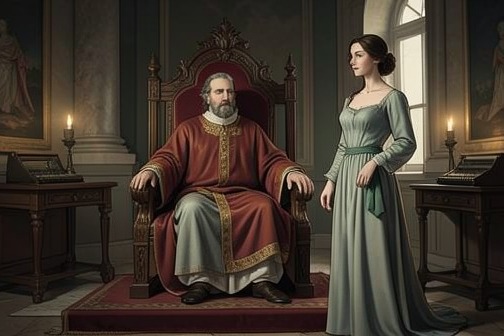
[Daśaratha](entity:character-recall-character-da-aratha-ffdd8279512e)’s death is a past event confirmed in an editorial note rather than presented here as a scene of dying. The note establishes that [Sítá](entity:character-recall-character-s-t-0be56374418b) had been told of his death and preserves a continuing bond between the dead king and his son: from heaven, Daśaratha still cares about [Ráma](entity:character-recall-character-r-ma-2db51e45ae4a)’s fortunes.
## Death as Established Background
The surviving evidence does not recount the circumstances, cause, or timing of Daśaratha’s death. Instead, it takes his death as known and refers to Sítá as having already received the news. The event therefore enters this passage as settled background, not as an action unfolding before the reader.
## Daśaratha’s Posthumous Concern
The note adds that Daśaratha, though in heaven, continued to take a loving interest in Ráma’s fortunes. His death ends his earthly presence but does not erase his paternal attachment; the account frames that attachment as persisting beyond death. This is the passage’s specific indication of Daśaratha’s posthumous relation to his son.
## Editorial Context and Limits
The statement occurs in a note discussing a rendering of Sítá’s words. The editor considers a translator’s substitution referring to their respective relations unnecessary, explaining that Daśaratha’s continuing concern for Ráma already accounts for the relevant reference. The note thus supplies a brief interpretive bridge between Sítá’s knowledge of the death and the dead king’s continuing concern, without giving a fuller account of either the death itself or how she learned of it.
Event 168
Descent of the Ganges

[Descent of the Ganges](entity:event-recall-event-descent-of-the-ganges-5163e0b1ceb8) is the mythic episode in which [Bhagiratha](entity:character-recall-character-bhagiratha-52c4008070aa) brings [Ganga](entity:character-recall-character-ganga-1ee81508ea3e) from heaven to earth. The book identifies it as a major legend in Book I, Canto XLIV; its significance lies in making the river’s arrival a consequence of a royal quest, while connecting the living landscape to the fate of [Sagara](entity:character-recall-character-sagara-419e97ec7220)’s dead sons.
## The legend and its place in the poem
The book’s notes direct readers to Book I, Canto XLIV for the full telling of the descent. A separate explanatory note identifies Ganga as Bhagiratha’s daughter, presenting the river not only as a force of nature but also as a figure within a royal and divine genealogy. The episode’s title names its central movement: Ganga comes down from heaven to earth.
## Bhagiratha and the descent
Bhagiratha is the human agent associated with bringing Ganga to earth and guiding her onward to the sea. The river’s descent therefore links celestial and terrestrial space through a purposeful journey. In the mythic account summarized by the book’s reference material, [Shiva](entity:character-recall-character-shiva-a32afbfe6397) receives and releases the descending torrent, mediating its passage to the world below.
## The connection to Sagara’s sons
The episode belongs to the larger story of Sagara’s sons, who were burned to ashes by [Kapila](entity:character-recall-character-kapila-49b2272d35c8) while searching for their father’s sacrificial horse. The descent of Ganga is linked to their fate: the river’s arrival turns the earlier episode of death and ash into part of a longer narrative of release. The legend thus connects Bhagiratha’s undertaking with the consequences of Sagara’s interrupted search.
## Narrative significance
The descent is both a cosmological event and a family story. Ganga’s movement from heaven to earth gives a divine dimension to the landscape, while Bhagiratha’s role makes that transformation the outcome of human purpose. Its placement in the opening book also gives the river’s myth a defined place in the poem’s account of sacred geography and royal ancestry.
Event 169
Samudra Manthana

[Samudra Manthana](entity:event-recall-event-samudra-manthana-04fcf4783b37), the Churning of the [Ocean](entity:character-recall-character-ocean-faa070d4a0c3), is presented through its divine treasures and the story of [Lakshmi](entity:character-recall-character-lakshmi-4d9520b17871)’s birth. The surviving account links the event to the Kaustubha gem, which shines on [Vishnu](entity:character-recall-character-vishnu-4fe080f11b04)’s breast, and to Lakshmi, whose name as daughter of the [Milky Sea](entity:location-recall-location-1ae65458e34a) supplies evidence for the antiquity of her birth story.
## Divine Treasures
The text associates the churning with Kaustubha, described as the finest of gems and as a living light upon Vishnu’s breast. This concise image makes the jewel a lasting emblem of the event’s divine yield, while the note identifies it specifically with Vishnu.
## Lakshmi and the Milky Sea
The accompanying commentary calls Lakshmi’s birth from the ocean a story of considerable antiquity. Its evidence is her name Kshírábdhi-tanayá, meaning daughter of the Milky Sea, which the commentator says is recorded by Amarasinha, described as one of the most ancient Indian lexicographers. The name preserves the oceanic origin within Lakshmi’s own designation.
## Reception and Comparison
The commentary compares Lakshmi’s birth from the sea with the Greek myth of Venus arising from sea foam, marking a resemblance between the two traditions. It presents that likeness as noteworthy alongside the lexical evidence for the Indian story’s antiquity, not as proof that the stories share an origin.
Event 170
Daksha's sacrifice
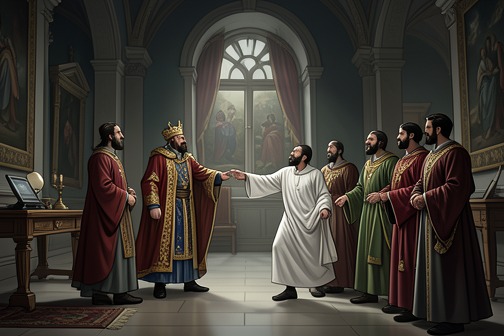
[Daksha](entity:character-recall-character-daksha-37bd37820a11)’s sacrifice is an episode in which the ancient progenitor Daksha excludes [Shiva](entity:character-recall-character-shiva-a32afbfe6397) from the sacred offerings, and Shiva responds by striking the gods. The book’s note connects the confrontation to the emergence of Shiva’s worship and its contest with older religious forms, while presenting that interpretation as a possibility rather than a settled explanation.
## Daksha and the sacrificial setting
The accompanying commentary identifies Daksha as one of the ancient progenitors, or Prajapatis, created by [Brahma](entity:character-recall-character-brahma-39f8aa187fff). The sacrifice therefore takes place within a divine order in which Daksha holds a foundational status. Its decisive breach is that Shiva is not invited to share in the sacred oblations.
## Exclusion and confrontation
The note describes Shiva as striking the gods because he was left out of the offering. The account thus makes exclusion from ritual participation the immediate cause of the conflict: the sacrifice, meant to distribute sacred offerings among the gods, becomes the setting for a rupture in their order. The evidence identifies this response but does not specify the details or outcome of the confrontation beyond the assault on the gods.
## Religious interpretation
The commentary suggests that the sacrifice may refer to the origin of Shiva’s worship, its subsequent growth, and the struggle it maintained with older forms of worship. Read in this light, the episode gives ritual exclusion a wider significance: the dispute over who may share in sacred offerings also reflects a contest over the standing of a form of worship. The note presents this as an interpretive possibility, not as an explicit statement of the episode’s meaning in the narrative.
Event 171
Trishanku's ascent to heaven
[Trishanku](entity:character-recall-character-trishanku-3b5ef47117f1)’s ascent to heaven is a mythic episode from Book I in which the king is raised into the sky through a sacrifice performed by Viśvāmitra. Its outcome is both personal and cosmic: Trishanku becomes a southern constellation, while later commentary reads the episode as a struggle over the authority to shape religious and political order.
## Place in the Narrative
The episode belongs to the story of Trishanku told in Book I, Canto LX. The accompanying note identifies Viśvāmitra as the sage who performed the sacrifice that raised the king to the heavens. In the epic’s embedded-tale structure, the ascent is therefore not an event in the poem’s main chronological action but an earlier story recounted by Viśvāmitra.
The commentary supplies a fragment of the crisis leading to the rite: after seeking help from Vaśiṣṭha without success, Trishanku appealed to Vaśiṣṭha’s sons. The notes preserve debate about how to interpret this appeal, including whether Trishanku was seeking another ritual protector. They do not reproduce the full sequence of the ascent, so its defining action in this account is the sacrifice and its extraordinary result.
## Sacrifice and Cosmic Outcome
The rite carries Trishanku upward to the sky, where he is associated with a constellation in the southern hemisphere. The episode thus converts a dispute involving a king and ritual authority into a lasting feature of the heavens. The result is more than a temporary elevation: the commentary treats Trishanku’s celestial state as an explanation for a constellation and links its origin to the work of Viśvāmitra.
A separate note discusses Viśvāmitra’s creation of seven new stars, proposing that these may represent southern stars that became known as people moved beyond the [Ganges](entity:location-recall-location-ganges-13554a03c098) region. That astronomical speculation concerns the new stars associated with Viśvāmitra’s mythic acts; it should not be confused with the more specific statement that Trishanku himself was raised to form a southern constellation.
## Power and Ritual Authority
The commentary presents the episode as a contest for supremacy between the regal or military order and Brahmanical, or priestly, authority. On this reading, the sacrifice makes religious power consequential in the political sphere: Viśvāmitra’s ritual action determines whether the king can attain his extraordinary destination. The episode’s ascent plot consequently becomes a way to think about competing forms of authority, not simply a marvel of supernatural travel.
The account also situates Viśvāmitra within a broader portrait of restless ambition. A commentator notes that, although he succeeds in the sacrifice for Trishanku, he does not remain in the same place; the note connects this movement to his former character as a warlike king, active and drawn to glory. His role in the ascent thus joins ritual achievement to a continuing drive toward action and distinction.
## Lineage and Chronological Tension
The notes identify Trishanku as a king of [Ayodhyá](entity:location-recall-location-ayodhy-08bd0b6815c4) and place him seventh in descent from [Ikshváku](entity:character-recall-character-ikshv-ku-075374a4475b); [Daśaratha](entity:character-recall-character-da-aratha-ffdd8279512e), by contrast, is placed thirty-fourth in the same genealogy. This lineage marks Trishanku’s story as belonging to a remote ancestral past. Yet the commentary observes that Vaśiṣṭha and Viśvāmitra, who appear in Trishanku’s story, also remain present in the age of [Ráma](entity:character-recall-character-r-ma-2db51e45ae4a), creating an apparent chronological tension within the mythology.
The ascent therefore leaves two kinds of permanence in its wake: Trishanku’s placement among the southern stars and the story’s enduring place in a genealogy whose legendary chronology resists simple alignment.
Event 172
Ambarisha's sacrificial substitution
[Ambarisha's sacrificial substitution](entity:event-recall-event-ambarisha-s-sacrificial-0ac91ef21951) is a ritual episode in which a ram caught in a thicket replaces a human victim. Its significance lies both in the substitution itself and in the later commentary’s reading of the story as a possible witness to the abandonment of human sacrifice in favor of animal offerings.
## The Substitution
The surviving account identifies the decisive change: the ram caught in the thicket takes the place of a person due to be sacrificed. The evidence supplied does not establish the full circumstances that led to the substitution or describe the ceremony’s completion, so the episode’s clearest supported action is this exchange of victim for animal.
The commentary compares the ram’s role with stories in which a ram replaces Isaac or Ishmael. These are presented as parallels to the motif of a human life spared through animal substitution, not as events within [Ambarisha](entity:character-recall-character-ambarisha-9621cddc71fd)’s own story.
## Ritual and Interpretation
The commentary proposes that this episode, together with the following canto, may preserve an indication of a historical shift: the immolation of lower animals taking the place of human sacrifice. This is an interpretation of the myth, rather than an explicit statement by the episode’s characters. The ram’s substitution thus carries a meaning beyond the immediate ritual action, making the story evidence—though not conclusive proof—for changing sacrificial practice.
The episode’s importance rests on that tension between narrative and retrospective explanation. The account depicts a particular victim being replaced; the commentary reads that act as a fragment of a wider transformation in ritual custom.
## Genealogy and Chronology
A separate note places Ambarisha twenty-nine generations after Ikshvaku, at a great distance in time from [Trishanku](entity:character-recall-character-trishanku-3b5ef47117f1), whose story is also associated with [Vishvamitra](entity:character-recall-character-vishvamitra-df735521f72c). Yet [Richika](entity:character-recall-character-richika-bce16239e359), described as the son of [Bhrigu](entity:character-recall-character-bhrigu-6b4d901155c3) and as having young sons during Ambarisha’s reign, is also said to have married Vishvamitra’s younger sister. The note identifies this overlap as a recurring chronological inconsistency in Indian mythology.
This genealogical observation complicates any attempt to treat the episode as a precise historical record. The commentary’s proposed change in sacrificial practice is therefore framed as a possible indication within myth, while the story’s own family chronology resists a consistent historical timeline.
Event 173
Sita's birth from the furrow
[Sítá](entity:character-recall-character-s-t-0be56374418b)'s birth from the furrow is presented through the circumstances of her discovery: [Janak](entity:character-recall-character-janak-b1843f7c4081) finds her while turning the ground in preparation for a sacrifice. The episode gives her an origin distinct from ordinary human birth and makes the furrow central to how that origin is understood.
## Discovery in the Sacrificial Ground
The account places Janak at work preparing a sacrificial field. As he turns the ground, he finds Sítá there. The evidence identifies this moment of finding but does not describe the ritual’s other participants or give further details about the field or the discovery.
## Name and Origin
An explanatory note states that Sítá means “a furrow.” The name therefore carries the circumstances of her discovery within it: the ground being prepared for sacrifice is not merely the setting, but the defining image associated with her origin. The same note describes her as not born of a woman, underscoring the difference between her emergence from the furrow and an ordinary birth.
## Place in the Narrative
The episode establishes the extraordinary origin attached to Sítá’s identity without supplying a fuller account of how she came to be in the ground. Its emphasis is on the conjunction of Janak’s sacrificial preparation, the act of turning the soil, and the child he finds. The furrow thus connects the narrative’s account of her discovery to the meaning of her name.
Event 174
Jatayu's defense of Sita
[Jaṭáyu](entity:character-recall-character-ja-yu-feaa8c7732e2)'s defense of [Sítá](entity:character-recall-character-s-t-0be56374418b) is presented as an act of protection by a semi-divine bird who was a friend of [Ráma](entity:character-recall-character-r-ma-2db51e45ae4a). The account establishes the purpose of his intervention, while leaving the battle's circumstances and outcome unspecified.
## Identity and Circumstance
A note identifies Jaṭáyu as a semi-divine bird and a friend of Ráma. These details place his intervention within the network of allies around Ráma and distinguish him from an ordinary bird: he acts in defense of Sítá.
## The Defensive Act
The account says that Jaṭáyu fought to defend Sítá. It gives no description of how the fight began, what Jaṭáyu did in combat, or what happened to him afterward. The episode is thus defined by its protective purpose rather than by a narrated sequence of blows or a stated result.
## Narrative Significance
The brief reference connects Jaṭáyu's friendship with Ráma to a concrete act of loyalty toward Sítá. His role is not simply that of an ally named in passing: the account remembers him specifically for risking himself in her defense. It does not, however, supply further details from which to reconstruct the rescue attempt or its consequences.
Event 175
Rama's killing of Vali
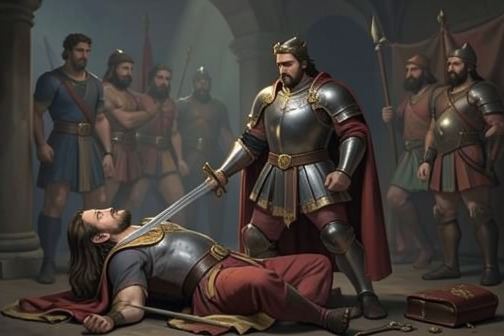
[Rama](entity:character-recall-character-rama-fdac9c17dd0c)’s killing of [Vali](entity:character-recall-character-vali-04db38c2fa63) is a decisive death whose accompanying commentary draws attention to a conflict between political alliance and the justification for punishment. The notes identify Vali as a de facto king, recall Rama’s bond with [Sugriva](entity:character-recall-character-sugriva-bd875ea369d2), and mark [Angad](entity:character-recall-character-angad-ece5a55cd18f)’s position in the succession that follows.
## Alliance and the Question of Authority
The commentary describes Rama as having made a solemn alliance with Sugriva, Vali’s younger brother, whom Rama regards as a dear friend and nearly an equal. This bond matters to the interpretation of the killing: Rama’s action is not treated only as the defeat of a rival ruler, but as an act undertaken in the context of a personal and political commitment to Sugriva.
A separate note invokes [Manu](entity:character-recall-character-manu-91d5f38f8c61)’s rule that offenders who receive their due punishment from kings are purified and may attain heaven. That principle offers a framework for understanding royal punishment, but the commentary does not let it settle the particular case. Instead, it draws attention to the gap between the general rule and Rama’s specific defence of his action.
## A Contested Justification
The note on Rama’s argument questions the reasoning he gives for killing Vali. In particular, it objects to the claim that Vali’s status as a monkey grants Rama the right to kill him as he chooses. Set beside the solemn alliance with Sugriva, this rationale makes the episode morally uneasy: royal authority and the duty to punish are invoked, while the commentary challenges whether those grounds adequately justify the act.
The disagreement is preserved rather than resolved in the notes. Their criticism makes the killing significant not merely as a change in power, but as an occasion to examine the limits of a ruler’s authority and the obligations created by alliance.
## Succession and Aftermath
The notes identify Vali as king de facto and point toward the political consequences of his death through Angad, Vali’s heir. Angad is described as too young to govern and therefore as heir apparent. This detail distinguishes inheritance from immediate rule: Vali’s death creates a succession question, but Angad’s age prevents him from taking on governance at once.
By linking the killing to Sugriva’s alliance with Rama and Angad’s status as a young heir, the commentary places personal loyalty, royal punishment, and succession within the same episode. Its lasting emphasis is the tension between the political outcome and the disputed means by which that outcome is reached.
Event 176
Hanuman's leap to Lanka
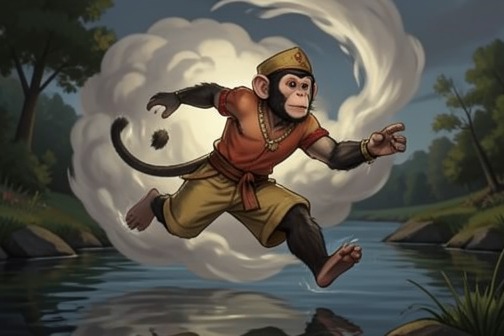
[Hanuman's leap to Lanka](entity:event-recall-event-hanuman-s-leap-to-lanka-83f3fd86cf8c) is a crossing episode shaped by encounters with supernatural powers and by the poem's interest in transformation. The notes accompanying the episode draw attention both to the journey's peril and to the extraordinary bodily changes that make such a passage possible.
## The Crossing and Its Challenges
The journey is not presented in the supplied material as a simple traverse. One note glosses a challenge from [Surasa](entity:character-recall-character-surasa-b000dd7c63c2) as permission to continue only if [Hanuman](entity:character-recall-character-hanuman-83c726a7b662) can manage it, making progress conditional on his ability to meet an obstacle. Another identifies [Simhika](entity:character-recall-character-simhika-f2725a886262) as the mother of Rahu, the agent associated with eclipses, placing the crossing among forces that threaten or interrupt the sun's passage.
## Transformation and Supernatural Scale
The commentary treats expansion and compression as powers available to supernatural beings. It argues that, once such powers are granted, the changes in scale attributed to Hanuman are internally consistent. This emphasis makes bodily transformation more than a marvel: it is the means by which a journey through formidable obstacles can continue.
## Solar Interpretation
A cited mythological reading interprets Hanuman as the sun entering and escaping a cloud, and compares the image with Jonah inside the fish. This is presented as an allegorical interpretation rather than as the episode's explicit explanation. The reading gathers the crossing's movement, interruption, and emergence into a compact natural image, while the poem's supernatural action remains meaningful on its own terms.
Event 177
Hanuman's meeting with Sita
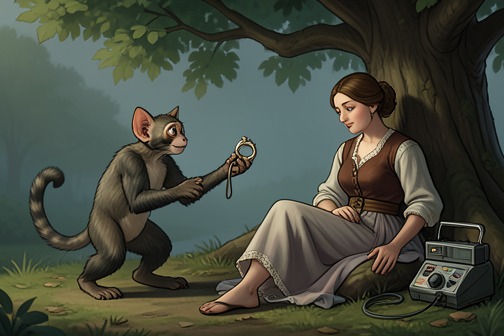
[Hanuman's meeting with Sita](entity:event-recall-event-hanuman-s-meeting-with-43524bff6378) in [Lanka](entity:location-recall-location-lanka-4b3ac7e9a824) turns a hidden search into a channel of recognition and news. The encounter joins the captive, who knows nothing of events since her abduction, to the story unfolding beyond her reach; a ring sent by [Rama](entity:character-recall-character-rama-fdac9c17dd0c) gives that connection a tangible token.
## Approach and Setting
[Hanuman](entity:character-recall-character-hanuman-83c726a7b662) had entered Lanka in a form reduced to the size of a cat, a detail that places concealment at the threshold of the meeting. [Sita](entity:character-recall-character-sita-1913dd4978f6) is in the grove, apart from her sleeping guards, having crept to a tree at some distance from them. Her separation from the guards creates the circumstances for a private encounter, but the surrounding danger remains present: she is still captive and watched.
## Establishing Recognition
The encounter depends on more than a stranger's arrival. A note on the scene explains the significance of speaking about Rama: a friend of Rama would praise him, whereas [Ravana](entity:character-recall-character-ravana-f2652ae52080) in disguise would avoid the subject. The subject thus becomes a means of distinguishing an ally from a possible deceiver. The distinction matters in a setting where appearance alone cannot guarantee trust.
The ring that Rama sends to Sita serves as a material link between them. A commentary on the episode records De Gubernatis's interpretation of the ring as a symbol of the sun's disc, with Rama figured as the Sun and Sita as the Dawn. That reading extends the token beyond its practical role, while leaving its immediate narrative force intact: it connects the captive to Rama through an object sent from outside her confinement.
## News Across the Separation
Sita knows nothing of what has happened to Rama since Ravana carried her away. The narrative therefore recounts for her the meeting between Rama and [Sugriva](entity:character-recall-character-sugriva-bd875ea369d2), [Bali](entity:character-recall-character-bali-4ed36663458c)'s defeat, and the events that followed. This account closes the informational gap created by the abduction: the meeting conveys not just the fact of contact, but the history Sita has been unable to witness.
The episode's retelling also links separate portions of the larger narrative. The commentary notes that the story is repeated, with slight variations and additions, from Book II. Its presence here is consequently both communication within the plot and renewed narration for the audience: what Sita needs to learn is also what readers must recall as the search for her approaches its next stage.
## Narrative Significance
The meeting brings concealment, recognition, and recollection together. Hanuman's small form belongs to the perilous approach through Lanka; the conversation tests whether the visitor can be trusted; and the ring gives the message a physical point of recognition. Because Sita is isolated from the developments that have brought the search to Lanka, the meeting restores a connection across both distance and lost time without ending her captivity.
Event 178
Hanuman's assault on Lanka
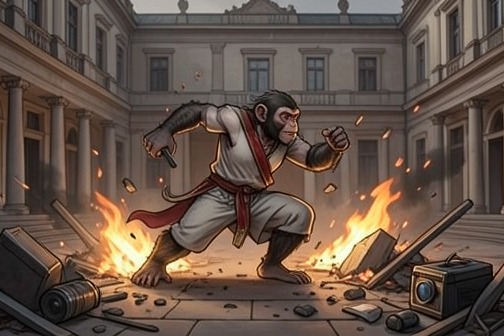
[Hanumán](entity:character-recall-character-hanum-n-b41d60813de6)’s assault on [Lanka](entity:location-recall-location-lanka-4b3ac7e9a824) is a calculated escalation within his mission there. After judging that conciliation, gifts, and division would not move [Rávaṇ](entity:character-recall-character-r-va-06a1d00141e6), he chooses force in the form of destroying the king’s pleasure grounds. The attack makes Hanumán’s presence an open challenge and leads from damage to the royal grounds to confrontation with Lanka’s rulers and defenders.
## Causes and Choice of Tactics
The commentary explains Hanumán’s decision through four ways of dealing with an enemy: conciliation, gifts, division, and force or punishment. He considers the first three useless in this case and chooses punishment, directing his attack at Rávaṇ’s pleasure grounds. The destruction is therefore not presented simply as incidental damage during reconnaissance: it is the deliberate means by which Hanumán answers Rávaṇ’s refusal to yield.
The target also gives the action a political edge. By striking a royal pleasure ground, Hanumán carries his resistance into the ruler’s domain. The chosen tactic changes his role from a concealed visitor gathering information to an adversary whose actions require a response.
## Confrontation and Capture
The assault brings Hanumán into combat with Lanka’s Rákṣasas and ultimately into Rávaṇ’s presence. The commentary records that [Indrajít](entity:character-recall-character-indraj-t-9eaa6775f6fc)’s magic weapon cast a spell on Hanumán; when Hanumán was bound with cords, Indrajít released him from that spell. This distinction between magical restraint and ordinary bonds is part of the account’s explanation of how the capture unfolded.
A small textual detail in the commentary concerns a chariot described first as drawn by asses and later as drawn by horses. The commentator notes the discrepancy and explains that the later reference to horses means asses. The note preserves a variation in the battle description rather than treating the two accounts as separate events.
## Envoy and Aftermath
Before Rávaṇ, Hanumán identifies himself as an envoy sent by the ruler of the [Vánaras](entity:creature-recall-creature-v-naras-af40f01820e3). That declaration reframes the assault as more than an individual act: Hanumán is also a messenger representing a political power. The commentary underscores the consequence of that status by citing the rule that killing an ambassador brings punishment. His identity as an envoy thus places a limit on how Rávaṇ may respond, even after Hanumán has inflicted deliberate damage.
The episode’s movement—from a strategic choice, through the destruction of the pleasure grounds and capture, to the declaration of envoy status—sets force against the obligations governing diplomacy. Hanumán has punished Rávaṇ’s authority on its own ground, but the encounter also makes his representative role explicit and brings the protection due to an envoy into the confrontation.
Event 179
Vibhishana's defection to Rama
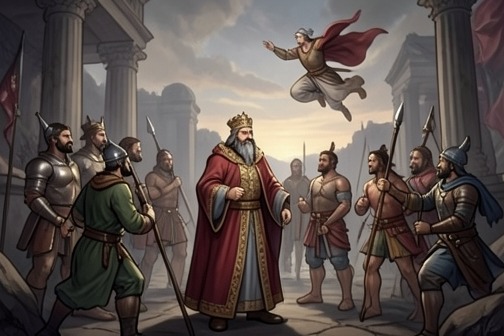
[Vibhishaṇ](entity:character-recall-character-vibhisha-e07caf5116fd)’s defection to [Ráma](entity:character-recall-character-r-ma-2db51e45ae4a) is a departure from [Rávaṇ](entity:character-recall-character-r-va-06a1d00141e6)’s side that the Bengal recension gives a more explicit sequence and impetus than the main text. In that version, Rávaṇ’s treatment of Vibhishaṇ precedes a visit to their mother, a journey to [Kailasa](entity:location-recall-location-kailasa-f6f396a0e4f4), and counsel from [Shiva](entity:character-recall-character-shiva-a32afbfe6397) before Vibhishaṇ seeks Ráma and the [Vánar Army](entity:organization-recall-organization-v-nar-army-aa4a90162424).
## The Departure in the Text
The accompanying note characterizes the defection as abrupt and says that [Válmíki](entity:character-recall-character-v-lm-ki-6e665def9561)’s narration treats it with unusual brevity. It also cautions that the speakers and speeches leading up to the departure differ considerably between the Bengal recension and the version followed in the main text. The event therefore has two distinct textual presentations: a compressed departure in the main account and a variant that supplies additional steps before Vibhishaṇ changes sides.
## The Bengal Recension
In the Bengal version, Rávaṇ first kicks Vibhishaṇ from his seat. Vibhishaṇ then tells his mother what has happened, making the incident with Rávaṇ the stated immediate circumstance before he leaves. Rather than going directly to Ráma, he flies to Kailasa and meets Shiva there.
Shiva advises Vibhishaṇ to seek Ráma and the Vánar Army. Vibhishaṇ follows that counsel, and his departure becomes a course of action mediated by consultation rather than a single, unexplained break. The note does not describe what happens after he reaches them.
## Narrative Significance
The variant account makes the change of allegiance more legible by placing Rávaṇ’s treatment of Vibhishaṇ, his disclosure to his mother, and his consultation with Shiva before his approach to Ráma. At the same time, the note’s emphasis on the main text’s brevity preserves a contrast between the versions: one leaves the transition abrupt, while the other records a short chain of cause and counsel. The evidence establishes this difference in narration without resolving the disagreements between the recensions.
Event 180
Rama's return to Ayodhya
[Rama's return to Ayodhya](entity:event-recall-event-rama-s-return-to-ayodhy-29988ab55833) is the homecoming that follows his victory over [Ravana](entity:character-recall-character-ravana-f2652ae52080), bringing the narrative back to the kingdom from which he had departed in exile. Its significance lies both in the reversal from absence to return and in its place within a larger story that continues after the hero reaches home.
## From Exile to Homecoming
The return answers an earlier rupture in the royal household. When [Rama](entity:character-recall-character-rama-fdac9c17dd0c)'s fate in exile becomes clear, his father is overcome by anguish; elsewhere, Rama is characterized as steadfast in truth. Against that background, the journey home carries more than the promise of physical reunion: it closes the interval of separation while preserving the poem's emphasis on obligations and their consequences.
The account identifies the homecoming as triumphant, but the available description does not narrate its stages or specify the circumstances of the arrival. It therefore supports the broad movement from victory and absence back to the paternal kingdom, rather than a detailed reconstruction of the journey or the reception awaiting Rama in [Ayodhya](entity:location-recall-location-ayodhya-ef190b6473a9).
## The Returning Party in Different Recensions
A note on the North-West recension preserves a particular detail about the return journey: [Sita](entity:character-recall-character-sita-1913dd4978f6) asks that [Tárá](entity:character-recall-character-t-r-551b368fbdfe) and the wives of the Vanara chiefs be invited to accompany her to Ayodhya. The aerial car descends, and the Vanara matrons join the party. The note contrasts this addition with the Bengal recension, which omits it. The difference makes the returning group itself a point of variation between versions, and shows how one recension gives Sita a role in shaping who shares the homeward passage.
## A Return, Not the End of the Epic
The return does not close the narrative history. In a discussion of the Uttarakanda, the scholar E. B. Cowell compares its relation to the Ramayana with that of the cyclic poems to the Iliad: it completes the story while also adding episodes that expand on earlier allusions. Its later chapters carry Rama's history beyond his triumphant return to his paternal kingdom, and the poem ultimately proceeds to the deaths of Rama and his brothers and the establishment of kingdoms by their descendants.
The episode is therefore a hinge in the epic's structure rather than its final destination. The return resolves the movement away from Ayodhya, while the continuation beyond it turns homecoming into one stage of a longer account of royal history and succession.
Event 181
Sita's banishment
[Sita's banishment](entity:event-recall-event-sita-s-banishment-027c30bd083f) turns the public judgment that [Ráma](entity:character-recall-character-r-ma-2db51e45ae4a) once resisted into the force that separates him from [Sítá](entity:character-recall-character-s-t-0be56374418b). He knows her to be pure in thought, word, and deed, yet cannot bear the shame and mockery stirred by slander in [Ayodhyá](entity:location-recall-location-ayodhy-08bd0b6815c4). The exile sends Sítá, unsuspecting and pregnant, to the very hermitage she had long wished to visit; its aftermath brings her sons before their father, but does not restore her to his household.
## Causes and Decision
The account sets the banishment after Ráma and Sítá have returned to Ayodhyá and settled together. In spring, as the winter ends, they sit in the shade of the Aśoka trees. Sítá tells Ráma that she longs to visit the holy hermitages on the banks of the [Ganges](entity:location-recall-location-ganges-13554a03c098), venerate the ascetics, and spend even a single day among them. Ráma readily promises that she will go. What appears to be a welcome journey thus becomes the means by which he carries out a decision she does not know he has made.
The cause is rumor, not any change in Ráma's judgment of his wife. People condemn him for taking Sítá back after her long captivity in [Rávaṇ](entity:character-recall-character-r-va-06a1d00141e6)'s palace. The narrative explicitly distinguishes their accusation from Ráma's own knowledge: he believes Sítá spotless in thought, word, and deed, and knows her love for him to be complete. Nevertheless, he cannot endure the public shame and resolves to abandon her. The episode's central conflict lies in that split between private conviction and public response: the account gives no indication that Ráma doubts Sítá, but his recognition of her innocence does not prevent the separation.
## The Abandonment at the Hermitage
Ráma orders [Lakshmaṇ](entity:character-recall-character-lakshma-7aad0629b677) to take Sítá to the hermitage she wishes to visit and leave her there. The instruction carries a finality beyond a temporary visit: Ráma intends never to see her again. Lakshmaṇ must carry out the painful order, and it is he who tells Sítá what has happened once they reach the hermitage. The place she had imagined as a destination of devotion becomes the site of her abandonment.
Sítá faints on hearing the news. When she recovers, she weeps over what she understands as a cruel and undeserved fate. The account does not leave her defined by that first collapse: she resolves to live for Ráma's sake and for the child she carries. Through Lakshmaṇ, she sends Ráma a composed message. She says she grieves not for herself, since she has been abandoned because of what people say rather than for any wrongdoing of her own; she also affirms the wife's duty to follow what her husband considers right, even at the cost of her life. Her message makes the unequal terms of the episode plain: she maintains her devotion even as Ráma's decision removes her from his protection and household.
## The Hermitage and the Sons
[Válmíki](entity:character-recall-character-v-lm-ki-6e665def9561) receives Sítá honorably, and the holy women of the hermitage are charged to care for her. There, away from the court that judged her, she gives birth to twin boys, [Kuśa](entity:character-recall-character-ku-a-080b9ea19afc) and [Lava](entity:character-recall-character-lava-58c876878914). Válmíki brings them up and teaches them to recite the Rámáyaṇ. Their education makes the poem itself the means by which the abandoned family will become known to Ráma: what begins as a household rupture eventually returns to the royal gathering as a song about the father's own deeds.
Years pass before Ráma celebrates the [Aśvamedha](entity:concept-recall-concept-a-vamedha-1cfd0736948c), the horse sacrifice. Válmíki attends with his two young pupils, whose parentage is not known to those gathered. The boys recite the poem before the delighted Ráma. He asks about their history and recognizes them as his sons. Their appearance changes what Ráma knows about his family, but recognition does not itself undo Sítá's banishment. Instead, she is invited to return and affirm her innocence before the assembly, making a public declaration the price of rejoining the household from which public opinion had driven her.
## Sítá's Final Departure
Sítá cannot bring herself to submit to a second ordeal before the spectators. The account presents this refusal as a response to the limit of what she can bear, not as an admission of guilt. Clothed in red, she clasps her hands, bows her face, and swears that even in thought she has never loved anyone other than Ráma, calling on the goddess of Earth to grant her a place of refuge. The oath turns the question of her purity away from the crowd's judgment and toward the Earth, who can receive her when the human household has not.
The Earth opens, and a splendid throne borne by dragons rises. The goddess of Earth lifts Sítá onto it, welcomes her, and descends with her as flowers fall from heaven. Sítá's story therefore ends not with a return to Ráma but with her departure from the human assembly that had demanded proof again. The sequence sets two public scenes against one another: first the rumors that prompt Ráma to abandon a wife he knows to be pure, then the gathering before which Sítá refuses another test and is taken away by the Earth goddess. The sons remain the link between the separated parents, but the final act belongs to Sítá.
Event 182
Rama's death
[Rama](entity:character-recall-character-rama-fdac9c17dd0c)’s death is the concluding event in the epic’s account of his life: after his return to his ancestral kingdom and a period of rule, he and his brothers die, and the story turns to the kingdoms founded by their descendants. The available account identifies this ending but does not describe how or where the deaths occur.
## Place in the Narrative
The epic’s closing movement continues Rama’s story beyond his victorious return and reign. Its ending therefore shifts the scale of the narrative from the hero’s life to what follows him: Rama and his brothers die, while their descendants establish kingdoms in different parts of India.
## Theological Context
In an earlier divine address, Rama is identified as [Vishnu](entity:character-recall-character-vishnu-4fe080f11b04) incarnate and urged, after reigning in [Ayodhya](entity:location-recall-location-ayodhya-ef190b6473a9) for a time, to return to paradise. This passage provides a divine frame for Rama’s eventual departure from mortal life, though it does not narrate the deaths of Rama and his brothers or specify their circumstances.
## Ending and Aftermath
The deaths of Rama and his brothers bring the family’s immediate story to a close, but not its political legacy. The continuation described in the epic’s closing account carries that legacy forward through the kingdoms founded by their descendants, ending the narrative with succession and dispersal rather than with Rama’s victory alone.
Event 183
Indra's slaying of Vritra
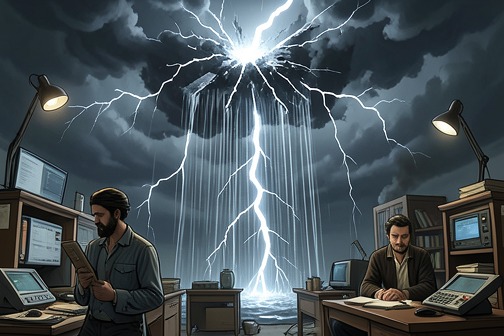
[Indra's slaying of Vritra](entity:event-recall-event-indra-s-slaying-of-vrit-710e4013bf5c) is an explanatory myth of drought and the release of rain. In the book's appendix, Vritra is described as a Vedic personification of the force that obstructs the clouds; [Indra](entity:character-recall-character-indra-9cdc4e2c85c7)'s thunderbolt breaks that obstruction and frees the waters.
## Vritra and the Withheld Rain
Vritra's name is glossed as “the coverer, hider, obstructer (of rain).” The note identifies him as an imagined malignant influence or demon of darkness and drought, believed to seize the clouds and prevent the sky from clearing. The waters are therefore not simply absent: they are held back behind a hostile obstruction.
## Indra's Battle
Indra battles this force with his thunderbolt. The account figures the clouds as mountains or castles—strongholds that contain the pent-up waters—and makes their shattering the decisive action. When Indra breaks open those cloud-fortresses, the waters are released.
## Mythic and Natural Meaning
The episode links divine combat to a recognizable natural crisis: drought ends when rain-bearing clouds break and pour out their water. The appendix presents Vritra as a Vedic personification rather than supplying a detailed sequence of combat, so the event's emphasis falls on the relation between obstruction, Indra's intervention, and the release of rain.
Event 184
Garuda's theft of Amrita
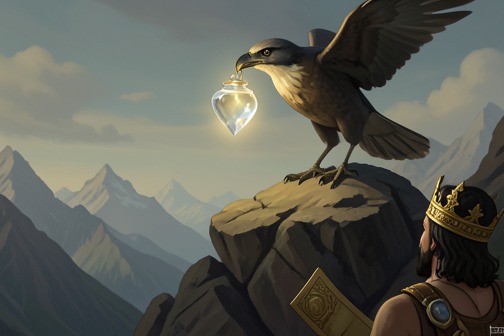
[Garuḍa](entity:character-recall-character-garu-a-b39daf34be65)’s theft of [Amrit](entity:object-recall-object-amrit-884e694d61e8) is recorded in a concise explanatory note: the King of Birds carries the drink of Paradise away from [Indra](entity:character-recall-character-indra-9cdc4e2c85c7)’s custody. The notice establishes the theft and the parties involved, but does not narrate how it was accomplished or what followed.
## The Reported Theft
The account turns on a direct reversal of possession. Amrit is in Indra’s custody; Garuḍa carries it off. The wording identifies Indra as custodian, but gives no further circumstances of the taking and does not describe a confrontation.
## Garuḍa and Amrit
The note identifies Garuḍa by the epithet King of Birds and names the object as Amrit, glossed as the drink of Paradise. These brief identifications frame the act as the removal of a distinctively celestial substance by a figure associated with birds; the note supplies no further explanation of either identity.
## Form and Limits of the Account
The episode appears in an explanatory note, not as a developed scene. Its compact statement preserves the essential relation—Garuḍa takes Amrit from Indra’s custody—while leaving the motive, method, and consequences unstated. The account therefore records the theft without supplying a fuller narrative of its place in Garuḍa’s story.
Event 185
Vamana's subduing of Bali
[Vishnu](entity:character-recall-character-vishnu-4fe080f11b04)’s Dwarf incarnation subdued [Bali](entity:character-recall-character-bali-4ed36663458c), a Daitya who had seized dominion over the three worlds. The surviving account records the outcome—a loss of two-thirds of Bali’s dominions—rather than the circumstances of the encounter.