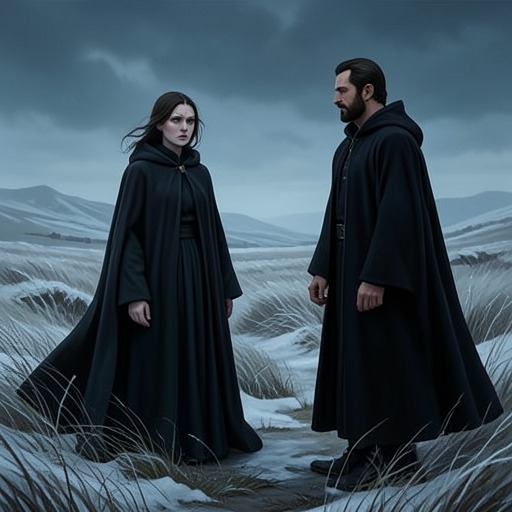
Arya's escape from Harrenhal
A Clash of KingsArya's escape from Harrenhal is the turning point at which captivity gives way to deliberate action. Harrenhal is not merely a fortress she leaves behind but the place where grief, disguise, memory, and violence force her to decide what kind of survivor she will become. The escape succeeds because Arya combines remembrance of her family and teachers with practical deception, stealth, and lethal skill; it ends with the heavy oak gate opened to the rain and with Arya, Gendry, and Hot Pie riding away from Roose Bolton’s control.
Despair and the Recovery of Identity
Arya’s immediate crisis begins in the godswood after Elmar dismisses the possible deaths of her brothers and declares that nobody cares about a serving girl’s family. She is furious enough to wish death on his princess, then seeks direction from the heart tree. The response is not a human rescuer but a distant wolf’s howl, followed by the remembered words of her father: “When the snows fall and the white winds blow, the lone wolf dies, but the pack survives.” The memory initially deepens her despair, because Bran and Rickon seem dead, Sansa is held by the Lannisters, Jon Snow is at the Wall, and even Arya’s own name has been replaced by the servant identity Nan.
The recognition that follows restores a buried continuity. Arya recalls that she is “Arya of Winterfell,” a daughter of the north with the wolf blood in her, and resolves to be as strong as Robb. Her symbolic rejection of weakness is concrete: she breaks the broomstick sword across her knee and casts away the pieces, declaring, “I am a direwolf, and done with wooden teeth.” The gesture does not erase fear or grief, but it changes their function. The wooden weapon belonged to play and concealment; the direwolf image gives her a harsher, more purposeful understanding of survival.
The Plan to Leave Harrenhal
That night Arya acts on the decision. She slips from her narrow bed, escapes through a cellar window because the guarded entrance to Kingspyre cannot be used, and crosses the still yard beneath the Wailing Tower. At the forge she wakes Gendry by covering his mouth and pinching him, then gives him the essential instruction in two words: “A sword.” Her request turns private resolve into a shared escape plan. Gendry leaves the mattress without waking the other apprentices, while Arya brings him into the dangerous space beyond the castle’s ordinary routines.
At the Tower of Ghosts, Arya waits for Gendry and Hot Pie beside the horses. The preparations reveal the different resources each brings. Gendry wears oiled chainmail beneath his cloak, carries his blacksmith’s hammer, and has obtained swords; Hot Pie arrives with bread and a large wheel of cheese, practical provisions for flight rather than signs of martial readiness. Their escape route is threatened by a guard at the postern, but Arya assigns the boys to remain with the horses while she deals with him. When Hot Pie suggests that she signal with an owl’s call, she corrects him: “I’m not an owl. I’m a wolf. I’ll howl.” The exchange makes her recovered identity operational: the wolf is no longer only a memory or a private metaphor, but the role from which she acts.
Deception, Killing, and the Open Gate
Arya approaches the postern alone, moving through the shadow of the Tower of Ghosts with the dagger rather than the sword Gendry has brought. The choice is tactical. The narrow oak door is guarded by one man, but sentries remain in the tower and patrol the walls, so any struggle or cry could bring the garrison down on them. Fear remains present, yet she walks quickly to stay ahead of it, imagining Syrio Forel, Yoren, Jaqen H’ghar, and Jon Snow beside her as a remembered line of instruction and courage.
The guard’s identity makes the deception more dangerous. He is a tall, thin northman in a ragged fur cloak, one of Roose Bolton’s men rather than a Frey or one of the Brave Companions whom Arya might more readily fool. She therefore does not claim to be Arya Stark or openly command him to move. Instead, she pushes back her cloak to display the flayed-man badge and says, “Lord Bolton sent me.” The lie works because it exploits the authority that imprisons her. Her disguise does not free her by concealing power; it frees her by borrowing the language and insignia of the power occupying Harrenhal.
The guard demands the promised silver. Arya offers the coin Jaqen H’ghar gave her, allowing the iron to pass for tarnished silver in the darkness, then deliberately drops it. When the man kneels to search the dirt, his throat is exposed. Arya draws her dagger across it “as smooth as summer silk.” The killing is silent enough to prevent an alarm, but it is not bloodless or abstract: blood covers her hands, the guard tries to shout, and blood fills his mouth. As he dies, Arya whispers “Valar morghulis,” linking the act to the fatal knowledge and reciprocal obligation represented by Jaqen H’ghar’s coin.
Once the guard stops moving, Arya retrieves the coin, lifts the bar, and pulls open the heavy oak door. A wolf howls outside Harrenhal as the rain begins to fall hard. Hot Pie reacts with shocked disbelief that she has killed the man, while Arya answers that the alternative should have been understood. She rides with blood-sticky fingers and tells herself that the rain will wash them clean. The physical cleansing does not undo the deed; instead, it marks the passage from a captive who fears what she may have to do into a fugitive who accepts violence as the price of opening a way out.
Escape as Transformation
The escape belongs to the classic escape and pursuit pattern, but its decisive movement is inward before it is geographical. Arya first confronts the threat of erasure: her family appears broken, her name has become Nan, and the surrounding castle turns every ordinary act into dependence on Roose Bolton’s household. Her prayer, her father’s remembered maxim, and the distant wolves produce recognition rather than rescue. She discovers that the “pack” is not physically gathered around her, yet its memory still supplies a basis for action.
The episode also reverses the usual power of the fortress. Harrenhal’s towers, guards, gates, and political hierarchies seem overwhelming, but Arya identifies the narrow point through which the entire system can be breached: one tired guard, one false appeal to authority, one dropped coin, and one sharp dagger. The larger war remains visible beyond her immediate escape. Storm’s End rises above Stannis Baratheon’s encircling army, Catelyn Stark seeks a peace between rival brothers, and Ser Imry’s overwhelming fleet advances toward King’s Landing with four times Joffrey Baratheon’s ships; yet in Arya’s story, strategy is reduced to silence, timing, disguise, and a gate that must be opened from within.
Her flight is consequently neither a simple victory nor a return to safety. She leaves Harrenhal carrying the consequences of her first deliberate killing, accompanied by Gendry and Hot Pie, with the wolves’ call and the phrase “Valar morghulis” following her into the darkness. She has not recovered her lost family or ended the war, but she has recovered agency. The girl who once wielded wooden teeth now possesses a real blade, a chosen disguise, allies in flight, and a self-conception strong enough to move through fear. In that sense, Arya's escape from Harrenhal is the moment when survival becomes intention.