Bitterbridge
A Clash of KingsBitterbridge is an ancient stone crossing over the Mander, a place where roads, armies, and rival visions of kingship meet. In the narrative it becomes the forward base of Renly Baratheon’s immense host and the point at which Catelyn Stark encounters the spectacular, disorderly social world created by war. Its importance lies less in a single battle than in the way the location exposes warfare as a system of movement, supply, ceremony, spectacle, and political theater.
Setting and Strategic Position
Bitterbridge takes its name from the ancient stone span crossing the Mander. Catelyn Stark approaches it by the roseroad, escorted by Ser Colen and his men after announcing that she has come as envoy from Robb Stark, the King in the North, to treat with Renly Baratheon, the King in the South. The crossing is therefore both a physical threshold and a political one: beyond it lies Renly’s camp, where Catelyn must navigate the competing claims of the Baratheon brothers and the uncertain distinction between escort and captivity.
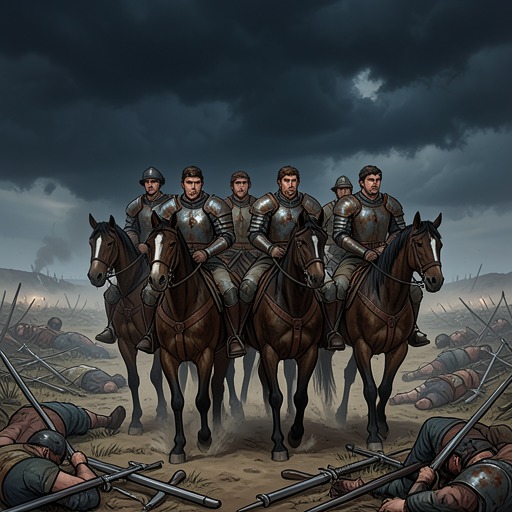
The approach announces the scale of the host before the location itself fully appears. Smoke from thousands of cookfires hangs over the countryside, horse lines stretch for leagues, and banners rise from staffs made from what seems to be an entire felled forest. Mangonels, trebuchets, and wheeled rams stand beside pavilions, while pikes, swords, wagons, draft animals, archers, teamsters, swineherds, pages, squires, knights, and camp followers fill the landscape. Bitterbridge is thus not merely a bridge or castle site: it is a logistical corridor transformed into a temporary city by military mobilization.
Renly’s Host at Bitterbridge
Near all the chivalry of the south appears to have answered Renly’s call. The golden rose of Highgarden is visible on the clothing of armsmen and servants and on green silk banners, while the devices of House Florent, House Fossoway, House Tarly, House Oakheart, House Crane, and House Mullendore mark the presence of the southern nobility. The concentration of these symbols makes Renly’s power legible through display. His authority is not represented by one isolated emblem but by a crowded field of allied houses, retainers, and dependents.
The camp itself is enormous but not entirely efficient. When Renly learns that Stannis Baratheon has attacked Storm’s End, he divides his forces. The main body of foot remains at Bitterbridge with his young queen, wagons, carts, draft animals, and siege machinery, while Renly leads his knights and freeriders east in a rapid movement toward his brother. Bitterbridge consequently functions as the rear base of Renly’s army, retaining the heavy equipment and supplies that cannot accompany a swift mounted advance.
That division creates a serious military weakness. Renly’s mobile force leaves its food, forage, and animals days behind with the baggage train. The camp he has abandoned is far larger than the force around him, but his own position is now dependent on reaching battle quickly. His bold movement resembles the speed and confidence associated with Robert Baratheon, yet it lacks the caution that Eddard Stark once brought to Robert’s decisions. Bitterbridge therefore represents both the abundance of Renly’s power and the logistical vulnerability concealed beneath its pageantry.
Tournament and Political Spectacle
Within the camp, Catelyn sees a melee underway beneath the battlements of a small castle. The field has been cleared and enclosed with fences, galleries, and tilting barriers; it is torn, muddy, and scattered with dented armor and broken lances, suggesting that the contest has already continued for a day or more. Hundreds, perhaps thousands, watch as fewer than twenty mounted knights continue to charge and strike at one another. A fully armored destrier collides with another and falls in a tangle of horseflesh and steel, while a knight in a rainbow-striped cloak shatters an opponent’s shield with a long-handled axe.
The tourney is an especially sharp contrast to the war surrounding it. The same camp contains siege engines, armed companies, and the material apparatus of invasion, yet it also stages chivalric entertainment for spectators who cheer violence when it has been bounded by rules and ceremony. The melee turns combat into a public performance, making rank and reputation visible while the larger war threatens to dissolve those distinctions into bloodshed. At Bitterbridge, political power is therefore displayed not only through numbers and banners but through the rituals by which aristocratic violence is made honorable.
The Location’s Narrative Significance
Catelyn’s arrival at Bitterbridge leads toward a parley rather than a settlement. She hopes that the rival kings might recognize their shared danger and avoid destroying one another while Robb Stark faces the Lannisters, but Renly and Stannis remain fixed in their opposing claims. Stannis insists that the Iron Throne is his by rights and treats those who deny that claim as foes; Renly answers that the realm rejects Stannis, from the old to the unborn. Bitterbridge thus becomes the staging ground for a political encounter in which the bridge’s function as a passage gives way to the impassable divide between the brothers.
After the parley, Renly’s camp is described as more orderly than the sprawling encampment on the Mander, though only a quarter as large. Its position atop a low, stony ridge running north to south gives it a defensible and organized character, but the order cannot resolve the strategic crisis created by Renly’s separation from his supplies. He prepares to meet Stannis in battle, and Bitterbridge remains behind as the material foundation of the campaign: a place of provisions, engines, servants, banners, and waiting forces whose importance is easy to overlook beside the kings’ personal confrontation.
The broader war repeatedly confirms the strategic logic visible at Bitterbridge. Fleets require lines of battle, landing forces, and protection for slower transports; rivers and chains can turn movement into entrapment; castles and ridges determine whether armies advance or starve. Bitterbridge belongs to this same geography of constraint. Its bridge concentrates movement, its surrounding roads support armies, and its camp reveals how quickly a noble claim becomes dependent on cooks, horses, wagons, forage, weapons, and the labor of people who do not decide which king is legitimate.
As a location, Bitterbridge embodies the tension between the glorious image of war and its practical substance. The banners and tournament promise chivalric order, while the packed camp exposes a mass of mouths, animals, machines, and vulnerable supply lines. The bridge joins opposing banks, but the political world gathered around it remains divided by rival crowns. Its decisive narrative function is to make that contradiction concrete: royal ambition appears as spectacle, yet survives only through the fragile infrastructure of roads, rivers, logistics, and armed men.