Capture of Winterfell
A Clash of KingsCapture of Winterfell is the seizure of the Stark castle by Theon Greyjoy during the War of the Five Kings. Its decisive significance lies in the reversal of both military and familial expectation: with Winterfell’s fighting men gone to answer threats elsewhere, Theon enters by stealth, claims the castle for House Greyjoy, and forces Bran Stark to proclaim his own submission. The capture makes political betrayal physically visible, replacing the familiar order of Winterfell with an improvised regime sustained by fear, a tiny garrison, and public violence.
Opportunity and Vulnerability
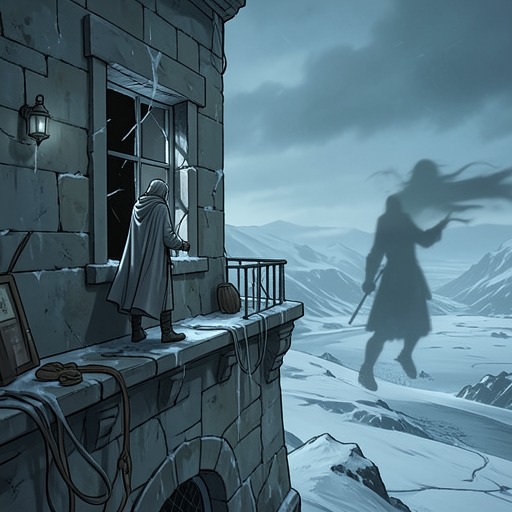
Winterfell is exposed because its defenders have been drawn away. Bran Stark wakes from a wolf-dream in which Summer has raced through the woods and fallen, then returns to his tower room with the bodily ghost of the wolf’s pain. The vision also brings an ominous recognition: the sea has come over the walls, as Jojen Reed had foreseen. When Bran calls for help, no one answers because the guard has been removed from his door. Ser Rodrik Cassel has taken every man of fighting age that he can gather, leaving Winterfell with only a token garrison.
The scale of the absence is made explicit. Eight days earlier, six hundred men from Winterfell and nearby holdfasts had marched away, while Cley Cerwyn was bringing three hundred more to join them. Maester Luwin had sent ravens to summon levies from White Harbor, the barrowlands, and the deep reaches of the wolfswood. At the same time, Dagmer Cleftjaw was attacking Torrhen’s Square, forcing the northern defense to respond across several fronts. Winterfell therefore falls not because its walls have ceased to matter, but because the wider war has stretched its human protection too thin.
Theon’s Night Assault
The assault begins with a stranger entering Bran’s chamber, wearing a leather jerkin sewn with overlapping iron disks and carrying a dirk, with an axe strapped to his back. Theon Greyjoy follows and initially offers reassurance, but the apparent safety is a feint. Bran asks whether Robb Stark sent him, only to learn that Robb is far away and unable to help. Theon then announces his changed status: he is now Prince Theon, and he has taken Bran’s castle.
The method is swift and covert rather than a conventional siege. Theon explains that he sent four men over the walls with grappling claws and ropes; they opened a postern gate, allowing the rest of his men to enter while the castle slept. The attack turns a supposedly secure stronghold into a place of sudden confinement. Theon orders his men to gather Winterfell’s people in the Great Hall, intending to use Bran’s authority to make the conquest appear lawful and complete.
The seizure also exposes the contrast between Theon’s former and present identities. He had been a ward of Bran’s father, yet he now presents himself as a prince and conqueror. His claim depends on the language of conquest rather than kinship or service: Balon Greyjoy has taken the ancient crown of salt and rock and declared himself King of the Iron Islands, while claiming the north as well. Theon’s occupation is thus both a military act and an attempt to enact a new political order before the castle’s inhabitants have time to resist.
Bran’s Forced Submission
In the Great Hall, Theon’s authority is immediately shown to be fragile. He raises his hands for quiet and appeals to the assembled people’s familiarity with him, but Mikken answers with an insult. One of the Ironborn guards beats the smith with a spear, first driving its butt into his stomach and then striking his face until he spits out a tooth. Bran tries to command Mikken to be silent in the stern manner of Robb Stark, but his voice comes out as a shrill squeak, revealing how little his formal lordship can protect anyone under occupation.
Theon turns Bran’s childhood status into an instrument of submission. He tells Bran to speak louder and call him prince. Remembering that a good lord protects his people, Bran announces that he has yielded Winterfell to Theon; when ordered to repeat the declaration with the proper title, he says that he has yielded Winterfell to Prince Theon and commands everyone to obey him as their new lord. The words are politically useful to Theon precisely because they come from the Stark seated at Winterfell’s high seat, but their coercive origin makes the supposed act of surrender morally and ceremonially hollow.
The public ritual collapses when Mikken refuses to serve Balon Greyjoy and declares that he serves the Starks. Theon dismisses smiths as strong-armed but weak-headed and promises generosity to those who serve him as loyally as they served Ned Stark. Before Mikken can finish another defiance, the bald Ironborn guard drives a spear point through the back of his neck and out through his throat. A woman screams, Meera Reed embraces Rickon Stark, and Bran understands the killing as blood from his own house. Theon’s question about who else wishes to speak converts the hall from an assembly into a demonstration of occupation: obedience is no longer requested but enforced by immediate execution.
Consequences and Narrative Significance
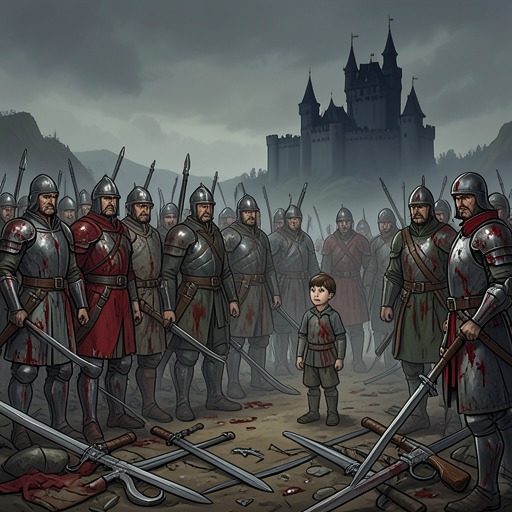
The capture changes Winterfell’s political meaning in a single night. The castle had been the center of Stark authority and the place from which northern defenses were organized; after Theon’s assault, its own lord’s son is made to validate an enemy seizure. The small number of Ironborn visible in the hall, roughly twenty with perhaps others at the gates and armory and no more than thirty in total, underscores the audacity of the conquest. Theon holds an immense symbolic stronghold with a force far smaller than the population and military resources that normally sustain it.
The event is a sharp value reversal. Security becomes exposure, wardship becomes betrayal, lordship becomes compelled speech, and communal loyalty becomes a choice made under the threat of a spear. Bran’s attempt to behave as a responsible ruler does not prevent violence; instead, his sense of duty is exploited to make the occupation speak in Stark language. Theon’s victory is therefore materially impressive but politically unstable, because its legitimacy rests on a frightened child’s declaration and on the killing of the first man brave enough to deny it.
The capture also belongs to a larger pattern of war in which grand claims are carried by vulnerable bodies. Elsewhere, armies and fleets rely on numbers, lines of battle, terrain, chains, walls, and fire; at Winterfell, a postern gate and four climbers are enough to overturn a kingdom’s local order. The same war that leaves King’s Landing facing thieves, disease, hunger, and open treason also strips distant castles of defenders. Winterfell’s fall is thus not an isolated act of personal treachery but a consequence of dispersed military pressure, failed protection, and the conversion of political allegiance into force.
The ending of the immediate scene offers no restoration. Bran remains inside the captured castle, Rickon is under the conqueror’s control, Mikken lies dead, and Theon demands further obedience from the household. Theon has achieved the capture he sought, but the scene closes on intimidation rather than consolidation. His occupation begins with a hidden gate, a forced proclamation, and a public murder, making Winterfell’s conquest less a settled accession than the opening of a dangerous and unstable rule.