Catelyn Stark
A Clash of KingsCatelyn Stark stands at the intersection of family duty and political necessity. She is at once a mother grieving the collapse of her household, a representative sent to speak for Robb Stark, and a mediator forced to enter a war she never wanted. Her importance lies in the way private loss and public responsibility become inseparable: every mission she undertakes carries the weight of her children, her dying father, and the wider realm.
Identity and Political Position
Catelyn’s authority is relational rather than absolute. She speaks as Robb Stark’s mother and envoy, carrying his position when he cannot appear in person, while also remaining tied to House Tully through her father and Riverrun. This divided allegiance gives her political work its emotional pressure. She does not approach diplomacy as an abstract exercise in statecraft; the people and places at stake are bound to her family, and every decision threatens someone she loves.
Her position is especially visible in the crown prepared for Robb. The new crown is modeled on the lost crown of the Kings of Winter, an open circlet of hammered bronze marked with the runes of the First Men and topped by nine black iron spikes shaped like longswords. It has no gold, silver, or gemstones: bronze and iron are described as the metals of winter, dark and strong against the cold. To Catelyn, however, the crown’s symbolic grandeur is inseparable from its burden. Fresh from the forge, it seems to press heavily on Robb’s head, suggesting that kingship is not merely an honor but a weight imposed upon her son.
Envoy Between Rival Kings
Catelyn never wanted to be sent south to meet Renly Baratheon. She tells Robb that when she last saw Renly, he was a boy no older than Bran Stark, and that she no longer knows him. Her preference is to remain at Riverrun beside her dying father rather than undertake a dangerous diplomatic journey. Robb rejects each possible substitute: he cannot go himself, his father-in-law is too ill, Brynden Tully is needed as his eyes and ears, and Edmure Tully must hold Riverrun when the army marches. Catelyn is therefore not choosing adventure; she is accepting a duty created by the absence or unavailability of everyone else.
The mission becomes still more consequential when she learns that Robb intends to march. No one had told her of that plan, and the discovery reveals how far events have moved beyond her control. The party travels south with twenty of Robb’s best men and five young lords whose names and high birth are meant to lend the mission weight. They avoid towns and holdfasts, pass bands of mailed men and smoke on the horizon, and survive partly because they are too weak to threaten and too numerous to make easy prey. After crossing the Blackwater, they see no signs of war for four days, a temporary calm that contrasts with the political violence awaiting them.
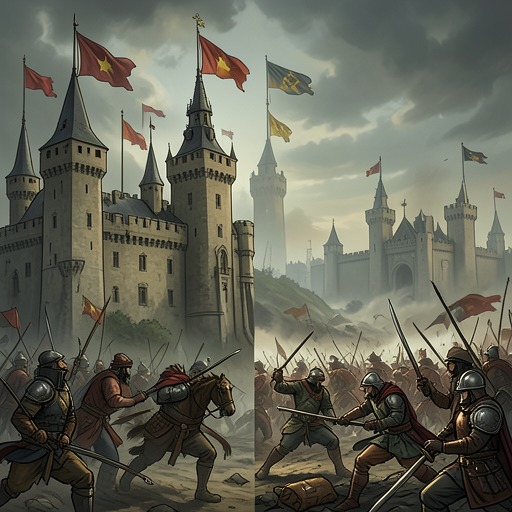
At Storm’s End, Catelyn sees the castle rising above rain-soaked fields and stony ridges while Stannis Baratheon’s encircling army appears tiny beneath its pale mass. Stannis’s foragers have cut down the trees for siege towers and catapults, and the altered landscape prompts her to remember that Ned Stark once rested in the same grove while leading a host to lift the last siege of Storm’s End. That earlier victory was bloodless, and Catelyn prays that she may achieve something similar. Her hope is not personal triumph but peace between rival claimants whose conflict endangers everyone.
Duty, Risk, and Mediation
Catelyn’s liege men believe her journey is madness. Ser Wendel Manderly argues that the fight is not theirs and that Robb would not wish his mother to risk herself. Catelyn answers that everyone is already at risk. She insists that she belongs at Riverrun with her dying father and at Winterfell with her sons, yet Robb sent her south to speak for him, and she will fulfill that commission. Her sharpness exposes the conflict between what she wants and what she believes must be done.
Her intended task is to forge peace between Stannis Baratheon and Renly Baratheon, whom she understands as brothers divided by a struggle for power. She knows that reconciliation will not be easy, but she judges that the good of the realm requires the attempt. This makes her a mediator without the power to command either side. Her influence rests on credibility, family connection, and the moral force of placing the realm’s survival above the immediate advantage of one claimant.
Catelyn’s conduct also embodies a conflict between competing ethical demands. A duty-centered view requires her to honor Robb’s command and protect her family’s interests; a consequence-centered view requires her to seek peace because continued rivalry will multiply the war; and a virtue-centered view asks her to remain courageous and responsible despite fear. She does not resolve these demands by choosing one and discarding the others. Instead, she carries them together, accepting danger because refusing it would leave others exposed.
Bereavement and the Collapse of Hope
The political mission is ultimately overshadowed by news from the north. A raven arrives from Castle Cerwyn, sent by Ser Rodrik Cassel, reporting that he has gathered what strength he can and is marching on Winterfell to retake the castle. The military information is immediately rendered insignificant by a more devastating revelation. When Brienne of Tarth asks whether the message concerns Catelyn’s sons, Catelyn can barely force the words out: she has no sons but Robb Stark.
She then explains that Bran Stark and Rickon Stark tried to escape but were captured at a mill on the Acorn Water, and that Theon Greyjoy has mounted their heads on the walls of Winterfell. The betrayal is made personal by Catelyn’s recollection that Theon ate at her table from the age of ten. The horror is not only that her children are apparently dead, but that their supposed killer was someone raised within the Stark household’s sphere of trust.
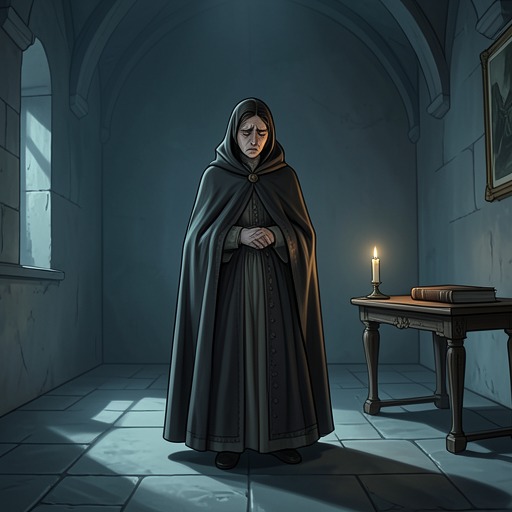
The wording of her confession marks a change in her relationship to the loss. Before speaking, she is trapped by the question’s simplicity and by the impossibility of giving a simple answer. Once she says the words, she feels that she has made the horror true by naming it. Her restraint—managing the statement without a sob—does not lessen the grief; it shows how thoroughly public composure has been forced to contain private devastation.
Narrative Role and Significance
Catelyn’s arc is defined by the collision between maternal attachment and political obligation. Robb’s crown, with its iron swords and winter-dark metals, externalizes the burden placed upon her son; her journey south shows her trying to keep that burden from becoming a catastrophe; and the news from Winterfell demonstrates that no act of mediation can fully shield a family already scattered by war.
She functions as a bridge between rival houses, generations, and forms of loyalty. Her movement from Riverrun to the besieged Storm’s End turns a family representative into a participant in the realm’s political crisis, while her later grief collapses the distinction between public messenger and bereaved mother. Catelyn’s significance therefore lies not in escaping the war’s consequences, but in making those consequences legible: behind crowns, sieges, armies, and claims to kingship are households whose members are used as symbols, hostages, and targets. Her attempt to speak for peace remains an act of responsibility precisely because she knows how much the conflict has already taken from her.