Daenerys Targaryen
A Clash of KingsDaenerys Targaryen is the last surviving child of King Aerys II Targaryen and Queen Rhaella, a fourteen-year-old widow whose authority is inseparable from the three dragons born through her ordeal by fire. Called Daenerys Stormborn, the Unburnt, Mother of Dragons, and Khaleesi, she begins as a displaced heir with a fragile following and ends the account as a ruler whose word commands her khalasar and whose existence has become consequential to the wider struggle for the Iron Throne.
Identity and Inheritance
Daenerys’s claim is rooted in blood, memory, and the collapse of the existing order. Robert Baratheon, the Usurper who displaced her family, is reported dead while she is in Qarth; the news brings joy to her because it confirms that the realm is no longer securely held by the man who took her inheritance. Arstan Whitebeard tells her that the Seven Kingdoms need her, that the realm is bleeding, and that four kings already contend for a country without justice. Her return is therefore presented not merely as a dynastic restoration but as a possible answer to political fragmentation.
Her royal identity is also built through names bestowed by others and accepted by herself. The Dothraki call the comet shierak qiya, the Bleeding Star, while Daenerys interprets it as the herald of her coming and a sign sent by the gods to show her the way. The titles Unburnt and Mother of Dragons make personal survival and political command indistinguishable: the woman who walked into the flames is also the woman who possesses living dragons, creatures no other person in the world can claim.
Fire, Loss, and the Dragons
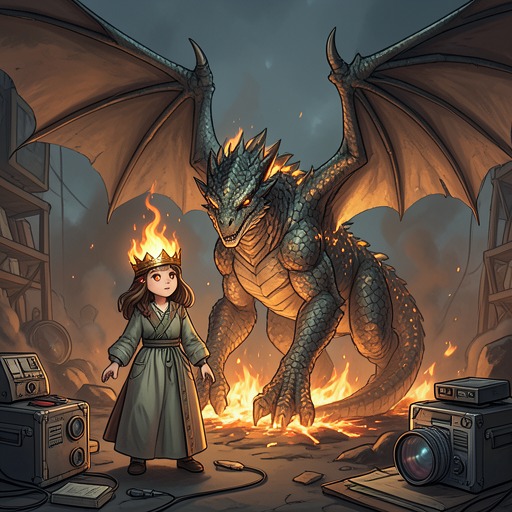
The dragons are born from catastrophe rather than inheritance alone. Daenerys understands them as having been given life by the deaths of her husband, her unborn son, and Mirri Maz Duur. She walked into the flames as they emerged and thereafter presents them as hers in the strongest possible sense, insisting that no man will take them from her while she lives. Her motherhood is thus both emotional and political: the dragons are children, proof of supernatural transformation, and a source of power that makes her vulnerable to every person who recognizes their value.
She names the dragons in relation to the dead. The green dragon becomes Rhaegal, after the brother who died on the green banks of the Trident; the cream-and-gold dragon becomes Viserion, after Viserys, whose cruelty and weakness do not erase his place as her brother. The black dragon is Drogon, named for Khal Drogo. These names preserve grief while converting it into a living future. The dragons do not simply commemorate the past; they carry the dead into Daenerys’s new political life.
The wider narrative repeatedly places Daenerys’s dragons beside other animal forms of knowledge and power. Bran Stark’s wolf dreams allow him to experience mountains and the world from a direwolf’s perspective; Grey Wind is said to have found the hidden goat track that enabled Robb Stark’s victory at Oxcross; the silence of the direwolves alarms Theon Greyjoy; and Jon Snow dreams of five scattered direwolves where there should have been six. Against these northern bonds, Daenerys’s relationship with her dragons appears as another model of human and nonhuman power joined together. Yet her dragons are not merely omens or symbols. They eat, grow, hiss, cling to her, and become the practical center of her claim.
The Comet and the Red Waste
The red comet gives Daenerys a direction when her material circumstances offer almost none. Ser Jorah Mormont warns that her dragons are still hatchlings, that an arakh could kill them, and that every man who sees them will want them. Her remaining followers are largely women, old or sick men, and boys, while the horses left to her are old, scrawny, ill, or lame. The stronger Dothraki have already seized the best of Drogo’s herds. Against this weakness, Daenerys chooses movement rather than submission: she orders the khalasar to follow the comet.
The decision marks a decisive change in her authority. She had named Ser Jorah the first of her Queensguard, and his counsel agrees with the omens, but the final command is hers. She mounts her silver mare wearing the skin of the white lion that Drogo killed, its head forming a hood over her burned-away hair. A dragon coils upon her arm while Ser Jorah rides beside her. Once she declares the route, no one challenges it. The people who had belonged to Drogo now belong to her; the Unburnt and Mother of Dragons has made her word their law.
The journey immediately tests the grandeur of that new identity. The khalasar rides by night and shelters beneath tents by day, leaving dead and dying horses behind. The land grows increasingly desolate, and even devilgrass becomes scarce. Doreah contracts a fatal fever, develops blood blisters, loses her hair, and finally lacks the strength to mount. Although Jhogo argues that she must be abandoned or tied to her saddle, Daenerys gives Doreah water, cools her brow, and holds her hand until she dies before allowing the khalasar to continue. Her rule is therefore defined not only by command but by a refusal to discard the weak when survival would make abandonment convenient.
Political Possibility and the Road Ahead
The report of Robert Baratheon’s death widens Daenerys’s horizon. She had been looking across the waste toward survival, but Belwas and Arstan later offer ships and a route back toward Pentos, saying that Magister Illyrio wants both the dragons and the girl who made them. They propose taking Daenerys, her three dragons, and her followers because the Seven Kingdoms have need of her. Daenerys keeps her joy from her face and answers in terms of what she possesses: three dragons and more than a hundred people in her khalasar, with their goods and horses.
That response shows how far she has moved from dependence on older men and inherited promises. She is still a claimant whose resources are precarious, but she now counts herself through the beings and people who follow her rather than through a lost court. The offer of ships recognizes that her dragons have altered the balance of power, while her insistence on their possession establishes the boundary of any alliance. She may accept guidance from Ser Jorah or a summons from Pentos, but her authority rests on the living power she has brought into the world.
Narrative Role and Significance
Daenerys’s trajectory combines exile, bereavement, initiation, and political ascent. The comet functions as a herald, the Red Waste as a threshold of deprivation, and the dragons as both reward and continuing ordeal. Unlike a completed return narrative, her journey has not yet brought her back to Westeros or restored her dynasty. The story ends with possibility rather than resolution: Robert is dead, the realm is divided, and Daenerys has the one power that can make her more than a forgotten heir.
Her contrast with the rival kings sharpens the book’s political argument. Robb Stark’s crown is a fresh bronze circlet marked with the runes of the First Men and nine black iron swords, while the grey direwolf banner turns northern history into a visible claim to independence. Renly Baratheon argues that Robert won the Iron Throne with a warhammer and treats kingship as a matter of force, fealty, and service rather than ancient right. Daenerys belongs to the same shattered political world, but her claim is carried by a different kind of image: not a forged crown or a battlefield banner, but three dragons emerging from fire and death. By the close of the narrative, that image has become a political fact.