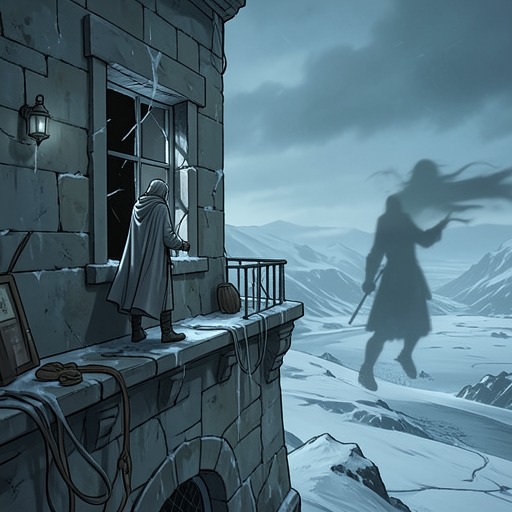
Deepwood Motte
A Clash of KingsDeepwood Motte is a northern castle and seat whose importance lies in the way it joins landscape, subsistence, and military access. Its position near the wooded western coast makes it vulnerable to an attack from the sea, while its harvests and local authority make it valuable to the forces struggling to hold the North. The castle is not presented through a single sustained siege scene; instead, its significance emerges through reports from its household, the plans of the ironborn, and the counteroffensive that follows.
Lordship and Provisioning
Deepwood Motte is represented at Winterfell by Glover men while Galbart and Robett Glover are absent. Their steward explains that Robett’s wife has remained behind because her children are too young for the journey, but Bran Stark soon perceives that the steward, rather than Lady Glover, truly governs the castle in practice. This detail makes Deepwood Motte more than a name on a map: it is a household whose authority is being exercised through delegated servants while its ruling family is divided by the war.
The steward is also responsible for deciding how much of the local harvest will be stored. He claims to be setting aside only a tenth, relying on a hedge wizard’s prediction of a plentiful summer before the cold arrives. Maester Luwin rejects the grounds for that confidence, and Ser Rodrik Cassel orders the reserve increased to a fifth. Deepwood Motte therefore enters the narrative as a material resource as well as a political seat. Its grain may determine whether people endure the coming cold, and its management exposes the tension between hopeful local custom and the harsher discipline demanded by wartime governance.
Target of the Ironborn Invasion
Balon Greyjoy assigns Asha Greyjoy thirty longships and picked men, ordering her to sail around Sea Dragon Point, land on the tidal flats north of Deepwood Motte, and march quickly against the castle. The plan depends on surprise: if Asha moves fast enough, Deepwood Motte may fall before its defenders understand that an attack is underway. Asha answers that she has always wanted a castle, and Balon tells her to take it. The exchange establishes the stronghold as a concrete prize in the Greyjoy campaign and marks it as the objective of a deliberately coastal assault rather than an inland advance.
The operation also reveals the different military logic surrounding the castle. Asha’s force approaches through the sea and tidal flats, exploiting the western coast and the mobility of the longships. Theon Greyjoy, by contrast, is sent to conduct reaving along the shore while his authority is limited by the presence of Dagmer Cleftjaw. Deepwood Motte thus forms part of a wider attempt to turn the North’s exposed coastline into an entry point for conquest, plunder, and political recognition.
Wider Northern Campaign
The castle’s strategic position is reinforced by the movements of nearby forces. The Glover steward comes from Deepwood Motte to Winterfell, while Tallhart men arrive from Torrhen’s Square, linking the stronghold to the network of northern houses responding to the war. Later, the defeat of Dagmer Cleftjaw at Torrhen’s Square gives Leobald Tallhart the confidence to leave his walls and join Ser Rodrik Cassel. Reports also state that Lord Manderly has sent barges upriver carrying knights, warhorses, and siege engines, while the Umbers gather beyond the Last River.
These developments change the meaning of Deepwood Motte’s position. A castle that the ironborn hope to seize quickly becomes part of a tightening northern defense. The failure at Torrhen’s Square deprives the invaders of the easy momentum on which their coastal strategy depends, while the gathering of mounted men and siege equipment threatens to bring a larger army against the ironborn-held positions. Deepwood Motte is consequently situated within a chain of strongholds whose control determines whether the invasion can remain a series of raids or become a durable occupation.
Architecture, Access, and Confinement
The surrounding narrative repeatedly contrasts Deepwood Motte with other fortified spaces. Harrenhal is seen as a colossal lake castle, its walls rising like cliffs and its towers twisted by dragonfire; the black iron gate encountered by the direwolves is another expression of stone defenses that permit no passage. In the Winterfell crypts, Osha leaves Bran Stark, Meera Reed, Hodor, and the wolves while attempting to clear a blocked door to the surface. These scenes do not describe Deepwood Motte’s own walls, but they place it within the book’s larger geography of castles as structures that regulate movement, conceal danger, and decide who can enter or escape.
Deepwood Motte’s distinctive access route is the one chosen by Asha: the tidal flats north of the castle. Its defenses are therefore shaped not only by masonry but by the relation between the stronghold and the coast. The same landscape that can sustain a lordship through its harvests can expose it to ships, sudden landings, and an enemy who does not approach by the expected road. The location’s narrative force comes from this double condition: it is a place of protection that can be reached through the environment surrounding it.
Narrative Significance
Deepwood Motte embodies the material stakes of the war in the North. Its steward’s argument over the harvest shows how distant military conflict enters ordinary administration, while Balon Greyjoy’s order to Asha demonstrates how the castle’s geography converts it into a tempting strategic objective. Its connection to Torrhen’s Square, the Stony Shore, Winterfell, and the forces gathering under northern commanders makes it part of an interconnected campaign rather than an isolated estate.
The castle also illustrates the instability of power during the Greyjoy invasion. Authority at Deepwood Motte is exercised by a steward in the absence of its ruling family; the stronghold is then threatened by an attack designed to exploit speed and surprise; and the fortunes of the invaders depend on battles fought elsewhere. Deepwood Motte therefore stands for a contested form of northern order, vulnerable at its edges but valuable precisely because it commands people, food, and access to the wider region.