Dragonglass
A Clash of KingsDragonglass is the black volcanic glass, also called obsidian, that Jon Snow discovers in a recently buried bundle at the Fist of the First Men. The find matters because it transforms an apparently mysterious grave into evidence of an older history and gives the Night’s Watch a weapon whose properties differ sharply from ordinary steel. Its recovery also becomes part of the warning that the world beyond the Wall is not merely wild but is stirring with forgotten powers.
Discovery Beneath the Fist of the First Men
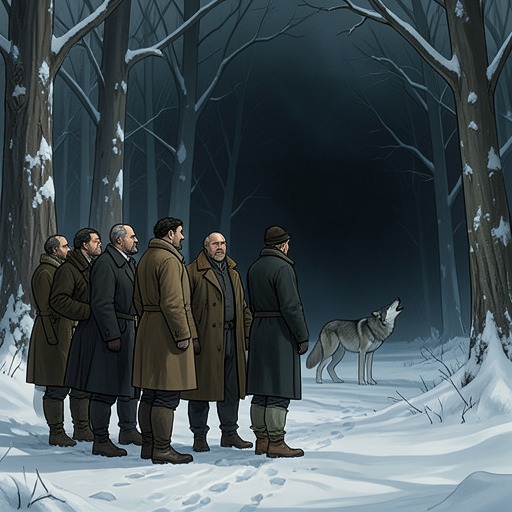
Jon finds the cache while searching the dark for Ghost. After following brief flashes of white through rocks, roots, holes, and thornbushes, he hears scrabbling and discovers the direwolf digging behind a fallen tree. The mound is made of loose, sandy earth without stones, roots, or the smell of decay, showing that whatever lies beneath has been buried recently rather than left as an ancient grave.
Two feet down, Jon encounters cloth wrapped around small, hard objects. When he frees the rounded bundle, its contents shift and clink, but the sound is wrong for coins or other metal treasure. A frayed rope holds the wrapping together. Once Jon cuts it with his dagger and pulls the cloth aside, a dozen knives, leaf-shaped spearheads, and numerous arrowheads spill onto the ground, their surfaces glittering darkly and brightly in the torchlight.
Among them, Jon picks up a dagger blade that is featherlight, hiltless, and shiny black. The torch catches its edge as a thin orange line, making its razor sharpness immediately visible. He identifies the material as dragonglass, the substance the maesters call obsidian, and wonders whether Ghost has uncovered an ancient cache belonging to the Children of the Forest, buried for thousands of years on the old Fist of the First Men.
Properties and Practical Use
The cache contains more than finished blades. Beneath the dragonglass lies an old bronze-banded warhorn made from an auroch’s horn, along with further arrowheads hidden inside it. The cloth surrounding the weapons is good, thick, double-woven wool; although damp, it is not rotted. Its black color and the bundle’s recent burial make clear that the cache was not simply an untouched relic from deep antiquity. The objects have been concealed in the recent past, even though their possible origin reaches much farther back.
Jon fashions a wooden hilt for one dragonglass blade and winds hempen twine around it for a grip. The result is ugly but serviceable. He judges the blade sharper than steel, while also recognizing that it is far more brittle. Dragonglass therefore offers an ambiguous kind of protection: it can cut more keenly than a conventional weapon, but it cannot endure the same punishment. Dolorous Edd dismisses glass knives as useless, whereas Jon remains unconvinced that they lack value.
Jon makes another dagger for Grenn and one for the Lord Commander. He gives the damaged warhorn to Samwell Tarly, who appreciates old things even when they are worthless; after Jon discovers that the horn is cracked, chipped at the rim, and incapable of producing a sound, he suggests using it as a drinking horn. Jon also distributes a spearhead and a dozen arrowheads, passing the rest among his friends for luck. The cache thus becomes not only armament but a set of tokens shared among the ranging party.
Meaning of the Burial and the Wider Threat
The objects’ concealment remains unexplained, and Jon’s conclusion is cautious but ominous: the dragonglass “must have been buried for a reason.” The sentence gives the material a narrative force beyond its immediate utility. It is a clue whose meaning has not yet been unlocked, and its unexplained presence links the physical ground beneath the expedition to histories that the Night’s Watch scarcely understands.
That tension deepens as the rangers encounter signs of renewed ancient power. Qhorin Halfhand tells Stonesnake to reach the Fist and warn Jeor Mormont about what Jon has seen: giants, wargs, and worse, together with the claim that “the trees have eyes again.” In that context, dragonglass belongs to a larger pattern. It is a tangible remnant of a hidden past discovered at the very moment when the wilderness begins to appear inhabited by forces older and stranger than the Watch’s customary enemies.
Narrative Significance
Dragonglass occupies the boundary between object and omen. At first it resembles treasure, but its forms are wrong for coins; then it resembles a burial offering, but there is no corpse; finally it becomes a weapon, though one whose fragility prevents it from being a simple improvement over steel. Each change in Jon’s understanding makes the material more conspicuous while leaving its deepest purpose unresolved.
The cache also turns Jon’s search for Ghost into an accidental act of historical recovery. Ghost’s digging exposes what human vigilance has missed, and Jon’s careful examination converts scattered objects into evidence. The black blades, the silent warhorn, and the shared arrowheads carry the memory of a vanished world into the present campaign. Their practical distribution among the brothers gives that memory a social life, while the unanswered reason for their burial preserves dragonglass as one of the story’s most important signs of dangers not yet fully revealed.