Dragons
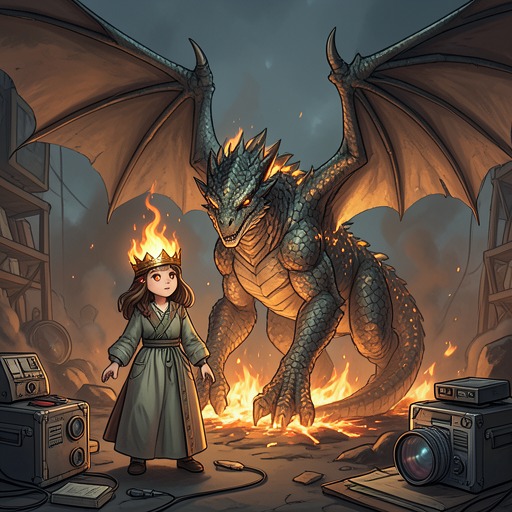
A Clash of KingsDragons are the most consequential living marvel in the narrative: three hatchlings whose survival gives Daenerys Targaryen a power no rival can easily measure or contain. They are at once vulnerable animals requiring food and protection, beings with their own appetites and perceptions, and the foundation of Daenerys’s claim to a future shaped by the return of an ancient force.
Rebirth and Political Value
Daenerys’s dragons are the only substantial military resource possessed by her starving khalasar. When Ser Jorah Mormont warns that Khal Pono commands ten thousand warriors while Daenerys has only a hundred people, she answers that she has the dragons. Jorah immediately identifies the danger within that hope: the hatchlings could be killed by a single stroke of an arakh, while a living dragon is beyond price, and only three exist in all the world. Their rarity makes them both a promise and a target. Daenerys therefore treats their possession as inseparable from her own survival, insisting that no one will take them from her while she lives.
Her attachment is not merely strategic. The dragons were born from faith and need, amid the deaths of Khal Drogo, her unborn son, and the maegi Mirri Maz Duur; Daenerys walked into the flames as they emerged and nursed them from her swollen breasts. Their origin binds catastrophe to renewal. They are living continuations of losses that might otherwise leave her only bereaved and powerless, and their existence turns her suffering into a source of authority that neither conventional inheritance nor armed followers could provide.
Bodies, Appetite, and Growth
At first the dragons are startlingly small, no larger than the scrawny cats Daenerys once saw around Magister Illyrio’s estate in Pentos. Their apparent fragility is deceptive. When they unfold their wings, each wing stretches to three times the creature’s length; translucent skin is held taut between long, thin bones, while neck, tail, and wing make up most of the body. Their scale and form emphasize that the marvel has returned in an infant state, not as an already perfected weapon.
Their independence appears most clearly in feeding. The hatchlings hissed and spat at raw horsemeat, with steam rising from their nostrils, and refused every morsel until Daenerys recalled Viserys’s childhood lesson that only dragons and men eat cooked meat. Once the meat was charred black, the dragons tore at it with heads that struck like snakes. They then consumed several times their own weight each day, growing larger and stronger. Their heat was palpable, and on cold nights their bodies seemed to steam. This is not passive symbolism: their physical needs alter the household’s routines, consume scarce resources, and determine whether the creatures can mature.
Daenerys keeps them close as the khalasar travels. At each evening departure she chooses one dragon to ride on her shoulder, while Irri and Jhiqui carry the other two in a woven-wood cage between their mounts. The arrangement keeps the hatchlings quiet and within sight, but it also reveals a relationship founded on continual management rather than complete mastery. They are dependent on human care while remaining dangerous, appetitive beings whose growth may eventually exceed the forms of protection designed for them.
Names and Valyrian Memory
The dragons restore a history that has survived only through stories. Daenerys tells her bloodriders that the dragons of Aegon’s Conquest were named for the gods of Old Valyria: Vhagar, Meraxes, and Balerion the Black Dread. The descriptions attached to those older creatures—armor-melting heat, horses swallowed whole, and wings whose shadows could cover towns—give the hatchlings a scale of ancestry they do not yet physically possess. The past is therefore not simply recalled; it is projected forward through the young bodies now traveling with Daenerys.
Their names turn family memory into a living genealogy. The green dragon is Rhaegal, named for Daenerys’s valiant brother Rhaegar, who died on the green banks of the Trident. The cream-and-gold dragon is Viserion, named for Viserys, whom Daenerys remembers as cruel, weak, and frightened, yet still recognizes as her brother. His dragon is imagined as accomplishing what Viserys could not. The black dragon receives the name Drogon, after Khal Drogo, Daenerys’s husband and former sun-and-stars. Each name preserves a dead person while also revising that person’s legacy: valor, failure, and intimate loss are redistributed among creatures that may create a different future.
The Dothraki respond uneasily to this historical continuity. Aggo sees the largest hatchling, black with vivid scarlet streaks on its scales, wings, and horns, and says that Balerion has come again. Daenerys accepts the resemblance but refuses simple repetition, answering that the dragon will have a new name for a new life. The dragons thus stand between inheritance and invention. They possess the aura of a vanished age, yet their identities are being made in the present by Daenerys’s choices.
Companionship and Independent Agency
The dragons do not merely extend Daenerys’s will; they intervene according to their own perceptions. When Captain Arstan Whitebeard speaks with Daenerys, green Rhaegal stares at him beneath her fingers, his eyes like molten gold and his teeth like black needles when he opens his mouth. The moment gives the dragon a watchful presence within a political conversation. Daenerys can touch and carry the creature, but she cannot reduce its gaze to an ornament. Its visible menace changes how a stranger’s presence is received.
That agency becomes decisive in the House of the Undying. As the Undying surround Daenerys and attack her with cold hands and mouths, the vision shifts from indigo to orange. A dragon perched above her spreads its wings and tears apart the terrible dark heart, then breathes fire. The Undying burn into parchment-like flesh and dry, tallow-soaked bones, while Daenerys pushes through the collapsing figures and calls for Drogon, who flies to her through the fire. In this crisis the dragon is not a weapon calmly directed by its rider. It acts as a rescuer, breaking the supernatural enclosure and making escape possible.
The rescue also establishes a recurring contrast between confinement and freedom. The dragons are carried in a cage during the march and held close to Daenerys’s body, yet in the decisive vision Drogon moves through fire to reach her. The creature’s value lies precisely in the fact that it cannot be treated as ordinary property: its power is intimate enough to protect her, but alien and dangerous enough to exceed ordinary human control.
Dragons and the Return of the Extraordinary
The dragons’ existence alters the political horizon of the world around them. Men who see them will want them, according to Ser Jorah, because their value exceeds that of the dragon eggs once prized above rubies. This anticipated struggle makes the creatures a source of future conflict even while they remain hatchlings. Their presence also gives material force to Daenerys’s identity as the Mother of Dragons and to the possibility that Targaryen power might return through living rather than merely genealogical evidence.
Their significance is sharpened by the surrounding signs of collapse. As the dragons prosper, Daenerys’s khalasar withers: supplies fail, horses die, people walk, and Doreah succumbs to illness. The juxtaposition prevents a simple triumphal reading of their birth. Dragons grow amid famine; their nourishment requires meat when human beings are starving; their promise is carried through a landscape where ordinary forms of life are disappearing. They embody renewal, but not an innocent or cost-free renewal.
Elsewhere, dragons are remembered through rumor, ancestry, and political speech. Theon Greyjoy’s reflections on the destruction of the Old Way place the Iron Islands inside a history reshaped by Aegon the Dragon, whose conquest ended the old reaving order. Renly Baratheon likewise treats Aegon’s conquest as proof that royal power depends less on abstract right than on the ability to win and hold allegiance. Against that history, Daenerys’s living dragons offer a different kind of legitimacy: not a legal argument alone, but an unmistakable force that can make old claims newly credible. The grey direwolf on the banner of the King in the North marks Stark identity through an animal emblem; Daenerys’s dragons go further, functioning as living companions, inherited names, political instruments, and agents whose return changes what power can mean.