Drogon
A Clash of KingsDrogon is Daenerys Targaryen’s black dragon and the most vividly assertive of her three hatchlings. His birth is inseparable from the deaths of Khal Drogo, Daenerys’s unborn son, and Mirri Maz Duur: Daenerys understands the dragons as creatures brought forth by faith, need, and loss, and insists that no man will take them from her while she lives. Drogon therefore signifies more than a rare living beast. He is the dangerous, breathing form of Daenerys’s survival and the power she claims as her own.
Identity and Naming
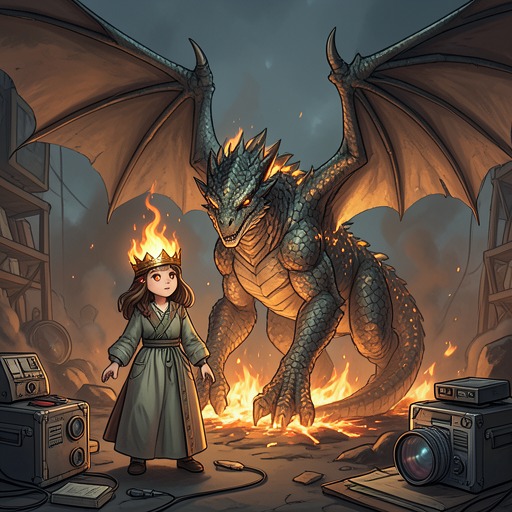
Drogon is the largest and most visually striking of Daenerys’s three young dragons. His scales are shiny black, marked by vivid scarlet streaks that continue across his wings and horns. When the Dothraki see him, Aggo compares him to Balerion, the Black Dread, recalling the imperial scale associated with the dragons of Old Valyria. Daenerys accepts the resemblance but refuses to let the comparison determine his identity. She names the black dragon Drogon, after the husband whose death helped make his birth possible.
The name places Drogon within Daenerys’s network of memory. Rhaegal commemorates her brother who died on the green banks of the Trident, while Viserion bears the name of the brother who was cruel, weak, and frightened. Drogon alone carries the name of the man Daenerys loved and lost. His black coloring, scarlet markings, and association with fire make him the most direct continuation of that loss, transformed into living strength rather than preserved as mourning alone.
Growth and Daily Bond with Daenerys
At first Drogon is still a hatchling, vulnerable to an arakh and potentially valuable enough to provoke every man who sees him into trying to seize him. Daenerys nonetheless regards the dragons as hers in an absolute, bodily sense. She says that they drank milk from her swollen breasts after emerging from the flames, making their bond simultaneously maternal, supernatural, and political. Her claim over Drogon is not a ceremonial title; it is a refusal to surrender the source of her new authority.
The dragons grow through carefully controlled feeding. Daenerys’s handmaids char horsemeat black, after which the hatchlings tear at it with heads that strike like snakes and consume several times their own weight each day. Their scales become smoother, their bodies larger and stronger, and their heat so palpable that they seem to steam on cold nights. Drogon’s development occurs alongside the khalasar’s deterioration: while people and horses wither in the desolation of the Red Waste, the dragons prosper, creating a stark contrast between the living engines of Daenerys’s future and the human community being consumed by the journey.
Each evening, as the khalasar sets out, Daenerys chooses one dragon to ride on her shoulder. Irri and Jhiqui carry the other two in a woven-wood cage between their mounts, keeping close enough that Daenerys never loses sight of them. Drogon is not merely transported as property. His presence is managed through proximity, dependence, and routine, while his position on Daenerys’s shoulder repeatedly displays the intimate alliance between ruler and creature.
Willfulness and the House of the Undying
Drogon’s independence becomes unmistakable in the House of the Undying. When the wizard king and the other Undying invite Daenerys to sit with them, promising knowledge, magical weapons, and answers to her questions, she begins to move toward them. Drogon abruptly leaps from her shoulder, flies to the top of an ebony-and-weirwood door, and bites at the carved wood. The act interrupts the seductive arrangement offered by the Undying and directs Daenerys’s attention toward another exit.
The contrast is crucial. The Undying present themselves as possessors of ancient knowledge who claim to have foreseen Daenerys’s arrival and even sent the comet to guide her. Drogon offers no explanation and makes no promise. His refusal is physical, immediate, and disruptive. His willfulness becomes a form of knowledge that Daenerys can trust more than the voices promising to satisfy every question. When she chooses the narrow hidden door, he flies back to her and follows her into the gloom.
The bond then becomes protective in the most literal sense. The Undying surround Daenerys, their cold bodies and mouths overwhelming her until she can no longer move. The scene turns from indigo visions to orange fire when Drogon spreads his wings above her and tears at the terrible dark heart. He rips the rotten flesh apart and breathes fire into the chamber, burning the Undying as their husk-like bodies crumble. Daenerys pushes through the falling figures while Drogon remains above her, and when she calls his name, he flies to her through the flames.
Drogon’s intervention changes the meaning of the ordeal. The House of the Undying attempts to absorb Daenerys into its visions and its ancient, deathly authority; Drogon restores her to heat, movement, and escape. His fire is not an ornamental emblem of Targaryen inheritance but an action that saves her life and destroys the power holding her captive. The dragon’s attack also establishes that his attachment to Daenerys does not make him passive. He acts on his own initiative, yet his independent action is aligned with her survival.
Political and Narrative Significance
Drogon’s importance is sharpened by the contrast between animal knowledge and human uncertainty elsewhere in the story. Grey Wind is credited with finding the hidden path that allowed Robb Stark to bypass the Tooth, while the direwolves’ silences and howls register losses that humans do not yet understand. Jon Snow dreams of five scattered direwolves where there should be six, and Bran Stark tries to answer Summer and Shaggydog’s mourning howl. Across these episodes, the animals perceive separation, danger, and change through forms of knowledge that exceed ordinary human speech.
Drogon belongs to this same pattern but carries a different political charge. The direwolves bind the Stark children to one another and to the North; Drogon gathers Daenerys’s personal grief into a visible instrument of future sovereignty. His name recalls Khal Drogo, his body recalls the lost dragonlords, and his fire makes escape possible when inherited promises prove deceptive. He is at once companion, weapon, heirloom, and unpredictable will.
Even before he can become a full-grown war dragon, Drogon alters the balance around Daenerys. Ser Jorah Mormont warns that every man who sees living dragons will want them, because a living dragon is beyond price. Daenerys’s insistence that the dragons are hers answers that threat with possession grounded in sacrifice rather than law. Drogon’s decisive act in the House of the Undying confirms the practical truth beneath her claim: whoever controls him does not merely possess a rare creature, but commands a power capable of breaking prisons, defeating ancient enemies, and carrying Daenerys into the next stage of her ascent.