Frostfangs
A Clash of KingsThe Frostfangs are presented as a landscape of immense cold, distance, and strategic danger. Their mountains are not merely a remote backdrop beyond the Wall: they hide Mance Rayder’s gathering, offer possible shelter for forbidden pursuits, and become the place where the scale of the wildling movement is finally revealed. In dreams and memories, their ice, precipices, and empty distances also enlarge the inner worlds of Bran Stark and Jon Snow, making the range a geography of both military threat and supernatural uncertainty.
Landscape and Setting
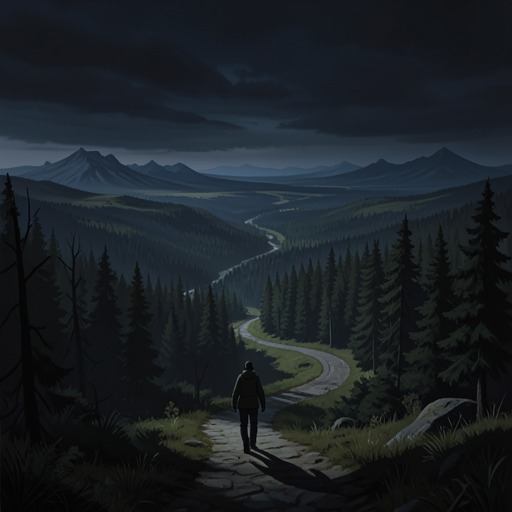
The Frostfangs are a cruel wilderness of stone and ice, far from the Wall and difficult to cross. From the heights, Jon Snow sees rugged country giving way to bare, stony hills and then to mountain ranges whose jagged peaks are sheathed eternally in snow. The mountains appear vast, cold, and inhospitable even at a distance, while the surrounding forest stretches in an apparently endless tangle of roots, limbs, pines, and weirwoods. The landscape combines commanding views with concealment: a high ridge may expose a valley, but the forest below can hide almost anything moving through it.
The range is therefore both sublime and threatening. Its scale exceeds ordinary human control, while its ravines, snowfields, and wooded hollows make knowledge provisional. Jon can see the Milkwater shining far below and the mountains receding into blue-grey distance, yet he cannot determine what may be moving beneath the forest canopy. The Frostfangs offer grandeur without safety; visibility opens onto remoteness rather than mastery.
Mance Rayder’s Muster
The Frostfangs become central to the Night’s Watch’s understanding of the crisis beyond the Wall when Craster confirms that Mance Rayder is gathering his people there. The villages are empty because wildlings are moving toward the mountains, and the information about the location transforms scattered reports into a coherent threat. The question is whether Mance is building a city or an army, but the inhospitable terrain makes a large permanent settlement difficult to sustain. Jeor Mormont therefore concludes that the gathering has a military purpose: Mance intends to strike south into the Seven Kingdoms.
Qhorin Halfhand offers a darker interpretation. He argues that Mance has chosen the mountains not only to conceal his forces but because he is seeking something in the high, cold places. His explanation is bluntly summarized as sorcery, suggesting that the Frostfangs conceal more than a troop concentration. The range thus becomes a place where military preparation and occult purpose overlap, and where the Night’s Watch must respond to an enemy whose aims remain only partly understood.
The Hidden Host
Jon’s vision gives the most concrete sense of what the Frostfangs contain. From a great precipice, he looks down on a valley bounded by a blue-white wall of ice, a river of ice several thousand feet high, and a deep cobalt lake reflecting the surrounding snowcapped peaks. Below, thousands of people are gathered. Some dig enormous holes in the half-frozen ground; others train for war, including riders charging a shield wall in a mock battle.
The encampment does not resemble an orderly royal army. There are no regular ditches, sharpened stakes, or neat horse lines. Instead, crude earthen shelters and hide tents spread haphazardly across the valley, alongside hay, goats, sheep, horses, pigs, and numerous dogs. Smoke rises from a thousand cookfires. The disorder is itself significant: the gathering is not simply a camp or a town but an entire people assembled in one place. The Frostfangs are consequently both the shield that hides the wildlings and the basin in which their collective strength becomes visible.
Dreams, Wolves, and Uncertainty
The mountains also inhabit the wolf-dreams of Bran Stark. In those dreams he can race up jagged icy mountains taller than any tower and stand beneath the full moon with the world spread below him. His longing to understand the wolves’ song makes the Frostfangs part of a larger uncertainty about the bond between human consciousness and animal perception. The mountains are experienced through the freedom of the direwolf as well as through Bran’s vulnerable human body, offering a realm in which ordinary physical limits are temporarily displaced.
Jon’s own dream reverses that sense of freedom. He sees five direwolves where there should be six, scattered from one another across a vast, cold forest. He feels emptiness and incompleteness, searches for his brothers and sister, and hears only the sigh of blowing snow in answer to his cry. The dream places familial separation within a landscape that seems too large to reunite its inhabitants. The Frostfangs therefore function psychologically as a space of lost connections as much as geographically as a mountain range.
Strategic and Narrative Significance
The range’s importance lies in the convergence of remoteness, concealment, and revelation. Mance Rayder chooses it because distance from the Wall and the severity of the terrain protect his muster, while the same isolation makes the gathering difficult for the Night’s Watch to measure. The Frostfangs turn geography into political force: mountains can hide a people, delay pursuit, and permit an army to form beyond the reach of ordinary surveillance.
At the same time, the range resists complete explanation. Its physical dangers are clear, but Qhorin’s suspicion of sorcery and the dream imagery associated with its icy heights introduce possibilities that cannot be reduced to military geography. The Frostfangs stand at the boundary between the known and the unknowable, where an apparently chaotic host may conceal a larger purpose and where visions can disclose realities that ordinary sight cannot reach. Their narrative power comes from that double function: they are a real strategic refuge and a symbolic threshold into the book’s expanding supernatural world.