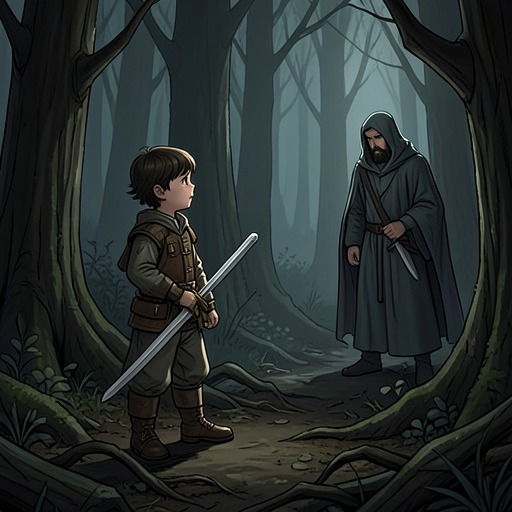
Hot Pie
A Clash of KingsHot Pie is one of the orphaned boys swept into the dangerous movement of wartime Westeros, but his importance lies in the ordinary humanity he carries through extraordinary violence. A baker’s son rather than a warrior, he is defined by food, bodily fear, blunt speech, and a capacity for unexpected solidarity. His apparent smallness becomes a measure of the world around him: in a land where nobles debate crowns and commanders order killings, Hot Pie remembers hunger, labor, and the immediate obligation to help someone being threatened.
Identity and Background
Hot Pie’s name comes from the street cry he once used while pushing his dead mother’s cart through the city: “Hot pies! Hot pies!” His background is therefore tied to work and food rather than lineage, arms, or courtly status. The memory gives his identity a material foundation. He knows the world through ovens, carts, pastries, and the practical business of feeding people, even as war turns food into a scarce and politically explosive resource.
He travels in the company of Arya Stark, Gendry, Lommy Greenhands, and other recruits under Yoren’s protection. Unlike the armed men around them, Hot Pie has no established martial identity. His first prominent interaction with Arya is comic and hostile: when the boys notice Needle, they mock Arya as a supposed “little squire” and question whether her sword is real. Hot Pie joins the teasing, suggesting that she is some lord’s squire boy, while Arya angrily defends Needle as castle-forged steel. His participation places him among the boys who misread Arya’s silence as fear, stupidity, or deafness.
From Bullying to Loyalty
Hot Pie’s relationship with Arya changes when danger makes his earlier mockery irrelevant. At the inn, when violence threatens Arya and her companions, he scrambles on all fours to find a large rock to throw. Arya is astonished because she hates him and cannot understand why he would risk himself for her. His action is not the gesture of a trained fighter: he reaches for the weapon available to an untrained, frightened boy. Precisely for that reason, it registers as an uncalculated act of courage.
Arya then refuses to let Hot Pie and the others die for her as Syrio Forel died protecting her. She pushes through the hedge with Needle and assumes a water dancer’s stance, turning the confrontation into a fight she will face herself. Hot Pie’s intervention nevertheless matters. He does not become a swordsman, nor does his fear disappear; instead, his loyalty appears in the form his limited abilities permit. The episode complicates Arya’s initial judgment of him, showing that a boy who helped ridicule her can still stand beside her when the consequences become real.
That same mixture of fear and attachment appears during the journey north. When Hot Pie sees the one-armed woman thrashing in the wagon, he admits that he is scared. Arya confesses the same. He then tells her that he never truly kicked a boy to death and that he only sold his mother’s pies. The confession strips away the violent persona he may have used to seem formidable. In the face of suffering, Hot Pie’s bravado collapses into a child’s account of what he actually is: a frightened working boy whose real experience is selling food, not killing.
Bread, Hunger, and the Wartime World
Hot Pie’s presence also connects the personal story to the broader food crisis. The countryside through which Arya’s group travels is marked by burned fields and displaced people, while inns fill with those fleeing south. In that setting, Hot Pie’s baker’s background is not decorative. It places him close to the basic resource whose scarcity exposes the failure of rulers and armies.
In King’s Landing, Tyrion Lannister sees markets crowded with people selling household goods, farmers conspicuously absent, produce priced at three times its former cost, and even roasted rats offered as food. Bakers hire sellswords to guard their shops because lean times make bread more valuable and dangerous. Later, bakers, butchers, and greengrocers gather to demand protection after a baker is burned in his own oven by a mob accusing him of charging too much. These scenes give Hot Pie’s history a grim political resonance: his childhood cry for hot pies belongs to the same economy in which bread can mean survival, resentment, and collective violence.
His own later work preserves the humble side of that theme. At Harrenhal, Hot Pie kneads bread with flour up to his elbows and complains that he needs an entire tray of tarts because Ser Amory Lorch favors them. He is not presented as escaping the world through heroic transformation. He remains a baker’s boy, and baking becomes one of the few stable forms of usefulness available amid imprisonment, suspicion, and death.
Fear, Memory, and Survival
Hot Pie is repeatedly associated with fear, but the narrative does not treat fear as simple cowardice. He is frightened by the injured woman, by the stories of ghosts at Harrenhal, and by the violence surrounding the traveling group. Yet fear coexists with action. He reaches for a rock when Arya is threatened, speaks honestly when he is terrified, and continues performing necessary work after arriving at Harrenhal.
His exchange with Arya also reveals how stories and rumors shape the emotional experience of war. After the woman dies and is buried beneath a weeping willow, Arya remembers Old Nan’s tale of a man who escapes evil giants only to be seized by the Others. Hot Pie’s fear belongs to the same imaginative world, where ordinary dangers merge with legends, ghosts, and the supernatural. At Harrenhal, he reports that there are ghosts because Pia saw something in the buttery, while Arya dismisses Pia’s visions as usually involving men. Hot Pie’s belief is comic on the surface, but it reflects a castle saturated with unexplained violence and death.
His survival is therefore neither triumphant nor passive. He endures by remaining useful, by acknowledging fear rather than mastering it, and by relying on a social bond that began in antagonism. The boy who once helped mock Needle becomes one of the companions whose small acts make Arya’s dangerous passage less solitary.
Narrative Role and Significance
Hot Pie serves as a counterpoint to the book’s warriors, rulers, and assassins. He has no claim to power and no special destiny. His memorable traits are deliberately modest: a baker’s past, a hunger for food, a talent for blunt remarks, fear of violence, and an occasional readiness to help. Those qualities make his courage more credible because it is not the polished courage of a knight. It is the improvised courage of someone who knows he is outmatched and acts anyway.
He also helps expose the distance between public identities and private reality. Arya is mistaken for a helpless boy, while Hot Pie exaggerates his own violence before admitting that he only sold his mother’s pies. In both cases, the journey strips away imposed stories. Hot Pie’s name sounds comic, yet bread is among the most serious concerns in a starving kingdom; his conduct seems fearful, yet he risks himself for Arya; his world appears narrow, yet it places him directly inside the political crisis created by hunger.
The result is a character whose significance comes from persistence rather than conquest. Hot Pie does not win a battle or alter a succession. He keeps kneading bread, remembers his mother’s trade, voices the fears that others conceal, and sometimes finds the courage to stand with someone in danger. Through him, the narrative preserves the moral weight of ordinary people whom war usually reduces to crowds, mobs, refugees, or casualties.