Jojen Reed
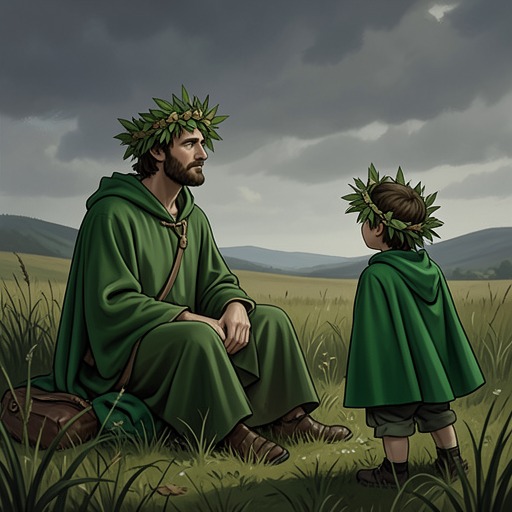
A Clash of KingsJojen Reed enters Winterfell as the younger, unarmed brother of Meera Reed and the son of Howland Reed, a great friend of the Stark family. Though several years younger than Meera, he is nearly Bran Stark’s height, slight and slender, dressed entirely in green, with moss-colored eyes and strikingly white teeth. His appearance is quiet rather than martial, but his solemnity gives him an authority disproportionate to his age. He and Meera kneel before the Stark dais to renew their family’s ancient fealty to the King in the North, speaking for the people of the Neck while Robb Stark is away fighting in the south.
Identity and Introduction
Jojen’s defining attribute is his possession of green dreams, prophetic visions that he distinguishes from ordinary dreams. Meera explains that her brother dreams as other boys do, but that green dreams are different. Jojen himself treats them as a form of knowledge: when a vision comes, he believes its truth does not depend on whether others find it strange. His moss-colored eyes, already emphasized at his introduction, become part of this impression of a boy who seems to look beyond the immediate scene and perceive something hidden behind it.
Jojen’s social identity also places him between worlds. He is a Reed of Greywater Watch, a family that has sworn fealty to the Starks for generations, yet his clothing, weapons, and manner mark him as culturally distinct from the northern household at Winterfell. Meera arrives equipped with a bronze-scaled jerkin, a long bronze knife, a frog spear, and a round shield, while Jojen carries no weapons. His authority therefore comes not from force but from interpretation: he reads signs, dreams, and impending dangers that the armed retainers around him cannot see.
Prophecy and Guidance
Jojen quickly becomes a guide to Bran, urging him to leave Winterfell sooner rather than later. The advice is unsettling because Bran has spent his whole life there and longs to see distant places, while the practical obstacles are immediate: Ser Rodrik Cassel is away dealing with turmoil in the east, and Maester Luwin would not permit Bran to leave. Jojen’s counsel thus turns Bran’s ordinary desire for travel into something more urgent. Departure is not merely an adventure or a prince’s wish; in Jojen’s reading, it is necessary.
The most revealing of Jojen’s green dreams concerns a winged wolf bound to earth by grey stone chains. A crow attempts to peck through the chains, but the stone is too hard and the beak can only chip it. When Bran asks whether the crow had three eyes, Jojen confirms that it did. The image presents Bran’s condition through a symbolic structure of confinement and attempted release: the winged wolf suggests a creature made for movement yet held down, while the three-eyed crow signals the mysterious knowledge gathering around him. Jojen does not explain every element, but his certainty makes the dream a framework through which Bran can understand his own stalled and altered life.
Jojen’s prophecy is not limited to symbolic images. When Bran doubts the meaning of dreams and repeats Maester Luwin’s view that they might mean anything or nothing, Jojen answers through a vision of the sea coming to Winterfell. He has seen black waves crashing against the gates and towers, salt water flowing over the walls, and drowned men floating in the yard. The dream first lacked recognizable faces, but after Jojen reached Winterfell he identified several of the dead: Alebelly, the guard who called the Reeds’ names at the feast; the septon; and the smith. This movement from indistinct vision to concrete recognition strengthens the dream’s force and gives Jojen a method of verification grounded in people Bran knows.
Relationship with Bran Stark
Jojen’s connection with Bran is founded on a contrast between Bran’s uncertainty and Jojen’s conviction. Bran is forced to answer for Robb Stark because Robb is absent, and he initially struggles to respond when Meera addresses the Stark household. Jojen later addresses Bran more directly, not as a helpless child but as someone whose future requires a decision. His instruction that Bran leave Winterfell places him in a mentor-like role, though the guidance is inverted: Jojen is younger, physically unthreatening, and unarmed, yet he possesses knowledge that the older adults around Bran lack.
The relationship also depends on trust. Jojen asks whether Bran believes him and whether Bran will trust words that sound strange. Bran’s nod marks a decisive shift from skepticism toward acceptance. That trust does not arise from a single explanation; it is produced by the accumulation of Jojen’s bearing, his distinction between ordinary and green dreams, the image of the winged wolf and the three-eyed crow, and the recognizable dead in the vision of the sea. Jojen’s power in Bran’s story is therefore not simply that he predicts danger, but that he teaches Bran how to treat the inexplicable as potentially real.
Narrative Role and Significance
Jojen functions as a herald of change and a threshold guide for Bran. His repeated insistence that Bran leave Winterfell turns the castle from a permanent home into a place marked for catastrophe. The sea dream makes that threat physical: walls, gates, towers, and familiar people are all exposed to a force that will overwhelm the structure meant to protect them. His prophecies also connect Bran’s personal imprisonment to a larger pattern of hidden knowledge, represented by the three-eyed crow and the chained winged wolf.
Yet Jojen’s significance lies as much in the form of his knowledge as in its content. He does not offer Bran a complete explanation or a safe route forward. Instead, he delivers fragments—a chain, a crow with three eyes, black waves, drowned bodies, and faces recognized only after the vision begins to unfold. These fragments demand interpretation and leave Bran suspended between ordinary political troubles and a deeper danger that the adults cannot adequately name. Jojen thus makes prophecy feel less like an answer than an obligation: once Bran trusts the vision, remaining still becomes impossible.