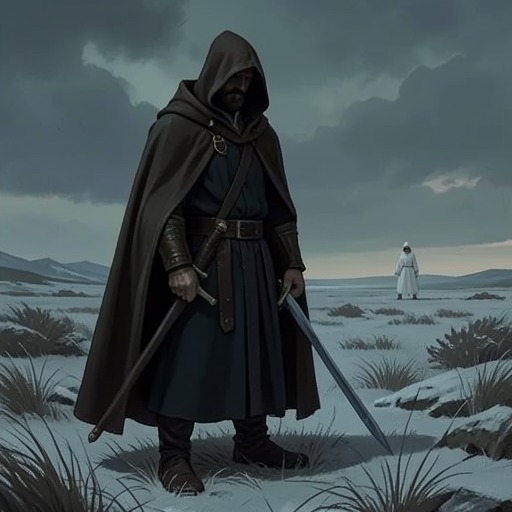
Jon Snow's capture of Ygritte
A Clash of KingsJon Snow's capture of Ygritte is significant because it turns a routine reconnaissance attack into the first intimate breach between Jon Snow and the wildlings. Ordered to kill, Jon instead takes Ygritte alive and then releases her, converting an enemy encounter into a moral and emotional bond. The decisive movement is not the capture alone but the sequence of recognition, surrender, hesitation, and mercy through which Jon's identity as a sworn brother begins to strain against his response to an individual enemy.
The Ambush in the Pass
Three wildlings had established a watchfire in a shallow depression above the narrowest part of a mountain pass. The position gave them shelter from the wind and a sheer drop below, but the same windbreak allowed the black brothers to crawl close to them on their bellies. Jon Snow and Stonesnake approached with the immediate purpose of killing the watchers before they could raise an alarm. The apparent advantage of surprise was complicated when Jon discovered that there were three enemies rather than the expected two: one slept beneath skins, one tended the fire, and one watched the pass with a horn.
Stonesnake moved first, leaping down among the wildlings as stones rattled around him. Jon Snow drew Longclaw and followed. The attack became a compressed struggle in which every object carried tactical meaning. The horn threatened to summon help, the fire supplied a weapon, and the sleeping figure transformed the encounter from a simple two-man assault into a fight against an unknown third combatant. Jon's opponent seized a burning brand and thrust it toward his face; Jon drove forward and struck with both hands, using Longclaw to cut through leather, fur, wool, and flesh. The dying man twisted as he fell and tore the sword from Jon's grasp, forcing Jon to continue with his dirk.
Recognition and Surrender
As the sleeper sat up beneath the furs, Jon Snow seized the figure by the hair and pressed the point of his dirk beneath the chin. He first assumed that he had another male wildling before him, but his hand stopped when he realized that the captive was a girl. The recognition changes the moral texture of the attack without removing its danger. Stonesnake identifies her as a watcher and a wildling and urges Jon to finish her, while the long-hafted axe beside her sleeping furs confirms that she is a spearwife who would have fought if given the opportunity.
Jon sees fear and fire in Ygritte's eyes, and blood runs down her throat where the dirk has pricked her skin. He notices that she is no older than he is and that something about her makes him think of Arya Stark, although the two girls look nothing alike. That association does not erase his duty, but it interrupts the easy division between a sworn brother's people and an enemy's people. Jon asks whether she will yield. Ygritte answers, “I yield.” He withdraws the dirk and declares her his captive, despite Stonesnake's objection that Qhorin Halfhand had said nothing about taking captives. Ygritte's response, “I gave you my name,” introduces a different understanding of the encounter: she has offered not merely submission but a human identity, resisting reduction to the category of wildling target.
The Refusal to Execute Her
The capture becomes a test of whether Jon Snow will obey an impersonal military logic or act according to his own judgment. Ygritte is dangerous, armed with an axe, and still close enough to kill him if she receives even half a chance. Jon kicks the weapon beyond her reach, but he does not kill her immediately. Later, when he and Ygritte are separated from the others, the question of execution returns in a starkly ritual form.
Jon asks whether she is afraid. Ygritte admits that she was afraid the previous night, but says that daylight has changed the matter. She bares her neck and kneels before him, asking him to strike hard and true and warning that she will haunt him. Jon draws Longclaw over his shoulder and measures the place where the blow should fall. The sword is not as long or heavy as his father's Ice, but it is Valyrian steel, and Jon believes that he can at least give her a quick death. His hesitation exposes the pressure beneath the formal duty: he tries to imagine himself as his father's son and as the man his training requires, yet the blow does not come.
Ygritte urges him to act before her courage fails. Jon lowers Longclaw and tells her to go, ordering her to flee before his judgment returns. The decision is a sharp value reversal. The scene begins with Jon acting as a hunter and Ygritte as prey; it ends with Jon sacrificing the certainty of obedience and Ygritte receiving freedom. His mercy is not presented as a safe or officially sanctioned resolution. It is an unauthorized choice made in the space between command and conscience, and it leaves the consequences of that choice attached to both of them.
Context of Captivity and War
The encounter takes place within a broader landscape in which captivity routinely means exposure to arbitrary violence rather than protection by law. Arya Stark's experience among the prisoners at the Gods Eye shows the same world from the ground level of the powerless: she remains in a storehouse for eight days, seeing someone die each day while Ser Gregor Clegane selects prisoners for questioning. Those too weak to march are killed, women are taken by soldiers, and one woman is publicly beheaded after resisting repeated abuse. Against that background, Ygritte's survival depends on Jon Snow's individual refusal, not on any reliable rule governing prisoners.
The contrast is also visible in the political centers of the war. In King's Landing, Jacelyn Bywater reports that thieves and murderers are abroad, disease is spreading along Pisswater Bend, food cannot be bought even with money, and treason is openly discussed in guildhalls and markets. At the same time, Osfryd Kettleblack reports that merchants are gathering in the square to seek refuge, and the queen orders that some be killed if they refuse to return home. These scenes establish a recurring wartime pattern: authorities speak in the language of order while treating vulnerable people as expendable. Jon Snow's decision does not undo that system, but it creates a small counterexample in which an enemy is recognized as a person before being destroyed.
Narrative Consequences and Significance
Jon Snow's choice to spare Ygritte does not resolve the conflict between the Night's Watch and the wildlings. It instead makes that conflict personal. The woman whom Jon was expected to kill now survives because he acted against the immediate logic of the mission, and her name, surrender, fear, and courage remain attached to the decision. The scene therefore functions as both a capture and a release: Jon takes Ygritte prisoner, but his inability to execute her releases her; in turn, Ygritte's presence forces Jon to understand that the enemy possesses age, fear, courage, and self-chosen identity just as he does.
The event also marks a change in Jon's conduct. He has trained for the moment when he must use his sword, and during the ambush he does kill a wildling with Longclaw. Yet the killing does not settle what duty requires when the opponent is disarmed and yielding. His resemblance to Arya Stark in memory, Ygritte's kneeling body, the blood at her throat, and the cold edge of Longclaw all make the decision concrete rather than abstract. Jon Snow's capture of Ygritte thus begins not with triumph but with a failure of certainty: he succeeds as a fighter, doubts as an executioner, and chooses mercy before his wits can compel him to reverse it.