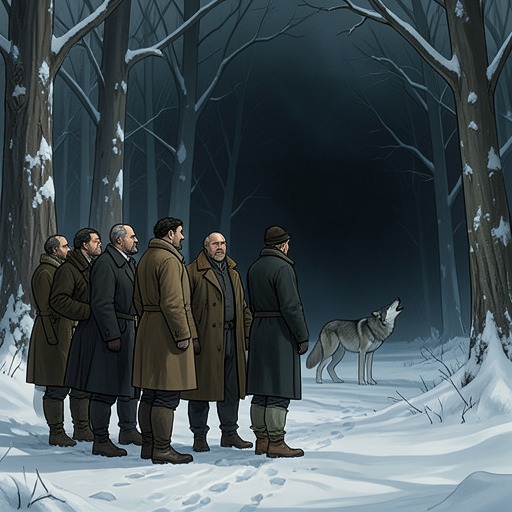
Mance Rayder
A Clash of KingsMance Rayder is a former ranger of the Night’s Watch who abandons the order and returns to the people among whom he was born, eventually becoming their king beyond the Wall. In the account given by the Night’s Watch, his gathering of wildlings in the Frostfangs is not a raid or a temporary migration but the preparation for a southward strike into the Seven Kingdoms. His importance lies in the way he turns the wildlings from scattered border communities into a coordinated force at the precise moment when the Wall and the realm are least prepared to resist them.
Identity and Background
Mance Rayder’s history binds him to both sides of the Wall. Qhorin Halfhand explains that Mance was wildling-born and was taken as a child after raiders were defeated. Raised within the Night’s Watch, he eventually left the Shadow Tower and, in Qhorin’s formulation, was only returning home. His desertion therefore cannot be reduced to a simple act of treason: it is also a reversal of an imposed allegiance and a return to the culture from which he came.
His motives are reported through competing explanations. Some say he deserted for a woman; others believe he sought a crown. Qhorin grants that Mance liked women and was not a man whose knees bent easily, but identifies a deeper cause in his love of the wild. The conflict between duty and belonging defines his place in the story: he is an oathbreaker to the Night’s Watch, yet his breach of its vows is also the act by which he becomes fully aligned with the wildlings.
The Gathering in the Frostfangs
The immediate evidence of Mance Rayder’s leadership comes from Craster, whose information confirms the Night’s Watch’s suspicions. Villages north of the Wall are empty because Mance is gathering his people in the Frostfangs. The mountains are described as cruel and inhospitable, a wilderness of stone and ice that cannot sustain a large population for long. From that geographical fact, Lord Commander Jeor Mormont infers the purpose of the movement: Mance means to lead the wildlings south into the Seven Kingdoms.
The scale of the force remains uncertain. No one knows how many wildlings have assembled or how many are of fighting age, and the question of whether Mance is building a city or an army is left open. Yet the uncertainty increases rather than diminishes the threat. The gathering has emptied settlements, concentrated people in an otherwise hostile landscape, and produced a movement whose military strength the Night’s Watch cannot confidently measure.
Mance’s opportunity is created by the political collapse of the south. The Lord of Winterfell is dead, his heir has marched south to fight the Lannisters, and the Night’s Watch is only a shadow of its former strength. Jeor Mormont recalls earlier wildling invasions led by figures such as Raymun Redbeard, Bael the Bard, the Horned Lord, Gendel and Gorne, and Joramun, but insists that Mance has advantages his predecessors did not. He has seen the weakness of the Wall’s defenders, and no one has ever dared call him fainthearted.
Military Threat and Intelligence
Reports reaching the Night’s Watch suggest that Mance’s coalition contains more than ordinary raiders. Qhorin Halfhand names Rattleshirt, the Weeping Man, and other chiefs, and reports that the wildlings possess wargs, mammoths, and greater strength than the Watch had imagined. Qhorin does not swear that every detail is true, since the captured informant may have exaggerated in order to prolong his life, but uncertainty cannot justify inaction. Whatever the exact numbers, the Wall must be warned, and so must the king.
The information changes the strategic meaning of Mance’s movement. A conventional wildling raid might be met as a border emergency; a gathering of chiefs, skinchangers, mammoths, and fighting men implies a coordinated campaign. The Night’s Watch therefore treats Mance not merely as a deserter or rival commander but as the organizer of a force capable of exploiting the realm’s divided attention and the Watch’s depleted ranks.
Conflict with the Night’s Watch
Mance’s relationship with the Night’s Watch is marked by intimacy as well as hostility. Qhorin says that the brothers of the Watch all knew him and that they had been friends as well as brothers. Now they are sworn foes. This contrast gives Mance’s opposition a personal dimension: the Watch is not confronting an unknown enemy beyond the Wall, but a man who understands its customs, weaknesses, terrain, and internal limitations from experience.
His former service also makes his present leadership a form of inverted mentorship. The Night’s Watch taught Mance the discipline and knowledge needed to defend the Wall; he carries that knowledge back to the wildlings. His strength comes not from ignorance of the Watch but from familiarity with it, while the Watch must confront an adversary who knows the institution from within and understands what its diminished condition means.
Narrative Role and Significance
Mance Rayder is largely constructed through recollection, reports, and strategic inference rather than direct appearance. He is therefore a powerful absent presence: the reader encounters the effects of his decisions before meeting the man himself. Empty villages, rumors of assembled chiefs, uncertain numbers, and warnings about wargs and mammoths make him legible as a threat whose outline grows through accumulated intelligence.
His story also unsettles the Night’s Watch’s moral categories. The order calls him an oathbreaker, but the account of his childhood and return home complicates the judgment. He is both deserter and displaced son, former brother and present enemy, political claimant and organizer of a vulnerable population. The narrative does not erase the danger he poses, but it prevents that danger from being understood as simple barbarism. Mance Rayder’s rise exposes the cost of the Watch’s decline and the consequences of a realm that has turned southward while danger gathers in the Frostfangs.