Melisandre
A Clash of KingsMelisandre, known as the Red Woman, is a priestess of R’hllor, the Lord of Light, the Heart of Fire, and the God of Flame and Shadow. On Dragonstone she is identified as a sorceress, shadowbinder, and the dangerous spiritual influence at the heart of Stannis Baratheon’s cause. Her importance lies not only in what she believes, but in her ability to convert belief into public action: prophecy becomes a claim to kingship, fire becomes proof, and shadowbinding becomes an instrument of assassination.
Identity and Presence
Melisandre’s appearance makes her seem less like an ordinary court religious figure than a living emblem of her faith. She dresses entirely in scarlet satin and blood velvet, with a ruby at her throat that seems to burn beside her red eyes. Her hair is a deep burnished copper rather than the more familiar shades of red, while her skin is smooth, white, and unblemished. She is slender, graceful, taller than most knights, and physically striking enough that men find it difficult to look away.
Yet the narration refuses to settle for conventional beauty. Melisandre is described as red and terrible rather than simply beautiful, so that color becomes her defining quality. Her red clothing, eyes, hair, ruby, and religious association with fire fuse her body with the imagery of R’hllor. The effect is not decorative. Her appearance creates an atmosphere of alarm and compulsion before she performs any act of sorcery, making perception itself part of her power.
She is also marked by a voice associated with the Jade Sea, a detail that places her outside the local world of Dragonstone even as she seeks to transform it. Servants fear to speak her name and call her the red woman instead. Cressen, who regards her as a madness that must not spread beyond Dragonstone, understands that her influence is already greater than that of a private adviser: she has become the personification of a rival religious and political order.
Prophecy and Stannis Baratheon’s Kingship
Melisandre presents Stannis Baratheon’s struggle as the fulfillment of an ancient prophecy. Before the gathered host, she declares that after a long summer the stars will bleed and the cold breath of darkness will weigh upon the world. In that hour, according to the books of Asshai, a warrior will draw a burning sword from the fire. The sword will be Lightbringer, the Red Sword of Heroes, and the warrior who claims it will be Azor Ahai returned, through whom darkness will flee.
Her speech gives Stannis’s political ambition a sacred chronology. The succession dispute is no longer merely a contest among armed rulers; it is recast as the approach of a foretold crisis and the selection of a divinely appointed champion. Melisandre therefore does more than support Stannis. She supplies a vocabulary in which military action can be understood as cosmic necessity and obedience to the king as allegiance to the Warrior of Light.
The prophecy reaches its public climax when Stannis walks into a fire to seize Lightbringer. His squires protect his hand and clothing, while the assembled men witness him wrench the sword from the burning wood. Jade-green flames coil around cherry-red steel, producing an image that appears to confirm Melisandre’s words. The rite is political theater as well as religious ceremony: the king’s body enters the fire, the sword emerges as proof, and a disputed claim is given a visible supernatural sign.
The scene also shows how Melisandre’s authority depends on performance before witnesses. Her prophecy is spoken loudly enough to carry across the host, and its fulfillment is staged as a spectacle that soldiers can see. The contrast between the old language of Asshai and the immediate physical evidence of fire allows her to bind distant legend to present power. Her faith does not remain inward or private; it reorganizes the public meaning of Stannis Baratheon’s rule.
Shadowbinding and the Body of Sorcery
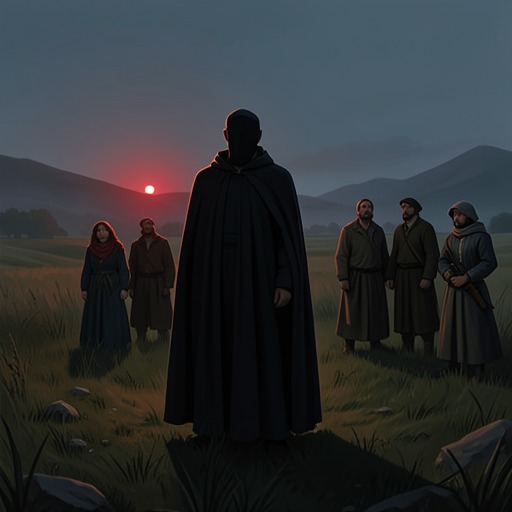
Melisandre’s supernatural power is revealed most starkly through the shadow she brings into the world. In an underground passage, Davos Seaworth encounters her beneath a cowl and robe, naked and apparently near to giving birth. Her body is swollen with pregnancy, her breasts heavy, and her belly distended. Blood runs down her thighs as she delivers a black shadow whose fingers curl around her legs before the creature rises taller than Davos and slips through the bars of the portcullis.
The event turns childbirth into a weapon-making ritual. Melisandre’s body is not merely the setting for magic; it is the mechanism through which violence is produced. The scene joins fertility, blood, pain, ecstasy, and political murder, refusing any clean separation between sacred generation and destructive force. The shadow is born, but it is born for an external purpose, moving immediately through the castle’s defenses and across the water.
Davos recognizes the shadow and the man who cast it, linking Melisandre’s sorcery to a specific political death rather than leaving it as an abstract marvel. Her power therefore operates through substitution: the shadow acts where an ordinary killer could not, while the human source of authority remains connected to the deed. Melisandre’s magic makes responsibility both visible and evasive, embodied in a creature that can kill while seeming to stand apart from the ruler it serves.
The episode also establishes the intensity with which her presence affects others. Davos responds first through breath, shock, and bodily recognition, while Melisandre’s glowing skin, hot-coal eyes, and deep laughter make the supernatural seem physically contagious. Her magic is not presented as a distant theological claim. It is an encounter that overwhelms sight, breath, and judgment.
Relationships, Fear, and Opposition
Cressen sees Melisandre as the heart of the danger gathering around Stannis Baratheon. He does not blame Lady Selyse for the transformation of Dragonstone’s politics; he blames the other woman, the foreign priestess whose influence threatens to spread. Cressen names her openly in his chamber and defines her as a sorceress and shadowbinder whose madness must be contained. His hostility is intensified by his long service to Stannis and by his fear that the king’s cause will force one of the sons he helped raise to destroy another.
Davos Seaworth occupies a more complicated position. He serves Stannis Baratheon with profound loyalty, remembering that the king raised him to knighthood, gave him an honored place, and exchanged a war galley for the smuggler’s skiff that had defined his former life. Davos’s gratitude binds him to the king, but his direct encounter with Melisandre’s shadowbinding makes him a witness to the cost and nature of the power supporting that loyalty. He can recognize what the shadow means even when the political order around it treats the supernatural as confirmation.
Melisandre’s influence also exists within a broader world of bodily suffering that the narrative repeatedly places beside religious and political power. Shireen Baratheon bears the stiff, dead, cracked, and mottled flesh left by greyscale, while the child’s sadness becomes a source of guilt for Maester Cressen. In the Red Waste, Daenerys Targaryen’s body is reduced by hunger and thirst: her milk dries, her nipples crack and bleed, and she grows lean and hard while fearing for her dragons. Elsewhere, Ser Gregor Clegane’s violence turns the bodies of captives into expendable labor and terror, and Tyrion Lannister’s wounds require bandages, boiling wine, and maggots before they can heal.
Against these forms of injury, Melisandre’s body appears unnaturally intact and theatrically powerful. Her skin is unblemished even when her sorcery involves blood, childbirth, and death. That contrast makes her an unsettling figure in a world where illness, hunger, disfigurement, and wounds visibly limit people’s choices. Her power seems to evade ordinary bodily vulnerability, but the shadow she produces shows that it does not transcend the body so much as seize and redirect it.
Narrative Role and Significance
Melisandre functions as the point where prophecy, spectacle, and political violence meet. Her crimson appearance gives the faith of R’hllor a human face; her public invocation of Azor Ahai supplies Stannis Baratheon with a sacred identity; and her shadowbinding demonstrates that the claims made in ritual can have lethal material consequences. She is consequently feared not only because she may be wrong, but because her belief is capable of acting upon the world.
Her scenes repeatedly challenge the boundary between revelation and manipulation. A prophecy is followed by a sword wreathed in colored flame. A woman apparently gives birth, yet what emerges is a weapon. A king’s legitimacy is displayed through fire, while a hidden killer moves through darkness. Melisandre’s methods rely on the same basic principle in opposite forms: make the invisible visible, then use that visibility to command belief.
The recurring opposition between red fire and black shadow gives her role its central tension. R’hllor’s language promises light against darkness, but Melisandre’s most terrifying deed is the creation of a shadow. Her power therefore complicates any simple division between holy illumination and profane violence. Fire can authenticate a king, while darkness can serve his cause; the sacred and the lethal are not separate domains in her practice but successive expressions of the same authority.
Melisandre’s significance finally rests on the instability she introduces into political judgment. Cressen sees her as a threat to be stopped, Stannis Baratheon accepts the signs that elevate him, and Davos Seaworth is forced to confront the physical reality behind the signs. Through these conflicting responses, she becomes more than an individual priestess. She is the embodiment of a world in which power resides not only in armies and crowns, but also in the stories people accept, the rituals they witness, and the fear generated when the impossible appears to answer back.