Night’s Watch neutrality
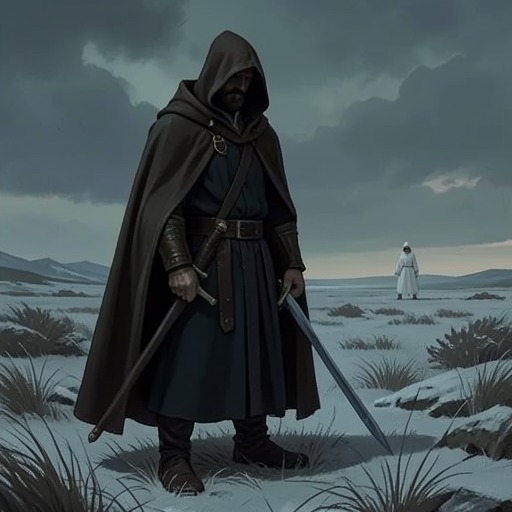
A Clash of KingsNight’s Watch neutrality is the principle that the Night’s Watch must not participate in the struggles among the competing rulers of the Seven Kingdoms. It is presented as both a practical necessity and a sworn institutional identity: men arrive from different regions carrying old loyalties, yet the Watch must remain available to defend the Wall rather than become another army in the War of the Five Kings. The rule protects the order’s unity, but it also demands silence, restraint, and at times obedience to a purpose narrower than justice as individual members understand it.
Definition and Institutional Purpose
The clearest formulation comes from Yoren at an inn where travelers insist that the Watch cannot remain untouched by the war. He answers, “That’s nothing to us,” insisting that whether the conflict is between House Tully and House Lannister makes no difference because “The Watch takes no part.” Arya Stark knows that Lord Tully is her grandfather and that the political struggle matters profoundly to her, but she keeps silent. The scene establishes neutrality as an imposed discipline: the rule does not erase personal allegiance, but requires members and recruits to conceal it.
Jon Snow later recognizes the same restraint within the brotherhood itself. When Donal Noye compares Robert Baratheon to true steel, Stannis Baratheon to hard but brittle iron, and Renly Baratheon to bright copper, Jon wonders what metal Robb Stark might be, but does not ask. Noye is a Baratheon man, and Jon assumes that he may regard Joffrey Baratheon as the lawful king and Robb Stark as a traitor. The Watch therefore maintains an unspoken pact not to probe too deeply into such questions. Its members have come from every part of the Seven Kingdoms, and old loves and loyalties do not disappear merely because a man swears an oath. Neutrality is sustained partly through deliberate avoidance of speech.
Neutrality Under Political Pressure
The principle is tested by the competing claims of the realm’s rulers. Stannis Baratheon understands that the Night’s Watch is an organized network whose communications could influence the political crisis, but he does not treat its neutrality as binding upon himself. He orders Davos Seaworth to distribute one hundred seventeen copies of his letter throughout the realm, from the Arbor to the Wall, because he believes many lords will refuse to recognize him as the rightful king. The plan includes ships, ports, holdfasts, septs, inns, and even the Free Cities across the narrow sea. Stannis acknowledges that his words will not be welcomed and that public readings would be more dangerous, but he intends the letters to make his claim and Cersei Lannister’s infamy known everywhere.
This campaign clarifies the asymmetry between the Watch and the political powers around it. The Watch’s neutrality does not prevent kings from addressing its officers, seeking its recognition, or using the routes and institutions connected to it. It means that the order itself must not answer those claims by joining a faction. The rule is thus less a condition of political isolation than a boundary that ambitious rulers repeatedly approach and attempt to exploit.
Limits of Moral Intervention
Neutrality also governs the Watch’s conduct beyond the Wall. Jon Snow objects to Craster’s brutality and argues from the principle that a brutal or unjust bannerman dishonors both himself and his liege lord. Jeor Mormont rejects the implication that the Watch can intervene wherever it encounters wrongdoing. Craster has sworn no vows to the Watch, is not subject to its laws, and is therefore outside its authority. Mormont tells Jon that the Watch cannot set the world to rights because it has other wars to fight.
The exchange reveals the cost of treating neutrality and jurisdiction as practical rules rather than universal moral commands. Jon sees a person and a wrong that demand response; Mormont sees the strategic limits of an order facing a larger danger. Craster’s conduct is not declared acceptable. Instead, the Watch refuses to make itself the instrument of every justice it recognizes, because doing so would abandon its assigned war. Neutrality therefore overlaps with a broader ethic of institutional restraint: the Watch must distinguish between what is evil and what it is empowered to do.
Oaths, Identity, and Strategic Deception
The rule does not require the Watch to behave passively when its survival or intelligence mission is at stake. Qhorin Halfhand instructs Jon that, if captured by the wildlings, he must go over to them, even if they demand that he cut his cloak into ribbons, swear an oath on his father’s grave, and curse his brothers and Lord Commander. Jon must ride with them, eat with them, and fight with them for as long as necessary, while remembering inwardly who he is and watching for information about their purposes in the Milkwater valley.
This command differs from partisan allegiance. Jon is not being asked to support one claimant to the Iron Throne; he is being ordered to preserve the Watch’s mission through concealment and apparent betrayal. The scene shows how the Watch’s public identity can be suspended or disguised without being abandoned internally. Its neutrality is therefore compatible with infiltration, provided that the ultimate loyalty remains directed toward the order’s defense of the realm rather than toward a competing king.
Conflicting Orders and the Meaning of a Vow
The tension surrounding neutrality belongs to a wider problem of overlapping obligations. Jaime Lannister explains that knights are made to swear too many vows: to defend and obey the king, keep his secrets, do his bidding, obey a father, love a sister, protect the innocent, defend the weak, respect the gods, and obey the laws. In his account, fulfilling one vow inevitably means forsaking another. The Night’s Watch faces a related dilemma in more institutional form. Its members retain family loyalties, regional memories, and moral judgments, yet the Watch’s oath requires them to place its common purpose above those competing demands.
Other scenes expose what happens when rival authorities claim the right to punish or command. Edmure Tully hangs men who arrived with Ser Cleos Frey after accepting their surrender, arguing that they were false envoys because they later attempted to free Jaime Lannister. Ser Rodrik Cassel, meanwhile, demands Winterfell and Theon Greyjoy’s life in the name of King Robb Stark’s justice, while Theon insists that Robb will never return and that the North is held. These conflicts are not actions of the Night’s Watch, but they provide the surrounding contrast: noble houses treat law, surrender, kinship, and allegiance as weapons within the war, whereas the Watch’s declared identity depends upon refusing that contest.
The principle is also threatened by the coercive institutions of the south. Yoren disguises Arya Stark as the orphan boy Arry and warns that the men traveling toward the Wall might betray her to the queen for a pardon or silver, or rape her first. Gold cloaks later arrive with a seal and warrant from the queen, seeking the disguised girl. The Watch’s movement through a realm controlled by royal guards is therefore politically dangerous even when its stated purpose is neutral. Neutrality offers no protection from rulers who define enemies broadly; it instead forces the Watch and its agents to survive without openly declaring a side.
Night’s Watch neutrality is consequently neither simple indifference nor proof that its members lack convictions. It is a collective discipline built from divided origins, enforced by silence, narrowed by jurisdiction, and occasionally preserved through deception. Its value lies in keeping the Watch from becoming another faction in the realm’s civil war; its tragedy lies in requiring men such as Jon Snow to witness injustice and political catastrophe while remembering that the order cannot answer every wrong. The maxim that the Watch takes no sides is less a description of a world without loyalties than a vow imposed upon men who still possess them.