Qarth
A Clash of KingsQarth is a great port city at the edge of Daenerys Targaryen’s journey through the Red Waste, presented first as a promised refuge and then as a brilliant, crowded, and morally unstable center of trade. Its walls and ceremonies project immense grandeur, but its rulers deny Daenerys the ships and soldiers she needs. The city’s splendor therefore becomes inseparable from disappointment: Qarth can receive a queen as a spectacle without recognizing her as a political power.
Arrival and Monumental Walls
On Daenerys Targaryen’s approach, Qarth announces itself through sound, color, and disciplined display. Men beat gongs from the walls, others blow unusual horns that coil around their bodies like bronze serpents, and a column of camel-riding honor guards emerges to meet her. The riders wear scaled copper armor and snouted helms with copper tusks and long black silk plumes, while their camels carry blankets in a hundred hues and sit on saddles inlaid with rubies and garnets. The welcome makes the city appear ceremonially powerful before Daenerys has crossed its gates.
The city’s physical structure reinforces that impression. Three enormous walls encircle Qarth, each with its own material, height, and imagery. The outer wall is red sandstone, thirty feet high, and carved with snakes, kites, fish, wolves of the Red Waste, striped zorses, and monstrous elephants. The middle wall rises forty feet in grey granite and depicts warfare in relentless variety: weapons colliding, arrows flying, heroes fighting, children being butchered, and the dead burning. The innermost wall is fifty feet of black marble, decorated with scenes of sexual pleasure so explicit that they embarrass Daenerys before she reminds herself that she is no longer a maid. Qarth thus encloses itself in successive layers of animal life, violence, and sensuality, making the city’s magnificence feel both cultivated and threatening.
Pyat Pree describes Qarth as the greatest city in the world, the center between north and south and the bridge between east and west. His language is extravagant enough to invite skepticism, yet Daenerys cannot deny the city’s splendor. Qarth is not merely a settlement but a self-advertising civilization, using architecture, ritual, and spectacle to proclaim ancient authority.
Port, Market, and Social Geography
Qarth’s harbor is one of the world’s great ports, a sheltered basin filled with color, noise, and unfamiliar smells. Winesinks, warehouses, gaming dens, brothels, temples, moneychangers, cutthroats, cutpurses, and spellsellers press together along the waterfront. Buying and selling continue throughout the day and night, with goods available cheaply when customers do not ask about their origins. Seamen from many nations move among the stalls, while vendors sell flavored waters and goat’s milk from glazed ceramic jugs. The air carries salt, frying fish, hot tar, honey, incense, oil, and sperm.
The market makes Qarth cosmopolitan, but not innocent. Its abundance includes both ordinary food and objects associated with fraud, sorcery, and exploitation. Aggo buys honey-roasted mice from an urchin, Jhogo purchases fat white cherries, and merchants display bronze daggers, dried squid, carved onyx, magical elixirs, and supposed dragon’s eggs that look like painted rocks. The city’s commerce thrives on the coexistence of the genuine, the doubtful, and the dangerous.
The quays also reveal the political and economic networks that sustain Qarth. Ships belonging to the Thirteen unload saffron, frankincense, and pepper from Xaro Xhoan Daxos’s ornate Vermillion Kiss, while the Bride in Azure takes on wine, sourleaf, and striped hides. Nearby, the Spicer galley Sunblaze draws a crowd bidding on slaves newly arrived from Astapor on Slaver’s Bay. Qarth’s magnificence is therefore tied to long-distance trade, maritime power, and slavery as much as to carved walls and ceremonial welcomes.
The Pureborn and Daenerys’s Rejected Appeal
The Pureborn are descendants of Qarth’s ancient kings and queens. They command the Civic Guard and the fleet of ornate galleys that controls the straits between the seas, making them the faction Daenerys needs if she is to obtain ships and soldiers. Her request is not casual diplomacy: she wants the military resources that Qarth’s ruling elite possess.
To reach them, Daenerys follows the city’s established protocols. She makes the traditional sacrifice in the Temple of Memory, bribes the Keeper of the Long List, sends the traditional persimmon to the Opener of the Door, and eventually receives the traditional blue silk slippers summoning her to the Hall of a Thousand Thrones. The sequence shows that access to Qarth’s power is regulated through ritual and prescribed exchange. Even a claimant with dragons must pass through the city’s ceremonial machinery.
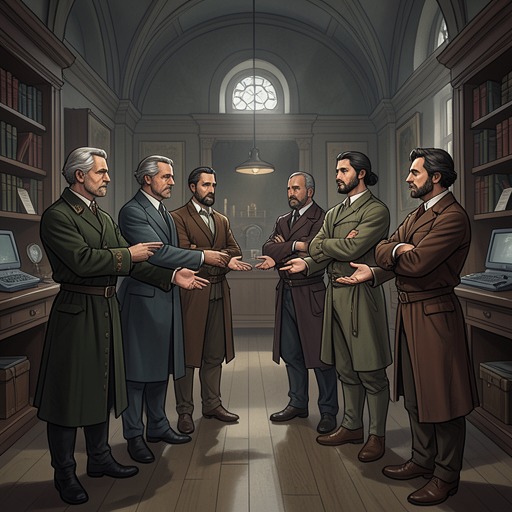
The Hall of a Thousand Thrones embodies the distance between grandeur and effective leadership. The Pureborn sit on immense ancestral wooden seats arranged in curved tiers across a marble floor beneath a dome painted with Qarth’s vanished glory. The chairs glitter with goldwork and amber, onyx, lapis, and jade, each competing to be more fabulous than the others. Yet the men seated upon them appear listless and world-weary. They listen to Daenerys’s pleas without truly hearing or caring, treating her as an afternoon’s amusement, a horse girl with a curious pet whose dragon interests them more than she does.
Daenerys receives neither the fleet nor the soldiers she sought. The failure exposes the city’s central political contradiction: Qarth possesses the resources to alter the balance of power, but its ruling class is insulated by inherited prestige, boredom, and self-satisfaction. Its elaborate rituals acknowledge Daenerys enough to admit her before the rulers, while its indifference denies the political meaning of her presence.
Gates, Enclosures, and Hidden Passageways
Qarth’s spaces repeatedly turn access into a question of power. Jhogo’s return makes the city a threshold: after disappearing for so long that Daenerys fears him lost, he arrives from the southeast with three strangers riding ugly, humped creatures larger than horses. He has gone to Qarth and returned with people who want to see Daenerys with their own eyes, reversing the earlier pattern in which Daenerys seeks recognition from Qarth’s established authorities. The city is both destination and filter, determining who can reach her and what kind of audience she receives.
Elsewhere, Qarth’s architecture conceals movement beneath its public surfaces. Tyrion Lannister enters an empty wardrobe in Chataya’s establishment, pushes aside a concealed back panel, descends a ladder, and reaches a slanting earthen tunnel well below street level, where Varys waits disguised in a scarred face, beard, steel cap, mail, and boiled leather. The passage shows that the city is not exhausted by what its walls and markets display. Beneath respectable or commercial interiors lies a clandestine network through which political actors can evade ordinary surveillance and transform their identities.
The city’s gates also appear in a very different, dreamlike register through Summer’s perception. A black iron gate shaped like a coiled snake blocks passage between stone walls. Summer and his brother cannot break it with their teeth or dig beneath it because flat stones lie under the earth; the other doors are thick and strong as well. The repeated sense that every route is locked makes the architecture an image of confinement. Qarth’s gates promise protection from the outside, but they also make escape dependent on knowledge unavailable to those trapped within.
A City of Splendor and Exclusion
Qarth’s narrative significance lies in the gap between what it displays and what it does. Its walls, honor guards, ships, markets, and ceremonial customs make it appear open to the world, yet its political center remains closed to Daenerys’s urgent need. The city welcomes movement as commerce and entertainment, but resists recognizing a displaced queen as an equal claimant to power.
That contrast gives Qarth a layered spatial identity. It is a port where goods and peoples circulate, a fortified city whose walls separate social and political orders, a market where valuable and dubious objects mingle, and a place of hidden tunnels where power operates out of sight. Its visible splendor cannot conceal the moral compromises of its trade or the exhaustion of its ruling class. For Daenerys, Qarth is consequently less a refuge than a threshold ordeal: she enters surrounded by ceremony, discovers that admiration is not alliance, and must continue without the military support she came seeking.