Qhorin Halfhand
A Clash of KingsQhorin Halfhand is one of the Night's Watch's most formidable rangers, a figure whose legend rests not on rank or ceremony but on endurance, speed, and absolute commitment to the defense of the realm. His story is defined by a paradox: he must die by the hand of one of his own brothers in order to give that brother a chance to survive, infiltrate the enemy, and continue the Watch's work. His mutilated body and controlled manner make sacrifice visible, while his final duel turns obedience into the instrument of survival.
Identity and Reputation
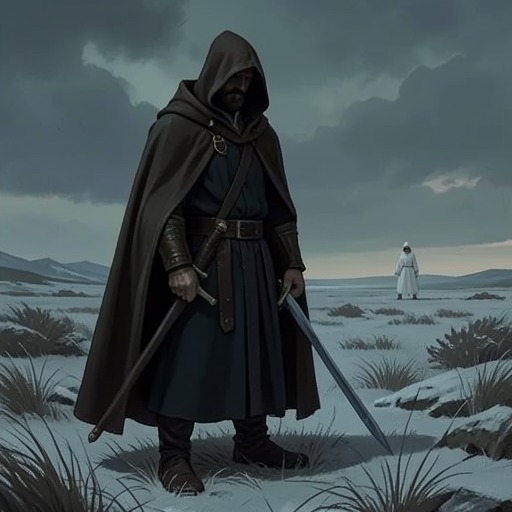
Qhorin arrives from the Shadow Tower with men already marked by hardship. Many of the riders are wounded, and some must share horses, evidence that trouble has followed them through the mountain country. Against this ragged company, Qhorin appears unusually austere: he is tall and straight, long-limbed, solemn, and clean-shaven, with a heavy braid touched by hoarfrost. His faded black clothing is nearly gray, visually binding him to the Watch even as the landscape seems to wear him down.
His most distinctive feature is the hand that remains. Only the thumb and forefinger are left; the other fingers were severed when he caught a wildling's axe that would otherwise have split his skull. The customary tale of the injury describes Qhorin thrusting his maimed fist into the axeman's face, blinding him with blood, and killing him while he could not see. Whether presented as legend or remembered fact, the episode explains the fear attached to his name: beyond the Wall, the wildlings have known no more implacable foe.
The hand is therefore not merely a sign of damage. It is also the emblem of Qhorin's method. He has survived by converting loss into action, and the missing fingers become a visible reminder that the Watch's victories are purchased through bodily sacrifice rather than romantic heroism. His legend is made credible by the disciplined, unsentimental man who steps down from his horse and immediately thinks first of hungry men and animals needing care.
Command and the Mountain Mission
At the gathering near the Fist, Qhorin treats the danger beyond the Wall as a problem demanding knowledge rather than reassurance. When Lord Commander Mormont hesitates to risk more men, Qhorin proposes fifteen scouts divided into three parties of five. One party will probe the Milkwater, another the Skirling Pass, and a third will climb the Giant's Stair. Jarman Buckwell, Thoren Smallwood, and Qhorin himself will command the parties, whose purpose is to learn what waits in the mountains.
His argument is starkly practical. The men of the Watch have already accepted death by donning black cloaks, and their deaths can still serve a purpose if they buy time for the brothers on the Wall. That time could be used to garrison empty castles, seal their gates against the cold, summon lords and kings to aid them, and repair the axes and catapults needed for defense. Qhorin treats the lives of the scouts as currency, but not as worthless currency: their lives will be well spent if their loss makes preparation possible.
Mormont finally allows him to choose his men. Qhorin immediately selects Jon Snow, despite Jon's youth, his role as Mormont's steward, and his lack of experience as a ranger. The choice surprises Mormont, but Qhorin answers that Tollett can care for the Lord Commander instead. He then invokes the strength of the old gods beyond the Wall, the gods of the First Men and the Starks. His selection places Jon at a threshold: Jon is no longer protected by the limited duties of a steward, but is being claimed for a mission whose meaning has not yet been explained.
Mentor, Test, and Final Command
Qhorin's relationship with Jon becomes most consequential after the ranging collapses into pursuit and danger. When Qhorin tells Jon to find brush for a fire, Jon understands that their end is near. The instruction is ordinary, but its timing reveals the harsh economy of Qhorin's leadership: even at the edge of death, the men must make use of the remaining light, gather fuel, and preserve warmth. Jon cuts branches from a dead tree while Ghost watches in silence; the simple fire becomes the last shelter before the decisive act.
Qhorin's final test is concealed within apparent betrayal. He orders Jon to turn and die, then attacks him with his sword. Jon blocks with Longclaw, but Qhorin's strength and experience overwhelm him. Their cloaks whirl as Jon's quickness meets the ranger's savage left-handed cuts; Qhorin drives him backward, keeps him off balance, and makes the younger man's arms grow numb. The fight is not a contest between equals. It is a brutal performance in which Qhorin forces Jon to respond as though he were genuinely trying to kill the man he has followed.
The opening comes only when Ghost seizes Qhorin's calf. Even then, Qhorin keeps his feet. As he twists, Jon finds the instant he needs: he plants, pivots, and cuts across the ranger's throat. The wound first appears as a string of red marks before the blood pours out and Qhorin falls. The scene converts the value of loyalty from obedience to a living commander into obedience to a larger purpose. Jon must violate the brotherhood's visible code in order to remain faithful to its survival.
Qhorin's last gesture confirms that the duel has achieved what he intended. Ghost's muzzle is red, but only the last half inch of Longclaw's point is stained, suggesting how narrowly the killing blow was made and how carefully the encounter was controlled. Qhorin raises his maimed fingers and says that Jon is sharp before his hand falls and he dies. The final acknowledgment is both a judgment of Jon's swordsmanship and a compressed recognition that Jon has understood the command hidden inside the attack.
Sacrifice and Narrative Significance
Qhorin's death is a sacrifice with an operational purpose. By making Jon appear to have murdered a Night's Watch officer, he gives the wildlings a reason to take Jon alive as an enemy who has broken with the Watch. Qhorin cannot accompany Jon beyond that point, and the surviving ranger's mission ends precisely where Jon's dangerous passage into the enemy's world begins. The older man's death is thus not the conclusion of the mountain mission alone; it is the threshold through which Jon enters a new and morally unstable phase.
The aftermath is psychologically severe. Jon thinks of Samwell Tarly, Grenn, Dolorous Edd, Pyp, and Toad at Castle Black, and wonders whether he has lost them as he lost Bran, Rickon, and Robb. Qhorin's strategy saves the possibility of Jon's continued service, but it leaves Jon unable to explain the act to himself in ordinary terms. He has killed a brother, obeyed a command that looked like treason, and been separated from the community whose identity gave the act meaning.
Qhorin therefore functions as both mentor and sacrificial threshold guardian. He does not teach Jon through a comforting explanation; he teaches by arranging circumstances in which Jon must act without public vindication. His mutilated hand, his insistence that death can buy time, his deliberate choice of Jon, and his final controlled duel all belong to one pattern. Qhorin makes the Watch's deepest principle concrete: service is measured not by survival or recognition, but by what a life purchases for those who must continue after it ends.