Rhaegal
A Clash of KingsRhaegal is one of the three dragons born to Daenerys Targaryen from the deaths surrounding Drogo’s pyre, and his existence transforms her from an endangered claimant into the mother of living dragons. Named for her valiant brother Rhaegar Targaryen, he belongs to a new generation of dragons whose survival gives Daenerys both emotional inheritance and a dangerous political power that no ruler in Qarth can safely ignore.
Birth and Naming
Rhaegal is one of three hatchlings that emerged when Daenerys walked into the flames after the deaths of her husband Drogo, her unborn son, and the maegi Mirri Maz Duur. Daenerys understands the dragons not as possessions acquired through conquest but as beings born from faith, need, sacrifice, and death. She fiercely insists that they are hers and that no man will take them from her while she lives, making her bond with them inseparable from the transformation of her own identity.
Daenerys names the green dragon Rhaegal for Rhaegar Targaryen, her brother who died on the green banks of the Trident. The name places Rhaegal within the memory of the fallen Targaryen dynasty while also marking the dragon as part of a renewed life rather than a simple repetition of the past. Daenerys tells her bloodriders that the hatchlings have been named for those the gods have taken: Rhaegal carries the memory of the brother she calls valiant, while the other dragons commemorate Viserys Targaryen and Drogo’s legacy through their own names.
Appearance and Conduct
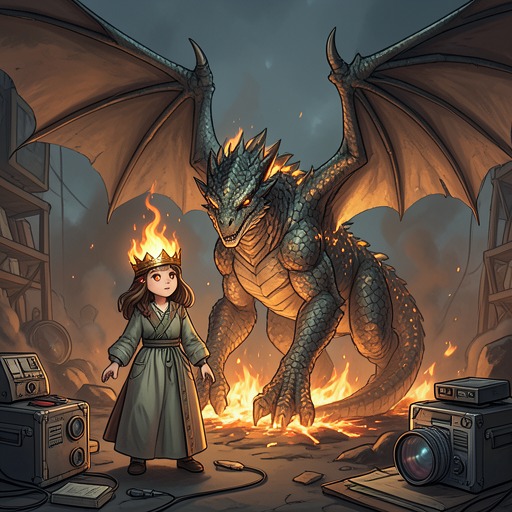
Rhaegal is the green dragon among Daenerys’s three hatchlings. In Qarth, he remains small enough to rest on her shoulder, but his claws are already sharp enough to pierce her skin. When Daenerys reaches for a cup of wine, Rhaegal hisses and digs his claws into her bare shoulder, forcing her to move him to the other side so that he will tear her gown rather than her flesh. The moment makes his presence materially demanding: he is not merely an ornament or heraldic sign, but a living creature with instinctive, potentially painful behavior.
His physical presence also changes the social space around Daenerys. When she appears before the Pureborn of Qarth, Rhaegal accompanies her as she makes her plea for ships and soldiers. The Qartheen officials are more interested in the dragon on her shoulder than in Daenerys herself, confirming both the political value and the dehumanizing spectacle of his presence. Rhaegal helps make her impossible to dismiss, yet he also exposes the extent to which powerful men regard her as an attraction attached to a rare creature rather than as a queen in her own right.
Bond with Daenerys Targaryen
Rhaegal’s relationship with Daenerys is defined by physical intimacy and absolute protectiveness. The hatchlings drink milk from her swollen breasts after their emergence from the flames, and Daenerys treats their survival as part of the same personal history that made her who she is. Her claim that they are hers is simultaneously maternal, political, and existential: to threaten the dragons is to threaten the life she has rebuilt from catastrophe.
The bond also resists ordinary political control. Ser Jorah Mormont warns Daenerys that even a living dragon is beyond price and that every man who sees one will want to seize it. Rhaegal therefore makes Daenerys stronger and more vulnerable at once. His existence attracts rulers, merchants, and potential enemies, while his dependence on Daenerys gives her a form of loyalty that cannot be negotiated through the usual exchanges of gold, marriage, or military service.
Political and Narrative Significance
Rhaegal represents the return of dragon power to a world that has treated dragons as extinct history. Daenerys invokes the ancient dragons of Valyria, including Vhagar, Meraxes, and Balerion the Black Dread, when explaining the hatchlings to her bloodriders. The comparison enlarges Rhaegal’s significance beyond his current size: he is a hatchling now, but he belongs to a lineage remembered for melting armor, swallowing horses, and casting whole towns into shadow.
At the same time, Rhaegal’s smallness prevents the restoration of Targaryen power from becoming immediate or complete. Ser Jorah points out that one stroke of an arakh could kill the hatchlings. Their future force is therefore still only potential, and Daenerys must protect that potential while crossing a dying wilderness and seeking allies. Rhaegal’s presence embodies the tension between promise and exposure: he is proof that an ancient power has returned, but also a fragile target whose survival depends on Daenerys’s judgment and movement.
Rhaegal’s role is consequently not reducible to symbolism. He acts, claws, hisses, feeds, and travels as a nonhuman companion whose needs shape Daenerys’s decisions and whose body reorganizes political attention around her. Alongside the other dragons, he supplies an alternative form of knowledge and power in a narrative where human claims to rule are repeatedly tested by forces that cannot be governed through titles alone. His name looks backward to a dead prince, but his living body points toward a future in which Daenerys’s claim may be measured not only by bloodline or conquest, but by the return of dragons themselves.