Riverlands
A Clash of KingsThe Riverlands are the geographic and human center of the war’s widening violence. Fighting spreads across the region around the Gods Eye, south toward the Blackwater and north across the Trident almost to the Twins, turning a land of river crossings and defended keeps into a battlefield where armies, raiders, and local lords compete for food, passage, and survival.
A Strategic and Vulnerable Region
The Riverlands’ importance lies in both its position and its resources. Its rivers divide and connect the country at once, while its castles and fords regulate movement between the major theaters of war. The Red Fork, the Tumblestone, and the approaches to Riverrun become military infrastructure: at the fords, the Mallisters place archers and pikemen behind sharpened stakes, bury iron spikes beneath the water, and scatter caltrops among the rocks on Edmure Tully’s orders. A crossing is therefore not merely a route but a prepared defensive position, designed to make an advancing host pay for every step.
The same geography exposes the countryside to armies moving in several directions. Smallfolk stream toward Riverrun for safety, driving animals and pulling wagons, while the standards of the Blackwoods, Marq Piper, Darry, and the Paeges gather again near the castle. Their return indicates that Edmure Tully has recalled lords who had previously left Riverrun to defend their own lands, a sign that the conflict has shifted from scattered local defense toward a larger confrontation with Tywin Lannister.
War Across the Countryside
The region is described as awash in blood and flame. Marq Piper and Karyl Vance win small victories, while Beric Dondarrion raids the raiders, striking Lord Tywin’s foraging parties and disappearing into the woods. The pattern reveals a war fought not only by formal armies but also by mobile resistance, ambush, and the struggle to deny an enemy provisions. Ser Burton Crakehall boasts that he has killed Dondarrion, only to lead his column into one of Dondarrion’s traps, where every man is slain.
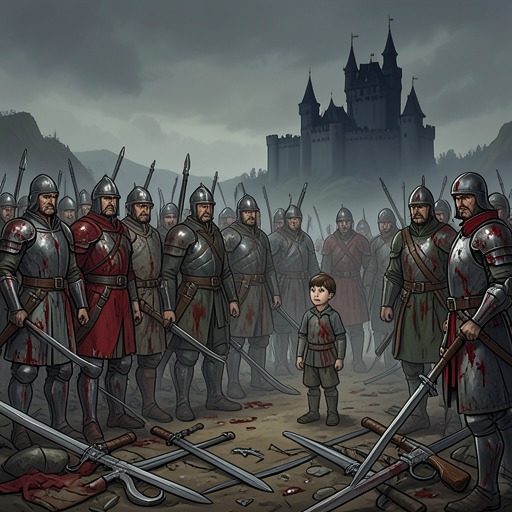
Local houses suffer in different ways. Jonos Bracken is wounded amid the ruins of his castle, and his nephew Hendry is killed. Tytos Blackwood drives the Lannisters from his lands, but they take every cow, pig, and grain of value, leaving Raventree Hall surrounded by a scorched emptiness. The Darry men retake their lord’s keep but hold it for less than a fortnight before Gregor Clegane descends upon them and puts the entire garrison to the sword, including their lord. The violence destroys not only soldiers but also the political and economic foundations on which the region’s noble houses depend.
Tywin Lannister directs this devastation from the safety of Harrenhal. His host feeds on the Riverlands’ harvest and burns what it does not seize. Gregor Clegane is only one of the forces he has released; Ser Amory Lorch and a sellsword from Qohor also operate in the field. Their methods include torching villages, raping and mutilating women, and leaving butchered children unburied so that wolves and wild dogs will find them. The destruction is therefore both military and exemplary: it removes supplies, terrorizes communities, and makes ordinary life itself evidence of the war.
Castles, Camps, and Battle Plans
Riverrun serves as the principal rallying point for the Tully cause. As Catelyn Stark approaches, she passes camps filled with the banners of river lords and sees dead men hanging from Riverrun’s battlements, their crimson cloaks still bright against the sandstone despite the crows and the blackening of their faces. The castle embodies both refuge and mobilization: smallfolk seek safety there, while its commanders prepare to make the surrounding country the site of a decisive battle.
Edmure Tully insists that Tywin Lannister must not cross Tully land unbloodied and intends to teach him a hard lesson. Catelyn Stark warns that the Riverlands have everything to lose by meeting Tywin in the field, especially after Ser Jaime Lannister previously cut Edmure’s host to pieces. Edmure refuses to discuss his battle plans in the yard and takes the conversation to the godswood instead, a brief scene in which family loyalty, regional pride, and military prudence pull in different directions.
The region’s strategic logic extends beyond land warfare. Stannis Baratheon’s fleet approaches the Blackwater from the south, and its plan depends upon moving ships up the river before landing troops beneath the city walls. Ser Imry Florent organizes the fleet into ten lines of twenty ships, with the first lines intended to destroy Joffrey Baratheon’s smaller fleet, later lines carrying archers and spearmen, and slower vessels ferrying the main host from the south bank. The Blackwater is thus treated as a battlefield and a logistical corridor, but its current, shoreline, and defenses turn that plan into a deadly gamble.
The decisive obstruction is the chain across the river mouth. When Davos Seaworth sees that the chain has been raised, a dozen galleys have already crashed into it; the current presses other ships against the wreckage, almost all of them burning. The boom forms a barrier of red-hot steel, blazing wood, and green flame between the fleet and the bay. The Riverlands’ waterways, which promise access and movement, can therefore be converted into traps by whoever controls their approaches.
Beyond the Battlefield
The war’s reach is also felt through memory and political history. Theon Greyjoy approaches Pyke by sea because he wants to see his father’s castle grow larger before him, reversing the childhood image of watching it shrink as Eddard Stark’s ward. His return is tied to a broader attempt to revive the Old Way, the ironborn tradition of reaving that Aegon the Dragon destroyed when he burned Black Harren, restored Harren’s kingdom to the rivermen, and reduced the Iron Islands to a marginal part of the greater realm. The Riverlands thus remain connected to older acts of conquest and suppression: the territory is not merely a current war zone but a historical hinge between island power and mainland rule.
The contrast with Qarth clarifies what makes the Riverlands distinctive. Qarth is presented as a sheltered international port, crowded with ships, markets, foreign sailors, temples, slaves, and goods traded day and night. The Riverlands, by contrast, are rendered through guarded fords, refugee columns, ruined keeps, scorched fields, and hanging corpses. One region concentrates commerce and maritime exchange; the other absorbs the direct costs of armies passing through a fertile but exposed interior.
The wolves’ view of a burned battlefield completes this transformation. After a night of fires, crashes, screaming horses, howls, and human shouting, the flames dwindle and the sun rises through smoke. Burned and collapsed camps contain no living men, only bodies covered by crows and wild dogs. The natural world does not heal the violence; it enters the aftermath as scavenger, witness, and beneficiary. In the Riverlands, war has become a cycle in which military movement produces famine, flight, ruin, and death, while the land itself records the conflict in ash, blood, and abandoned settlements.