Roose Bolton
A Clash of KingsRoose Bolton emerges as one of the war’s most unnerving commanders: outwardly plain, physically pallid, and soft-spoken, yet capable of converting defeat, occupation, and uncertainty into political leverage. At Harrenhal, his authority is announced through the image of a blood-dipped man and confirmed by the castle kneeling before him, while the leeches attached to his naked body make his private presence as disturbing as his public reputation.
Military Position and Strategic Calculation
Roose Bolton’s reputation is shaped by both defeat and recovery. Lord Tywin Lannister defeated him on the Green Fork, but failed to pursue him, allowing Roose Bolton to seize the ruby ford and the crossroads after Lord Tywin moved to Harrenhal. By the time Edmure Tully describes the northern position, Roose Bolton commands ten thousand men, a force intended to reinforce the wider Stark war effort and complicate Lord Tywin’s movements.
That recovery is politically important because it shows Roose Bolton operating within the unstable structure of Robb Stark’s campaign rather than simply serving as a defeated subordinate. Edmure Tully’s plan depends on Roose Bolton holding the ford and crossroads while Helman Tallhart brings additional troops from the garrison left at the Twins. The strategy also exposes a tension between local necessity and the obligations of the broader alliance: those men were meant to guard the Twins and help ensure that Lord Walder Frey remained faithful to Robb Stark. Roose Bolton’s military value therefore carries a cost, since every reinforcement sent south weakens another part of the coalition’s security.
Lord of Harrenhal
When Harrenhal falls, Roose Bolton arrives as its new master with a force from the north. Arya Stark sees him first as an unremarkable man whose only striking features are his strange pale eyes. He is neither plump, thin, nor muscular, and he wears black ringmail beneath a spotted pink cloak. His banner depicts a man dipped in blood, an emblem that gives visual form to the violence surrounding his rule without requiring him to display obvious physical ferocity himself.
The contrast between his ordinary face and his heraldic bloodiness intensifies his menace. His squire calls for the castle to kneel to the Lord of the Dreadfort, and Harrenhal obeys. Roose Bolton’s accession follows a grotesque purge: the Bloody Mummers have killed some of Ser Amory Lorch’s men in their beds and others at table while they are drunk. The new lord inherits not a stable court but a fortress marked by murder, stripped corpses, and fear. His authority is thus established through the aftermath of violence, with the castle’s submission turning that disorder into a new hierarchy.
Arya Stark is assigned to mop dried blood after the takeover. Men freed from the dungeon appear to have spoken about what happened there, and the fool Shagwell’s jokes about heads and weasel soup make her fear that knowledge of her own actions may be spreading. Roose Bolton’s arrival closes this episode of uncertainty: the castle has a new master, and Arya must now serve within the household of the man whose forces control Harrenhal. His rule transforms the castle from a place of hidden resistance into a watched and dangerous administrative center.
The Leech Lord and the Logic of Attrition
Roose Bolton’s physical presentation is most disturbing in his bedchamber. Arya enters while Qyburn, Walton, and a dozen Freys attend him and finds him lying naked on the bed. Leeches cling to the inside of his arms and legs and dot his pallid chest, becoming glistening pink as they feed. He pays them no more attention than he pays Arya, making the scene less a display of pain than of practiced indifference.
The leeches give concrete shape to the title by which he is associated, the Leech Lord, while also linking his body to the war’s imagery of blood, depletion, and survival. The image is repellent, but its narrative force comes from restraint: Roose Bolton does not need to threaten anyone in the room. His stillness, his pale body, and his refusal to react make the violence seem methodical rather than passionate. The grotesque treatment of his body mirrors his political method, in which men, supplies, and loyalties are gradually drained under pressure.
That method appears in the council over Harrenhal’s future. Ser Aenys Frey warns that the immense castle requires an army to hold, that its countryside has been burned or abandoned, and that the garrison is living on forage. If the Lannisters deny them access to food, the defenders may be reduced to rats and shoe leather within a moon’s turn. Roose Bolton answers that he does not intend to be besieged there. His quiet voice forces the men around him to strain to hear, leaving his chambers unnaturally hushed. The response is characteristically economical: he does not answer every logistical concern, but identifies the decisive danger and rejects the passive position it implies.
Reputation, Fear, and Narrative Function
Roose Bolton’s power depends on a striking contradiction. He looks ordinary, speaks softly, and shows little outward agitation, yet every surrounding detail associates him with bloodshed: the banner, the conquered castle, the butchered garrison, the leeches, and the fear that makes Harrenhal kneel. His menace is therefore atmospheric as much as active. The narrative presents him through the reactions and objects around him, allowing reputation to precede or exceed any explicit act of cruelty.
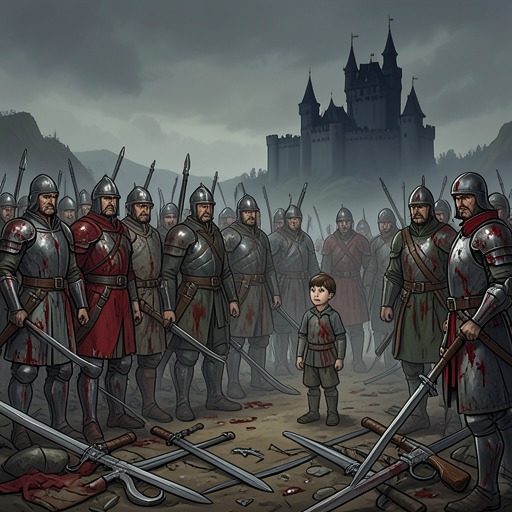
The episode at the castle gate reinforces that reputation. During the fighting, a knight in dark armor with a rounded red helm and a pale pink cloak rides out through the smoke and demands that the defenders open the gate. When Black Lorren asks whether he is friend or foe, the Red Helm answers by having three corpses dumped before the walls. Among them are the old castellan, Leobald Tallhart, and Cley Cerwyn; Ser Rodrik Cassel has lost his left arm. The display makes death into a message delivered to those still holding the castle. Although the scene is not a direct speech by Roose Bolton himself, it belongs to the political world his command creates: victory is communicated through bodies, and surrender is made intelligible through visible consequences.
Roose Bolton consequently functions as a dark counterpoint to more openly martial leaders. His strength is not theatrical courage but controlled pressure: recovering after defeat, placing troops where they alter the strategic map, accepting a castle already soaked in violence, and refusing to let Harrenhal become a trap. The available scenes do not resolve his ultimate fate, but they establish the governing principle of his presence. He survives by remaining difficult to read, allowing others to act in blood while he turns the resulting fear, exhaustion, and uncertainty into power.