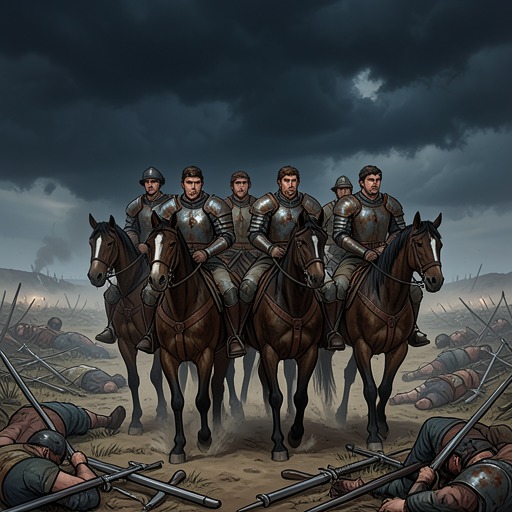
Sansa–Sandor Clegane relationship
A Clash of KingsThe Sansa–Sandor Clegane relationship is defined by a sharp contradiction: Sandor Clegane is frightening to Sansa, but he is also one of the few people in the court who protects her without pretending that the world is kind. His burned face, rough voice, contempt for knighthood, and service as Joffrey Baratheon’s guard make him an embodiment of violence, while his interventions on Sansa’s behalf reveal a personal code more reliable than the ceremonious ideals surrounding the royal court.
First Impressions and the Hound’s Identity
Sandor first appears beside Joffrey Baratheon in the royal box, standing behind the king with his hands on his swordbelt. The white cloak of the Kingsguard lies across his broad shoulders, but its snowy appearance clashes with his brown roughspun tunic, studded leather jerkin, and visibly scarred face and throat. His greeting to Sansa is curt, and his voice resembles a saw scraping wood. The image establishes him as an uncomfortable contradiction within the court: officially attached to the Kingsguard, yet visually and morally set apart from the polished knights whom Sansa has been taught to admire.
Sansa’s earliest encounter with his protective side comes during Joffrey’s name-day tourney. When she invents a religiously colored excuse to prevent Ser Dontos from being killed that day, Joffrey recognizes the lie and appears ready to punish her. Sandor supports her words by invoking the belief that what a person sows on a name day will be reaped throughout the year. His intervention gives Sansa’s desperate fiction authority and persuades Joffrey to postpone the execution. Sandor does not soften the king or appeal to mercy; instead, he uses a saying that Joffrey might fear, turning the king’s superstition against his cruelty. His protection is therefore practical rather than tender, and its effectiveness depends on understanding the dangerous mind of the person who holds power.
Honesty, Dogs, and Rejection of Chivalry
As Sandor escorts Sansa across the drawbridge, she asks why he permits people to call him a dog while refusing the title of knight. His answer explains the principles behind their relationship. He prefers dogs to knights because a hound will die for a person without lying, and will look that person directly in the face. He recounts how his grandfather’s dogs died defending Lord Tytos Lannister, while the kennelmaster lost a leg saving his lord; the reward was land and a towerhouse, and the three dead dogs became the three dogs on the family banner.
The story makes Sandor’s name more than an insult. For him, the hound represents loyalty without ornament, courage without ceremony, and truth without the flattering language of court. He contrasts that directness with the “little birds” who cannot meet his gaze, and with the songs of chivalric devotion that have no power to protect the vulnerable. When he grips Sansa beneath the jaw and forces her chin upward, the gesture is painful and intimidating, but it also enacts the standard he has just described: he demands that she face him rather than hide behind courtly evasions. Sandor’s conduct remains threatening, yet his threat is unusually legible. Sansa may fear him, but she is less likely to mistake his violence for courtesy or his contempt for kindness.
Protection in the Mob
The relationship becomes more concrete during the riot in which Sansa is attacked by a mob. Sandor later reminds her that she was glad to see his face then, even though she still cannot bear to look at him. Her memory confirms the reason. After a stone strikes her and a man with garlic on his breath tries to pull her from her horse, Sandor intervenes. He shoves her back into the saddle, then attacks the men surrounding her with his sword. One attacker is left with an arm severed, and the others flee before Sandor; in the moment of victory, his terrible burned face is transformed by laughter.
This rescue creates the central emotional paradox of the bond. Sandor’s protection is not gentle: it is delivered through bloodshed, speed, and overwhelming force. Yet the same violence that makes him horrifying to Sansa becomes the means by which he restores her immediate safety. The court’s public order has collapsed, and the crowd treats her as an object to seize; the Hound’s private brutality becomes more dependable than the institutions and ceremonies meant to defend a noble girl. Sansa’s fear of him therefore coexists with a bodily memory of survival. She cannot simply classify him as monster or protector, because the scene makes him both at once.
Fear, Memory, and the Final Encounter
Sansa’s continuing inability to meet Sandor’s eyes shows that protection has not erased terror. When he tells her that the “little bird” still cannot look at him, he recalls the earlier mob attack and exposes the unequal intimacy created by danger. He knows what she remembers, and he understands that her fear is directed at him even though he once saved her. Their relationship is consequently built less on open confidence than on recognition: Sandor recognizes the frightened, constrained girl behind her courtly behavior, while Sansa recognizes that the frightening man may act more honorably than those who claim to embody honor.
During the Battle of the Blackwater, the connection reaches its most threatening form. Sansa retreats from the window as wildfire illuminates the southern sky in green, orange, red, and yellow, hoping sleep will carry her to a morning when the fighting is over and her fate is known. In the darkness, a hand seizes her wrist and another covers her mouth. Sandor, drunk, addresses her as “Little bird” and says that he knew she would come. The green glare briefly reveals his blood-stained face beneath the stained white cloak before he becomes only a hulking darkness in the room.
The encounter preserves the relationship’s unresolved structure rather than converting it into a simple rescue narrative. Sandor is again the armed figure who enters Sansa’s private space while the city burns, but his condition and appearance make him as frightening as the violence outside. The white cloak no longer signifies clean chivalry; against blood, darkness, and wildfire, it becomes another sign of the failure of the court’s public ideals. The relationship ends in this charged uncertainty, with Sansa vulnerable before a man who has protected her but whom she still cannot safely understand.
Narrative Significance
The relationship tests the difference between appearance and conduct. Sandor’s scars, rough manners, and association with the royal household make him look like the obvious threat, while courteous structures repeatedly leave Sansa exposed. His name-day intervention and defense during the riot demonstrate that his loyalty is expressed through action rather than noble language. Conversely, Sansa’s fear remains justified: he is capable of frightening gestures, painful physical control, and unpredictable behavior, particularly when drunk and surrounded by war.
Their bond also marks Sansa’s movement away from childhood fantasies of knighthood. Sandor does not fulfill the ideal knight; he rejects it, mocks its claims, and replaces its language with the image of the hound that does not lie. Yet he performs the protective function that the ideal is supposed to promise. For Sansa, this makes him a living lesson in the gap between symbols and realities. The “little bird” and the Hound occupy opposite positions in the court’s hierarchy of power, but each becomes legible to the other through fear, repeated danger, and the memory of protection. Their connection remains incomplete, morally unsettled, and powerful precisely because it never turns violence into innocence or fear into easy trust.