Ser Gregor Clegane
A Clash of KingsSer Gregor Clegane, the Mountain That Rides, functions less as an autonomous political actor than as the most brutal instrument of House Lannister’s war. His size, reputation, and unquestioned capacity for violence allow powerful men to project terror across the Riverlands while preserving the language of command, loyalty, and lawful authority. Through him, warfare becomes the deliberate destruction of ordinary life: villages burn, captives are interrogated, women are abused, and the weak are killed when they can no longer serve an army’s purposes.
Identity and Allegiance
Ser Gregor is a bannerman of Tywin Lannister, and his allegiance is publicly framed through the authority of the crown. When Arya Stark’s party encounters the burning town, Ser Amory Lorch identifies himself as a servant of Lord Tywin Lannister, the Hand of the King, and commands the gates opened in the name of Joffrey Baratheon. Gregor is not present in that confrontation, but the scene establishes the political structure in which men such as him operate: private violence is carried out under official banners and converted into obedience through royal authority.
Catelyn Stark understands the distinction between Gregor’s immediate brutality and the larger power behind it. She calls Gregor a frothing dog and a beast whose head would be a noble gift to the realm, but she also judges him to be no more than Lord Tywin Lannister’s catspaw. Ser Brynden Tully agrees that Tywin is the true danger, describing him as the commander who has loosed Gregor, Ser Amory Lorch, and other agents into the countryside. Gregor’s significance therefore lies not only in what he personally does, but in how a great lord’s policy is made physically present through a man feared as an animal.
Terror in the Riverlands
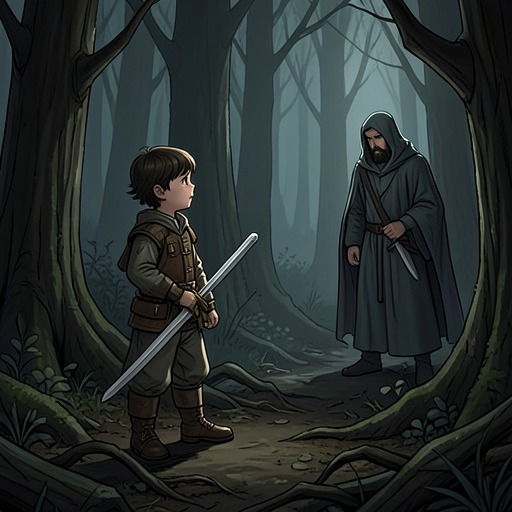
The clearest account of Gregor’s conduct comes through Arya Stark’s captivity in a storehouse beside the Gods Eye. She remains there for eight days, and every day she sees someone die. Gregor enters after breaking his fast and chooses prisoners for questioning, selecting them arbitrarily while the villagers avoid looking at him. Their attempts at invisibility offer no protection; there is no safe hiding place, no trick, and no reliable way to escape his notice.
The interrogations are conducted publicly so that every captive can witness the fate assigned to rebels and traitors. The Tickler asks about hidden gold, silver, gems, food, and the movements, numbers, equipment, horses, and wounds of Lord Beric Dondarrion’s forces. The questions repeat so relentlessly that by the third day Arya can recite them herself. The information obtained is contradictory and nearly useless: the prisoners offer incompatible accounts of Beric’s numbers, direction, strength, and route. Yet the process continues, because its purpose is not simply intelligence. It is also an exhibition of power, designed to make the captives watch suffering and understand that no answer can guarantee survival.
The Tickler carries out the questioning, sometimes assisted by Chiswyck or other soldiers, while Ser Gregor stands motionless and watches until the victim dies. No one survives the procedure—not a man, woman, or child. The bodies are hung beyond the fires for wolves to find. Gregor’s stillness makes him more frightening rather than less active: he does not need to shout or wield the instrument of torture at every moment, because his presence authorizes and completes the violence around him.
Violence as Military Practice
Gregor’s campaign is organized as a moving apparatus of seizure and punishment. He brings back a dozen pigs, a cage of chickens, a scrawny milk cow, and nine wagons of salt fish, while the captives are forced to travel on foot. Anyone too weak to keep up is killed immediately, as are those foolish enough to flee. The army’s provisions and the prisoners’ bodies belong to the same economy of use: animals and food are taken, people are extracted for information or labor, and anything that cannot continue is discarded.
Sexual violence is likewise treated as an ordinary privilege of the guards. Women are taken into the bushes at night, and most of them submit because resistance appears hopeless. One girl is forced to go with four or five different men each night until she strikes one of them with a rock. Gregor then makes everyone watch as he removes her head with a sweep of his massive two-handed greatsword, ordering that her body be left for the wolves. The killing is both punishment and spectacle. Her attempt to resist is not treated as an assault requiring judgment; it is answered by immediate execution before the entire captive population.
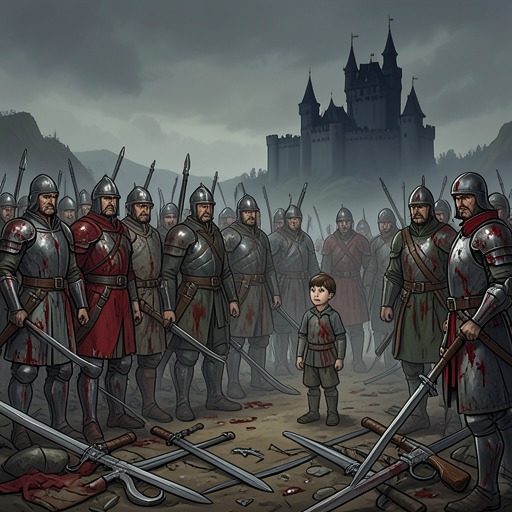
Gregor’s brutality extends beyond the storehouse. Ser Brynden recounts that Jonos Bracken was wounded amid the ruins of his castle, Hendry was killed, and Darry men recaptured their lord’s keep only to lose it in less than a fortnight when Gregor descended upon them. Gregor put the entire garrison to the sword, including the young lord himself. The boy would have made a valuable ransom, but Gregor’s violence ignores the political value of prisoners. It is precisely this refusal of restraint that makes him useful as terror and dangerous even to the conventions of noble warfare.
Reputation and the Shadow of the Wolf
Gregor’s reputation is measured against other forms of violence throughout the narrative. Catelyn already knows his evil name before hearing the details of the Darry massacre, and Ser Brynden describes the countryside left by Tywin’s agents as a landscape of burned villages, violated women, mutilated victims, and butchered children left unburied to draw wolves and wild dogs. He says that such scenes would sicken even the dead. Gregor is therefore associated with a violence so extreme that ordinary military vocabulary cannot contain it.
His reputation also contrasts with the animal power surrounding the Stark children. Tales of Grey Wind, the direwolf of Robb Stark, say that the wolf found a hidden goat track during the Battle of Oxcross and guided the king’s forces around the Tooth. Some even claim that Robb cut out Stafford Lannister’s heart and fed it to Grey Wind, though Catelyn rejects the story because she refuses to believe her son savage. The contrast is revealing: Grey Wind’s ferocity is transformed by rumor into heroic or monstrous legend, while Gregor’s violence is directly witnessed as policy and atrocity. Both are described through animal imagery, but the direwolf belongs to a bond between human and nonhuman life, whereas Gregor is repeatedly reduced to a dog or beast by those who see him as an instrument of destruction.
The narrative’s recurring attention to direwolves sharpens Gregor’s symbolic and material place in the war. Bran Stark hears Summer and Shaggydog howl in grief when the wolves sense catastrophe, and Jon Snow dreams of five scattered direwolves where there should be six, their separation becoming a felt ache of incompleteness. When Bran and Rickon later emerge from the ruins of Winterfell, Summer and Shaggydog return to them through the rubble. Against this persistent animal loyalty, Gregor represents the human body severed from pity, kinship, and communal limits: immense, effective, and violently detached from the lives it destroys.
Change and Narrative Role
The supplied evidence does not show a moral reversal, inner recognition, or death for Ser Gregor Clegane. Instead, it presents a stable pattern. He chooses prisoners, oversees their deaths, destroys garrisons, executes a resisting woman, and participates in a campaign that converts the countryside into food, intelligence, and ash. His lack of development is itself narratively meaningful. Other characters are forced to interpret fear, loyalty, grief, and responsibility, while Gregor appears as the fixed limit against which those human responses are tested.
For Arya, the encounter with Gregor’s regime changes the meaning of fear. She had believed she understood fear, but eight days beside the Gods Eye teach her that fear is not merely the anticipation of danger; it is the condition of having no secure action, no protection from arbitrary selection, and no guarantee that truth or submission will matter. She looks at Needle, which has been taken from her, and recognizes that attempting to stab Gregor would only result in her being cut in half. His power is therefore experienced not as a conventional opponent to be defeated in fair combat, but as an overwhelming force that has temporarily removed the possibility of resistance.
Gregor’s broader narrative role is to expose the gap between political language and lived consequence. Commands are issued in the name of Joffrey Baratheon and under the authority of Tywin Lannister, while the actual result is torture, rape, execution, requisition, and flight. Even in King’s Landing, where the City Watch commander warns Tyrion Lannister that thieves, murderers, disease, hunger, and open treason are spreading through the city, the violence of the war has already exceeded the ability of official institutions to contain it. Ser Gregor embodies that failure in its most concentrated form: a knight whose title and allegiance remain legible, but whose conduct makes the protections associated with knighthood meaningless.