Stony Shore
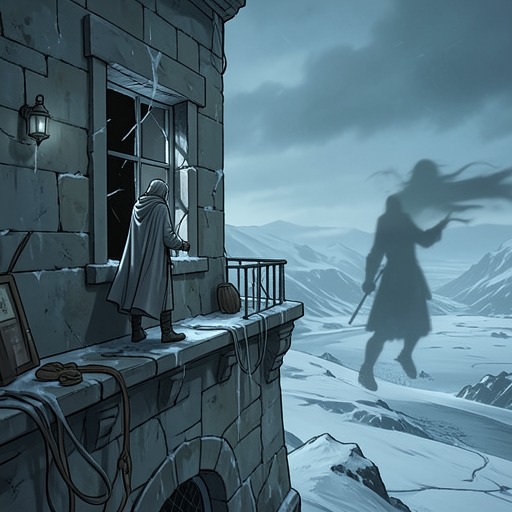
A Clash of KingsThe Stony Shore is a bleak, exposed coastline on the North’s western seaboard, defined in the evidence by fishing villages, surf, pebbled beaches, and the longships that can approach under cover of darkness. Its decisive significance is strategic as much as geographical: when the North’s principal strength is far to the south, the shore offers Theon Greyjoy a place from which the ironborn can begin their invasion while disguising the attack as ordinary raiding.
Setting and Maritime Character
The Stony Shore belongs to a world shaped by the sea rather than by roads or inland strongholds. Fishing villages depend on the coast, while longships can move through the darkness and strike before defenders understand the scale of the threat. The coastline is therefore both a place of livelihood and a natural exposure, with the surf and scattered settlements offering little protection against a sudden landing.
The broader maritime network surrounding it contrasts sharply with fortified ports elsewhere. Dragonstone is crowded with war galleys, fishing vessels, carracks, cogs, and Lysene ships as Stannis Baratheon prepares his fleet; the Blackwater Rush is treated as a naval battlefield requiring lines of battle, troop transports, and coordinated river and bay operations; and Qarth’s harbor displays an international commerce of ships, spices, slaves, and sailors. Against those organized ports, the Stony Shore appears as the vulnerable edge of the realm: a coast inhabited by local communities rather than protected by a concentrated fleet.
The First Ironborn Attacks
Theon Greyjoy’s assault on the Stony Shore is planned as part of a wider operation ordered by his father, Balon Greyjoy. The ironborn leadership keeps the larger hosting secret, allowing the violence on the coast to be attributed to independent sea raiders seeking plunder. The North is not meant to recognize its true peril until the hammers fall on Deepwood Motte and Moat Cailin.
Theon brings his ships toward the shore in the chill darkness before dawn and leaps from the prow with a longaxe in hand to lead the attack. He has arranged the operation himself, even though he dislikes what it requires. The landing is presented not as a confused raid but as a deliberate military action: the timing, the ships, and Theon’s personal leadership all serve the larger objective of establishing the ironborn presence without revealing the invasion’s full design.
The first clash briefly appears to involve a local force from House Tallhart. The defenders had been joking and singing as they approached, their three trees streaming above them and rabbitskins hanging from their lances. Hidden archers break that confidence with a storm of arrows, after which Theon leads his men-at-arms in the close fighting. He orders the opposing leader spared for questioning, only to discover that the captured man is Benfred Tallhart, whose presence turns the attack from anonymous raiding into a direct blow against a known northern house.
Destruction of the Villages
When Theon returns to the Sea Bitch, Benfred Tallhart’s limp body is being dragged from the surf. The masts of the longships stand against the sky behind him, while the fishing village has been reduced to cold ashes that stink when rain falls. The men have been killed except for a handful deliberately allowed to flee and carry the news to Torrhen’s Square. The survivors are not spared as an act of mercy; they are used to transmit a controlled warning while the larger ironborn movement remains hidden.
The treatment of the women and girls reveals the invasion’s social as well as military violence. Young and attractive women are claimed as salt wives. Older or less desirable women are raped and killed, or taken as thralls when they possess useful skills and seem unlikely to cause trouble. The coast is thus stripped not only of defenders but of households, labor, and continuity. Its destruction is an attempt to convert a living frontier into a warning, a source of captives, and a temporary military platform.
The attack also revives the ideology of the Old Way. The ironborn creed that “We Do Not Sow” defines a society that prizes reaving over cultivation and treats wealth, women, and glory as things to be taken rather than produced. The Stony Shore becomes the place where that principle is enacted against fishing communities: the sea supplies the attackers with mobility, while the coast supplies the vulnerable human settlements from which the attackers seize bodies and goods.
Strategic Consequences
The Stony Shore attacks are intended to delay recognition of the invasion, but they cannot prevent the North from responding. The survivors carry word to Torrhen’s Square, and the coastal violence contributes to the gathering northern resistance. Theon understands that his sister, Asha Greyjoy, is sailing the Black Wind north to win a castle of her own, while he fears that her achievement will eclipse his own bloody work. His anxiety over credit is inseparable from the invasion’s larger contest for prestige within the Greyjoy family.
The shore also becomes a fallback route for the defeated ironborn. After Dagmer Cleftjaw loses the fight at Torrhen’s Square, he leads the survivors back toward the Stony Shore. Theon is informed that the victory has encouraged Leobald Tallhart to leave his walls and join Ser Rodrik Cassel, while Lord Manderly sends barges upriver loaded with knights, warhorses, and siege engines and the Umbers gather beyond the Last River. The coast that first enabled the offensive now serves as a retreating army’s line of withdrawal.
This reversal exposes the limits of ironborn control. The Stony Shore can be reached by sea, but holding the surrounding North requires discipline, mounted strength, and the ability to withstand forces that know the land. Dagmer’s defeat demonstrates that maritime surprise is not the same as territorial security. Theon’s coastal success therefore marks the beginning of the invasion without guaranteeing its survival.
Narrative Significance
The Stony Shore concentrates the book’s contrast between mobility and rootedness. The ironborn arrive by ship, appearing suddenly from the sea and using the coastline’s distance from the main northern forces as protection. The villagers, by contrast, are tied to fishing settlements that can be erased in a single assault. The shore makes the imbalance visible: naval movement grants the invaders initiative, while dependence on a local place makes the inhabitants vulnerable.
Its violence also places Theon’s political ambition beside the tradition he claims to restore. He imagines that the collapse of the realm and the weakness of its boy rulers have created the moment in which he can succeed where Balon Greyjoy failed. Yet the proof of that ambition is not a crown or a lasting conquest but a burned village, dead men, captive women, and a retreating force. The Stony Shore is consequently both the opening of Theon’s attempted rise and an early sign of the moral and strategic ruin embedded in the Old Way he seeks to embody.