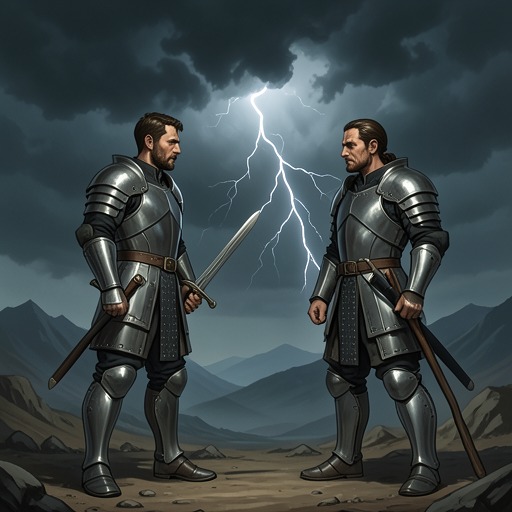
Storm's End
A Clash of KingsStorm's End is both a legendary stronghold and a political obstacle in the War of the Five Kings. Set against the violence of Shipbreaker Bay, it carries a history of surviving forces that destroy lesser works, yet its apparent invulnerability does not make its possession simple: Stannis Baratheon’s army surrounds it, while Ser Cortnay Penrose refuses to yield. The castle therefore turns architectural endurance into a question of legitimacy, loyalty, and the human cost of conquest.
Origin and Defiant Architecture
Storm's End is associated with the foundation legend of Durran, the first Storm King, and Elenei, daughter of the sea god and the goddess of the wind. When the gods sent wind and water against Durran’s first castle after his marriage to Elenei, the structure collapsed, killing his friends, brothers, and wedding guests. Durran alone survived because Elenei sheltered him, and he responded not by placating the gods or moving inland, but by declaring war upon them and rebuilding.
Durran raised five further castles, each larger and stronger than the last, only to see each destroyed by the gales of Shipbreaker Bay. His lords, priests, and smallfolk all urged compromise, but he refused. The seventh castle became the greatest of them all. Some versions of the tale credit the Children of the Forest with shaping its stones through magic; others say that a boy who would become Bran the Builder instructed Durran. Whatever the variation, the legend ends with the seventh castle standing against repeated storms, allowing Durran Godsgrief and Elenei to live there until their deaths. Storm's End thus possesses a founding story in which persistence, rather than accommodation, creates security.
The fortress is seen from outside as a vast mass of pale grey stone, its back turned toward the unseen sea. From a distance it makes the army of Stannis Baratheon, encircling it below, look as insignificant as mice beneath a wall. Up close, its height and thickness become still more oppressive. Its scale makes the besieging force appear temporary beside a structure designed to outlast generations of rulers and armies.
Storm's End in Memory and Loss
The castle is inseparable from the death of Lord Steffon Baratheon and his wife. Their two-masted galley, Windproud, broke apart within sight of Storm's End when Shipbreaker Bay suddenly became a violent proof of its name. Their two eldest sons watched from the parapets as the ship was smashed against the rocks and swallowed by the sea. A hundred oarsmen and sailors died with them, and for days the tides carried swollen corpses onto the strand below the castle.
That disaster also shaped the history of Patchface. Maester Cressen went down with others to help identify the dead, and the boy was initially mistaken for another corpse. Jommy dragged him toward a burial wagon before Patchface coughed up water and sat upright. He had been lost in the sea for two days, an interval no one could explain. Fisherfolk claimed that a mermaid taught him to breathe water in exchange for his seed, while Patchface himself offered no explanation. The clever, nimble boy Lord Steffon had found in Volantis never returned to Storm's End; the survivor was physically and mentally broken, barely capable of speech. His tattooed red-and-green face remained the identifying mark that connected the altered survivor to the boy who had been brought there.
The castle also enters the memories of other characters as a place that gives history a visible shape. Catelyn Stark sees it across rain-soaked fields and stony ridges while travelling to attempt a reconciliation between Stannis Baratheon and Renly Baratheon. Its mass dominates the landscape, making the surrounding army seem small and exposing the disproportion between human political ambition and the fortress’s accumulated symbolic weight.
The Siege and the Contest of Legitimacy
By the time Catelyn reaches Storm's End, Stannis Baratheon’s forces have encircled the castle by land and sea. The immediate dispute is represented by the meeting between Stannis Baratheon and Ser Cortnay Penrose beneath the walls. Stannis approaches with stiff courtesy but does not dismount, while Ser Cortnay answers him without granting the royal style that Stannis expects. The exchange makes the siege a contest over recognition before it becomes a contest over stone.
Stannis Baratheon declares that his eventual victory is certain because he has twenty thousand men and Ser Cortnay is besieged by both land and sea. He rejects the suggestion that the matter should be settled by single combat, arguing that there is no reason to risk one champion when the castle can be taken by force. At the same time, he threatens that an assault will bring no mercy: if the walls are stormed, Ser Cortnay and every defender will be hanged as traitors.
Ser Cortnay refuses to be intimidated. He answers that the gods may decide the matter, tells Stannis to bring on his storm, and recalls the name of the castle before riding back toward the gate. His response turns Storm's End’s legendary identity into a weapon of resistance. The fortress does not merely shelter a garrison; its name invokes a tradition of surviving precisely the kind of overwhelming violence Stannis threatens to unleash.
The exchange also exposes a conflict within Stannis’s camp. Lord Estermont fears that storming the walls will kill thousands and argues that a single combatant’s life would be the wiser risk if the cause is righteous. Davos Seaworth recognizes the religious assumption behind this proposal: the camp now has only one god, Melisandre’s Lord of Light, whose favor is expected to decide whether a champion can prevail. Storm's End therefore concentrates several competing authorities—military numbers, hereditary right, personal courage, and divine sanction—without allowing any one of them an uncontested victory.
Strategic and Narrative Significance
Storm's End is important because it makes endurance politically legible. Its founding story celebrates defiance against destructive powers, while its later history shows that even those protected by its walls remain vulnerable to the sea and to mortality. The death of Lord Steffon Baratheon demonstrates that a fortress can survive storms without saving everyone who lives beneath its shadow; the siege demonstrates that an apparently impregnable castle can still become the center of a succession crisis.
The location also provides a structural contrast with other fortified spaces. Harrenhal is enormous but visibly scarred and misshapen by the fire of Aegon’s dragons, its towers recalling melted stone and historical terror. Storm's End, by contrast, is presented through a legend of repeated destruction followed by successful rebuilding. Its meaning lies less in invulnerability than in the refusal to accept defeat as a reason to stop rebuilding.
At the same time, the surrounding political world repeatedly converts places into instruments of power. The royal gallery and lists in King's Landing are built for spectacle and attended mostly by guardsmen; Tyrion Lannister moves through hidden passages beneath the city to evade ordinary observation; the fleet gathers at Dragonstone as military force is organized for the attack on King's Landing. Storm's End belongs to this larger geography of controlled access and contested walls, but it gives that geography an unusually concentrated image: a castle whose physical resistance, remembered catastrophe, and present siege all ask whether authority is something inherited, proclaimed, defended, or simply endured.