The assassination of Renly Baratheon
A Clash of KingsThe assassination of Renly Baratheon is the decisive rupture between the competing Baratheon claims during the War of the Five Kings. Renly dies inside his green tent at the very moment when battle with Stannis Baratheon is expected to begin, killed by an unseen blade that appears only as a moving shadow. The immediate result is not merely the death of a claimant: Renly’s followers lose their king, Brienne of Tarth is framed by circumstance as his murderer, and most of his great host passes to Stannis, making the killing a political victory as well as a supernatural horror.
Setting and Immediate Stakes
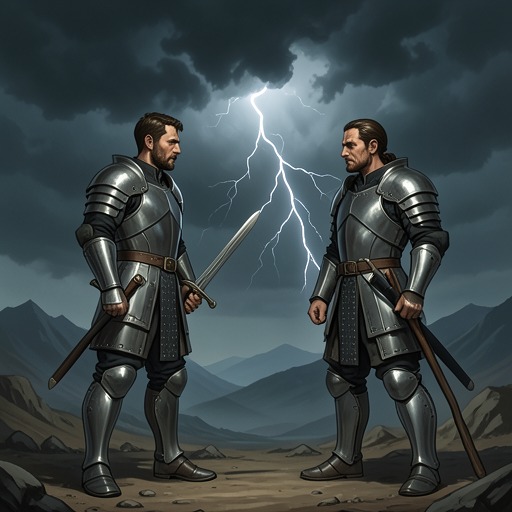
The murder occurs after Renly has rejected Catelyn Stark’s attempt to replace armed rivalry with a Great Council. Catelyn proposes that Robb Stark, Renly, and Stannis all set aside their crowns so that the lords of the Seven Kingdoms can choose a ruler after hearing Bran Stark’s account of the Lannisters’ crimes. Renly answers with a comparison between political choice and the leadership of a direwolf pack, then prepares for force. Brienne of Tarth equips him with his kingly armor: a cloth-of-gold cloak marked with the crowned stag of House Baratheon, a green-and-gold gauntlet, a belt carrying sword and dagger, and a greathelm crowned with golden antlers.
The scene therefore places ceremony, sovereignty, and impending violence in the same enclosed space. Renly is dressed to become visibly larger than life, while Catelyn is still trying to make him acknowledge the ethical and political cost of fratricidal war. His confidence that strength will decide the matter leaves the tent poised between negotiation and battle. The assassination converts that unresolved choice into an irreversible fact before either army can test its strength.
The Shadow Killing
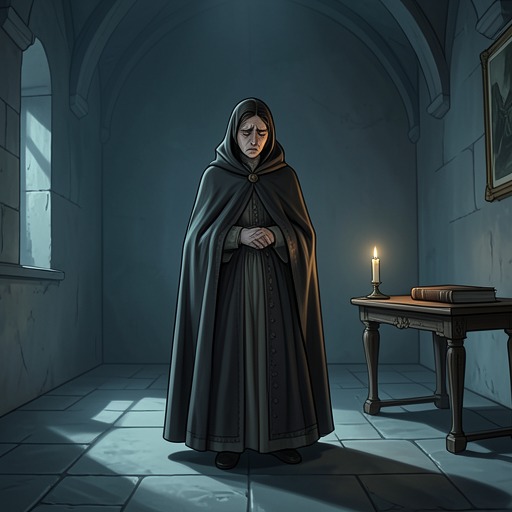
Catelyn begins to appeal to Renly in the name of the Mother when a gust of wind throws open the tent door. At first she thinks she sees movement, but the apparent disturbance becomes the king’s shadow shifting against the silken walls. Renly begins a jest; the shadow moves, lifts a sword, and appears black against green while the candles gutter and shiver. The visual evidence is deliberately unstable: Renly’s actual sword remains sheathed, yet a second, shadow-like sword seems to act independently of it.
Renly’s final perception is an ordinary physical sensation rendered ominous by the impossible attack. He says, "Cold," and the steel of his gorget parts as though it were cloth beneath a blade that cannot be seen. Blood pours from his throat. He has time only for a thick gasp before the wound overwhelms him. The violence is swift enough to defeat every expected defense: armor does not protect him, the sword at his side is never drawn, and the guards outside arrive only after the killing has been completed.
Brienne of Tarth catches the collapsing king. Blood spreads across the green and gold of his armor, while she tries to hold him upright and screams in anguish. Her reaction establishes both her devotion and her immediate vulnerability. The scene is witnessed through horror rather than explanation: Catelyn knows that something dark and evil has happened, but cannot understand it, and the narrative gives the shadow a form without making its mechanism fully ordinary or fully visible.
Misrecognition and Political Consequences
Robar Royce and Emmon Cuy burst into the tent with armed men soon after Renly falls. They find Brienne of Tarth holding the dead king and drenched in his blood. Emmon Cuy immediately condemns her as a wicked woman and orders her away, turning the most loyal protector at the scene into the apparent culprit. The murder thus produces a second violence: the victim’s death is followed by the social misreading of the witness. Brienne’s grief cannot speak before accusation fixes the interpretation of what the men have seen.
In King’s Landing, Tyrion Lannister receives the news with alarm and calculates its strategic meaning. He had expected Renly and Stannis to destroy one another in a bloody battle, leaving the Lannisters to benefit from the weakening of both. Instead, Renly has been removed before the confrontation, and Tyrion concludes that Stannis must be assumed to have arranged it because Stannis gains most clearly from the deed. The inference is political rather than evidentiary: the beneficiary appears to identify the killer even though the actual method remains mysterious.
The transfer of power confirms the force of that inference. Most lords who rode with Renly to Storm’s End go over to Stannis with their banners, weapons, and chivalry, while the greater part of Renly’s foot remains at Bitterbridge. The assassination therefore changes the military balance almost instantly. Renly’s kingship, which had depended on the visual abundance of his host and courtly supporters, collapses into a succession of defections once his body is gone.
Stannis’s Dream and Denial
The later conversation between Davos Seaworth and Stannis complicates the apparently simple conclusion that Stannis personally killed his brother. Stannis says that he sometimes dreams of Renly’s death: a green tent, candles, a woman screaming, and blood. He insists that he was still in his own tent when Renly died and that Davos’s son Devan can confirm he tried to wake him. According to Stannis, Devan reported that he thrashed and cried out before dawn, when his lords were waiting for him to mount and arm himself.
Stannis separates dream from action with a lawyer’s precision. He says that he was in his tent when Renly died and that, when he woke, his hands were clean. Yet the cleanliness of his hands does not settle the matter for Davos, who feels his phantom fingertips begin to itch and silently recognizes that something is wrong. Stannis’s account preserves both a denial and an unsettling proximity: he did not wield a visible weapon, but his dream reproduces the killing’s exact images, including the tent, candles, scream, and blood.
The ambiguity is sharpened by Stannis’s memory of the peach Renly offered during their parley. Renly had mocked, defied, and threatened him, then presented a piece of fruit whose sweetness Stannis could not interpret. Stannis wonders whether it concealed a political meaning, a jest, or an attempt to make him reveal fear by reaching for his sword. He says that Renly brought his doom upon himself through treason, but also admits that he loved his brother and will think of Renly’s peach until death. The peach becomes the intimate remainder of the assassination: alongside the shadow, blood, and military gain stands an inexplicable gesture of brotherly provocation that Stannis cannot stop revisiting.
Narrative Significance
The assassination is structured as a tragedy of reversal. A public dispute that seems destined for a military contest ends privately, in darkness, before the first sword is raised. Renly’s armor, antlered helm, and unsheathed weapons promise protection and heroic combat, but the killing bypasses the entire code those objects represent. Brienne of Tarth’s loyalty is transformed into apparent guilt, Catelyn Stark’s attempt at mediation is interrupted, and Stannis’s expected victory arrives without the battle he was preparing to fight.
Its deepest consequence is the collapse of certainty. The event is witnessed, but not understood; its political beneficiary is apparent, but its agent is not shown; Stannis remembers the murder with unnerving exactness while denying physical presence; and the surviving interpretation is divided between supernatural shadow, political suspicion, and fraternal guilt. The result is a death that cannot be contained by a single explanation. Renly’s body settles the succession struggle for the moment, but the unanswered question of how he died continues to haunt Stannis, Davos Seaworth, Brienne of Tarth, and the wider political order that profited from the king’s disappearance.