The knights of summer
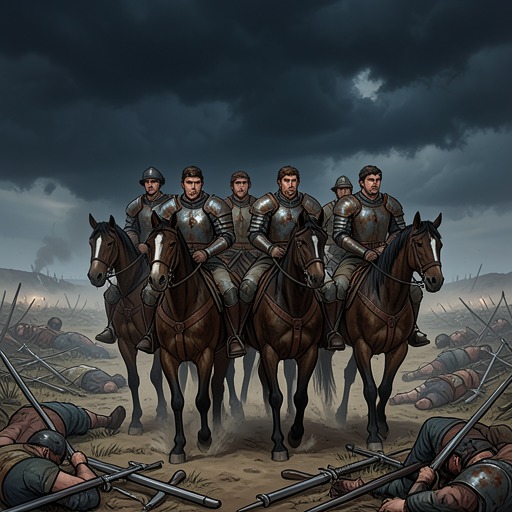
A Clash of KingsThe knights of summer is a seasonal expression for the young nobles and warriors gathered around Renly Baratheon: boys raised on songs of gallantry, glory, honor, and spoils who regard war as an enlarged tourney rather than as an experience that will permanently alter them. Catelyn Stark’s phrase is affectionate but ominous. It names the beauty of their confidence while insisting that their summer cannot last.
The Young Warriors of Renly’s Host
Catelyn observes that the Knight of Flowers and many of the other men in Renly’s hall were scarcely old enough to remember the decisive wars that shaped the realm. They had been infants during the Sack of King’s Landing and little more than boys when Balon Greyjoy raised the Iron Islands in rebellion. Their youth leaves them “unblooded” in her judgment: they are strong, lively, laughing, and consumed by lust, but they still treat danger as play.
The atmosphere around them is theatrical. Lord Bryce goads Ser Robar into juggling a pair of daggers, while Renly mocks Jaime Lannister as the “Kingslayer” and the hall answers with laughter. The scene turns martial identity into entertainment, reducing titles, weapons, and past violence to material for jokes and performance. Catelyn sees men who believe themselves immortal because their knowledge of war comes chiefly from songs and stories.
Summer Against Winter
When Lord Rowan questions why such vigorous young men deserve pity, Catelyn answers that their brightness will not endure. She says they are “the knights of summer, and winter is coming,” making the phrase a compressed prophecy of mortality, disillusionment, and historical change. Summer signifies youth, abundance, confidence, and the illusion that celebration can continue without interruption; winter signifies war’s cost, grief, and the forces no one can postpone forever.
Catelyn’s insight is personal as well as political. She remembers being a girl when Robert Baratheon, Eddard Stark, and Jon Arryn raised their banners against Aerys Targaryen, and a woman by the time the fighting ended. Her pity therefore comes from experience rather than abstraction. She knows that war does not merely test the young; it makes them old, and it leaves losses that continue after the songs have ended. For her, winter arrived when Eddard died, even though the younger knights have not yet suffered the event that will make the metaphor intelligible to them.
The Songs’ Rebuttal
Brienne of Tarth rejects Catelyn’s warning by appealing to the permanence of legend. She argues that winter will never come for people like them because those who die in battle will be remembered in song, where knights remain gallant, maids beautiful, and the sun always shining. Her answer exposes a competing meaning of summer: not merely a season in life, but an artistic world in which heroic beauty is preserved against decay.
The contrast is not simply between pessimism and optimism. Brienne recognizes that the songs can transform death into lasting honor, while Catelyn recognizes what such transformation conceals. The songs maintain eternal summer by removing the ordinary consequences of violence: aging, grief, bodily suffering, and the ruin of hopes. Catelyn does not deny the power of remembrance, but her silence toward Brienne shows that she cannot accept memory as protection. Winter comes for everyone, including those whom songs make beautiful.
Political and Historical Resonance
The expression also illuminates the wider conflict over kingship. Robb Stark is only fifteen when his fresh bronze crown is placed on his head, and Catelyn sees its weight pressing heavily upon him. His crown imitates the lost crown of the Kings of Winter, with hammered bronze, First Men runes, and nine black iron spikes shaped like longswords. The symbolism gives a young ruler an ancient identity, but the physical gestures by which Robb repeatedly shifts the crown reveal how difficult that inherited role is to inhabit.
Robb’s proclamation of a free and independent kingdom north of the Neck, including the River Trident and its tributaries, turns youthful military success into national sovereignty. Renly Baratheon offers a different settlement: Robb may retain his lands and titles and even call himself King in the North, provided he bends the knee and offers fealty, loyalty, and service. Renly treats kingship as a word that can be retained ceremonially while authority remains centralized; Robb’s claim treats it as the foundation of an independent political community. In this contrast, the “knights of summer” image acquires a political edge: youthful confidence is not only a mood but a force attempting to make temporary victory into lasting order.
The same struggle is set against older defeats and failed restorations. The Old Way of the ironborn once imagined war, reaving, and conquest as the proper work of an ironman, but Aegon the Dragon destroyed that order by burning Black Harren and returning Harren’s kingdom to the rivermen. Balon Greyjoy later rebelled in an attempt to restore it, only to be defeated by Robert Baratheon and Eddard Stark. Renly, by contrast, argues that Robert’s right came from winning the Iron Throne with his warhammer rather than from a principle that maesters alone could establish. Across these examples, political summers are made to look permanent by crowns, ancestral stories, banners, and songs, yet each rests upon a power that can fail.
The Banner and the Coming Winter
The image persists beyond Catelyn’s conversation because the competing political communities continue to build themselves through inherited signs. The banner of the King in the North remains the grey direwolf of the Starks of Winterfell running across an ice-white field, a design that joins the warmth of royal aspiration to the cold imagery of the North. The banner presents continuity across thousands of years, even while the kingdom it represents has only recently been declared independent.
That tension defines the expression’s lasting significance. The knights of summer are not merely foolish youths, nor are they simply idealized heroes. They are people inhabiting a brief interval in which victory, beauty, fellowship, and legend seem capable of resisting history. Catelyn’s phrase preserves the radiance of that interval while placing it under the sign of its ending. Summer is real, but it is temporary; the songs may keep the sun shining, yet they cannot prevent winter from coming for the living.