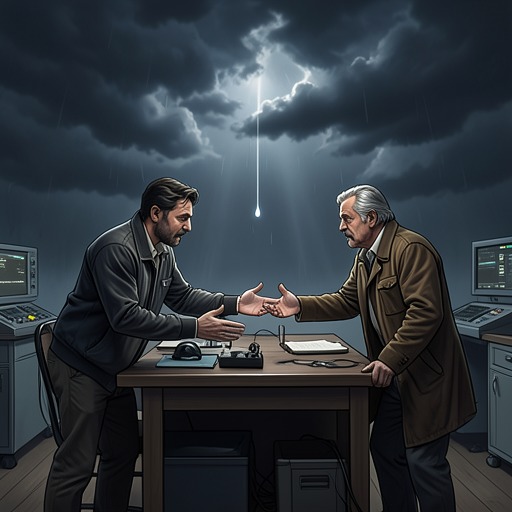
The night is dark and full of terrors
A Clash of KingsThe night is dark and full of terrors is the defining refrain of Melisandre’s religious vocabulary. It presents darkness not as an absence of light but as an active field of danger, and it makes the promise of illumination depend upon faith in R’hllor, the Lord of Light. Across its appearances, the phrase moves from courteous warning to public liturgy and finally to a response that helps authorize Stannis Baratheon’s claim to sacred power.
Private Warning and Defiance
Melisandre first uses the words as a courteous admonition to Maester Cressen, telling him that a man his age must watch where he steps because the night is dark and full of terrors. The sentence sounds like a prayer belonging to her faith, but its immediate force is practical and ominous: it places Cressen in a world where ordinary caution is inadequate because unseen terrors may be present. Cressen rejects the implication, answering that only children fear the dark, and insists inwardly that he has a faith of his own. His defiance creates the phrase’s first important contrast. Melisandre treats darkness as a spiritual reality; Cressen treats fear of it as childish weakness.
The scene nevertheless refuses to let Cressen’s skepticism settle the matter. As he dismisses the warning, he hears Patchface resume his song about shadows coming to dance. The recurrence gives Melisandre’s formula an unsettling echo outside her control. Her words are not confirmed by an explicit supernatural explanation, but the surrounding language makes Cressen’s rational confidence feel precarious. Darkness becomes a space of anticipation, where the threat remains partly unseen and therefore more expansive than any single visible danger.
From Prayer to Political Liturgy
The phrase acquires public force during the burning of the Seven at Dragonstone. Melisandre walks around the fire three times, praying once in the speech of Asshai, once in High Valyrian, and once in the Common Tongue. In the language understood by Davos Seaworth, she calls on R’hllor to come to the worshipers in their darkness and asks the god to take the Seven, described as false gods, and cast light upon them. Queen Selyse Baratheon repeats the words, turning Melisandre’s private religious vocabulary into a communal response.
The setting intensifies the phrase’s transgressive power. Dragonstone’s sept was the place where Aegon the Conqueror knelt before sailing, yet the queen’s men have overturned its altars, torn down its statues, and smashed its stained glass with warhammers. The old sacred order is therefore not merely debated but materially destroyed. The language of darkness functions within that rupture: it names the followers of the Seven as people trapped in error and presents the burning as an escape into R’hllor’s light. At the same time, the ceremony produces unease rather than uncomplicated revelation. Hundreds witness the flames, and even soldiers find it difficult not to feel disturbed while the gods most of them have worshiped all their lives are burned.
Davos’s reaction gives the refrain an important human counterpoint. Although the gods had meant little to him as a smuggler, he had still made customary offerings to the Warrior before battle, the Smith when launching a ship, and the Mother when his wife was pregnant. Watching the Seven burn makes him feel ill, not only because of the smoke. The phrase therefore divides the gathered crowd between those who accept a new sacred language and those who experience its victory as an assault on memory, custom, and moral order.
The Answer of the Queen’s Men
The same words are repeated after Melisandre presents Lightbringer. She raises her hands and announces that a promised sign has appeared, identifying the sword with Lightbringer and proclaiming Azor Ahai’s return as the Warrior of Light and the Son of Fire. Her declaration transforms the ceremony from destruction into recognition: the burning of the Seven has prepared the scene for a sign that is meant to validate Stannis Baratheon’s chosen status.
When Melisandre calls on the Lord to cast his light upon the worshipers, Selyse and her queen’s men answer together that the night is dark and full of terrors. The phrase now operates as a liturgical antiphon, with Melisandre speaking the invocation and the assembled believers supplying the response. Its meaning has shifted from warning to collective affirmation. The crowd does not merely hear that darkness is dangerous; it publicly acknowledges dependence on the power that claims to overcome it.
Yet the visual evidence complicates the proclamation. Stannis’s glove begins to smolder as he holds the sword, and he curses before thrusting its point into the damp earth and beating out the flames against his leg. He removes the singed glove, while the gods in the pyre become scarcely recognizable and the head of the Smith falls away in ash and embers. Lightbringer glows ruddy hot, but the flames clinging to it dwindle and die. The refrain thus accompanies a sign whose interpretation remains unstable: the ceremony insists on divine confirmation, while the visible result includes pain, embarrassment, and extinguished fire.
Fear, Faith, and Uncertainty
The expression’s power comes from its ability to hold several meanings at once. For Melisandre, darkness is the condition in which R’hllor’s light must be sought. For Cressen, the phrase is an argument against fear that he can answer with rational pride. For Davos, it becomes part of a ceremony that forces him to measure political loyalty against religious revulsion. For Selyse and the queen’s men, it is a shared profession of faith and allegiance to Stannis Baratheon’s new sacred cause.
Its repeated use also creates a gradual movement from intimate menace to institutional language. The first utterance is directed at one vulnerable old man; the second is embedded in a carefully staged public rite; the third is answered by a political congregation immediately after Lightbringer is proclaimed. At each stage, the phrase enlarges its audience and its stakes. It does not dispel uncertainty so much as organize uncertainty into ritual: what cannot be explained is placed within the opposition between darkness and light, false gods and the Lord of Light, hesitation and obedience.
The refrain ultimately remains more persuasive as a statement of atmosphere and power than as an unambiguous proof of divine truth. Its insistence makes fear communal, gives Melisandre’s ceremonies a memorable verbal shape, and supplies Stannis Baratheon’s followers with a compact language for crisis. But the surrounding scenes preserve the gap between proclamation and result. The night may indeed be dark and full of terrors; whether the light offered against it is miraculous, political, or both is left deliberately unsettled.