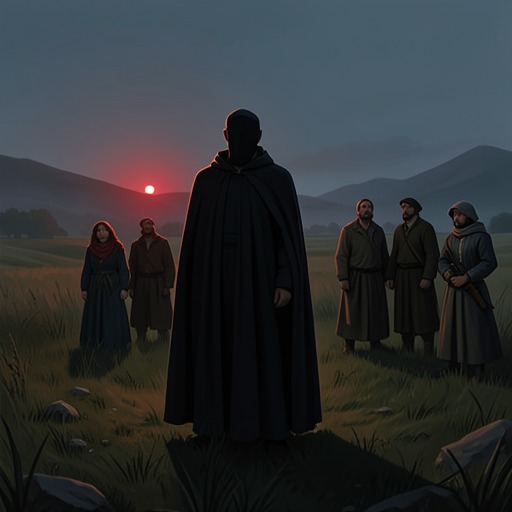
The three-headed dragon
A Clash of KingsThe three-headed dragon is one of the book’s most persistent prophetic images, linking Daenerys Targaryen’s living dragons to the founding memory of House Targaryen. It first appears as a cryptic promise that a prince is “the prince that was promised,” whose song is “the song of ice and fire,” followed by the declaration that “The dragon has three heads.” Daenerys later rejects the literal possibility of a three-headed animal, yet turns the image into a program for her return: three ships are renamed for the dragons of Aegon’s Conquest so that the world will know the dragons have returned.
Prophetic Origin
In the House of the Undying, Daenerys witnesses a vision of a man naming an infant Aegon and proclaiming him the prince that was promised. The child’s destiny is joined to the song of ice and fire, but the vision immediately adds that there must be one more because the dragon has three heads. The scene does not explain whether the three heads are individuals, heirs, companions, or symbolic offices. Its force lies in its combination of royal birth, prophecy, music, and unfinished succession: the promised prince is not presented as a solitary figure, but as part of a triadic design.
The vision also makes the image intimate and unsettling. The man’s eyes seem to meet Daenerys’s beyond the door, as though the prophecy reaches across time to address her directly. The household and its music then fade, leaving the words behind. The three-headed dragon therefore functions not as a simple heraldic sign but as a fragment of knowledge that survives the disappearance of the people who uttered it.
Historical and Dynastic Meaning
Daenerys connects the image to the first Targaryen conquest when she discusses it with Ser Jorah Mormont. She knows that the Targaryen sigil is a three-headed dragon, but points out that no literal dragon has three heads. Ser Jorah explains the conventional historical interpretation: the three heads were Aegon the Conqueror and his sisters, Visenya and Rhaenys. Daenerys recalls that her own descent runs through Aegon and Rhaenys, through their son Aenys and grandson Jaehaerys.
This explanation gives the prophecy a dynastic precedent without settling its future meaning. The original three heads were not three aspects of one creature but three members of a conquering family whose power was coordinated through blood, marriage, dragons, and war. The emblem thus preserves a political memory: Targaryen sovereignty was founded through a collective configuration rather than through one ruler acting alone. For Daenerys, who has lost her immediate family and crossed the world as an exile, the image offers a possible form for rebuilding a broken dynasty.
Daenerys’s Interpretation and Political Use
After leaving the Palace of Dust, Daenerys continues to count the threes associated with her prophetic experience: three fires, three mounts to ride, and three treasons. She asks what the three heads mean, but neither she nor Ser Jorah can supply a definitive answer. Her uncertainty is important. The image guides her attention and decisions, yet it does not provide an explicit instruction that can be obeyed mechanically.
When Daenerys prepares to leave Qarth, she orders three ships to be renamed Vhagar, Meraxes, and Balerion, the names of the dragons associated with the original conquest. She commands that the names be painted in large golden letters so every observer will understand that the dragons have returned. The three-headed dragon consequently moves from prophecy into public communication. It becomes a deliberate political message, converting three ships into a fleet of historical signs and presenting Daenerys’s expedition as a renewal of Targaryen power rather than merely another stage in an exile’s wandering.
The gesture also reveals the tension between symbol and reality. Daenerys has three living dragons, but they are still hatchlings and vulnerable to capture or death. She insists that they are hers and that no one will take them while she lives. The three-headed image therefore expresses both extraordinary promise and severe limitation: the dragons announce a restored power, while their youth makes that restoration precarious.
The Image Among Rival Claims
The three-headed dragon belongs to a wider political world in which symbols manufacture competing communities. Robb Stark’s newly forged crown recalls the lost crown of the Kings of Winter, and its bronze circlet, First Men runes, and black iron swords give the northern kingdom a material history. His proclamation that the lands north of the Neck and the River Trident form a free and independent kingdom turns ancestry and territory into a claim of sovereignty. The banner of the King in the North likewise carries the grey direwolf of the Starks across an ice-white field.
Renly Baratheon offers the opposite theory of kingship: Robert won the Iron Throne with his warhammer, and Renly argues that his own military power makes his claim equally valid. He is willing to let Robb call himself King in the North only if Robb bends the knee and acknowledges Renly as overlord. Against these competing claims, the three-headed dragon represents a different basis of legitimacy, one grounded in conquest, Targaryen blood, remembered dragons, and prophecy. None of these political signs is simply decorative. Each turns an uncertain present into an apparently continuous destiny.
The image also contrasts with the Ironborn memory of the Old Way. Aegon the Dragon destroyed that order by burning Black Harren, restoring Harren’s kingdom to the riverlords, and reducing the Iron Islands to a marginal part of the larger realm. The Greyjoy words, We Do Not Sow, preserve a separate ideal of raiding and conquest despite that historical defeat. Like the three-headed dragon, the Old Way survives through repeated narration and inherited signs; both show how political identity can outlive the conditions that originally produced it.
Animal Power and Unresolved Significance
The three-headed dragon is not the only image in which nonhuman creatures carry knowledge and political force. Bran Stark’s wolf dreams allow him to run through mountains and look down upon the world as a direwolf, while Summer and Shaggydog respond to his attempted howl as the last of their pack. Grey Wind is said to have found the hidden path by which Robb Stark bypassed the Golden Tooth, making the direwolf an active participant in military victory rather than a mere emblem. When Theon Greyjoy notices that the wolves have fallen silent after his capture of Winterfell, their absence becomes a warning he instinctively recognizes.
The dragon image similarly refuses to remain wholly human or heraldic. Daenerys’s three dragons are living beings, born through fire and death, and their existence changes the balance of the world. Yet the prophecy does not identify its three heads. It may refer to three dragons, as Daenerys’s political gesture implies; to three riders in the manner of Aegon, Visenya, and Rhaenys; or to three people whose cooperation will shape the promised future. The text preserves all of these possibilities at once.
Its final significance lies in that productive uncertainty. The three-headed dragon joins prophecy to history, private vision to public sovereignty, and animal life to dynastic symbolism. It promises a return while exposing the absence that makes return necessary: the old Targaryen order is gone, and Daenerys must make its signs visible before its political substance exists. The image therefore does not merely predict what will happen. It gives Daenerys a language in which conquest, inheritance, alliance, and destiny can be imagined together.