Theon Greyjoy
A Clash of KingsTheon Greyjoy is an heir divided between two homes and two political identities. Taken from the Iron Islands as a boy after Robert Baratheon’s rebellion, he was raised as a ward of Eddard Stark, yet he never ceased to regard himself as Lord Balon Greyjoy’s son and successor. His return to Pyke is therefore not a simple homecoming: it is an attempt to make blood, memory, and authority coincide. That attempt drives him toward increasingly theatrical claims of manhood and increasingly destructive acts of conquest.
Identity and Return
Theon’s first decisive movement is toward the home from which he was removed. He wants to see Pyke from the sea as he saw it ten years earlier, when Robert Baratheon’s war galley carried him away to become Eddard Stark’s ward. The Myraham’s difficult passage past the point allows the return to unfold as a visual reversal: the castle that once dwindled behind him must now grow larger before him. Home is approached through memory, but the memory is inseparable from dispossession, and the adult who returns is already measuring himself against the child who was taken away.
At Pyke, Theon tries to force recognition from Lord Balon. When his father asks what he has become, Theon answers that he is “A man,” then defines that man through inheritance: “Your blood and your heir.” The formulation reveals both confidence and anxiety. He does not merely claim adulthood; he claims legitimacy through Balon’s blood and the succession attached to it. Balon’s curt response, “We shall see,” leaves that legitimacy unsettled, making Theon’s promise that his father will see it less a secure fact than a challenge he must prove through action.
The Command to Strike
Lord Balon gives Theon an opportunity to prove himself, but not the grand opportunity Theon appears to want. He is ordered to take eight longships north, harry the Stony Shore, raid fishing villages, sink ships, and draw northern lords away from their stone walls. Aeron Greyjoy and Dagmer Cleftjaw are to accompany him. The assignment is strategically limited and deliberately practical: it is a raid intended to create pressure elsewhere, not an independent conquest.
Theon immediately objects to the number of ships, asking what he can accomplish with only eight longships. His reaction exposes the gap between the task assigned to him and the stature he wants to inhabit. Balon’s plan treats him as an instrument within a wider campaign; Theon hears the command as a test of whether he can become the active heir he has announced himself to be. His dissatisfaction with a contained raid helps explain why later action expands beyond the mission’s stated purpose.
Winterfell and the Performance of Power
Theon’s most consequential escalation is the seizure of Winterfell. He tells Bran Stark that Robb Stark is too far away to help and announces, “I’m Prince Theon now. We’re both princes, Bran. Who would have dreamed it? But I’ve taken your castle, my prince.” The statement joins triumph, irony, and wounded kinship. The boy before him is not an anonymous enemy but someone connected to the household that raised him, and Theon frames the capture as a reversal in which the former ward has become the prince who possesses the castle.
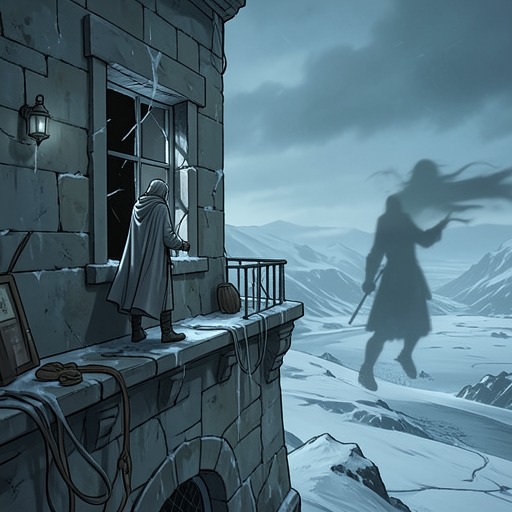
He explains that four men went over the walls with grappling claws and ropes and opened a postern gate for the rest of his force. The operation succeeds through infiltration rather than overwhelming strength, allowing Theon to declare that Winterfell is his while the fighting continues inside. His claim is therefore both fact and performance: possession has been achieved, but authority still has to be spoken into existence before Bran, before his men, and before himself.
The capture also turns Theon’s divided identity into an act against the people who once sheltered him. He uses the language of shared princely status with Bran even as he takes Bran’s home. The intimacy of the address does not soften the conquest; it sharpens its contradiction. Theon seeks recognition as a Greyjoy prince by occupying the symbolic center of his Stark past.
Deception, Violence, and Reinforcement
Theon’s rule at Winterfell is further entangled with deception when a man identified as Reek appears in fine armor. Theon is disquieted by the contrast between the serving-man’s apparent station and his equipment. The stranger explains that the man who wore that armor is dead: he gave Reek his horse, clothes, ring, and other identifying possessions, sending him toward the Dreadfort so that pursuers would mistake him for the important man. He then dressed himself in Reek’s rags and smeared himself with the girl’s filth to escape notice.
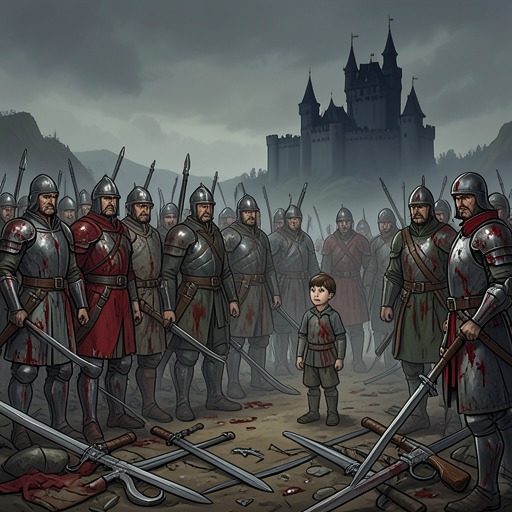
The account reveals a world in which identity can be manufactured through clothing, rings, armor, and the assumptions attached to rank. The disguise is not harmless cunning. It is bound to the murder of a girl, the exploitation of a dead man’s body and name, and the calculated manipulation of pursuers. The man’s arrival with his father’s garrison completes the deception’s political purpose: he claims to have brought three times the promised two hundred men, and insists that these are not inexperienced boys or fieldhands but his father’s own soldiers.
Theon’s discomfort at Reek’s appearance places him in a position of uncertain recognition. He can identify the serving name, but not the social reality concealed beneath the armor. That confusion mirrors his own instability. He has changed names and roles from ward to heir to prince, while the men around him use visible signs of status to decide whom they must obey. At Winterfell, power depends not only on force but on the ability to make a contested identity appear authoritative.
Arc and Narrative Significance
Theon’s trajectory is a dark inversion of a conventional return-and-integration story. He leaves the Iron Islands, is shaped within the Stark household, and returns expecting that blood will restore him to a place that has continued without him. Instead of reconciling the identities he carries, he tries to silence one through the other. The result is not mature belonging but a succession of threshold crossings: arrival at Pyke, the demand to be recognized as a man and heir, the command to raid the Stony Shore, and the seizure of Winterfell.
His actions expose the political meaning of being treated as both family and hostage. As Eddard Stark’s ward, Theon is included in a household whose values and relationships form him, yet his original political identity remains available for use by the Iron Islands. When he returns, neither side fully receives the person produced by that divided upbringing. His answer is to make conquest serve as proof. The castle, the title, the ships, and the armed garrison become external substitutes for an inwardly secure identity.
The name “Prince Theon” consequently carries a double force. It is a legitimate claim grounded in his father’s house, but it is also a defensive performance against the possibility that neither Pyke nor Winterfell will regard him as fully belonging. His capture of Winterfell is decisive because it transforms a personal crisis of recognition into a political catastrophe: the former ward attacks the home that shaped him in order to prove that he is no longer its dependent. Theon Greyjoy’s significance lies in that contradiction, where the search for an inherited self produces betrayal, violence, and a fragile power that must continually be asserted because it has never become secure.