Vargo Hoat
A Clash of KingsVargo Hoat is the captain of the Brave Companions, better known as the Bloody Mummers, and one of the most immediately disturbing figures to appear at Harrenhal. His authority is theatrical rather than hereditary: he rides beneath a black goat with bloody horns, wears a goat-shaped black-steel helm, and hangs a chain of mismatched coins around his neck. Yet the title he claims, “Lord Vargo Hoat,” is treated by his own associates as a fraud. His power comes instead from command of a company willing to turn war into spectacle, extortion, mutilation, and opportunistic allegiance.
Appearance and Self-Made Authority
Vargo Hoat is introduced through the eyes of Arya Stark as the head of an unnerving and heterogeneous company. The Brave Companions include copper men with bells in their braids, lancers on striped black-and-white horses, bowmen with powdered cheeks, men with shaggy shields, brown-skinned riders in feathered cloaks, a fool in green-and-pink motley, swordsmen with fantastically dyed forked beards, scarred spearmen, and figures dressed as a septon and a maester. Their variety makes the company appear less like a conventional military unit than a collection of violent identities assembled under one banner.
At their head rides a man who is exceptionally tall and painfully thin, with an emaciated face lengthened by a ropy black beard reaching nearly to his waist. His goat helm and coin-chain make his image inseparable from theatrical menace. The goat is not merely a heraldic device: it becomes the visual shorthand by which the castle recognizes him and his men. Weese warns Arya that the company calls itself the Brave Companions and that its captain is Vargo Hoat, while insisting that she use no other name for them and address their captain as lord if she wishes to keep all her parts.
The title is openly contested. One soldier says that Vargo is no genuine lord, only a sellsword with an inflated opinion of himself; Weese concedes the point but emphasizes that practical power matters more than legitimacy. Vargo’s self-invention therefore exposes a central feature of wartime hierarchy. A man may lack birth, honor, or even clear speech, yet command obedience if he controls armed followers and can make the consequences of disrespect immediate.
The Brave Companions at Harrenhal
The company arrives at Harrenhal as a living answer to the rumors Arya has overheard. Before seeing them, she hears soldiers speak of the Bloody Mummers as Lord Tywin Lannister’s sellswords. Their arrival supplies the grotesque physical reality behind the name: unfamiliar faces, extravagant costumes, scarred bodies, strange mounts, and a captain whose appearance seems designed to make ordinary military order look monstrous.
Vargo’s first substantial exchange at Harrenhal is with Ser Amory Lorch. The sellsword rides beneath the gallery and addresses him as the lord castellan, while Vargo reports that Roose Bolton attempted to cross the river and that the Brave Companions shattered his vanguard, killing many and sending Bolton fleeing. He presents Robett Glover and Ser Aenys Frey among the captives. His thick, slobbery voice turns the report into another element of his grotesque presence, but the substance is clear: he has brought prisoners, military intelligence, and a victory that gives the company immediate leverage within the castle.
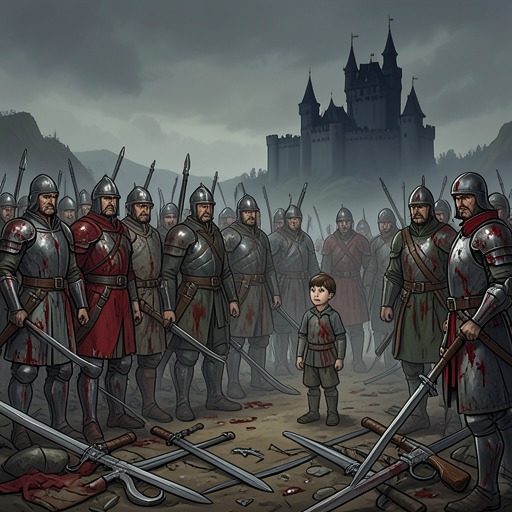
The prisoners’ condition reveals the cost of that victory. They are bound in a long, shuffling chain, many wounded, and are driven forward by riders who use whips whenever anyone falters. Arya recognizes northern devices among them, including the twin towers, the sunburst, the bloody man, and the battleaxe of House Cerwyn. The capture of Robett Glover and other northern soldiers transforms Vargo’s military success into a personal threat for Arya, who understands that these are men of her father and Robb Stark.
Vargo’s report is also a claim to usefulness. The Brave Companions are not merely present at Harrenhal; they have made themselves difficult for the castle’s rulers to dispense with. Their violence supplies the kind of service that wartime lords reward even while distrusting the men who perform it. Vargo’s command thus rests on a grim exchange: victory grants him protection, and protection permits further violence.
Violence as Public Performance
The Bloody Mummers do not conceal the brutality that sustains them. The morning after their arrival, Arya watches them strip the dead of valuables and drag the corpses to the Flowstone Yard, where a pyre is prepared. Shagwell the Fool hacks the heads from two dead knights and swings them by their hair while making them speak. The scene is not an accidental excess committed in private. It is performed in the open, before the surviving inhabitants of Harrenhal, and makes humiliation part of the company’s military language.
Vargo is not shown personally carrying out every act of cruelty, but the company’s conduct establishes the environment of authority he commands. The men can plunder corpses, torment prisoners, and make jokes from the dead because the chain of command has created a space in which such behavior is both possible and useful. Arya is assigned to mop dried blood while the castle absorbs the new order. The ordinary labor of cleaning becomes a continuation of conquest: violence is first inflicted, then made into the servant’s work to erase.
The company’s public grotesquerie also blurs the boundary between soldier and entertainer. Their name, costumes, fool, dyed beards, bells, and talking severed heads make war resemble a carnival whose attractions are terror and degradation. Vargo’s goat imagery gives that carnival a single emblem. The result is a form of power that depends not only on winning battles but on ensuring that everyone in the castle can imagine what the victors may do next.
Harrenhal Under New Rule
After the Bloody Companions have taken control of the castle’s immediate atmosphere, a new lord arrives: Roose Bolton, Lord of the Dreadfort. His squire orders Harrenhal to kneel, and Vargo formally presents the castle as belonging to Bolton. The exchange shows Vargo’s position with precision. He is powerful enough to seize the castle and deliver it to its new master, but he is not the master himself. His authority is delegated, contingent, and dangerous, dependent on the succession of stronger patrons.
Vargo’s formal deference does not make him harmless or subordinate in practice. He has already shaped the conditions under which Bolton takes possession: northern captives are displayed, blood has been scrubbed from the yard, the dead have been burned, and the castle has learned to fear the men who hold its gates. Vargo therefore functions as the instrument through which political change becomes physical reality. Lords may exchange banners, but the sellswords enforce the exchange with chains, whips, corpses, and fire.
His character is consequently defined less by interior development than by a stable pattern of self-made legitimacy. He has no established noble identity in the evidence, and other soldiers mock his claim to lordship. Nevertheless, he insists on the title, dresses himself as its emblem, and commands enough force to make the fiction operational. At Harrenhal, that is nearly indistinguishable from genuine power: a title becomes real when armed men punish those who refuse to use it.