War of the Five Kings
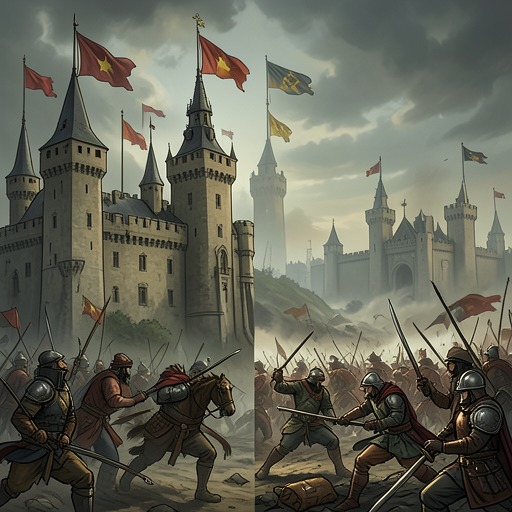
A Clash of KingsThe War of the Five Kings is not a single campaign but a condition of political disintegration following the death of Robert Baratheon. With Joffrey Baratheon, Stannis Baratheon, Renly Baratheon, and Robb Stark each associated with a royal claim, and Balon Greyjoy's rebellion opening a separate challenge from the Iron Islands, the conflict replaces a unitary realm with rival centers of authority. Its central contradiction is that every king speaks in the language of rightful rule while the kingdom itself is consumed by war.
Origins in a Broken Succession
The crisis begins with the collapse of the order that had seemed secure under Robert Baratheon. Sansa Stark remembers Robert's earlier tournament, held in honor of her father, as a world of high lords, famous champions, silken pavilions, trumpets, feasts, and song. That memory is abruptly measured against the present: Robert is dead, her father has been executed as a traitor, three kings are already named, war rages beyond the Trident, and desperate men fill the streets of King's Landing. Joffrey Baratheon's tournament must therefore be held behind the thick stone walls of the Red Keep, a ceremonial imitation of a vanished stability.
The succession is contested most explicitly by Stannis Baratheon. His proclamation declares that Joffrey Baratheon, Tommen Baratheon, and Myrcella Baratheon are not trueborn children of Robert Baratheon but the offspring of incest between Cersei Lannister and Jaime Lannister. Stannis grounds his claim in birth and blood, identifies himself as the trueborn son of Steffon Baratheon and Cassana of House Estermont, and claims the Iron Throne as the rightful king of the Seven Kingdoms. He orders the declaration copied and distributed throughout the realm, using one hundred seventeen ravens and directing Davos Seaworth and Dale Seaworth to carry letters by ship to ports, holdfasts, villages, septs, and inns.
Stannis's campaign also reveals the weakness of legality when it lacks willing allegiance. He expects that many letters will be lost to storms, hawks, arrows, or indifference, and that even those read aloud by maesters may be burned while the hearers pledge themselves to Joffrey Baratheon, Renly Baratheon, or Robb Stark. The proclamation is thus both a legal argument and an admission that legal right alone cannot command obedience. Even its language is contested: Stannis rejects the courteous description of Robert as his beloved brother and insists that Jaime be called a knight as well as the Kingslayer, showing a rigid concern for exact titles amid a struggle in which titles are being remade.
Rival Kings and Competing Legitimacies
Robb Stark's kingship is the most direct expression of regional independence. His crown, newly forged for him at Riverrun, recalls the lost crown of the Kings of Winter: an open circlet of hammered bronze, carved with the runes of the First Men and topped by nine black-iron spikes shaped like longswords. It contains no gold, silver, or gemstones. Bronze and iron make the crown a material emblem of winter, endurance, and northern identity rather than wealth.
The political claim attached to that crown is equally concrete. Robb Stark demands that Joffrey Baratheon and the Queen Regent renounce dominion over the North, declares the lands north of the Neck and the River Trident territories of a free and independent kingdom, and defines its boundaries from the Golden Tooth to the Mountains of the Moon. He requires Tywin Lannister to withdraw beyond those borders and cease raiding, burning, and pillage; he rejects taxation and service owed to the Iron Throne, House Baratheon, and House Lannister; and he demands the release of his imprisoned lords and knights, together with ten highborn Lannister hostages as pledges of peace. The cry of “THE KING IN THE NORTH!” turns a military revolt into a public act of political identity, while the grey direwolf of House Stark running across an ice-white field gives that identity a persistent banner.
Renly Baratheon offers a deliberately different theory of kingship. He dismisses abstract genealogical claims by arguing that Robert Baratheon won the throne with his warhammer and that no one but maesters cares about distant blood ties, ancient marriages, or the technical precedence of elder daughters and younger sons. His own claim, he says, is as good as Robert's. Yet Renly's offer to Robb Stark exposes the limits of that apparent flexibility: Robb may retain his lands, titles, honors, and even the name King in the North, but only if he bends the knee and performs homage. Renly can tolerate the word “king”; he cannot tolerate independence, because he wants to rule a whole kingdom rather than a broken one.
The meeting between Catelyn Stark, Stannis Baratheon, and Renly Baratheon makes the conflict's central absurdity plain. Catelyn urges the brothers to recognize their common enemy, but Stannis replies that the Iron Throne is his by right and that anyone who denies it is his foe. Renly counters that the entire realm rejects Stannis, from dying old men to unborn children, from Dorne to the Wall. Their dispute is not merely over policy or strategy. It is a contest between hereditary right, conquest, recognition, and the emotional capacity to inspire loyalty. Catelyn sees the cost of that contest more clearly than either brother: Tywin Lannister has twenty thousand swords at Harrenhal, another Lannister force gathers near Casterly Rock, Cersei Lannister and her son hold King's Landing and the Iron Throne, yet the rival kings expend their strength against one another while the kingdom bleeds.
War as Mobilization and Geography
The war changes according to terrain, logistics, and the institutions available to each claimant. At Storm's End, the army of Stannis Baratheon appears beneath the immense castle as small as mice with banners, a visual reminder that a powerful host can be made insignificant by fortification. Catelyn Stark has come there because Robb Stark sent her south to seek peace between the Baratheon brothers, despite the danger and despite her desire to remain with her dying father at Riverrun or with her sons at Winterfell. The castle's legendary resistance to storms echoes her political task: Durran Godsgrief repeatedly rebuilt after wind and water destroyed six castles, and the seventh stood defiant. In the present, however, the old endurance of Storm's End forms the backdrop to a negotiation that cannot reconcile the claims of the men gathered beneath it.
The conflict also exposes the difference between a battle plan designed by experienced seamen and one shaped by aristocratic confidence. Stannis Baratheon's fleet, four times the size of Joffrey Baratheon's, is arranged by Ser Imry into ten lines of twenty ships. The first two lines are to destroy the smaller royal fleet; following lines are to land archers and spearmen beneath the city walls; slower ships at the rear are to transport the main host across the river, while Salladhor Saan and his Lyseni ships guard the bay. The plan reflects massive military organization, but its haste is partly forced by earlier losses: ships have been wrecked in Shipbreaker Bay and the Straits of Tarth, and a storm has scattered the fleet across the narrow sea. Numbers and formal formation cannot erase the vulnerability created by weather, delay, and unfamiliar waters.
Davos Seaworth recognizes that vulnerability from a perspective formed by smuggling rather than command. He knows ships, sails, shores, and desperate fighting on wet decks, but a smuggler avoids danger by raising sail and fleeing before the wind rather than by sounding warhorns and raising banners. He would have sent swift ships upriver to probe the enemy instead of committing the fleet headlong, yet Ser Imry's confidence in overwhelming numbers dismisses caution as cowardice. The episode makes command a social question as well as a tactical one: Davos's low birth and purchased knighthood shape how his judgment is received, even when his experience gives him insight the lords lack.
Battles, Fire, and the Cost of Rule
At the Blackwater Rush, the war's military scale becomes a mechanism of destruction. As Davos is swept toward Blackwater Bay, he discovers that the chain across the river mouth has been raised. The boom hangs only a few feet above the water; galleys crash into it, ships pile against one another, and almost all are soon aflame. Beyond them lie Salladhor Saan's ships, but the trapped vessels form a barrier of red-hot steel, burning wood, and green flame. A naval invasion intended to carry Stannis Baratheon's army to King's Landing is converted by the river defenses into a scene of entrapment, showing how a single engineered obstacle can overturn a superior fleet.
The battle is also perceived through nonhuman senses, which strip away the language of banners and claims. Summer and Shaggydog prowl beneath the trees while fire, smoke, blood, horses, men, and iron reach them as smells and sounds. Through the night, explosions, barking dogs, screaming horses, human howls, laughter, and shouts merge into a world of terrifying noise. By morning the flames have vanished, leaving a grey and smoky sun. The burned and collapsed camps contain no living men; crows cover the dead, wild dogs retreat, and the direwolves fight over a dying horse before feeding. The scene refuses to let royal ideology conceal the physical aftermath of warfare: men build camps, kings move armies, and animals inherit the field of blood and ash.
Balon Greyjoy's challenge demonstrates that the war's fragmentation is not confined to the mainland succession. Theon Greyjoy remembers the Old Way, the ironborn tradition of reaving, taking wealth and women, and treating war as an ironman's proper trade. Aegon the Conqueror destroyed that order when he burned Black Harren, returned Harren's kingdom to the rivermen, and reduced the Iron Islands to a marginal part of a larger realm. Yet the old tales continue around driftwood fires and within Pyke's stone halls, and House Greyjoy's words, “We Do Not Sow,” preserve the memory of a society defining itself against farming, mining, and dependence on the mainland.
Balon Greyjoy's earlier rebellion had been staged to restore the Old Way more than to satisfy the vanity of a crown, but Robert Baratheon and Eddard Stark crushed it. Their deaths and the rule of boys create a new opening. Theon Greyjoy interprets the shattered realm as the season in which he might achieve what his father failed to accomplish. His ambition therefore belongs to the same historical fracture as the rival mainland kings: the weakening of central authority permits older regional identities and grievances to return, each presenting its own restoration as justice.
A War That Rewrites Community
The War of the Five Kings produces political communities by attaching claims to objects, geography, and inherited stories. Robb Stark's bronze crown turns the authority of the Kings of Winter into a present claim; the grey direwolf banner transforms House Stark's lineage into a shared sign; and the boundaries claimed for the independent North and Riverlands give rebellion a territorial form. By contrast, Stannis Baratheon's letters attempt to create obedience through written law, bloodline, and the circulation of royal proclamation. Renly Baratheon's argument converts kingship into the visible result of victory and popular attachment. Each method seeks to make a contested claim appear natural, but each depends on people, ships, fortresses, ravens, and swords.
The war's repeated contrasts expose the instability of every form of legitimacy. Stannis possesses a legal argument but is feared rather than loved; Renly possesses broad recognition but cannot accept a realm divided beneath him; Robb wins battles and commands a powerful regional loyalty but must translate military success into durable sovereignty; the Lannister regime holds King's Landing and the Iron Throne while its legitimacy is attacked as fraudulent. Against these claims stand the practical burdens of command: crossing rivers, supplying hosts, holding castles, managing prisoners, protecting ships, and preventing fire from turning an army into wreckage.
The result is a conflict in which victory is never only a matter of defeating an opposing king. It requires the construction of an authority that soldiers will serve, lords will recognize, towns can endure, and symbols can sustain. The tournament behind the Red Keep's walls, Robb Stark's awkwardly adjusted crown, Stannis Baratheon's chests of letters, the army diminished beneath Storm's End, and the raised chain at the mouth of the Blackwater Rush all show the same transformation from different angles: the old realm has not simply entered a war; it has become a battlefield on which the meaning of a realm is being decided.