Wildfire
A Clash of KingsWildfire is the alchemists’ volatile incendiary substance, distinguished from ordinary flame by its persistence, its ability to spread through almost any material, and the danger that its containers may fail without warning. In the war for the Iron Throne, it is not merely a weapon stored by human hands. Its physical behavior repeatedly escapes calculation, turning walls, ships, water, and fire into parts of the same destructive mechanism.
Nature and Manufacture
Wildfire is produced by the Alchemists’ Guild, an old order whose former claims to broader knowledge have faded even as its command of this one substance remains terrifyingly effective. Behind the Guildhall of the Alchemists beneath the hill of Rhaenys, Tyrion Lannister enters a long, dank vault where Hallyne the Pyromancer carries a sealed iron-and-glass oil lamp with extreme care. The room is lined with orderly rows of clay jars, and the scale of the store makes the substance a matter of state rather than private craft.
The jars are round, ruddy, and roughly textured, with thin pottery that could be crushed by an imprudent grip. Their pebbled surface is deliberate: a smooth vessel might slip from a man’s hand. Inside, the wildfire appears as a thick substance that flows more readily when warmed, like lamp oil. The very design of its container reveals the contradiction at the heart of the weapon. It must be handled securely, yet the contents are so reactive that handling itself is perilous.
The Alchemists’ Guild can no longer transmute metals and has been largely displaced by the maesters of the Citadel, but it can still make wildfire. Existing stores include jars dating from King Aerys’s reign, and age makes the substance increasingly fickle. Any flame or spark may ignite it; excessive heat can cause jars to blaze of their own accord. Once fire starts inside one jar, the heat expands the contents violently until the vessel bursts, potentially setting off every jar stored nearby. Water cannot quench the burning substance. It seeps into cloth, wood, leather, and even steel, causing the material itself to catch fire.
Strategic Preparation in King’s Landing
As unrest spreads through the riverlands and Lord Renly raises rebels in Highgarden, the roads south and west are closed. In King’s Landing, Cersei Lannister responds with a vast program of military preparation. Lord Janos Slynt triples the size of the City Watch, a thousand craftsmen work on the city’s defenses, stonemasons strengthen the walls, carpenters build scorpions and catapults by the hundred, fletchers produce arrows, and smiths forge blades. The Alchemists’ Guild pledges ten thousand jars of wildfire.
The number alarms Tyrion Lannister precisely because he understands what it means. Ten thousand jars would be enough to turn all of King’s Landing into cinders. The weapon is therefore both a sign that the queen has not been idle and a threat to the city she intends to defend. Financing the preparations requires new revenue: Petyr Baelish imposes a tax on people wishing to enter the city. Wildfire thus belongs to a larger system of emergency mobilization in which manpower, fortifications, taxation, and industrial production are gathered for a single decisive siege.
Tyrion’s inspection makes the danger more concrete. The stored jars are not cleanly controllable instruments but aging, unstable material packed in large numbers beneath a populated city. The Alchemists’ Guild offers technical assurances, yet its own warnings undermine confidence in them. The weapon’s value depends on its unpredictability being contained, while its unpredictability is exactly what gives it extraordinary destructive power.
Deployment on the Blackwater
During the Battle of the Blackwater, wildfire is used against Stannis Baratheon’s fleet as it advances toward King’s Landing. Stannis’s naval force greatly outnumbers the fleet defending the city, and Ser Imry organizes it into ten lines of battle, each containing twenty ships. The leading lines are intended to sweep upriver and destroy Joffrey Baratheon’s smaller fleet, while following ships land archers and spearmen beneath the city walls. The slower vessels are assigned to transport the main part of Stannis’s army across the southern bank, with Salladhor Saan’s Lysene galleys guarding against a counterattack from the bay.
The fleet’s confidence is sharpened by delay and bad weather. Ships have already been lost on the voyage from Storm’s End: two cogs founder on the rocks of Shipbreaker Bay, a Myrish galley goes down in the Straits of Tarth, and a storm scatters the fleet across much of the Narrow Sea. When the surviving ships regroup in Blackwater Bay, haste appears strategically necessary. That urgency helps create the conditions in which a concentrated fleet becomes vulnerable to the Alchemists’ fire.
Davos Seaworth witnesses the weapon’s first decisive manifestation as a flash of green and a nest of burning emerald forms rising from the stern of Queen Alysanne. The cry of “Wildfire!” distinguishes the attack from ordinary burning pitch. The fire spreads over Queen Alysanne and the ships around her faster than Davos expects. Men engulfed in green flame leap into the water, while the defenses of King’s Landing add spitfires from the walls and boulders from trebuchets behind the Mud Gate. The river battle becomes a layered assault in which wildfire, artillery, and the crowded formation of ships magnify one another’s effects.
The most devastating release comes when Swordfish strikes the rotted hulk used to carry the substance. The vessel splits apart, and a thousand broken jars spill green wildfire across the river’s surface. The image makes the substance seem less like cargo than a poisonous body opened from within. Davos orders Black Betha away, but the explosion follows almost immediately: the deck disappears beneath him, black water overwhelms him, and he survives only by breaking the surface and clinging to debris.
The Chain and the Transformation of the River
Davos’s escape is then blocked by the raised chain across the mouth of the Blackwater Rush. Stretched taut only a few feet above the water, the boom catches the attacking galleys and forces them together. A dozen ships have already crashed into it; most are burning, and the remainder are about to ignite. Beyond the barrier lie Salladhor Saan’s ships, but the chain makes them unreachable. The river’s mouth becomes a closed field of red-hot steel, blazing wood, and swirling green flame.
This combination of devices gives Wildfire an effectiveness no single commander fully controls. The chain prevents withdrawal, the packed fleet supplies fuel and targets, the river carries the burning substance, and the city’s engines continue to strike from above. A weapon intended to break an assault therefore changes the geography of the battle itself. Water, normally a means of escape and a defense against fire, becomes the surface over which the flames spread; the harbor becomes a trap rather than a refuge.
Consequences and Significance
Wildfire produces a sharp reversal in the battle’s value structure. Stannis Baratheon’s numerical superiority and carefully organized fleet promise movement toward the city, but the attack turns that advantage into confinement. The ships’ size and concentration, initially signs of strength, make them vulnerable to a substance that can pass from hull to hull and cannot be reliably extinguished. Military order becomes an instrument of destruction when the formation is caught within the chain and the fire.
The weapon also exposes the instability beneath royal power. King’s Landing answers rebellion through a mixture of expanded policing, forced labor or contracted craft production, taxation, fortification, and alchemical stockpiling. The result is a defense that protects the city by bringing the possibility of its total incineration into its foundations. Wildfire is therefore both a product of centralized authority and a challenge to that authority: once ignited, it does not distinguish between king and rebel, defender and attacker, warship and river.
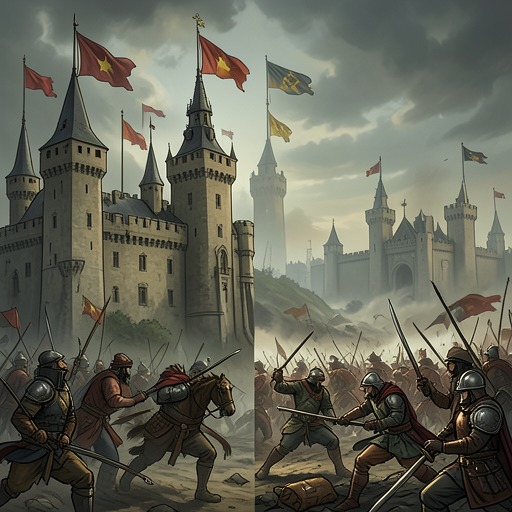
Its recurring association with ash, flame, and mass death extends beyond the naval engagement. The fires of battle are seen from the woods as a great winged snake whose roar is a river of flame; through the night, men, horses, dogs, and combatants are reduced to noise, smoke, and terror before the grey, smoky morning reveals burned and collapsed camps. Wildfire’s significance lies in this collapse of human boundaries. It begins as a calculated substance in a jar, becomes a weapon in a fleet action, and ends as an environment in which the distinction between material, landscape, and living body is almost impossible to preserve.