Winterfell
A Clash of KingsWinterfell is the ancestral stronghold of House Stark and the central northern setting through which inheritance, disability, political duty, invasion, and loss become visible. For Bran Stark, it is at once the place he must govern and the prison created by the injuries that have taken away his former life. By the end of the presented narrative, Winterfell has been seized by Theon Greyjoy and reduced by fire and collapse to a dead, smoking shell, turning the Stark home into the material emblem of a broken succession.
A Home That Becomes a Prison
Bran Stark experiences Winterfell through the limits imposed on his body. He prefers the hard stone of the window seat to his featherbed because, in bed, the walls seem to press inward and the ceiling hangs heavily above him; the room becomes a cell, and Winterfell itself a prison. Yet the castle also preserves a field of vision and sound that remains available to him. From the window he watches candles and hearth fires kindle behind the diamond-shaped panes of its towers and halls, while the direwolves sing to the stars. The fortress therefore holds two opposed meanings for him: confinement within its rooms, and the wider world still calling from beyond its walls.
That contrast is sharpened by the activities Winterfell once made possible. Bran can no longer walk, climb, hunt, fight with a wooden sword, or imagine himself riding a warhorse beneath streaming banners. The castle survives as the setting of those lost aspirations even as it demands that he assume responsibilities he never wanted. He had dreamed of knighthood, not princely administration, but as his brother Robb Stark's heir and the Stark in Winterfell he must listen to matters of lordship and represent the ruling house.
The Political Seat of the Starks
Winterfell is not merely a family residence; it is a seat where regional power arrives, displays itself, and expects judgment. During the harvest feast, visitors gather for tilting at quintains, including the Walders and the retainers of Lord Wyman Manderly of White Harbor. Manderly comes by barge and litter because he is too heavy to ride, accompanied by knights, squires, lesser lords and ladies, heralds, musicians, and even a juggler. Their banners and surcoats fill the castle with color and ceremony, but Ser Rodrik Cassel makes clear that the feast is only a pretext: no one crosses a hundred leagues merely for duck and wine. Winterfell functions as the place where important matters are brought before the Stark heir and his advisers.
Bran's reception of these guests from his father's high stone seat, carved with direwolves, marks the uneasy transfer of authority. He is praised for performing the role well, but the praise cannot conceal the strain beneath it. The castle's political continuity depends on a child who must imitate the lordship once exercised by his father and then by Robb Stark, while privately grieving the physical and imaginative life that office has displaced.
Conquest and the Collapse of Authority
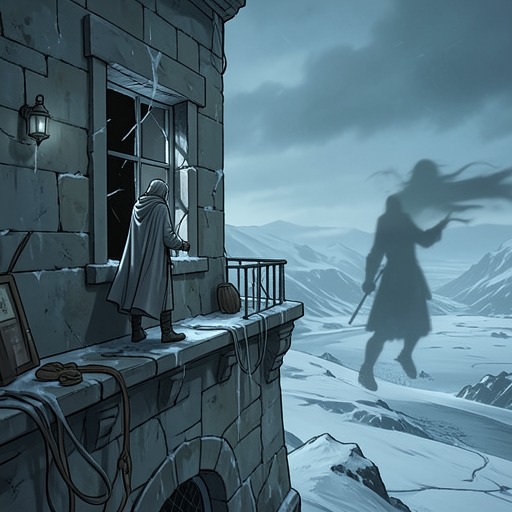
Winterfell's political meaning changes abruptly when Theon Greyjoy takes it. Theon tells Bran that Robb Stark is far away and cannot help him, then announces that he is now Prince Theon and has captured the castle. His force enters through a postern gate after four men climb the walls with grappling claws and ropes, while his soldiers engage Winterfell's defenders. The method is as important as the result: the ancient seat is not defeated through an open contest described as glorious, but penetrated through a concealed entrance and turned against its own household.
Theon's claim that Winterfell is his exposes the difference between possession and legitimacy. Bran remains the Stark heir, yet the castle's walls can be occupied by another prince. The fortress that had represented protection and dynastic order becomes proof that those structures have failed. Its capture also transforms Bran's earlier sense of imprisonment into a harsher political reality: the home that confined him is now controlled by an enemy, and its authority has been converted into the authority of the conqueror.
War Beyond the Walls
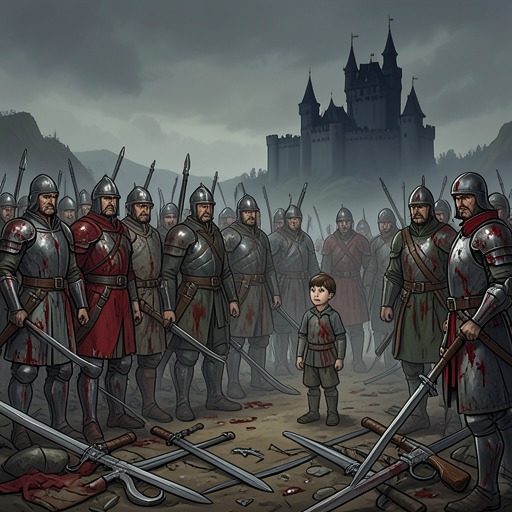
The wider war makes Winterfell part of a landscape in which places and people are exposed to arbitrary violence. Arya Stark's experiences elsewhere show what awaits communities outside the protection of a functioning lordship. At a storehouse beside the Gods Eye, she spends eight days watching prisoners die while Ser Gregor Clegane selects people for questioning and kills those too weak to keep pace. His column carries captives, livestock, and nine wagons of salt fish; women are taken by guards, and a girl who resists repeated abuse is beheaded by Ser Gregor before the assembled prisoners.
These scenes place Winterfell's earlier ceremonies in stark contrast with the lawless movement of armed men across the countryside. In Winterfell, banners, feasts, and formal audiences stage the promise that power has obligations. On the roads, power is reduced to selection, hunger, forced movement, and immediate death. The castle's eventual destruction shows that even the seat of House Stark cannot remain separate from this condition.
The same breakdown reaches the capital, where the City Watch reports thieves and murderers abroad, disease spreading along Pisswater Bend, and food unavailable even for money. Open talk of treason replaces private muttering, while the enlarged watch contains brutes, drunkards, cowards, and traitors who are poorly trained and loyal chiefly to themselves. Against this background, Winterfell's fall is not an isolated misfortune. It belongs to a general crisis in which institutions retain their names while losing the capacity to protect the people gathered beneath them.
The Burned and Ruined Castle
When Bran, Rickon Stark, Jojen Reed, Meera Reed, Osha, and Hodor emerge from hiding, Winterfell is no longer a living castle. The sky is pale grey, smoke eddies around them, and they stand in the shadow of the First Keep, one entire side of which has torn loose and fallen into the yard. Stones and shattered gargoyles cover the ground; crows pick at a body crushed beneath the debris, though Bran cannot identify it. The ruin seems to repeat the violence of Bran's own fall, and the sight of the broken gargoyles makes his survival feel nearly as inexplicable as the castle's destruction.
Fire has consumed the floors and beams of the First Keep, leaving rooms exposed through the collapsed wall, even the privy visible from outside. Yet part of the broken tower remains standing, no more burned than before, an uneven remnant amid the devastation. Jojen coughs in the smoke, Rickon demands to go home, and Hodor circles in distress while the group huddles among ruin and death. Osha observes that the castle is dead and burned, just as Bran dreamed, but the silence is deceptive: the absence of rescuers makes the place feel abandoned, while a noise behind them immediately restores danger to the scene.
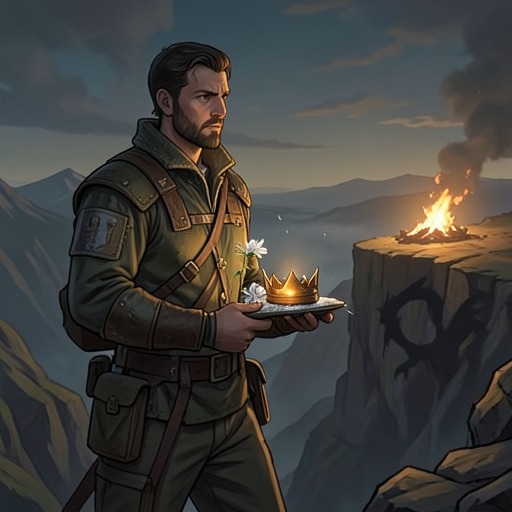
Winterfell's final image is thus neither a restored refuge nor a cleanly completed conquest. It is a damaged threshold from which the survivors must move onward. The castle remains recognizable enough to preserve its identity, but ruined enough to deny the safety that identity once promised. Its broken stone externalizes the collapse of Stark control, while the surviving fragments preserve the possibility that the house and its story have not been wholly erased.