Andras
A Court of Thorns and RosesAndras is a High Fae of the Spring Court who crosses the Wall in the shape of an enormous gray wolf and becomes the first supernatural figure directly killed by Feyre Archeron. His death is not an isolated act of predation or self-defense: it is a planned sacrifice in Tamlin’s attempt to break Amarantha’s curse, making Andras both a victim of political coercion and the concealed catalyst for the central relationship and conflict of the story.
Identity and Assignment
Andras is identified as High Fae rather than an ordinary wolf or lesser faerie. Tamlin possesses the ability to change his sentries into other shapes, and he uses that power to send Andras across the Wall disguised as a wolf so that he will not be recognized as a faerie. The disguise is imperfect because of Andras’s extraordinary size, but it places him within the mortal hunting grounds while concealing the purpose of his mission.
His assignment is tied to the Spring Court’s struggle under Amarantha’s rule. Andras is one of Tamlin’s men, sent across the Wall as a deliberate target for a human whose hatred of faeries is strong enough to kill without provocation. The task therefore turns his body into a test arranged by forces above him: he is required to appear as dangerous game while carrying the political burden of the curse that governs Tamlin and the court.
The Encounter in the Forest
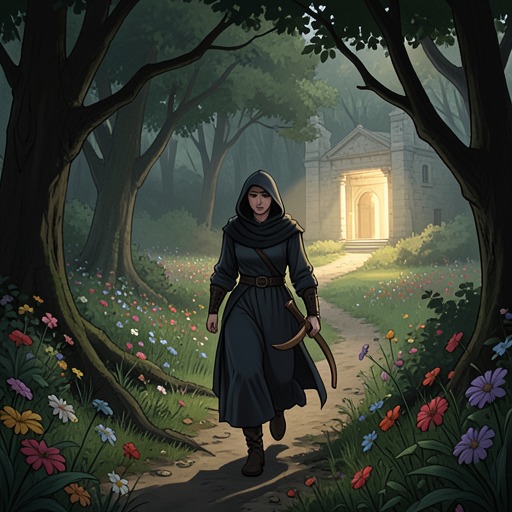
Feyre encounters Andras while hunting in a snowbound forest. She is already measuring the possible value of the kill in practical terms: the meat could feed her family, and the hide could be sold or made into clothing. As she prepares to shoot a doe, she notices a second pair of golden eyes shining from the brush beside her. The forest falls unnaturally silent as the wolf approaches the unaware deer.
Andras then bursts from the thicket and attacks the doe. In the open, he is even larger than Feyre had expected, possessing overwhelming muscle, speed, and strength. Feyre fires an ash arrow before he can destroy much more of the animal. The arrow strikes his side; he releases the doe as blood brightens the snow, then turns toward Feyre with raised hackles, bared fangs, and a low growl. Feyre draws another arrow and prepares to defend herself, believing she has confronted a monstrous predator.
The encounter is framed through Feyre’s mortal perception and immediate need. She sees the wolf as a threat to the scarce food on which her family depends, while the reader later learns that Andras is also acting within a larger design. The scene’s apparent simplicity—a starving hunter killing a dangerous animal—therefore conceals an exchange shaped by the Wall, the Treaty, and the power of the High Fae.
Death and Hidden Purpose
After Andras’s death, his identity is first revealed indirectly when Lucien Vanserra asks whether Andras is dead and receives confirmation from Tamlin. Lucien’s grief and anger show that the wolf was not an expendable beast but a known member of the Spring Court. Later, Lucien explains that Andras had been High Fae and that Tamlin had changed him into wolf form before sending him across the Wall.
The full purpose of the mission is eventually disclosed by Alis. Amarantha had placed a curse on Tamlin and the Spring Court after Tamlin rejected her demand that he become her lover and consort. She offered a possible escape: within forty-nine years, Tamlin had to find a human woman with hatred for faeries, a woman willing to kill one of his men in an unprovoked attack and later fall in love with him sincerely enough to confess that love to his face. The masks placed on the High Fae and the prohibition against explaining the curse were designed to make that condition nearly impossible.
Andras was the man chosen to begin this chain. He had been sent out by Tamlin knowing that he might die, and his behavior at the moment of death is retrospectively transformed by that knowledge: he stared at Feyre and allowed her to kill him rather than simply attacking her. Feyre realizes that his stillness was part of the plan, allowing her violence to satisfy the curse’s first requirement. What she had understood as an accidental killing was therefore a sacrifice arranged by Tamlin, although one whose meaning was hidden from her by Amarantha’s rules.
Consequences for Feyre and the Spring Court
Andras’s death brings Feyre into Prythian. Because she has killed a faerie, Tamlin takes her across the Wall and into the Spring Court, where she reaches the lavish estate that replaces her bleak mortal surroundings with roses, sunlight, marble, and an unsettling emptiness. The movement from the snowbound forest to Tamlin’s estate is the direct spatial consequence of Andras’s death, carrying Feyre across the boundary between mortal life and the realm she has been taught to fear.
His death also structures Feyre’s early relationship with Tamlin. At first, Tamlin appears to be the captor or avenger of a murdered faerie; later, he is understood as the High Lord who permitted one of his sentries to become bait in a curse-breaking plan. The revelation complicates both his apparent protection of Feyre and her sense of moral agency. Feyre killed Andras to protect herself and secure food, yet the act was simultaneously anticipated and exploited by Tamlin and Amarantha.
The consequence extends beyond the Spring Court. Andras’s death supplies the opening move in Amarantha’s game, leading to the court’s attempt to make Feyre fall in love with Tamlin and ultimately placing her within reach of the wider conflict under the mountain. The later sight of Amarantha’s brutal punishment of Clare Beddor clarifies the lethal stakes of misdirection and substitution in that political system: humans and faeries alike can be made into expendable pieces when powerful rulers turn private grudges into public trials.
Narrative Significance
Andras functions as a threshold figure. In life, he moves between the faerie and mortal worlds through the Wall; in form, he occupies the unstable space between person and beast; in plot, his death transports Feyre from her family’s cottage into Prythian. His transformation shows that shapeshifting is not merely a magical ability but a political instrument, allowing the Spring Court to conceal its agents while exposing them to mortal violence.
He also embodies the story’s recurring conflict between visible appearance and hidden identity. Feyre sees a wolf, not a High Fae; the masks and glamours surrounding the Spring Court likewise prevent her from perceiving the people and structures governing her captivity. Andras’s body is therefore a literal disguise and a narrative misdirection. Only after his death does the wolf become legible as a sacrificed soldier, and only later does that sacrifice become legible as the first condition of Amarantha’s curse.
Andras’s importance lies precisely in the brevity of his appearance. He has no opportunity to explain his mission or defend his identity. His silence is imposed by the plan that sends him across the Wall, while his death leaves Feyre with guilt, confusion, and the false belief that she acted in an ordinary act of survival. The story later restores his personhood by naming him, identifying him as one of Tamlin’s men, and revealing that he accepted the danger knowingly. Through Andras, the narrative makes its central transition costly: Feyre’s entrance into Prythian begins not with a welcome, but with the death of a hidden High Fae who was sent to be killed.