Ash Wood
A Court of Thorns and RosesAsh Wood is a rare and dangerous material in the human–faerie conflict, valued because it can make the immortal healing magic of the High Fae falter long enough for a human to deliver a killing blow. In Feyre Archeron’s hands, an ash arrow begins as an expensive object of uncertain usefulness and becomes a recurring measure of what human knowledge can accomplish against supernatural power: it threatens the wolf who takes her from her family, remains part of her survival calculations in Prythian, and ultimately becomes the substance of the dagger with which she kills Tamlin and breaks the curse beneath the Mountain.
Definition and Legendary Origin
Ash Wood is associated with mountain ash, a tree said to be effective against faeries because of the way its wood interferes with their healing. Human lore also holds that faeries hate iron, but the two materials serve different purposes. Iron is treated as a traditional faerie aversion, whereas Ash Wood is described as the substance that disrupts immortal recovery long enough to make a fatal wound possible. The distinction matters because it turns an otherwise ordinary weapon into a limited answer to faerie invulnerability.
The knowledge is inherited through songs and childhood teaching rather than established human science. People have been told from infancy that faeries hate iron and that ash can weaken their magic, yet the evidence for Ash Wood is little more than rumor and its rarity. Feyre has seen drawings of the trees but never a living specimen: the High Fae burned most of them long ago, while the few survivors are said to be small, sickly, and concealed by nobility in high-walled groves. The tree therefore carries both a practical and historical meaning. Its absence records an old act of faerie destruction, while its survival suggests that access to defensive knowledge is controlled by the powerful.
Feyre’s Ash Arrow
Before entering Prythian, Feyre owns one ash arrow, purchased from a traveling peddler during a summer when her family had enough money for a luxury. It is the longest and heaviest arrow in her quiver, carved from mountain ash and fitted with an iron head. For three years it remains unused while Feyre wonders whether the costly weapon is genuine or merely a fraud. That hesitation gives the object an unusual status: it is neither trusted weapon nor useless superstition, but a material test whose value can be learned only in immediate danger.
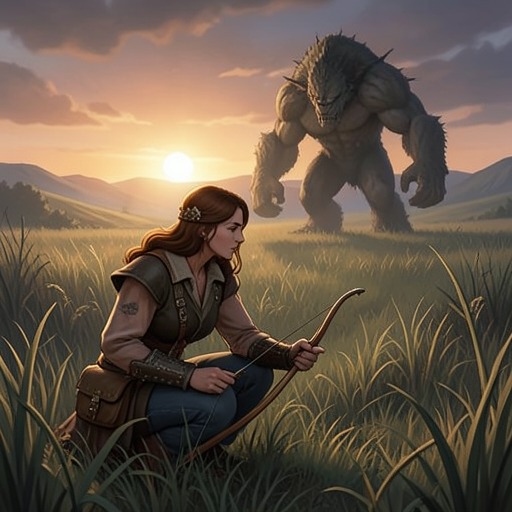
When Feyre sees the enormous wolf in the forest, she has a hunting knife and three arrows. The first two are ordinary and likely to do no more than sting an animal of that size, so the ash arrow becomes her only plausible chance of killing it. She draws it with minimal movement and understands that she cannot afford to miss. The scene makes Ash Wood inseparable from human vulnerability: Feyre does not possess superior strength or magical protection, only one rare arrow, a bow, and the discipline to aim before the creature can discover her.
The arrow never reaches its target. After Feyre is compelled to leave with Tamlin, he finds the ash arrow in her quiver, sniffs it, snarls, and snaps it in half before throwing it into the fire. His reaction confirms that the material is a genuine threat, even though the weapon’s first intended use fails. The broken arrow also marks the destruction of Feyre’s last apparent option. Once Tamlin has identified and removed it, her decision to go with him is no longer a negotiation between equal powers; Ash Wood has exposed the boundary of what a human weapon can do against a High Lord who knows how to neutralize it.
Limits and Repeated Uses
Ash Wood is not an all-purpose defense. When Feyre encounters the Bogge, Lucien Vanserra tells her that the creature cannot be hunted or killed, even with her beloved ash arrows. The Bogge’s danger depends on acknowledgment: looking at it and making it real allows it to kill. In that encounter, Ash Wood’s established anti-faerie function does not solve the problem, because the threat operates according to a different rule. The material’s power is therefore sharply bounded rather than magical in a universal sense.
Feyre also remembers Ash Wood when the naga approach. She has ten arrows, nine after firing the one already nocked, but none are made of ash. She hopes the ordinary arrows can hold the naga down long enough for her to escape, yet the absence of Ash Wood makes the danger more acute. The comparison clarifies its role: ordinary weapons may delay or injure, while ash is valued for creating the possibility of a decisive kill. Its scarcity repeatedly converts a tactical problem into a question of whether Feyre has the right material at the right moment.
At the human cottage, Feyre passes this knowledge to Nesta Archeron before leaving to try to help Tamlin. She warns that faeries can lie and that iron does not trouble them, but says that Ash Wood appears to work. She tells Nesta to use Feyre’s money to buy a grove for Elain Archeron to tend. The instruction is practical, defensive, and forward-looking at once. Feyre is not merely preserving a weapon for herself; she is attempting to establish a renewable source of protection for her family, recognizing that a single arrow cannot answer a continuing threat.
From Weapon to Dagger
Ash Wood becomes decisive again beneath the Mountain, where Feyre is forced to kill three faeries as part of Amarantha’s trials. The dagger she uses is made of ash, and when she drives it into the heart of the pleading young faerie, the blade cuts through flesh and bone as smoothly as real metal. Blood covers her hand, and the victim’s shock and hatred remain fixed on her as he dies. The material’s effectiveness does not make the act clean or heroic in emotional terms. Instead, Ash Wood enables a victory that produces moral injury: its power preserves Feyre’s larger purpose while making her personally responsible for intimate, witnessed killing.
The same material is present at the climax of the curse. Feyre understands that Tamlin must be stabbed to break the spell, and she tells him that she loves him before plunging the ash dagger into him. The blade pierces flesh and bone, and for a moment she believes it may pass completely through him. Here Ash Wood reverses its earlier symbolic position. Against the wolf, it represented a human’s possible defense against an unknown predator; against Tamlin, it becomes the instrument through which love must take the form of apparent betrayal. Its physical function remains consistent, but its emotional meaning has changed from protection to sacrifice.
Tamlin’s death is not final. After Feyre solves Amarantha’s riddle and the curse is broken, the High Lords restore her life, and she wakes without the wounds that should have killed her. The narrative thus places Ash Wood at the threshold between death and renewal. It can interrupt faerie healing, make a lethal strike possible, and yet cannot determine the ultimate meaning of the death it causes. The dagger opens the path to liberation, while the restoration that follows transforms the consequences of the wound rather than erasing its violence.
Political and Thematic Significance
The history of Ash Wood connects private survival to the larger imbalance between the Mortal Realm and Prythian. Humans preserve fragments of knowledge about how faeries may be resisted, but the trees themselves have been burned and the remaining groves are hidden by the nobility. In this context, scarcity is political. A material that could give humans leverage is not widely available, so ordinary people face supernatural power with incomplete stories, improvised weapons, and dangerous uncertainty.
Its significance also changes as Feyre learns that the supposed blight devastating Prythian is actually Amarantha’s rule and deliberate violence. Reports from the Winter Court describe younglings whose magic was burned away and whose minds were broken; Alis later explains that there is no separate blight, only Amarantha’s attacks and the ruin she causes. Ash Wood belongs to the same moral landscape of concealed power. It is a small, material counterforce to an apparently natural disaster that is really political domination: both the weapon and the truth about the blight reveal that what seems invincible or inevitable may have a concrete source and a corresponding vulnerability.
Ash Wood finally embodies the narrow agency available to Feyre. It does not make her stronger than the High Fae, restore what she has lost, or remove the cost of violence. It gives her one opening. The arrow is broken, ordinary arrows are insufficient, and the ash dagger demands that she act despite love, terror, and guilt. Yet that limited opening is enough to move her from prey to active participant in the struggle over Prythian. Ash Wood is therefore not simply a monster-killing substance; it is the material form of a fragile human possibility that becomes consequential when knowledge, courage, and sacrifice meet.