Ash arrow
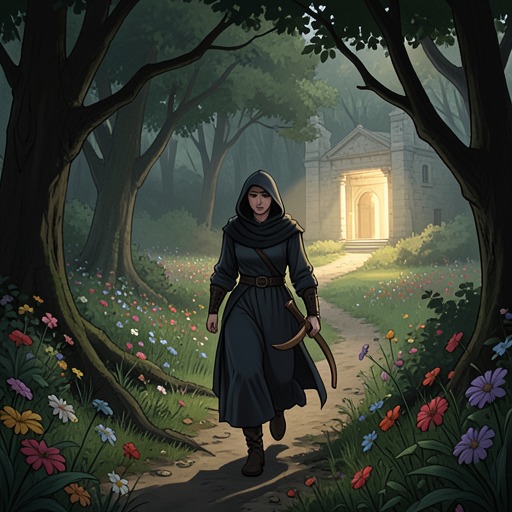
A Court of Thorns and RosesThe Ash arrow is a long, heavy arrow carved from mountain ash and armed with an iron head. Its importance lies in the combination of two materials feared by faeries: iron is hated by them, while mountain ash is believed to make their immortal, healing magic falter long enough for a human to deliver a killing blow. In a world where the High Fae have burned nearly all mountain-ash trees, the weapon is both a practical hunting tool and a fragment of surviving knowledge about how mortals might resist immortal power.
Construction and Rarity
Feyre Archeron owns only one such arrow. She bought it from a traveling peddler during a summer when her family had enough copper for an unusual luxury, then spent weeks wondering whether the expensive piece of wood was genuine or merely a fake. The arrow is the longest and heaviest in her quiver, contrasting with the two ordinary arrows she carries, which would probably do little more than sting a wolf of exceptional size.
The scarcity of its material gives the weapon an almost legendary status. Feyre has seen drawings of mountain-ash trees but never a living one; the High Fae burned the trees long ago, and the few survivors are described as small, sickly, and concealed by nobility inside high-walled groves. The arrow therefore embodies a history of destruction as well as a tactical advantage. Its rarity explains why Feyre doubts it, while its presence preserves the possibility that an apparently powerless human can still exploit a weakness in faerie immortality.
Use Against Andras
For three years the Ash arrow remains unused in Feyre’s quiver. It is finally drawn when she encounters a gigantic wolf pursuing a doe in the snowy forest. Feyre recognizes that the decision may determine not only her own survival but also whether anyone else is endangered, and she prepares the weapon with minimal movement so the animal will not notice her.
She fires before the wolf can destroy much more of the doe. The arrow strikes its side, drawing bright blood and forcing it to release the animal. When the wounded wolf turns toward Feyre, it looks at her with an awareness and surprise that make her fear the intelligence may belong to an immortal creature rather than an ordinary beast. She fires a second arrow through its wide yellow eye, and the wolf collapses. The first shot is the arrow’s crucial test: it penetrates, causes substantial injury, and helps create the opening for the killing blow.
Hidden Identity and Consequences
The arrow’s success conceals the identity of its target only temporarily. The wolf is Andras, a High Fae associated with Tamlin and the Spring Court, and his death is the act that brings Feyre into the faerie world. What Feyre experiences as a successful act of desperate hunting is therefore also the first move in a larger political and supernatural design. The weapon makes the killing possible, but it does not make the consequences containable.
Its function is sharply ironic. Feyre uses an object acquired as a precaution against creatures known only through lullabies, legend, and rumor; the arrow proves real precisely when she refuses to consider that the wolf might be a faerie. The weapon turns inherited folklore into immediate physical evidence, while the apparently ordinary act of shooting game becomes the threshold between the Mortal Realm and Prythian.
Narrative Significance
The Ash arrow concentrates the book’s early tension between mortal knowledge and faerie secrecy. Feyre possesses a rare means of harming the High Fae, yet she does not understand the political identity of the creature before her, the reason for its presence, or the scale of the response its death will provoke. Its material history also foreshadows the wider damage caused by faerie power: mountain-ash trees were destroyed by the High Fae, while later revelations show that Amarantha’s rule has damaged borders, lands, and magic across Prythian.
As a narrative object, the arrow is both stored potential and irreversible choice. For three years it remains an expensive uncertainty; in the forest it becomes a precise instrument of survival; afterward, its use cannot be separated from loss, reprisal, and Feyre Archeron’s forced crossing into Prythian. The weapon’s decisive significance lies not simply in killing Andras, but in making the boundary between human vulnerability and faerie power suddenly, violently permeable.