Calanmai and the Great Rite
A Court of Thorns and RosesCalanmai and the Great Rite form a spring festival in Prythian whose apparent revelry conceals a binding exchange between sovereignty, bodily transformation, and the renewal of the land. Known also as Fire Night, the celebration turns the countryside into a ritual space of bonfires, drums, masks, hunting, sacrifice, and supernatural selection. It is both a communal holiday and an ordeal imposed upon the High Lords, especially Tamlin, whose participation places Feyre Archeron at the edge of a world whose customs she does not yet understand.
Origins and Seasonal Purpose
Calanmai marks the official beginning of spring. Bonfires are prepared across the hills, and the magic generated during the ceremony is said to regenerate the land for the coming year. Tamlin explains that the rite is therefore not merely symbolic: the fertility of crops and the continuing renewal of the court depend upon the magic released on that night. The festival opens a temporary interval in which faeries from the Spring Court and other territories may cross borders and gather together, making the normally divided landscape unusually mobile and populous.
The ceremony gives seasonal change a supernatural mechanism. Spring is not simply observed; it is produced through an exchange between the land and those who rule it. Lucien Vanserra describes this as a give-and-take: the magic of each of the Seven High Lords comes from the earth and eventually returns to it, and every High Lord performs the Great Rite each year. Political authority is thus tied to an agricultural and cosmic obligation. The ruler’s body becomes the conduit through which the court’s continued life is renewed.
Festival and Threshold
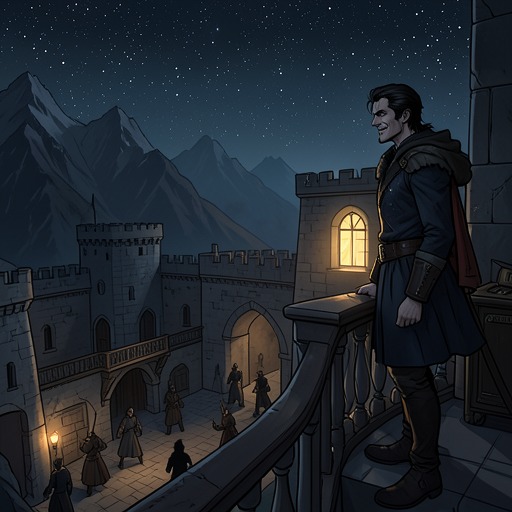
On the day of Calanmai, the estate changes character. Tamlin and Lucien are absent, the servants and kitchen staff disappear, prepared food is left behind, and distant drums begin to sound beyond the garden and game park. The rhythm is described as a summons rather than ordinary music, while fires rise on the hills against an orange and red sky. Feyre has not been invited, and her exclusion makes the celebration feel less like a holiday than a forbidden threshold into faerie society.
The contrast becomes sharper when Tamlin appears armed and prepared to leave. Shirtless, carrying a bow and wearing a baldric and gilded mask, he presents the martial aspect of the rite rather than the genial High Lord Feyre knows. He tells her that he has to go because Calanmai requires his participation. Lucien later clarifies that this obligation is not optional pageantry: Tamlin must perform the Great Rite as a High Lord, even though the ceremony will strip away his ordinary identity.
The festival also briefly suspends social distinctions. By contrast, the later Summer Solstice is explained as a time when day and night are equal and everyone may set aside rank and simply enjoy being a faerie. Calanmai is more dangerous and hierarchically charged. Its public fires and communal anticipation surround a private transformation in which the High Lord becomes an instrument of elemental magic.
The Great Rite
During the Great Rite, extraordinary magic enters Tamlin’s body and takes control of his mind, body, and soul. The power transforms him into the Hunter, leaving him with one command: find the Maiden. He will not retain his name or behave as the Tamlin familiar to Feyre; the ritual consumes every other purpose and instinct until the hunt is complete.
The first stage of that hunt is the killing of a white stag, which serves as the sacrificial offering. Afterward, Tamlin proceeds to a sacred cave whose path is lined with faerie females waiting to be chosen as his mate for the night. No one knows in advance which woman will be selected. The choice is governed by instinct, and being chosen is treated within faerie culture as an honor. From the mating, magic is released into the earth and spreads through it, regenerating life for the year ahead.
This structure makes the rite a chain of sacrifice, transformation, union, and renewal. The white stag supplies the offering; Tamlin’s temporary loss of self supplies the vessel; the chosen Maiden supplies the human or faerie union through which the magic is discharged; and the land receives the final benefit. The ceremony therefore presents fertility as inseparable from danger and from the ruler’s surrender of personal agency.
Feyre’s Exclusion and the Wider Pattern of Trials
Feyre is deliberately kept outside the ceremony, and her lack of knowledge becomes part of the threat surrounding it. She paints a monstrous creature rather than attending the fires, then remains at the estate while the drums summon the participants. Her position as an outsider allows her to witness the ritual’s effects without sharing its rules, but it also foreshadows the way supernatural authorities will later convert her ignorance into a weapon against her.
Under Amarantha, the same combination of spectacle, hidden information, and compulsory participation reappears in a far more openly punitive form. Amarantha offers Feyre a bargain: complete three tasks to prove the depth of human loyalty and love, and Tamlin’s curse will be broken, allowing him and his court to leave freely. She adds a riddle as an alternative escape, with an incorrect answer carrying the threat of death. The bargain turns love into a public test governed by exact terms, just as Calanmai turns the High Lord’s devotion to the land into a ritual obligation.
The trials reproduce Calanmai’s imagery in distorted form. Amarantha tells Feyre, identified by Rhysand as a huntress, to hunt a creature that emerges as a giant worm with a mouth filled with rings of teeth. In the second task, Feyre must choose among three levers while descending spiked grates threaten both her and Lucien Vanserra. In the final task, she is ordered to stab three apparently innocent faeries through the heart with polished ash daggers. The public arena replaces the hills and sacred cave, but the underlying pattern remains: a ruler establishes the rules, an audience watches, bodies bear the cost, and survival depends on completing an ordeal whose meaning is concealed from the participant.
Death, Renewal, and Narrative Significance
The most direct echo of the Great Rite comes when Feyre finally understands Amarantha’s riddle and realizes that love is the key to breaking Tamlin’s curse. She says that she loves him and drives an ash dagger into his heart. The act fulfills the final task, but its immediate value is death rather than renewal: Tamlin falls, Feyre’s own body is later killed, and the ritualized logic of sacrifice appears to have reached its most devastating conclusion.
Yet the scene reverses that apparent ending. When Feyre’s corpse lies before Amarantha, Tamlin’s grief and rage erupt into violence. Amarantha retreats, whispers for mercy, and is blasted backward by golden light; Tamlin shifts into his beast form and attacks her. After the queen’s defeat, Tamlin declares his love and places a hand over Feyre’s heart. Feyre then experiences darkness bordered with gold and struggles upward toward air, life, and Tamlin waiting at the surface before gasping back into her body.
Feyre’s resurrection as High Fae transforms the seasonal rite’s pattern into a political and personal culmination. Calanmai promises that sacrifice and union can regenerate the land; Feyre’s death and restoration instead regenerate her identity and alter the balance of power in Prythian. The rite’s recurring movement from ordinary life into sacred danger and back into renewed existence therefore becomes a structural image for the wider story: boundaries are crossed, identities are stripped away, and survival produces a transformed order rather than a return to what existed before.