Day Court
A Court of Thorns and RosesThe Day Court is one of the seven territories of Prythian and one of the two courts depicted in the mural as glowing above the southern courts. Its visual brilliance suggests openness and illumination, yet the court’s history reveals that it has also been a site of political resistance, coercion, and survival under Amarantha’s rule.
Position and Appearance
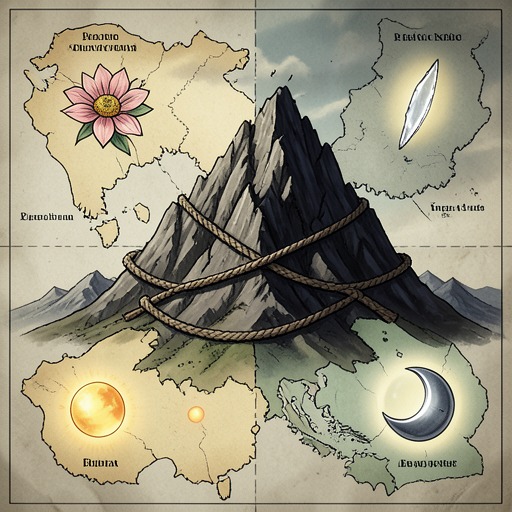
The Day Court occupies the upper part of the mural’s central map of Prythian. Feyre Archeron identifies Autumn, Summer, and Winter first, then sees two brighter territories above them: the Dawn Court in softer red tones and the Day Court above it, rendered in bright gold, yellow, and blue. Beyond the Day Court lies the immense, frozen darkness of the Night Court, creating a vertical progression from the more temperate territories toward increasingly remote and dangerous landscapes.
The mural offers no ordinary geographical survey. Its colors and arrangement turn the courts into an emotional and symbolic pattern. The Day Court appears as a place of radiance, set against the darker, more threatening territory above it, while the surrounding map emphasizes that beauty in Prythian is never separate from power. Feyre’s response to the painted territory is shaped by the scale of the world she has entered and by her realization that the courts possess histories and forces far beyond the limits of the Mortal Realm.
Political History Under Amarantha
The Day Court was among the territories that resisted Amarantha’s domination. Alongside the Summer Court and the Winter Court, it sought aid from other Fae territories after Amarantha used the High Lords’ powers to bind them to their lands. Because the rebellious courts could not move freely or openly coordinate, they relied on humans who crossed into Prythian as messengers, including young women associated with the Children of the Blessed.
Amarantha intercepted those messengers before they could leave the shores. Their fate helped extinguish the rebellion, and Amarantha later executed three High Lords and most of their families for attempting to unite against her. After the rebellion was crushed, the successors of the murdered rulers were too frightened to challenge her again. The Day Court therefore belongs to a political landscape in which resistance existed, but the control of land, movement, and communication made organized opposition exceptionally dangerous.
The High Lord’s Appearance
At the end of Amarantha’s reign, the High Lord of the Day Court appears among the rulers who restore Feyre Archeron. He approaches after the High Lords of the Summer Court and Winter Court, wearing white and gold; his dark skin shines with an inner light, making him the most visibly radiant of the assembled rulers. He places a drop of light upon Feyre, as the other High Lords do, contributing a portion of power to the restoration of her shattered soul.
His gesture is also relational and political. He smiles sadly at Tamlin before walking away, acknowledging the cost of Feyre’s sacrifice and the grief surrounding her death without interrupting the ritual. The Day Court’s contribution is thus not merely an expression of its visual association with light. It becomes an act of collective judgment and mercy, joining the other courts in recognizing what Feyre gave and helping return her to life as High Fae.
Narrative Significance
The Day Court embodies the contrast between appearance and history that shapes Prythian. On the mural it is bright, elevated, and almost jewel-like; in the political account of Amarantha’s reign, it is one of the courts forced into submission after its attempt at resistance failed. Its radiance does not erase vulnerability. Instead, the court’s brightness exists beside the memory of murdered rulers, intercepted messengers, and a population disciplined through fear.
Its appearance in the resurrection scene extends that contrast into the novel’s final movement. The Day Court’s High Lord brings light to a moment defined by death, ruin, and the remains of Feyre’s soul. The court consequently functions as both a geographical territory and a symbol of power redirected toward restoration: its brilliance is most meaningful not when it decorates the map, but when it is given away.