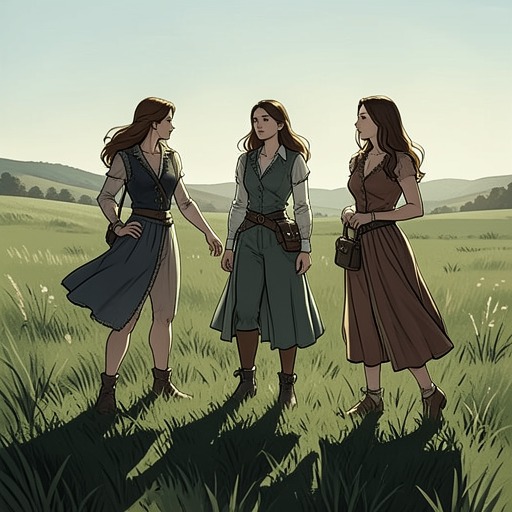
Elain Archeron
A Court of Thorns and RosesElain Archeron, Feyre Archeron’s second-eldest sister, occupies an uneasy place in the Archeron family: she is loving and capable of tenderness, yet so sheltered from hardship that she often fails to recognize what survival requires. Her arc moves from passive dependence within the impoverished cottage to a sudden recovery of memory and emotional recognition, making her response to Feyre’s return one of the clearest signs that the family’s buried truth has resurfaced.
Identity and Life in Poverty
Elain lives with Feyre Archeron, Nesta Archeron, their father, and the memory of the mother who left them bound by unequal expectations. At the cottage, she is wrapped in a threadbare blanket, but keeps her gold-brown hair perfectly coiled because eight years of poverty have not erased her desire to look lovely. Her hunger is evident, yet her attention fixes first on the doe Feyre has brought home and on whether Feyre will clean it. Elain has never been seen with hands sticky from blood and fur; Feyre learned to prepare and harvest kills through other people’s instruction, while Elain remained removed from that work.
The narration distinguishes Elain’s passivity from Nesta Archeron’s sharper hostility. Elain is not described as deliberately cruel. Rather, it does not occur to her that she might be capable of dirtying her hands, and Feyre cannot decide whether Elain truly fails to understand their poverty or refuses to accept it. This uncertainty defines their relationship: Elain’s innocence places a burden on Feyre, but it also keeps Elain from becoming simply an enemy within the household.
Domestic Affection and Unequal Care
Elain’s attachment to beauty is not limited to her own appearance. During a more prosperous summer, Feyre bought her seeds for the flower garden Elain tended in the milder months. Elain, in turn, bought Feyre three small tins of red, yellow, and blue paint—the only gift she had ever given her. Feyre used the paint to decorate the cottage with vines, flowers, and small curls of flame along the windows, thresholds, hearth stones, and other household edges. Even after the good summer ended, the fading and chipped paint preserved a material record of affection inside a home otherwise marked by deprivation.
Her gifts are modest and irregular, but they complicate the impression of complete selfishness. Elain also brought home a new chisel for their father’s wood carving. When Feyre gave her and Nesta money after dealing with Isaac Hale, Elain spent it, as did Nesta, though the family’s later circumstances show that Feyre remains the person carrying the practical cost of their survival. The sisters’ spending provokes resentment, but Nesta at least later goes out to chop more wood without being asked, while Elain’s contribution remains more closely associated with beauty, objects, and domestic feeling than with physical labor.
Recognition and the Return of Memory
When Feyre returns to the family home transformed by her life among the High Fae, Elain initially fails to recognize her. She and Nesta Archeron greet the seemingly wealthy visitor with formal caution, accepting the fabricated explanation that Feyre has gone to care for a rich aunt named Aunt Ripleigh and has inherited her fortune. Elain’s first response is astonishment at the supposed death and inheritance, not immediate recognition of her sister. The scene exposes how thoroughly Feyre’s former identity has been separated from the figure standing before them in fine clothes, pearls, and a carriage.
Elain’s recognition arrives at the threshold of departure. When Feyre is preparing to leave, Elain has a horse, a satchel of food, and supplies ready, while their father is absent. She embraces Feyre and says that she remembers all of it now, recovering the truth that had been concealed from the family. Her awakening is therefore both emotional and practical: she does not merely acknowledge Feyre’s face, but helps prepare her for movement and danger. Elain still cannot accompany Feyre, though she tells her that she would have liked to see the continent with her, a wish that reveals affection and regret at the distance between their lives.
Family Relationships and Political Context
Elain’s relationship with Feyre is founded on dependence but not emptied of love. Feyre continues to buy her seeds despite recognizing Elain’s inability to share the household’s labor, and the painted cottage records a reciprocal if unequal bond. Elain’s eventual embrace and tears show that her earlier failure to recognize Feyre does not represent emotional indifference. Once memory returns, she responds with intimacy rather than suspicion and accepts Feyre’s warning to remain on guard.
Her position is also framed by the wider political violence surrounding the family. The Children of the Blessed once crossed the Wall believing in the High Fae, and Amarantha’s forces captured and killed the human messengers sent to seek aid from the Day Court, Summer Court, and Winter Court. Elain belongs to the mortal family that has lived beneath the consequences of that divided world, even while the household’s ward-markings against faerie harm are revealed as useless. Her domestic life is thus never wholly separate from the supernatural conflict: the danger that reaches the cottage is the same danger that has bound the courts and destroyed attempted resistance.
Change and Narrative Significance
Elain does not undergo the overt heroic transformation experienced by Feyre Archeron, nor does the available evidence show her entering the courts or taking up a weapon. Her change is instead a movement from uncomprehending dependence toward recognition. At the beginning, hunger does not lead her to work; it leads her to ask Feyre when the doe will be cleaned. At the end, memory breaks through the false story surrounding Feyre, and Elain has already gathered food and supplies for her sister’s departure.
That contrast gives Elain a distinctive narrative function. She embodies the sheltered side of poverty: a person can be materially deprived while remaining psychologically insulated from the labor that deprivation demands. Yet the paint, the garden, the chisel, the embrace, and the prepared horse prevent her from being reduced to helplessness. Elain’s care is often indirect and insufficient, but it is real. Her late recognition restores the family connection that Feyre feared had been lost, while her wish to travel with Feyre suggests an unexplored capacity for a life beyond the cottage’s narrow obligations.