Feyre Archeron
A Court of Thorns and RosesFeyre Archeron begins as a human huntress surviving at the edge of a hostile world, but her arrow against a wolf becomes the act that carries her from mortal poverty into the central conflict of Prythian. Her importance lies not simply in defeating Amarantha: Feyre repeatedly converts deprivation, fear, and practical skill into action, then discovers that saving others may require her to violate the moral identity she had built for herself.
Identity and Mortal Background
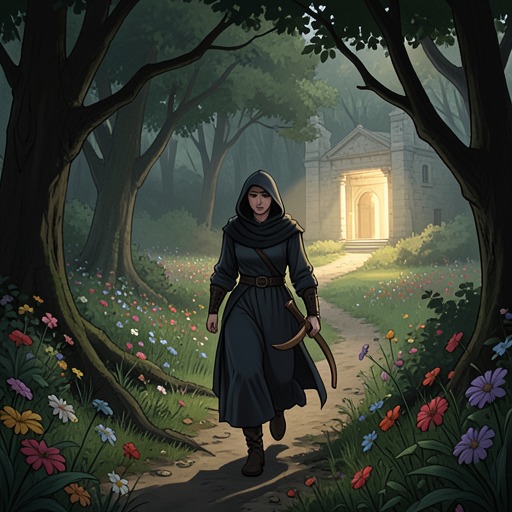
Feyre is introduced in a forest transformed by snow and ice into a labyrinth, where she has spent eight years hunting to keep her family alive. Her vantage point in a tree becomes useless as wind erases both her tracks and the signs of quarry, yet she remains willing to judge risk because her life has already been reduced to repeated dangers. When a gigantic wolf attacks a doe, Feyre fires an ash arrow into its side before it can destroy more of the animal. The shot is both an act of survival and the opening move of the larger story: the wolf is not an ordinary predator, and the killing brings the hidden world of the High Fae directly to her family’s door.
Her hunting exists within severe material deprivation. At the market, the smell of spices, salt, and sugar reminds Feyre and her sisters, Nesta Archeron and Elain Archeron, of foods they cannot afford. She hopes the money from selling hides might buy something delicious for the household, while the weight of the coins in her pocket immediately becomes a source of expectation and pressure. Feyre’s practical responsibility is therefore economic before it is heroic. She is not protected by a standing army; her territory is too poor to monitor the Wall with Prythian, and the Treaty offers an illusion of safety rather than reliable defense. The iron bracelets worn by her sisters and Isaac Hale function as small, desperate safeguards against a power everyone has been taught to fear.
Feyre also inherits the historical burden of the mortal world. Humans were once enslaved by High Fae overlords, forced to build their civilizations, before rebellion and the War produced the Treaty and divided the world between the mortal South and the magical North. This history shapes her suspicion of faeries and makes her first understanding of the Wall political as well as personal. The mercenary’s warning that creatures may be crossing it, including a martax pack that destroyed half a village, turns an old cultural fear into an immediate threat.
Crossing the Threshold
After the wolf’s death, Feyre learns that the creature was a faerie and that the Treaty demands restitution. A beast comes to her cottage, and Feyre recognizes that resistance could place her family in danger. She considers attacking or escaping, but the creature’s strength and hearing make both possibilities nearly impossible. Her choice is not willing submission so much as a calculated sacrifice: by leaving, she may draw the danger away from Nesta Archeron and Elain Archeron, though doing so breaks the promise she made to protect them.
Feyre’s terse decision to ask when they will leave marks the threshold crossing. The creature answers that they will go immediately, and it destroys the ash arrow in the fire before taking her away. The broken arrow is a concrete reminder that the tool with which Feyre first asserted control cannot protect her in the world she has entered. Yet the transition does not erase her agency. She goes because she has assessed the available choices and selected the one most likely to preserve her family, even while imagining the possibility of killing or disabling her captor later.
Once in Prythian, Feyre repeatedly tests the limits of her captivity and her ignorance. When she asks the Suriel whether there is any way to return home, the answer is that she must remain or risk death for herself and her family. The loss of that last hope changes her objective. She begins to treat knowledge as a survival resource, asking what the Suriel knows about Tamlin rather than continuing to imagine escape. Her movement through the supernatural realm is thus driven by the same practical intelligence that governed her hunting: observe, calculate, and act despite incomplete information.
Love, Loyalty, and the Political Crisis
Feyre’s understanding of her captivity expands into an understanding of Amarantha’s rule. Alis tells her that Amarantha came from Hybern as an emissary, presented herself as the Never-Fading Flower, and spent fifty years moving among the courts while claiming to repair the damage caused by the War. Her history is far darker: she had been the King of Hybern’s most lethal general, and after Jurian betrayed and butchered her sister Clythia, she developed an extreme hatred of humans. Even after the Treaty, she killed her own slaves rather than free them.
Amarantha’s apparent diplomacy concealed an imperial strategy. She used trade, communication, and shared resources to gain the confidence of the High Lords, while ships carrying Hybernian goods also carried her personal forces. At a ball held in her honor, she poisoned the seven High Lords with a potion stolen from the King of Hybern’s spell book, stripped away most of their power, and seized Prythian within days. For forty-nine years she ruled through enslavement and gathered the most dangerous faeries under her protection, while preparing an army for an eventual assault on the human territories. Feyre’s personal captivity therefore becomes a point of entry into a system of conquest, infiltration, and military preparation.
When Feyre reaches Amarantha, she declares that she has come to claim the one she loves and specifically names Tamlin, High Lord of the Spring Court. Her declaration transforms private attachment into public defiance. Amarantha offers a bargain: Feyre must complete three tasks proving the depth of human loyalty and love, after which Tamlin’s curse will be broken and Feyre, Tamlin, and the Spring Court may leave freely. Feyre insists on including the curse, the court’s release, and permanent freedom in the terms, demonstrating that she understands how precise wording can determine the outcome of a Faerie Bargain.
The bargain is made more vicious by the presence of Clare Beddor’s corpse. Amarantha reveals that Clare was tortured and killed after Feyre gave Rhysand Clare’s name instead of her own. This moment forces Feyre to confront the reach of Amarantha’s violence and the consequences of her own attempt to protect someone else. Clare’s death is not merely a threat to Feyre; it is proof that Amarantha can turn names, loyalties, and evasions into instruments of punishment.
Trials and Moral Injury
Amarantha reshapes Feyre’s familiar skills into spectacles of survival. She identifies Feyre as a huntress and commands her to hunt, converting the role that once fed her family into another mechanism of coercion. In a separate trial, Feyre must select the correct lever from three choices while two enormous, spike-encrusted grates descend toward her and Lucien Vanserra. The structure makes the rules visible but the information inadequate: the task is presented as a puzzle, yet failure means death for one or both participants, and an audience watches the contest as entertainment.
The most decisive trial is not solved by skill alone. Feyre must kill three faeries, and the act turns her physical courage against her own moral limits. One young faerie begs her not to continue, but she lunges and plunges an ash dagger into his heart. The blade passes through flesh and bone, blood covers her hand, and the dying faerie’s shocked and hateful gaze remains fixed on her. Feyre succeeds within Amarantha’s rules, but the victory is experienced as an ethical rupture rather than a clean triumph. She has killed to preserve the possibility of freeing Tamlin and the imprisoned court, yet the necessity of the act does not prevent its memory from becoming a source of guilt.
Her love for Tamlin reaches its most paradoxical expression at the climax. Feyre recognizes that the curse can be broken only through the act she is about to perform, kneels before him, says that she loves him, and stabs him. The declaration and the violence are inseparable: love becomes the reason for the wound, while the wound becomes the means of liberation. The scene reverses the expected logic of rescue, making the beloved appear to die so that the larger spell can be destroyed.
Resurrection, Change, and Narrative Role
Feyre dies or seems to die after the final confrontation, but she experiences a return through darkness bordered with gold before gasping air back into her lungs. She awakens on the cold floor of the throne room with no pain, blood, or broken bones. Her body is no longer the body of the human huntress who entered Prythian: her skin gleams, her fingers seem longer, and she feels strong, fast, and sleek. The High Lords restore her as High Fae, making her transformation literal as well as psychological.
The resurrection is a reward that refuses to feel uncomplicated. Feyre survives Amarantha’s death and the liberation that follows, but she cannot separate her new life from the violence required to obtain it. In the quiet afterward, she places a hand on Tamlin’s heart and hears its steady beat, while he heals her remaining wounds. Yet her attention returns to the two faeries she killed. She knows that she slaughtered them and had not even seen their bodies removed. The celebration, flight, and confusion of the court cannot erase the private reckoning that follows.
Feyre’s arc therefore combines a quest, a rescue, a riddle-driven ordeal, and a transformation. She crosses from the mortal realm into Prythian, survives a system that turns punishment into performance, and returns from death with a new nature. But the conventional heroic return is deliberately unsettled. She gains freedom, power, and immortal life while carrying moral injury from the actions that secured them. Her story makes agency costly: every decisive choice protects someone or advances liberation, but each also leaves a mark on the self that chose it.
Narrative Significance
Because Feyre narrates her experience from an intensely limited first-person perspective, the reader encounters the political order through the perceptions of someone who begins with little reliable knowledge of Prythian. Hunger, weather, weapons, money, scars, and bodily danger remain as important as courtly history. This perspective prevents the supernatural conflict from becoming abstract. The Treaty is felt as poverty and fear; Amarantha’s empire is understood through missing power and murdered people; and the trials are experienced as immediate bodily calculation rather than as distant legend.
Feyre’s movement from hunter to High Fae also exposes the instability of the human-faerie boundary. She begins by killing what she believes is a wolf, enters the world of the beings her culture has taught her to fear, and ultimately becomes one of them. The transformation does not simply reward her for courage. It complicates the political divide established by the Treaty and leaves her suspended between the mortal family she tried to feed and protect and the immortal court she helped liberate. Her defining significance is this unresolved passage: Feyre wins by refusing helplessness, but survival changes the terms of who she is and what freedom can mean.