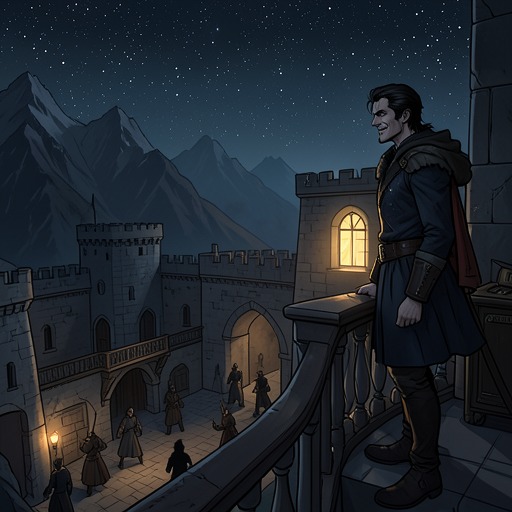
Feyre's bargain with Rhysand
A Court of Thorns and RosesFeyre's bargain with Rhysand is a decisive exchange between mortal desperation and faerie power. Beneath the Mountain, Feyre is dying from the poisoned wound inflicted during the first trial, and Rhysand offers the only immediate treatment available: he will heal her arm in return for one week of every month at the Night Court. What begins as a forced choice over survival becomes a literal and political bond, inscribed on Feyre's flesh and later connected to the wider network of gifts, debts, and obligations that governs her passage through Prythian.
Causes and Conditions
Feyre enters the bargain already weakened by the first trial. The Middengard Wyrm's mud has contaminated her injured arm, while fever and uncertainty leave her unable to know whether the infection is advancing. Rhysand makes the danger explicit: she is dying, and any delay could leave her dead or cost her the arm above the elbow. His offer therefore has the structure of a bargain, but not the freedom of an ordinary negotiation. Feyre is confined beneath the Mountain, deprived of reliable medical help, and forced to measure her devotion to Tamlin against the immediate threat to her own life.
Rhysand initially demands a far greater price than Feyre is willing to accept. He proposes that, after the three trials, she live with him at the Night Court for two weeks every month, during two weeks of his choosing. Feyre refuses this first offer, remembering that she has already been made vulnerable by an earlier bargain. The refusal does not end the negotiation; instead, Rhysand presses her to consider how much she is willing to risk on the hope that another form of help will come. His argument turns her uncertainty into the central pressure of the scene: waiting may preserve her independence in theory while allowing the infection to destroy her in fact.
The Negotiation and Choice
Feyre's decision is ultimately driven by her determination to free Tamlin. When Rhysand begins to disappear into shadow, she stops him and agrees to bargain. Her choice is not presented as trust in Rhysand. It is an act of self-sacrifice for Tamlin, for whom she is willing to sell her soul and give up everything necessary to secure his freedom. The emotional value at stake shifts from bodily integrity to survival, then to loyalty and liberation: Feyre accepts control over her future because she believes Tamlin's release requires her to remain alive.
The terms are reduced through direct haggling. Rhysand counters Feyre's proposed week with ten days; she holds to a week, and after a long silence he accepts. The final agreement requires Feyre to spend one week of every month at the Night Court, beginning after the three trials. The duration is limited, but the obligation is recurring. It does not merely postpone a debt until the crisis ends; it creates a continuing relationship between Feyre and Rhysand and ensures that the consequences of the bargain will extend beyond the Mountain.
Healing and the Mark
Once Feyre says that the bargain is made, magic stirs between them. Rhysand grabs her arm, and the healing is violent rather than gentle: bone and flesh are shattered in a blinding burst of pain before she loses consciousness. When she wakes, the fever has vanished, her mind is clear, and the mud has been removed. The immediate result is unmistakable. Rhysand has done what Feyre feared no one would do in time, restoring her from the edge of death and preventing the poisoned wound from determining her fate.
The treatment carries its own permanent consequence. Rhysand explains that bargains are customarily marked upon the flesh in his court. Feyre's entire left forearm and hand are covered in black swirls and whorls, including her fingers, while a large feline eye with a slitted pupil appears in the center of her palm. The mark makes the invisible contract visible. It records the bargain as both legal obligation and bodily alteration, turning Feyre's hand into a constant reminder that her survival has been purchased through a claim on her future.
Immediate Consequences Beneath the Mountain
The bargain changes Feyre's position while she remains imprisoned. Rhysand is not simply an observer or tormentor at the court; he is now the person who has healed her and the holder of a claim that can be invoked after the trials. The mark also makes their connection legible to others, even though Feyre does not welcome it and asks Rhysand to remove it. His laughter at that request underscores the imbalance between them: the bargain is complete, and her gratitude cannot undo its terms.
Rhysand's protection becomes visible when he leads Feyre into the throne room, where Amarantha summons him and Lucien's brothers watch Feyre with eager, hostile attention. He tells Feyre to stay close and keep silent, guiding her by the arm as the crowd parts. The bargain does not free her from danger, but it gives Rhysand a reason and a means to keep her within his reach during the court's most threatening encounters. Her status has shifted from an isolated captive to someone attached to a powerful faerie through an enforceable agreement.
Wider Pattern of Debt and Significance
Feyre's bargain with Rhysand belongs to a larger pattern in which aid is rarely free. A mercenary once explains that she helped Feyre because someone had done the same for her and hers when they needed it most, and she now considers the debt due for repayment. In Feyre's human family, money, food, and practical assistance likewise circulate through uneven exchanges: Feyre pays Isaac Hale, who takes the contraceptive brew because she cannot afford it, while her sisters spend the money and Elain Archeron uses part of it for a new chisel. Tamlin alters her family's memories to protect them and prevent them from violating the Treaty, presenting protection itself as an intervention that carries political consequences.
The Night Court agreement is more severe because it converts healing into scheduled access to Feyre's body and time. Yet the story later complicates the apparent one-sidedness of the exchange. At the end of the confrontation with Amarantha, after Feyre's death, the High Lord of the Autumn Court drops a glittering spark onto her chest, and the High Lords of the Summer Court and Winter Court do the same while Tamlin bows in gratitude. These gifts help restore Feyre, showing that life, power, and allegiance can also be transferred through acts that resemble payment or obligation. Against this background, Feyre's bargain with Rhysand is not an isolated transaction but an early, bodily expression of Prythian's governing logic: rescue creates debt, promises become power, and every gift may reorganize the relationship between giver and receiver.