Feyre's Family Cottage
A Court of Thorns and RosesFeyre's Family Cottage is the ruined mortal home where Feyre Archeron and her family endure poverty before Feyre's removal to Prythian. Its decisive significance lies in its double identity. It is materially a failing shelter, marked by hunger, cold, and the absence of reliable protection; emotionally, it is the site of family memory, maternal death, and promises that govern Feyre's choices. When Feyre later sees it again, the cottage has become an image of her former life rather than merely its setting, allowing her to measure the transformation in both the house and herself.
Setting and Material Condition
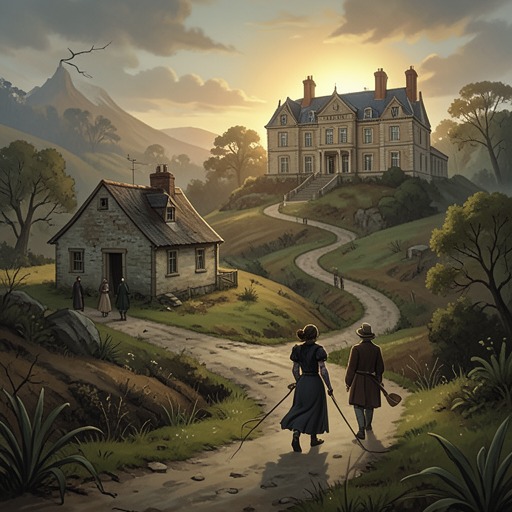
Feyre's Family Cottage stands in a snowbound mortal landscape, its gray stones and shuttered windows surrounded by darkness. The family survives in a house so dilapidated that the faint light escaping through its shutters appears almost fragile against the blue winter evening. Hunger is part of the cottage's atmosphere: Feyre returns from hunting nearly dizzy with exhaustion, while her sisters' conversation and Elain Archeron's sharpness are repeatedly filtered through the pressure of having too little food.
The threshold carries faded ward-markings that were supposed to protect the household from faerie harm. Feyre knows that the markings are useless. Her father had traded one of his wood carvings to a passing charlatan who claimed some High Fae ancestry, then carved whorls, swirls, and runes around the door and windows while muttering nonsense. The markings therefore represent more than failed magic. They are a desperate attempt to purchase security with the family's remaining skill and dignity, and their survival on the stone preserves the history of a household that could no longer afford genuine protection.
The cottage also preserves traces of a lost prosperity. Its enormous ironwood bed is the last remnant of the family's former wealth, commissioned by Feyre's father as a wedding gift for her mother. It is the bed in which the sisters were born and in which their mother died. Feyre has painted much of the house, but she has never painted the bed, leaving this object outside her attempt to brighten or reinterpret the surrounding rooms. The bed concentrates the cottage's most intimate inheritance: birth, marriage, poverty, and death occupying the same piece of furniture.
Family Life Within the Cottage
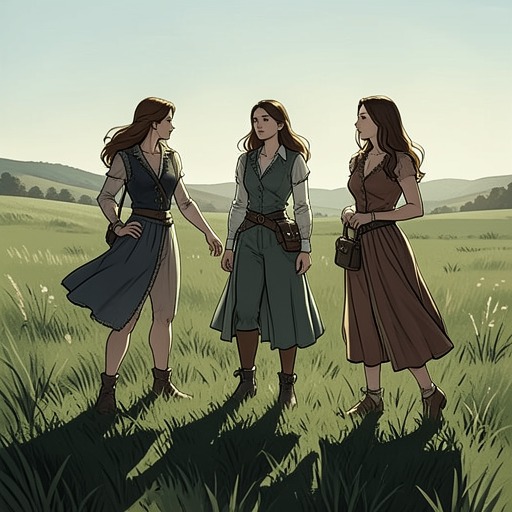
The cottage is divided among the sisters without becoming a true shared refuge. Feyre has painted violets and roses around Elain Archeron's dresser, flames around Nesta Archeron's, and a night sky with yellow stars around her own. These paintings are efforts to make the dark room more livable, but neither sister has commented on them. The unacknowledged decoration reflects the larger emotional economy of the household: Feyre performs practical and creative labor for people who depend on her, while receiving little recognition in return.
The cottage's domestic routines expose the family's unequal burdens. Feyre hunts and returns with blood on her, yet her arrival is met chiefly with questions about what she has brought home to eat. Her sisters are associated with talk of young men, village ribbons, and neglected wood-chopping, while Feyre carries the responsibility of obtaining the food that keeps them alive. Her father, crippled and broken, cannot reliably provide for the household. The cottage is consequently not simply poor; it is a structure in which care has been displaced onto the daughter best able to act.
Feyre's departure begins at the cottage's threshold and is shaped by what the household has demanded of her. After the beast arrives to claim her for the death of Andras, her father tells her not to return and urges her to go somewhere new and make a name for herself. Feyre does not explain the promise she made to her mother, because explanation cannot alter the bargain already imposed by circumstance. She leaves her father's hands, crosses the snowy ground, and follows the beast toward the woods, turning the doorway into a boundary between enforced family duty and an unknown captivity.
Contrast with Tamlin's Estate
The cottage gains fuller meaning through its contrast with Tamlin's Estate. The mortal home is cramped, cold, and visibly decayed; Tamlin's Estate spreads across rolling green land, surrounded by woods yet so expansive that Feyre can scarcely see the distant forest. Its alabaster buildings are veiled in roses and ivy, with patios, balconies, and staircases, and its gardens display irises, snowdrops, and daffodils in balmy spring air. Feyre cannot imagine painting the estate adequately because its abundance exceeds the scale of her former experience.
Inside Tamlin's Estate, black-and-white marble, a sweeping staircase, giant glass doors, and a second garden replace the cottage's dark room and failing threshold. The comparison unsettles Feyre's inherited image of faeries as merely feral monsters. High Fae wealth and architecture, which her mortal ancestors had destroyed after the War, now confront her as a living domestic reality. The cottage thus functions as the baseline against which the grandeur of Prythian first appears almost impossible, while its poverty explains why food, shelter, and beauty carry such force for Feyre.
Return and Reinterpretation
After her life in Prythian has changed, Feyre returns along a road she could once have navigated in darkness and finds the cottage still standing. Elain Archeron's old flower garden has become a wild tangle of weeds and blooms. The ward-markings remain on the stone threshold, the front door that had previously been shattered has been replaced, and one circular windowpane is cracked. The interior is dark, and the land appears undisturbed. These small alterations suggest repair without renewal: the building has been maintained enough to remain a home, but it has not been transformed into the kind of place Feyre once imagined escaping toward.
Feyre traces the route she had taken each morning from the front door across the road and the rolling field to the line of trees she once called her forest. The forest, formerly terrifying, lethal, hungry, and brutal, now seems plain and ordinary. That change is not presented as a renovation of the landscape; it is a change in the scale of Feyre's perception. Having crossed the boundary into Prythian and survived its estates, courts, prisons, and dangers, she can no longer grant the cottage's surrounding world the absolute power it possessed during her childhood.
Prison, Shelter, and Narrative Significance
Feyre looks at the cottage as the place that had been a prison. Elain Archeron had said she missed it, and Feyre wonders whether Elain saw not imprisonment but shelter: a refuge from a world that had offered very little good, yet still permitted her to search for it. The sisters' opposing readings give the building its deepest ambiguity. Feyre's hatred records the cost of being made responsible for the household, while Elain's hope identifies the emotional value that can survive even in deprivation.
Feyre concludes that Elain's way of looking at the cottage reveals greater strength than her own earlier hatred. The judgment does not erase the family's poverty or excuse the neglect that made the house feel confining. Instead, it marks Feyre's changed understanding of home. The cottage remains the origin of her hunger, artistic gestures, maternal memory, and departure, but on her return it also becomes a symbolic threshold: the place from which she escaped, the shelter another sister remembered, and the ordinary landscape against which her transformed identity can be recognized.